
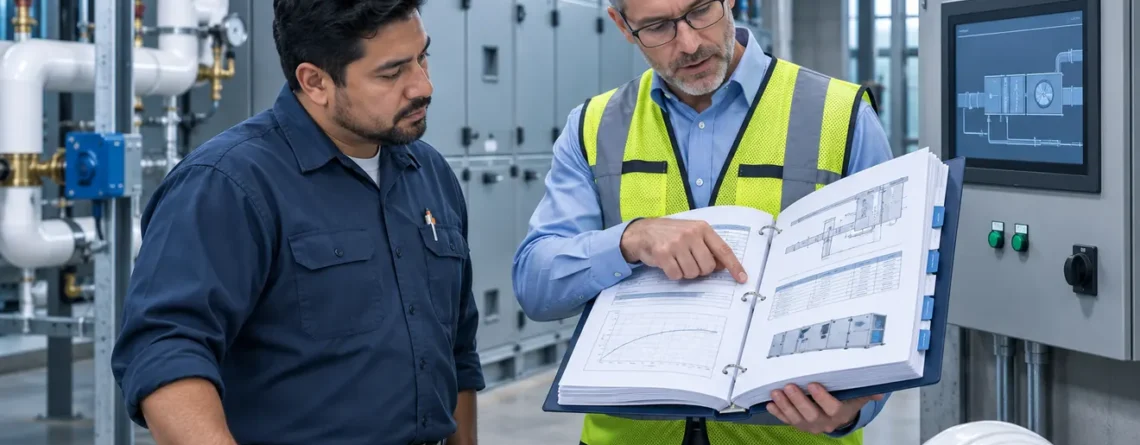
A ventilation monitoring handoff should identify what was installed, where each point measures, how the point and its history were verified, which functional conditions were demonstrated, and who owns unresolved work. Link each accepted claim to the test method, raw evidence, applicable criterion and reviewer. The resulting record should let an operator retrieve the data behind a pass, identify limits on use, and repeat the relevant check after a repair or change.

A usable handoff links equipment and software to the evidence that establishes their accepted use.
Index the claims that the project will accept
Begin with the approved project requirements, design basis, sequence and commissioning plan. In an existing building, these may include current facility requirements, revised drawings and explicitly agreed test boundaries. Identify the exact versions used at acceptance. A final report can describe the process, but a cross-reference from each important claim to specific evidence is what lets an operator verify its scope.
A point can be verified for correct location, value and data delivery while outdoor-air performance remains unresolved. A functional test can demonstrate damper motion and the intended response to a simulated input while leaving sensor accuracy or actual flow unverified. A testing and balancing (TAB) report can document airflow under its own conditions, yet still leave an open question about what happens after a fault or change of mode. Identify each kind of evidence separately.
| Acceptance claim | Primary evidence | What to link alongside it |
|---|---|---|
| Sensor is installed in the intended air | Location record, photographs and as-built drawing | Sensor ID, room use and representative-location rationale |
| BAS receives a reliable measurement | Point verification and field comparison | Reference, units, scaling, timestamps and quality |
| Trend can support the intended review | Raw export and trend settings | Sampling mode, clock, gaps and access verification |
| Sequence responded to the tested condition | Functional procedure, event record and outcome | Effective command, status and restoration |
| Outdoor airflow met the criterion at the test boundary | Suitable airflow measurement and test conditions | Equipment mode, method, range, criterion and uncertainty as relevant |
| Operator can maintain the system | Systems manual, training record and named owner | Replacement settings, evidence retrieval and open issues |
The Whole Building Design Guide describes commissioning test reports, an issues and resolution log, systems manual and operator training as related deliverables with defined participants. ASHRAE's handbook discusses conditions for verification testing and documentation of responses. Apply the project-specific commissioning requirements and approvals when deciding who can accept each claim. WBDG commissioning documents, ASHRAE Handbook chapter on HVAC commissioning
Capture the as-built measurement and control chain
For each monitored point, record site, system, equipment and zone identifiers. Add the physical sensor location and sampling boundary, including mounting height or duct identification where relevant. Include a marked-up floor plan or equipment drawing and a photograph that lets a technician find the correct device. A room name on the operator graphic can differ from the physical or asset register name, so provide the relationship explicitly.
Record sensor manufacturer, exact model, serial or asset ID, and installed firmware when relevant. Capture the field configuration that can change the measurement or its use. This can include range, engineering units, mounting accessories, sample tubing or shields, calibration mode, applied offsets, warm-up behavior, outputs and configured filtering. Keep the document or configuration export version and date. A model number establishes what could have been configured. An as-built snapshot establishes what was configured at the time of acceptance.
Follow the signal into the BAS. Identify controller, input or network object, gateway transformations, graphics label, history identifier and downstream consumer. Keep the authoritative control input distinct from related displays, derived values, setpoints, commands and proofs. If a system contains both room and return CO₂ sensors, record each sampling boundary and the reason for using it. A point marked “CO₂” without the measured location and role cannot support a zone-specific acceptance claim.
Capture the installed sequence revision and configuration references without embedding sensitive credentials in the handoff. Record where authorized personnel retrieve backups and how to identify the active version. Note which point names, identifiers and revisions must be preserved when the field device is replaced. A future change should leave a record of the effective time, the parts that changed, the verification repeated and the history continuity decision.

The point sheet should identify the installed channel and the reference used to check it.
Keep point verification and functional performance separate
Point verification establishes that a specific field condition reaches the expected receiving point with correct meaning. Record the start condition, source used for comparison, instrument reference details, observed output, BAS reading and recorded history. Capture the approved tolerance and how uncertainty or resolution was considered. If the sensor's field comparison and an analog input simulation were both carried out, make two entries. The first compares instruments in air, while the second verifies a configured signal path under defined conditions.
A reference record needs enough information to evaluate its relevance. Record identity, method, usable range, calibration or verification status, and the environmental or setup conditions that influence the comparison. If two instruments were placed near each other, state the locations, time alignment and stabilization conditions. A room gradient or different response times can explain transient disagreement. For a supplied gas or electronic test input used by an authorized technician, retain the relevant procedure, source information and the specific boundary exercised.
A functional test establishes the response of the approved system under defined conditions. Record the applicable sequence clause or criterion, test prerequisites, operating mode, test stimulus, expected action, observed request and effective state, outcome and restoration. A simulated high room reading can verify how the sequence interprets that input, while leaving real sensor exposure and its data path outside that test. A witnessed naturally occurring event may cover those boundaries, but its occupancy and input conditions may be less controlled. Label the actual method.
A damper command, observed or reported position and measured outdoor airflow each support different claims. Confirm which measurement satisfies the project criterion and record the location and method. When a multizone system is involved, distinguish system intake from delivery to the monitored zone. If the project relies on a TAB test under a particular fan or system condition, identify those conditions and its record reference. An airflow instrument outside its usable range cannot establish the required result just because its displayed value appears plausible. US DOE Ventilation Assessment and Action Guide, US DOE HVAC commissioning overview
| Test record field | Record entry to expect |
|---|---|
| Identifier and scope | Stable ID, asset or zone, claim, procedure revision and date |
| Prerequisites | Applicable balance and checkout results, operating mode and acceptable test window |
| Stimulus or comparison | Actual condition, approved simulation or independently measured reference |
| Tiêu chí | Source document and exact applicable condition or tolerance |
| Quan sát | Time-aligned measurement, command, proof and exceptions |
| Outcome | Pass, fail, deferred or other project-defined status with rationale |
| Restoration | Confirmed normal mode, temporary actions closed and person verifying |
| Evidence | Raw data, event notes, annotated view and relevant configuration revision |

Test evidence should preserve the operating condition, observed response and restoration record.
Preserve trends that can be interpreted later
A screenshot can orient a reviewer but can omit timestamps, values, quality and gaps. Retain raw exports for the agreed test interval together with annotated views if useful. Include the time source, timezone and offset, data-acquisition or trend interval, method of aggregation or change-of-value settings, units and quality rules. Identify the file and data series for each point. If the BAS chart is resampled for display, preserve the original resolution needed to reconstruct event order.
Record the beginning and end of the observation period and what conditions were present. For an occupied room concentration trend, record occupancy or schedule context, system mode and relevant outdoor or airflow observations. For a sequence test, mark the requested and effective stimulus, the actual start of the measured response and restoration. An export that lacks the preceding state can make a recovery look like a normal start. A plot that stops while a supervised override is still active does not show restoration.
Check data completeness before acceptance. Open the actual export with the tools the owner will have. Verify columns, units, repeated timestamps, time zone, gaps and valid versus stale samples. If a supervisory controller gives a point a new timestamp each time it reads a held value, explain where data freshness is established. If a point logs only on change, record how a later reader can distinguish a steady signal from a dead link. A commissioning record needs the quality context that the comparison depended on.
For multi-point tests, check the synchronization between devices or state the limits of alignment. If two independent clocks disagree by 45 seconds, a reported 20-second order of operations may not be demonstrable. If a physical actuator stroke is shorter than the available interval, the evidence may show initial and final positions without resolving travel time. Avoid claiming time resolution the system did not capture. Retain manual observer timestamps with a statement of how they were recorded and related to the controller time.
Use clear evidence identifiers. A test record might refer to an export, a specific sheet of the approved procedure, a configuration snapshot and a photo. Names like "final final graph" are difficult to interpret after a few revisions. Keep a table of evidence IDs and locations that the owner can use even after the project archive is transferred. Treat an updated interpretation as a new revision linked to the original evidence.
Track unresolved conditions through retest
An issue record should identify the affected system and acceptance claim, the observation and evidence, the requirement, the responsible party and the current disposition. Differentiate the person doing the corrective work from the person reviewing the outcome and the person accepting any remaining risk or restriction. Write dates for identification, expected resolution, correction, retest and closure as applicable.
Keep the original failed test linked to the corrected result. When a change affects a point mapping, temperature compensation setting or sequence revision, document the actual change and the validation scope. A replacement device can change both the measurement and the reported fault state. A configuration fix can restore a point while leaving a downstream archive or fallback unverified. Scope the retest to the affected boundaries and to any nearby functions that the project requires to be checked.
Separate deferred conditions from failures. A seasonal airflow or economizer condition may be unavailable during initial commissioning, and a zone may be unoccupied before turnover. State the condition that remains unobserved, what use is accepted in the meantime if any, who will schedule the verification, and what event or date triggers follow-up. A plan for later evidence should remain visible in the final handoff. The US Department of Veterans Affairs manual illustrates field reports and a master issues log within its agency project process. VA Whole Building Commissioning Process Manual

A retest links the original finding, the change and the new evidence.
Transfer ownership and show that the evidence can be retrieved
Provide a simple index that leads from a room or equipment identifier to the relevant point sheet, control sequence, test record and issues. Include a monitored-points inventory, as-built drawings and settings, raw test evidence, acceptance notes, training material and maintenance instructions. Reference the controlled location of configuration exports and the owner-approved access route. The handoff should serve both the operator reviewing a trend and the technician tracing a field input.
Name the responsible role for monitoring, sensor maintenance, controls revisions, airflow verification and unresolved issues. Where one person holds several roles, document who covers them after turnover. Separate what requires project review from ordinary display or archive access. A read-only user should be able to review an accepted trend and its quality without needing permission to alter an input or command.
During training, walk the operator through one real verified point and one known limitation. Retrieve the raw export, identify its units and location, show how fault and override states are displayed, and identify where the approved comparison method is recorded. Demonstrate how to find the owner and next step for an open issue. The handoff record should show who attended, which tasks were demonstrated and where current instructions are stored.

Operator training should show how to trace a live point back to its verified configuration and evidence.
Work through a hypothetical handoff entry
Consider a single-zone office with a wall CO₂ transmitter, an air-handler outdoor-air measurement and an approved sequence that accepts a room demand. The project creates point record P-17 for the wall transmitter. It links to a floor plan, installation photo, device configuration and exact controller point. A comparison record identifies the reference instrument, interval, location, quality and observed difference. That test verifies the indicated concentration and its transfer within the applicable criterion. It does not address the outdoor airflow.
The team creates a separate test FT-06 to compare the approved response to an input condition in normal occupied mode. The record contains the sequence revision, expected demand and airflow response, supervised test method and synchronized trend export. The demand and position change as expected. The airflow signal is invalid in the required range during the test. Record the observed logic and motion as demonstrated and mark the airflow claim as unresolved. Open an issue linked to both the functional test and the affected airflow point. The operator should be able to see that scope even if the system graphics show an apparently normal damper.
After a corrective investigation, a repeated test is performed under comparable approved conditions with an airflow method valid for the test range. The retest record references the original finding, the configuration or physical change, the new raw export and the restored normal mode. The responsible reviewer compares the measured result to the criterion and records the disposition. The original test remains available. These are example record identifiers and events, with no implied project result or numeric acceptance limit.
Design a compact evidence register
A register can be a table within the systems manual or a controlled record linked from it. Create distinct identifiers for points, functional tests, evidence files and issues. A point identifier refers to a measurement location and configuration. A test identifier refers to a specific procedure and scope. An evidence identifier refers to the original export, observation, photograph or comparison. An issue identifier refers to an observation that requires an assigned action or explicit disposition.
| Example record | Essential fields | Links to retain |
|---|---|---|
| P-17 Room CO₂ | Location, serial, field output, BAS point, intended use | Drawing, configuration, comparison |
| P-18 Outdoor airflow | Intake, device, configured range, proof or history tag | Installed setup, method and balance reference |
| FT-06 Demand response | Requirement, mode, stimulus, observation, restoration | Both points, evidence, unresolved issue |
| E-42 Raw export | Start and stop, clock, points, units and quality | FT-06 and original file |
| I-09 Flow validity | Observation, owner, disposition and due trigger | FT-06, P-18, corrective record and retest |
Keep the relationships usable if one asset serves several tests. A flow point can appear in multiple verification records without copying and editing the same asset description into each one. Record the exact point and configuration revision at each event, then refer to the controlled current entry for routine operation. A person checking last year's test can see what was installed at that time even if the current asset has changed.
Include a summary of evidence and exclusions with each accepted claim. An example entry might say that verification applies to the occupied mode at the documented fan condition, with data captured at the stated interval. It can note that an economizer condition is deferred and reference the trigger for follow-up. That is more useful than a single pass against an entire equipment schedule. Include the approving role and date so users can distinguish an internal observation from an accepted project result.
Capture representative conditions and test boundaries
A sensor comparison done in stable air can be suitable for checking agreement. It may not demonstrate performance under rapid occupancy changes or after a device restart. A sequence verification under an approved simulated condition can test the path after the simulation point. The record should identify the portion bypassed and any separate evidence that covers it. If a source was physically measured, record the actual means of observation and its relationship to the project point.
For example, a room concentration check performed with two monitors near the same representative position could document whether readings agreed within the project's method at the observed conditions. A comparison next to a doorway during frequent door opening may instead expose spatial gradients. Record the condition and note what can be concluded. Sensor1stop's guide to CO₂ measurement provides background on sensor methods and the measurement context a field record needs to preserve.
When delivery performance depends on multiple equipment modes, identify which modes the evidence covers. A daytime report from a variable-air-volume system at high fan speed may not establish outdoor airflow at its low-speed condition. A normal-mode test can leave an unavailable-input behavior open. Use the commissioning plan to determine which boundaries and modes require verification and capture representative prerequisites. Where two records use different methods or fan states, state the difference rather than merging them into a generic pass.
Note exclusions relevant to interpretation. A shared return reading may apply to a combined stream, leaving individual room conditions unresolved. A room point can support a monitoring handoff while airflow verification belongs to another phase. Distinguishing these boundaries in the record lets the operator investigate a later concern without assuming the earlier test evaluated every related claim.
Make the handoff usable after turnover
Plan an operator retrieval check using normal project access. Give an operator a room ID and ask them to identify the associated sensor, where its value appears, the point's verified use and an open issue if one exists. Ask them to locate the raw trend data and reference comparison. If the project relies on an archived configuration, verify that the named owner can retrieve the correct revision. Record any missing permissions or links and resolve them through the project's normal process.
A handoff can also establish the expected response to common maintenance events. For a device replacement, the operator needs the installed model and settings, the controls technician needs the correct point mapping and acceptance check, and the reviewer needs evidence of any impact on history or control. For a change to room use or partitions, someone should decide whether the sensor still represents the intended zone. Preserve the effective date and any limitation on comparing the old and new trend periods.
Define the location of active and superseded documents. A printed operations guide can be useful at the equipment, while the authoritative sequence and exports remain in controlled storage. Document how revisions are issued and who owns the index. A folder of final PDFs can satisfy a submission requirement while making routine edits or retrieval difficult. Include the native settings, structured exports or source files that the owner is authorized to maintain when those files are part of the agreed delivery.
When the building enters a different season or returns to ordinary occupancy, review the deferred item list against actual conditions. An owner can close a completed test by referencing its evidence, record a revised trigger, or continue an interim restriction through the project's decision process. Preserve the time and scope of the decision. A status field with no supporting record is difficult to audit once the commissioning participants are no longer present.
Câu hỏi thường gặp
Is a screenshot enough to show that commissioning passed?
It may support one observation, such as the state displayed at a documented time. Acceptance also needs the applicable criterion, test conditions, relevant source data and the review decision. Save the raw data when the claim depends on timing, units, measured range or quality.
Should a simulated input be recorded if the sequence responded correctly?
Yes. The input method defines the tested boundary. A simulation can verify logic and selected downstream behavior, while a separate comparison can verify the physical sensing channel and its normal acquisition path.
Can an old air balance report be attached to a new retrofit handoff?
It can document prior evidence. Check equipment and configuration revisions, test modes and whether alterations affected the relevant air path. Use an appropriate new verification when the old report cannot support the current claim.
How do I record a condition that cannot be tested before handoff?
Use the project's deferred status with the missing condition, scope of interim use, owner, trigger or date and expected evidence. Keep that entry linked to the test, final report and operator instructions.
When should the handoff record be updated?
Update the affected entries when a sensor moves, a device or controller changes, scaling or control logic is revised, the underlying air system changes, or an issue is closed. Preserve the prior evidence and link it to the new effective configuration and verification.





Để lại một câu trả lời