

A useful gas-monitor record links the asset's identity, its condition before work, the reference and method, every maintenance or configuration change, the result after work, the release decision and the rule for its next review. It should preserve a service history across the life of the installed measurement chain. A current calibration sticker or a single “pass” entry cannot explain whether a filter was blocked, a sensor was replaced, an output was rescaled or an earlier measurement interval needs investigation.

A service history connects the asset, its evidence and the work performed.
The template below is intended for a controlled service form or maintenance system. It separates evidence from authorization: the technician records what happened, the defined acceptance criteria determine the result, and an authorized reviewer decides whether the equipment can return to its intended use. Model-specific maintenance and calibration instructions remain the source for the actual work. The form does not prescribe a universal gas challenge, alarm setting or recalibration interval.
What does the record need to reconstruct?
Think of the record as a chain of events rather than a certificate collected once per year. A sensor can remain within a concentration tolerance while an installed sample line is obstructed. A transmitter can be correctly adjusted while a controller displays the wrong range. A replacement sensing module can work correctly but erase the continuity of an old drift trend if its identity is not captured.
The service history should answer five questions. What equipment was responsible for the measurement? What condition was it in when work began? What changed? What evidence supports its condition when work ended? Who authorized the resulting use and follow-up? Those questions apply to a portable monitor, a fixed detector and a sampled analyzer, although the fields and procedures differ.
OSHA's bulletin on calibrating and testing direct-reading monitors discusses the value of records for identifying drift, erratic behavior and excessive maintenance or repair. The lifecycle implication is that successful service results and failed or incomplete events belong in the same history. Keeping only the latest pass removes the pattern that can justify replacement or a revised review interval.
| Record object | What remains stable | What changes over time |
|---|---|---|
| Asset master | Site asset identifier and intended duty | Location, configuration and installed components |
| Component history | Individual sensor/module serial identity | Installation, removal and service status |
| Service event | Unique event ID and original evidence | Review status and linked corrective actions |
| Reference inventory | Source identity and certificate relationship | Validity, use history and certificate revisions |
| Release record | Decision, scope and approving person | Subsequent restrictions or superseding decisions |
How do you identify the complete measurement chain?
Start with the site's asset ID, manufacturer, model and serial number. Add hardware and firmware revisions where relevant, installed sensor identity, target gas, range and units. For a fixed system, identify the transmitter, controller, channel and physical location. For a portable monitor, identify the whole instrument and its installed channels. Similar-looking housings are not interchangeable evidence.
The asset record should distinguish a replaceable sensing element from the transmitter that houses it. If a module is changed, retain the removed and installed IDs and effective date. A drift history attached only to the housing can otherwise mix measurements from several different elements. A service contractor's job number is useful but should not replace the site's persistent asset identifier.
Sample-path components matter when they are part of the measurement. Record inlet location, tubing or line identifier, pump, filters, barriers, shields and any conditioning arrangement relevant to the method. The purpose is not to list every screw. It is to identify components whose condition or configuration can alter the gas reaching the sensing element or the time required to detect a change.
For the output chain, specify what was read: the instrument display, digital register, current loop, controller display or historian tag. A comparison at one point in the chain establishes a narrower result than a verified end-to-end check. If several outputs are checked, give each its own result or clearly link them to the same event. “Display correct” should name the display.
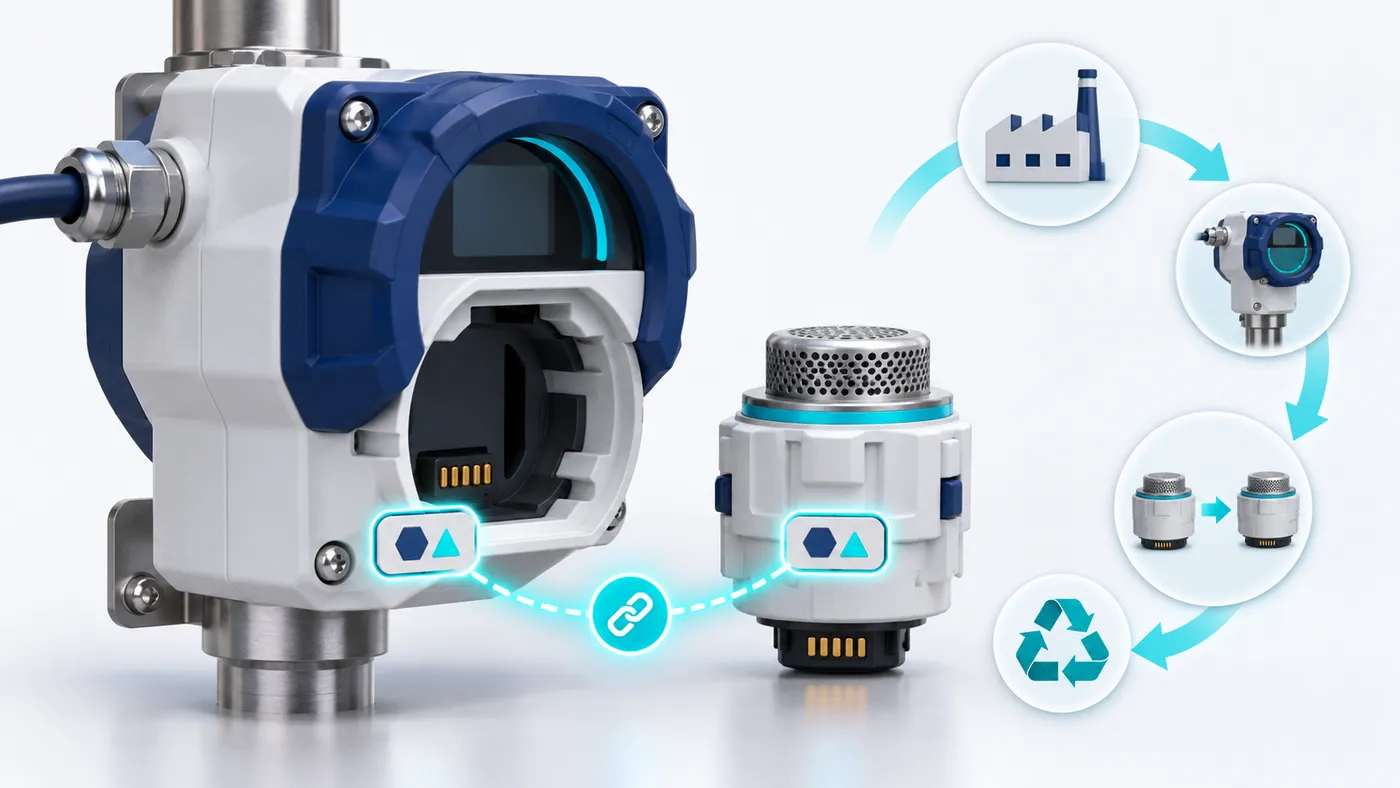
A replacement module needs its own identity within the continuing asset history; symbols show lifecycle relationships only.
What should be captured before cleaning or adjustment?
As-found evidence describes the condition before an intervention changes it. Record the complaint or service trigger, visual condition, device status, fault history, configuration and any available comparison readings. Capture relevant photographs or exports where the quality system permits, but do not use an unlabelled photo as a substitute for a measurement record.
A sequence matters. If a technician cleans the inlet, replaces a filter and then takes an “as-found” reading, the original installed condition has already changed. The post-cleaning result may be useful, but it should be named accurately. If immediate intervention is necessary and an original reading cannot be obtained, record that fact and the reason rather than inventing a value or leaving an ambiguous blank.
MSA's TG5000 calibration-confirmation documentation gives a model-specific example of retaining the last successful calibration date and as-found/as-left values. That is valuable evidence, but a complete site service history may also need sample-path work, component replacements, configuration changes and approval information outside the instrument's internal memory.
Preserve original failed results. A failed first attempt followed by a successful adjustment is not equivalent to a first-attempt pass. The difference can matter for evaluating drift during the previous operating interval. A system that overwrites the old result with the latest successful number loses exactly the evidence needed for that review.
How do you separate calibration, adjustment and maintenance?
Use separate action fields. A calibration comparison relates the indicated result to a reference under stated conditions. An adjustment changes a parameter or characteristic. Maintenance can include cleaning, replacement, inspection or repair. Verification evaluates whether specified requirements are met. Local terminology may differ, but the record should make the actual action clear.
For example, replacing a contaminated filter is a sample-path maintenance action. Entering a new span value is an adjustment. Comparing the resulting output with a supported reference is a measurement event. Confirming the intended controller or alarm function is a separate functional result. A single “calibrated” checkbox cannot show which of those occurred.
The number of calibration points belongs to the approved method and measurement claim. The Sensor1stop guide to zero calibration explains the baseline part of that distinction. The present record is broader: it follows maintenance and configuration history whether the approved comparison uses one point or several. It should link to the method instead of trying to replace its technical requirements.
Avoid a form that requires every technician to mark “two-point calibration” merely because the printed template has two rows. Some instruments use a different authorized method, and some service events do not include adjustment at all. Provide repeatable rows for actual measurements and an explicit “not performed, reason” field. The form should describe the work, not force the work into an inappropriate label.
Which reference and conditions belong with each result?
Identify the actual gas source, cylinder or reference instrument, certificate, adopted concentration, units, balance gas and relevant validity. If several reference sources are used, link each measurement row to the correct one. A certificate stored elsewhere can be referenced by a stable ID, provided a later reviewer can retrieve the exact version used.
Record environmental and configuration conditions that the method requires. Temperature, pressure, humidity, power state, warmup, compensation settings, flow status and stabilization can matter. Do not replace them with a generic “normal” entry when the acceptance claim depends on a defined range. Equally, do not add meaningless fields that will be filled with guesses; adapt the form to the instrument and method.
For a sampled system, record the point where the reference entered the chain. A service port at the detector head and a remote inlet can support different claims. If the test bypasses a filter, line or pump, say so. A passing sensor-head comparison does not prove that an installed remote sample will reach the sensor within the required time.
The record should also identify the method document and revision. A title alone is insufficient when the procedure changes. Include the applicable acceptance criterion and decision rule or a controlled reference to them. That makes the result reviewable without assuming that the current procedure is identical to the one used months earlier.
What does the actual service form look like?
Use the following blocks as a template. They are intentionally separate so a digital system can link repeated measurement rows and maintenance actions to one event. Blank fields should be explained with a value such as not applicable, not performed or unavailable, accompanied by a reason when it affects interpretation.
Block A: event and asset identity
| Cánh đồng | Entry to complete |
|---|---|
| Service event ID | Unique identifier; link to work order |
| Asset and location | Site ID, location and intended duty |
| Dụng cụ | Manufacturer, model, serial, hardware and firmware |
| Installed sensor(s) | Type, target gas, serial/module ID, installation date |
| Measurement configuration | Range, units, gas table and relevant corrections |
| Output chain | Display/register/loop/controller/channel/historian tag |
| Sample chain | Inlet, line, filter, pump, shield and conditioning IDs |
| Trigger | Scheduled review, failure, exposure, relocation, repair or other |
| Personnel and timing | Technician, start/end time and relevant qualification reference |
Block B: original condition and measurement evidence
| Cánh đồng | Entry to complete |
|---|---|
| Complaint or observation | Symptoms and event history |
| As-found physical condition | Inlet, filter, enclosure and relevant sample-path condition |
| As-found status | Faults, diagnostic outputs and unavailable channels |
| Original configuration | Export or recorded settings before changes |
| Phương pháp | Controlled procedure and revision |
| Thẩm quyền giải quyết | Source/instrument ID, certificate and adopted values |
| Điều kiện | Relevant environment, warmup, stabilization and sample entry point |
| As-found measurements | One row per actual point and output, before intervention |
| Initial assessment | Criterion, decision rule, result and limitations |
Block C: work performed and final condition
| Cánh đồng | Entry to complete |
|---|---|
| Maintenance actions | Action, reason, time, component and person |
| Replacements | Removed/installed IDs, part numbers and disposition |
| Adjustments | Parameter, old value, new value and authorization |
| Other configuration changes | Firmware, range, units, correction, filter or controller settings |
| Xác minh bên trái | Actual points, reference IDs, outputs and conditions |
| Functional checks | Function tested, result, scope and method |
| Remaining concerns | Restrictions, incomplete checks and corrective-action links |
| Release | Decision, authorized reviewer, date and intended use |
| Next review | Due date or trigger rule, basis and approving person |
Repeatable measurement row
| Thời gian | Sân khấu | Output/point | Reference ID and value | chỉ định | Difference | Criterion/rule | Kết quả |
|---|---|---|---|---|---|---|---|
| Complete | As-found/as-left | Nhận dạng | Value, unit and basis | Value and unit | Signed, with unit | Controlled reference | Pass/fail/indeterminate |
The table is a record structure, not a universal list of required concentrations or tolerances. Add uncertainty information or a controlled uncertainty-budget reference where the decision requires it. Preserve raw readings when a rounded display value is also reported. If the instrument automatically generates a service report, attach it and record how its fields map to the site form.

Original and final condition records remain separate after an intervention.
What does a checked fictional service event show?
Consider a fictional CO₂ monitoring asset, IAQ-027. Before work, a supported reference value is 1002 ppm and the selected digital output reads 1050 ppm. The indicated difference is 1050 − 1002 = +48 ppm. The technician records the actual configuration and finds a filter that requires service according to the relevant method. Those observations are separate entries.
After the approved filter service and an authorized adjustment, the same defined output reads 1010 ppm under the recorded comparison conditions. Its difference is 1010 − 1002 = +8 ppm. The reduction in indicated difference is 40 ppm. Because two interventions occurred, this event alone cannot assign all 40 ppm to the filter or all of it to the adjustment. The record preserves the sequence rather than claiming a single cause without evidence.
Suppose the site method has a hypothetical acceptance limit of ±30 ppm and a hypothetical decision rule requiring |difference| + U ≤ 30 ppm, where the expanded uncertainty applicable to that comparison is U = 12 ppm. The as-found calculation is 48 + 12 = 60 ppm, which does not satisfy the rule. The as-left calculation is 8 + 12 = 20 ppm, which does. These invented values illustrate recording a rule; they are not recommended limits for a real monitor.
The final record should still identify whether the remote sample inlet, controller scaling and any required functions were checked. If only the digital concentration at a service port was verified, the release statement must have that scope. A numerical pass in one comparison does not silently close every maintenance concern in the installed system.
What happens when the as-found result is unacceptable?
Treat the finding as both a present equipment issue and a possible historical data issue. Preserve the original measurements, identify the last supported satisfactory evidence and examine relevant events since then. The review may consider drift, exposure, faults, maintenance, environmental changes and the decisions made from the affected output. The extent of that review depends on the equipment's duty and the organization's approved process.
Avoid assuming linear drift unless there is evidence for it. A failure could have developed gradually or occurred after a discrete contamination or power event. A current error cannot automatically be projected backward over the whole service interval. If the timing is uncertain, record the uncertainty and the basis for the chosen affected interval.
A successful adjustment does not erase the need for that review. It establishes a new condition under the as-left test. The prior interval may still need a documented disposition by the responsible owner. Link the service record to the review or corrective action so that the case cannot be closed merely by printing a new sticker.
For an instrument that cannot complete verification, preserve the unsuccessful event and its status. The appropriate action may be repair, replacement, restriction or withdrawal from the intended use, according to the site's controls. Record the authorized decision and any interim arrangements in the relevant system. Do not use a blank release field as a substitute for a clear unavailable status.
How should maintenance history change the next-due rule?
A next-due date should have a documented basis: the manufacturer's requirements, applicable program requirements, operating conditions, service history and the organization's interval-review method. Do not set an interval solely because a blank form happens to contain “annual.” Different instruments and duties can require different periodic and event-driven reviews.
ILAC-G24:2022 and OIML D 10:2022 address the determination and review of recalibration intervals for measuring equipment. Their relevance here is the use of evidence and a documented method, rather than a universal fixed period. Interval review should consider the instrument's history and the consequences of an unsuitable result within the applicable quality system.
Separate scheduled dates from triggering events. An exposure, repair, relocation, sensor replacement, firmware change or failed intermediate check can require review before the calendar date arrives, depending on the model and approved procedure. The asset system should be able to express “due by date, or earlier on specified event” instead of treating the printed date as unconditional permission to continue use.
If an interval is changed, record old rule, new rule, supporting evidence and approval. A shorter interval can be a response to instability. A longer interval requires an adequate basis and cannot override a mandatory requirement. Preserve the decision history so a later reviewer can see why the current schedule differs from the original one.

The inlet, filter and line are part of the installed measurement history; the illustration is not an assembly instruction.
Who reviews and releases the equipment?
Define roles in the procedure. The person who performs work records observations and actions. A reviewer checks completeness, criteria, unresolved issues and the scope of final evidence. The person authorized to return the equipment to the intended duty makes the release decision. In a small organization these roles may overlap where permitted, but the record should still show which responsibilities were exercised.
Lawrence Berkeley National Laboratory's gas-detection-system requirements illustrate a program that assigns maintenance responsibilities, qualified personnel and formal system documentation. Those requirements belong to that institution's program. They show why ownership and approval matter; they should not be presented as universal legal requirements for every gas monitor installation.
A release statement should say what has been accepted and any restrictions. “Sensor concentration comparison accepted; installed alarm transmission test pending” is different from “complete system released.” Whether partial release is permissible depends on the applicable system controls. The service form should make the distinction visible instead of turning every completed measurement into an unconditional green status.
Electronic approval should preserve identity, date, record version and subsequent changes. A later correction to a serial number is different from a changed measurement value or decision. Keep the original entry and a traceable correction history. A shared spreadsheet can support a simple process, but unrestricted overwriting undermines the evidence even if the final page looks orderly.
How do you make the history useful between service visits?
Review trends using comparable information. Plotting signed as-found differences can reveal a pattern, but only if reference basis, output, range and relevant conditions are compatible. Mark sensor replacements and configuration changes explicitly. A trend line crossing a replacement date can imply continuity that does not exist.
Use failure categories that support decisions: drift, communication, sample-path restriction, reference issue, configuration, physical damage, incomplete test or unknown. Keep a narrative field for details, because a category alone may conceal different causes. A repeated “calibration failed” code is less useful than evidence showing whether the same output drifted or the gas never reached the inlet.
Retain intermediate checks and operator observations with their scope. A functional response check can provide valuable evidence of response without proving full concentration accuracy. A visual inspection can identify a blocked opening without establishing sensor sensitivity. Recording these events accurately expands the history; calling all of them calibration collapses useful distinctions.
Set retention and access according to the actual quality system and applicable requirements. There is no single retention duration established by this template. The practical minimum for analysis is enough history to reconstruct component life, interval decisions and potentially affected use. Ensure the records remain retrievable after contractor changes, software migrations and asset renaming.

Approval records the supported use and the next review rule.
How can you migrate old records without overstating their evidence?
When moving paper forms or contractor reports into a new maintenance system, preserve the original attachments and classify what they actually show. A historical sticker may establish that a service provider marked an instrument due on a date. It may not establish the reference value, original error or complete installed-system result. Record missing evidence as missing rather than filling fields from current assumptions.
Use a migration note to distinguish transcribed values from interpreted information. An old record saying “span checked” should not automatically become “full-range calibration passed.” A certificate naming only the transmitter should not be assigned to a replacement sensing module without supporting identity evidence. The goal is a usable history with honest limits, not a cosmetically complete database.
Resolve identity conflicts before combining trends. Two instruments may have shared a site nickname, or an asset may have moved between locations. Use serial numbers, work orders, installation records and dated configuration exports to establish continuity where possible. If continuity cannot be demonstrated, retain separate histories with a note explaining the unresolved relationship.
For future events, define required fields and controlled choices that prevent the same gaps from recurring. A form can require the reference ID, actual output, stage of work and release decision while still allowing a justified unavailable entry. Rigid fields that encourage invented values make the record worse. Required evidence and honest exception handling need to be designed together.
After migration, sample several records end to end: asset to service event, event to reference certificate, event to maintenance action and event to approval. Confirm that attachments open and that the original result remains visible after a correction. This small reconstruction exercise tests whether the history supports decisions, which is the reason to maintain it.
What makes a record reviewable by the next technician?
Use consistent units, explicit timestamps and stable identifiers. Explain abbreviations that are not defined in the controlled method. Attach instrument exports in a format that remains accessible, and preserve the readable report alongside any proprietary file. The next technician should be able to identify the original condition and the final release scope without relying on a conversation with the previous technician. That practical handover is a useful check on whether the form contains evidence or merely completed boxes.
Câu hỏi thường gặp
Is a calibration sticker a sufficient record?
No. It can identify status and a due date, but it usually cannot reconstruct reference values, original condition, changes, uncertainty or release scope. Link the sticker or asset identifier to the detailed record.
Should I record a failed attempt if the final attempt passes?
Yes. Preserve both and explain the intervention between them. The original failure may be important for reviewing the previous operating interval or identifying recurring maintenance problems.
Does replacing a sensor create a new asset?
It creates a new component history even if the site keeps the same overall asset ID. Record the removed and installed sensor identities and effective dates. Avoid blending their drift evidence without marking the change.
Can one form cover calibration and sample-path maintenance?
Yes, if it separates measurements, maintenance actions and final verification. That linkage is useful because a sample-path change can affect the installed measurement. A generic pass checkbox is insufficient.
Must every monitor be calibrated annually?
There is no universal interval supplied by this template. Use the exact manufacturer's requirements and the applicable program, then document the evidence and review rule. Event-driven requirements can apply before the next scheduled date.
What is the most important approval field?
A release decision tied to a defined intended use, supporting evidence and an identifiable authorized person. The result should remain understandable even when the technician who performed the work is unavailable.






Để lại một câu trả lời