
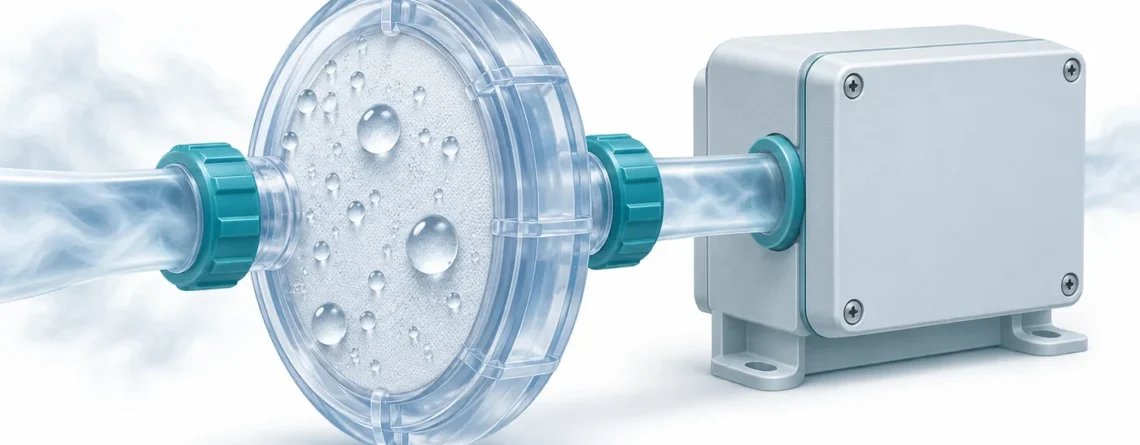
合適的疏水過濾器可以防止液態水進入氣體感測器,同時允許氣體通過。它通常不會從潮濕樣本中去除水蒸氣,並且不能保證下游不會形成冷凝。保護取決於膜、液體化學性質、壓力差、安裝和過濾條件。
因此,實際問題比過濾器是否防水更廣泛。氣體測量需要受保護的感測元件和代表性樣品。過濾器可以保護元件,同時延遲氣體到達、增加壓力降或被液體覆蓋。乾燥機可以在改變濃度基礎的同時解決水分問題。這些影響必須單獨考慮。
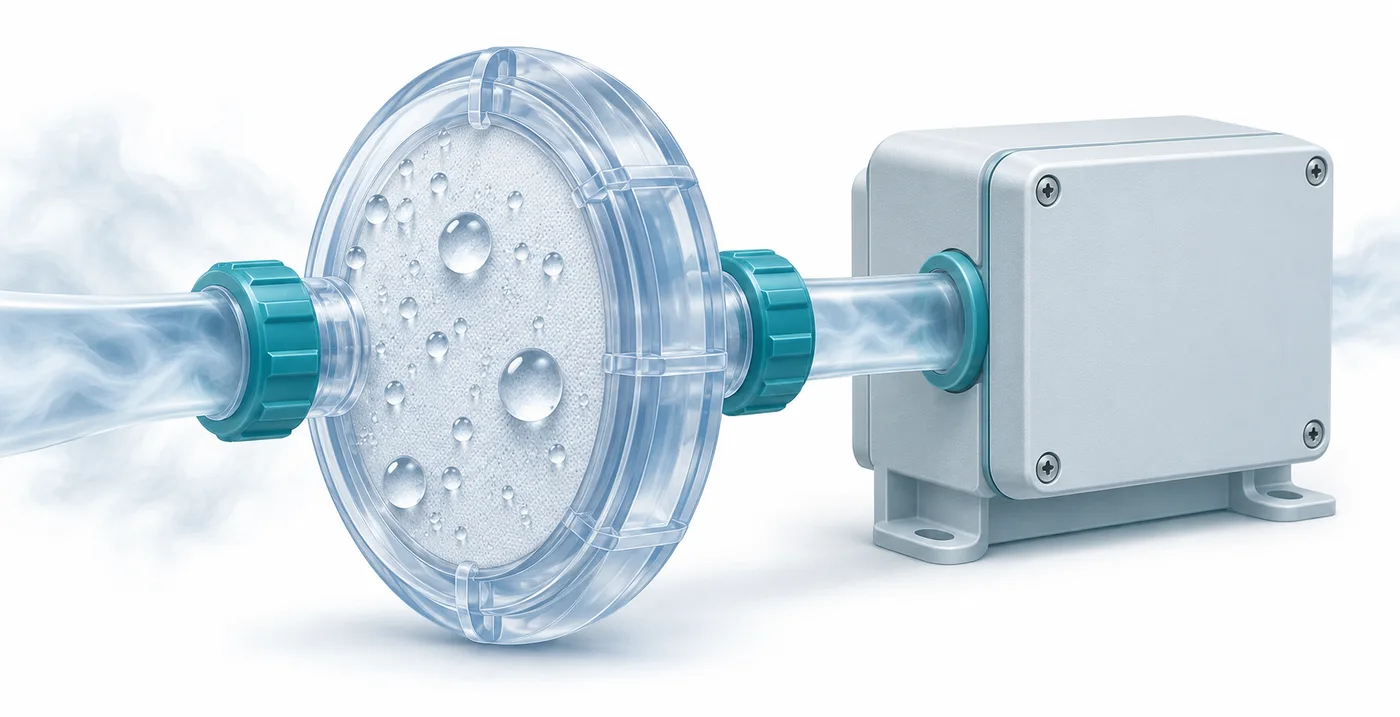
概念屏障:薄膜可以阻擋液滴,而潮濕氣體則保留在兩側。液體屏障並不自動成為蒸氣乾燥器。
水蒸氣和液態水需要不同的控制
水蒸氣由氣相的水分子組成。潮濕的氣體看起來完全透明。液態水以水滴、薄膜、薄霧或收集的冷凝物的形式出現。樣品可以包含任一相或兩者。
A hydrophobic membrane's liquid resistance arises from its material and pore behavior under specified conditions. Water vapor can still accompany the gas through the available gas pathways. Calling the incoming sample high humidity does not reveal whether the main threat is vapor exposure, entrained liquid or condensation after cooling.
相對濕度描述了當地溫度下接近飽和的程度。它與水的摩爾分數不同。當潮濕氣體在沒有獲得或失去水分的情況下變暖時,即使其含水量並未減少,其相對濕度也會下降。
露點很有用,因為它將水含量與在相關壓力下開始冷凝的溫度聯繫起來。如果採樣路徑的一部分低於露點,就會在那裡形成液體。上游的膜無法阻止水穿過膜時仍是蒸氣。
壓力變化也屬於評估範圍。露點和水蒸氣條件取決於壓力。從加壓過程中提取的樣品在減壓後可能不會具有相同的冷凝行為。使用每個階段的條件,而不是從來源複製的單一濕度數字。
在选择硬件之前,请用物理术语描述水问题:入口处的水滴、整个生产线的潮湿蒸汽、冷凝水的冷配件或不能承受水含量的传感器。不同的描述導致不同的補救措施。
疏水膜實際上能做什麼?
A suitable membrane can provide a barrier to liquid intrusion while permitting gas exchange. The useful performance depends on the pressure difference and the liquid's interaction with the membrane. It is not an unlimited barrier under every flow, pressure and chemical condition.
Gore's packaging-vent FAQ 區分水性液體的疏水行為和與低表面張力流體(例如油或洗滌劑)相關的疏油行為。它還解釋了用液體覆蓋通氣膜可以防止氣體交換。這些是有用的膜原理,但包裝範例並不能證明氣體分析儀的安裝。
因此,受污染的樣品對薄膜的挑戰可能與乾淨的水不同。油、清潔殘留物和界面活性劑會影響潤濕。詢問過濾器相容性時,請指定實際液體和污染物;僅憑清潔水聲明可能無法證明適用性。
完整的過濾器不僅包括薄膜材料。外殼密封、支撐結構、連接、組裝和方向可能會產生額外的限制。密封不良的支架中的防液膜不會形成防液樣本路徑。
Gore's performance-membrane information also distinguishes membrane applications and airflow characteristics. The integration lesson is to use the relevant product's data and test conditions. Material names such as PTFE do not identify a universal pressure drop, gas response or water-entry rating.
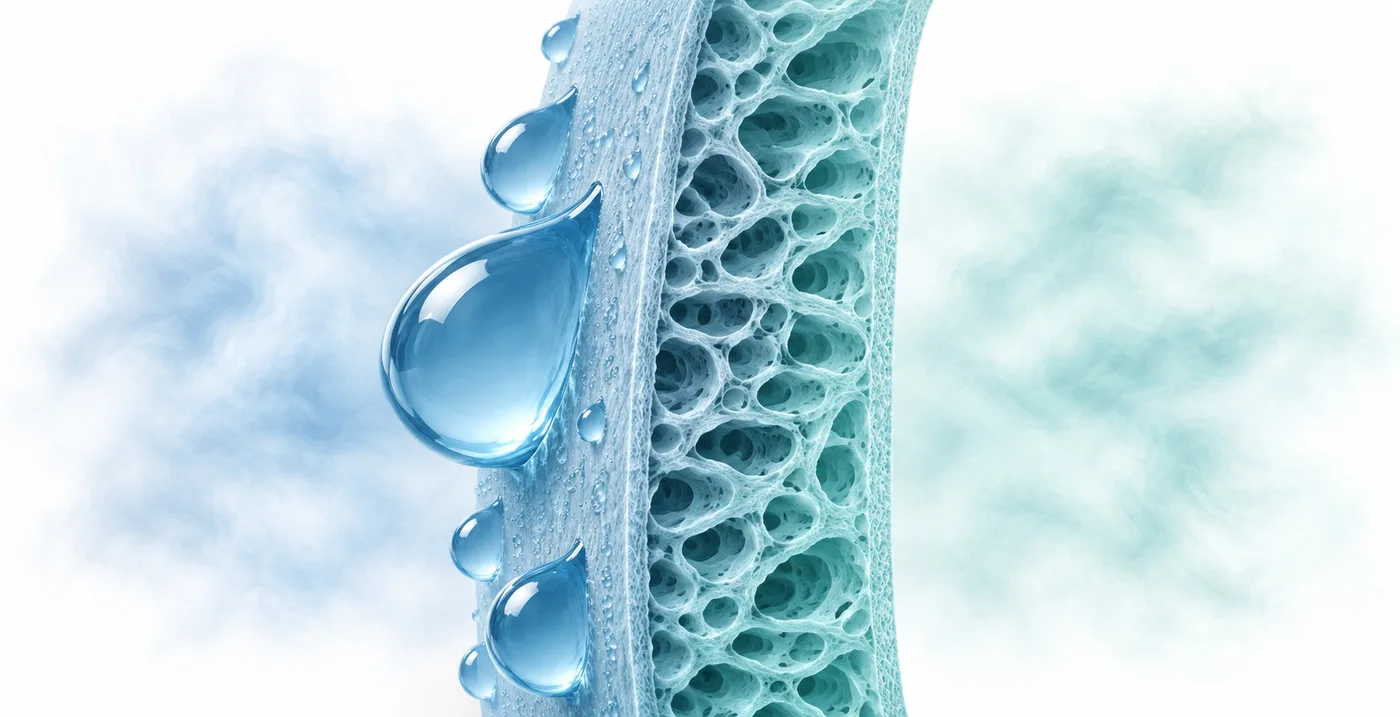
概念性膜行為,而非微觀產品模型。液體阻力和水蒸氣去除是不同的功能。
過濾成功後為何會出現凝露現象?
Consider a warm humid sample that passes through an inlet membrane without any droplets crossing it. The sample then enters a cooler fitting. If that fitting is below the sample's dew point, some of the vapor condenses there.
按照該順序,入口屏障可以執行其預期任務。下游的水由蒸氣局部形成。在相同的熱佈置中用另一個液體屏障替換過濾器可能不會改變根本問題。
最冷的表面比櫃子的平均溫度更重要。金屬隔板、裸露的連接器或接觸冷壁的管道可能會產生局部冷凝點。大部分溫度較高的採樣管線仍可能包含有問題的冷部分。
Vaisala's high-humidity application note 說明了傳導和安裝冷點的重要性。它的例子涉及湿度探头,但推理适用于定位气体路径中可能发生冷凝的位置:实际表面的温度,而不仅仅是周围过程,决定了那里是否形成水。
檢查從源頭到廢氣的完整路徑。過濾器可能處於室溫,而附近的入口被加熱,或者感測器室可能在夜間關閉期間冷卻。因此,啟動時可能呈現與穩定運轉不同的水狀況。
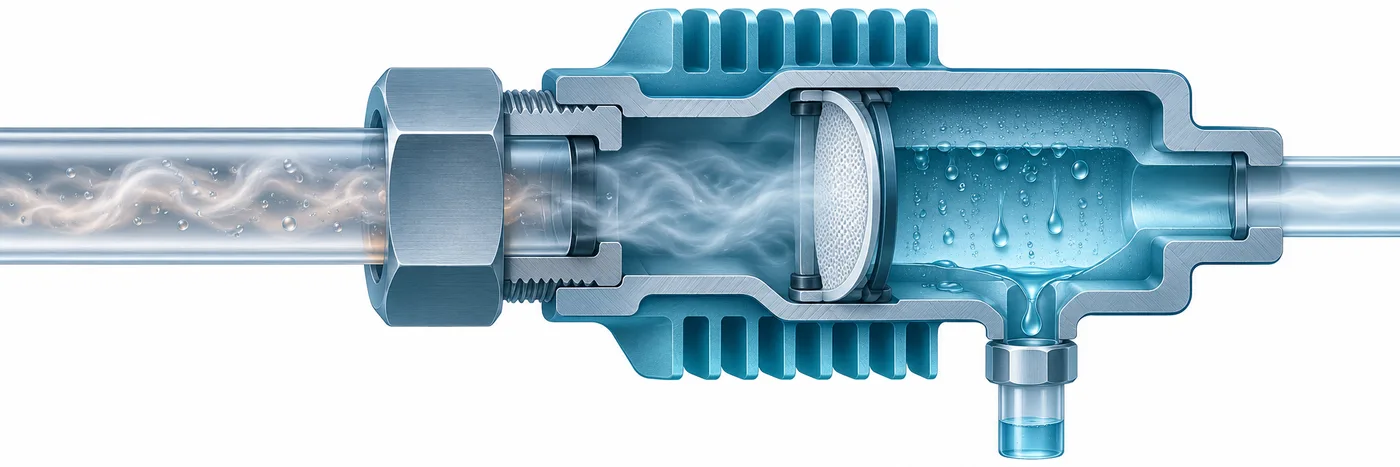
概念性下游冷凝:蒸氣穿過膜,然後在較冷的部分形成液滴。不需要液體突破。
比較屏障、捕集器、乾燥器和加熱路徑
這些組件解決不同的問題,不應被視為可互換配件。
液體屏障可抵抗邊界的侵入。捕集器收集或分離已經存在的液體。乾燥機使用指定的製程去除水蒸氣。加熱路徑旨在使表面保持在相關冷凝條件之上,同時保留樣品中的蒸氣。
| 組件或策略 | 主要任務 | 它沒有建立什麼 |
|---|---|---|
| 疏水膜 | 阻止液體進入,同時允許適當的氣體交換 | 乾燥樣氣或潮濕時不受限制的反應 |
| 液體捕集器或分離器 | 去除或收集液滴和冷凝物 | 徹底去除水蒸氣 |
| 蒸氣乾燥機 | 減少水分含量 | 目標氣體回收率不變或濃度基礎不變 |
| 加熱樣品路徑 | 透過熱控制降低冷凝風險 | 去除水蒸氣 |
| 顆粒過濾器 | 控制指定粒子 | 耐液體性除非單獨額定 |
| 感測器經批准適用於潮濕氣體 | 在記錄的濕度條件下運行 | 對液體、污染或冷凝的無限耐受性 |
乾燥機需要進行目標氣體相容性評估。有些氣體可能會因與乾燥介質或冷凝物接觸而損失、延遲或改變。下游濕度讀數低並不能證明目標氣體到達時未改變。
疏水阀需要进行容量和维护评估。液體體積聚會改變可用的體積、流量和壓力,並且疏水閥無法在不注意的情況下無限期地收集水。它的存在應記錄為採樣配置的一部分。
加熱路徑需要完整的熱覆蓋和適當的溫度測量策略。加熱一個感測器元件並不能證明每個配件都保持在露點以上。溫度控制也必須與採樣氣體和儀器材料保持相容。
這 HMM170 防冷凝文檔 提供有关参数含义的有用的特定于模型的警告:加热会改变与温度相关的湿度输出的使用方式,并且可能需要外部过程温度输入。加熱是一種測量設計選擇,而不僅僅是使濕探頭正常讀取的一種方法。
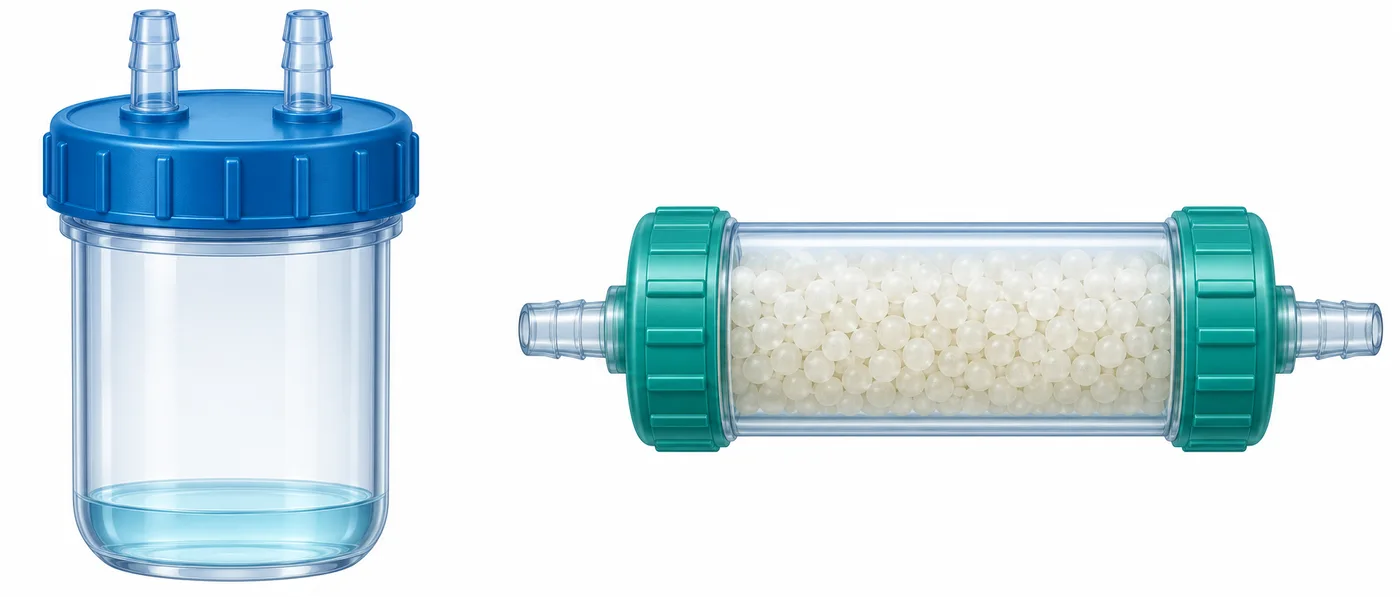
概念組件:收集器處理收集的液體;乾燥機改變水蒸氣含量。選擇還必須保留目標測量。
疏水過濾器是否可以使結果基於乾基?
不會。如果水蒸氣與樣品一起通過,它仍然是池中氣體混合物的一部分。耐液膜本身不會將濕基濃度轉化為乾基濃度。
濕基分數包括總氣體量中的水蒸氣。乾基分數不包括它。即使目標氣體不會與水發生反應且感測器不受濕度影響,這種差異也適用。
Vaisala's CO2 measurement application note 解釋說,添加或去除水會改變氣體成分,從而改變報告的濃度基礎。這是真正的混合物變化,與光學或電子濕度幹擾不同。
A reading can therefore change after moisture removal without indicating a sensor error. Before comparing two analyzers, determine whether both report the same basis and whether their sample conditioning differs.
The converse also matters. If a filter has become wetted and the reading changes, do not immediately label the result a wet/dry conversion. The path may also have developed a pressure drop, a delayed response, a leak or target-gas loss. A valid basis conversion assumes more than the presence of water.
A checked wet/dry example
假設假設樣品的乾基含量為 1000 ppm CO2。水蒸氣佔濕混合物總量的3.0%。假設添加水不會添加或移除二氧化碳,並且比較使用一致的摩爾分數單位。
乾氣體佔濕混合物的97.0%。因此,濕基濃度為:
濕二氧化碳 = 1000 × (1 − 0.030) = 970 ppm。
逆向計算:
乾燥 CO2 = 970 / (1 − 0.030) = 1000 ppm。
The difference is 30 ppm. A membrane that passes the water vapor leaves this basis difference present. A correctly specified dryer that removes water without changing CO2 could change the result toward the dry-basis value even when the sensor's calibration remains unchanged.
本例的 3.0% 數字是水摩爾分數,而不是 3% 相對濕度。將 RH 值直接代入方程式是不正確的。將 RH 轉換為水分數需要相關的溫度和壓力資訊。
在相同的假設下,相同的算術可以應用於另一個非反應氣體部分。它並沒有證明真正的乾燥機可以保存這種氣體。對於溶解在冷凝物中、吸附在表面上或在採樣系統中發生反應的氣體,單獨研究回收率。
部分乾燥的樣品也需要其剩餘的水含量。因為安裝了疏水閥而將出口稱為乾燥是不夠的。捕集器去除收集到的液體;離開它的氣體在當地條件下仍可能含有大量蒸氣。
濾波器如何改變響應時間?
氣體需要一段時間才能到達感測元件。管道體積、過濾器外殼體積、流量和擴散都會產生影響。膜增加了傳輸邊界,其效果取決於其面積、厚度、支撐和條件。
對於流動系統,簡單體積除以實際體積流量可提供粗略的傳輸時間尺度。它不是完整的響應時間規範,因為混合、吸附和感測器動力學可以拓寬響應。即使新樣品到達其入口後,外殼仍可容納舊樣品。
For a diffusion instrument, there may be no pump to overcome a restrictive path. A membrane or protective cover can slow exchange with the environment. The bare sensor's response time should therefore not be assumed to describe the installed instrument.
液體覆蓋會減少可用於氣體交換的膜面積。然後,感測器可以繼續報告其室內緩慢變化的氣體的穩定值。當測量結果變得陳舊時,穩定性看起來令人放心。
This creates an important diagnostic distinction: a noisy reading is not the only sign of a wet sampling problem. An unusually unresponsive or delayed signal can be equally informative. Compare response behavior, flow status and moisture evidence rather than relying on the apparent smoothness of a trend.
Pressure drop can connect moisture to gas error
A restrictive filter can change the pressure at the cell in a pumped system. If the analyzer has pressure sensitivity or uses a pressure input, that pressure change can affect the reading. A symptom that appears humidity-related may therefore include a pneumatic contribution.
The relevant pressure is the condition at the measurement cell. A pressure sensor upstream of the filter may not see the drop downstream. Increasing the flow demand can enlarge the difference while the upstream pressure remains ordinary.
A flow indication also needs location and units. A flowmeter upstream of a leak or restriction may not describe what reaches the cell. Standard and actual volumetric flow are different quantities, so record the meter's basis when evaluating transport.
Do not use a pressure-compensation setting to compensate for an unqualified sampling path. Pressure correction cannot recover gas lost to a leak or water contact, and it cannot make a delayed sample represent the present process.
這 Alphasense 技術常見問題解答 includes gas-train design guidance addressing flow direction, pressure effects, filtering and condensation. Apply the instructions for the chosen sensor and analyzer; a layout appropriate to one family should not become a universal pump-placement rule.
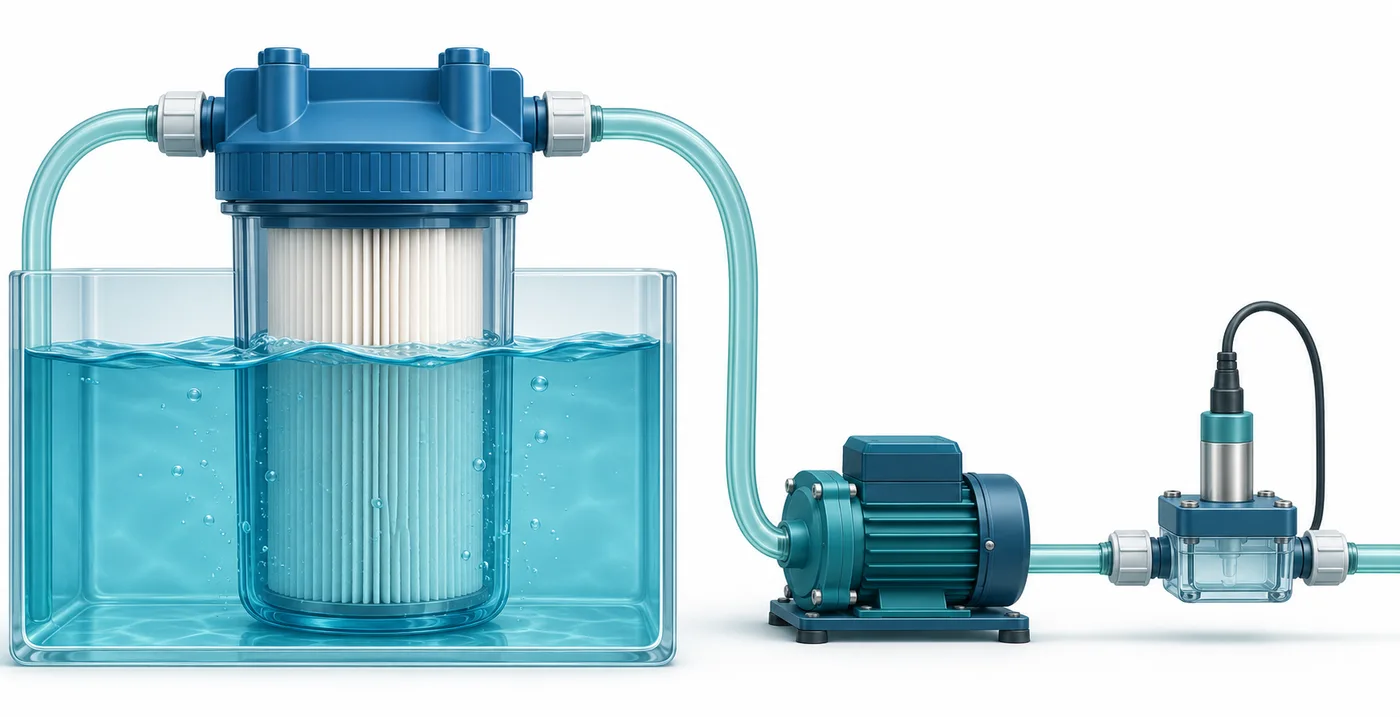
Conceptual liquid coverage: a protected sensor can still receive a restricted or delayed sample. Protection and representativeness need separate checks.
Select the filter using more than pore size
Pore size is only one selection parameter. The complete decision should include liquid-entry behavior, airflow or pressure-drop data, membrane area, housing volume, temperature and chemical compatibility.
Ask which test fluid and pressure conditions support the liquid-resistance claim. Clean water does not represent every condensate. A process containing oils, surfactants or solvents may require different materials or additional separation.
Check the target gas as well as the water. A filter acceptable for CO2 or oxygen may not preserve a reactive trace gas adequately. The relevant question is recovery and response at the required concentration, not merely whether gas can pass through the membrane.
Inspect the housing materials and seals. A membrane may be chemically suitable while an adhesive or elastomer is not. Low concentrations can make otherwise small surface interactions significant.
Review permitted orientation and maintenance. A filter that can shed droplets in one position may remain flooded in another. Installation space should permit inspection and replacement without damaging tubing or confusing the flow direction.
Finally assess the installed response. A component's airflow curve under a specified pressure difference does not establish the complete analyzer's response to a concentration step. The sensor, enclosure, tubing and processing remain part of the result.
Diagnose the symptom by following the water
If liquid is visible before the filter but not after it, the barrier may be containing droplets. Still check whether liquid coverage has reduced gas exchange. Successful containment does not establish unchanged flow.
If droplets appear after the filter, consider both breakthrough and local condensation. Compare surface temperatures and dew point, inspect seals and assess membrane compatibility. The position of the first visible droplet can help form a hypothesis, but visual inspection alone may miss thin films.
If the reading becomes slow during humid operation, compare flow and cell pressure with the clean, dry configuration. Check for collected liquid, saturated protective material and changes in available membrane area. Preserve the original trend before replacing parts.
If the reading changes after drying, first reconcile sample basis. Then assess whether the dryer or condensate could remove target gas. A concentration increase consistent with water removal and a decrease caused by target-gas loss can even partially cancel.
If the problem appears during temperature cycling, inspect cold points and shutdown conditions. A system can operate acceptably after warming but collect water while idle. Restart then introduces a different sample-path state.
文章關於 氣體感測器中的濕度影響 provides broader context for distinguishing moisture dilution, sensor response and physical condensation. Those mechanisms should remain separate in the fault record.
A useful acceptance record for a humid sample path
Begin with the measurement definition: target gas, concentration range, source location, required response and wet or dry basis. Without that definition, it is difficult to decide whether a change introduced by conditioning is acceptable.
Record the sample path in sequence. Include source pressure and temperature, tube materials and dimensions, filter type, trap or dryer, pump, cell and exhaust arrangement. Add the locations of pressure, temperature and humidity measurements.
Describe expected water states. Is the inlet expected to contain droplets? Can any section cool below dew point? Does the system intentionally remove vapor? State which component handles each condition rather than writing a broad moisture protection label.
保持清潔和有挑戰性的條件不同。乾燥調試比較可以建立基本的氣體反應,而潮濕服務行為尚未解決。任何濕度挑戰都應遵循製造商支持的適當方法並保留目標氣體參考條件。
Record pressure drop and response behavior along with concentration agreement. A sample path that gives the right settled value but arrives too late may fail the application's need. A path that responds quickly but changes the gas basis may require a documented conversion or a different design.
Specify maintenance evidence. Useful indicators can include filter condition, flow status, collected-liquid level or a manufacturer-defined diagnostic. A fixed replacement interval alone may not reveal an unexpectedly severe moisture event.
After changing a filter type, tubing route or dryer, reassess the affected evidence. Nominally interchangeable parts can differ in internal volume, membrane area and surface chemistry. A stable gas-sensor calibration does not make all sample-path changes neutral.
How to compare two proposed solutions fairly
Compare solutions against the same required output. If one keeps the sample humid and another dries it, first decide how both results will be expressed on the chosen basis. Otherwise an expected composition difference can be mistaken for superior accuracy.
Include time behavior. A small diffusion barrier and a large conditioning assembly can reach the same final value at very different times. Define whether the application needs a settled laboratory result, a process trend or a prompt indication.
Include failure visibility. A solution that loses flow silently when wet presents a different integration problem from one with a clear low-flow status. The diagnostic does not prevent every failure, but it can keep a stale reading from being treated as current.
Include the real maintenance environment. A trap that is easy to inspect on a bench may be inaccessible in a cabinet. A membrane that works with clean condensate may see detergent during routine cleaning. Those conditions belong in selection, not only in later troubleshooting.
Avoid declaring one component universally best. The correct combination is the one that controls the relevant water phase, preserves the target-gas measurement, meets the response requirement and provides interpretable failure behavior within the documented conditions.
A transport example: protection succeeds while the sample changes
考慮一個假設的熱過程樣品,其中含有潮濕氣體和偶爾夾帶的液滴。入口膜可以抵抗這些液滴。然後氣體通過冷卻櫃配件,然後到達分析儀。感測器仍然受到保護,免受原始液滴的影響,但接頭處會形成新的液體。
三個觀察結果會回答不同的問題。乾燥的感測器表面支援可見液體未到達該表面的有限結論。配件處收集到的水錶示存在局部相變。與源的濃度差異引發了關於水分基礎、目標氣體回收和洩漏的單獨問題。
Adding another membrane near the sensor could provide another liquid boundary, but it would not explain the sample change upstream. Moving the first membrane would likewise leave the water vapor present unless another process removes it. The design decision should follow the required sample basis and the permitted source-to-cell conditions.
An interpretable comparison would document both source and cell conditions and the intended conditioning method. It would also preserve response-time evidence, because a liquid film can restrict exchange even when a final concentration eventually appears reasonable. This example shows why the most useful question is not whether the sensor stayed dry, but whether the entire measurement remained representative.
常見問題
Does hydrophobic mean that water vapor cannot pass?
No. A hydrophobic membrane can resist liquid water while permitting humid gas exchange. Check the exact product specification.
Can a filter prevent every condensation problem?
No. Vapor can cross a membrane and condense on a colder surface downstream. Temperature and dew point through the whole path matter.
Is a water trap the same as a dryer?
No. A trap handles collected liquid; a dryer reduces water vapor. Gas leaving a trap can still be humid.
Does drying always improve gas accuracy?
No. Drying can make the sample compatible with an analyzer, but it changes concentration basis and may affect target-gas recovery. Those effects need qualification.
Why did the reading become stable when the filter got wet?
One possibility is restricted exchange, leaving slowly changing gas at the sensor. Confirm with flow, pressure and response evidence; stability alone does not establish accuracy.
What should be checked after replacing the filter?
Confirm the correct part, seals, orientation, flow or pressure behavior and installed gas response. A changed housing volume or membrane can alter performance even when the sensor itself is unchanged.
來源
- Gore packaging-vent FAQ: membrane wetting and gas exchange principles.
- Gore performance membranes: application-specific membrane characteristics.
- Vaisala high-humidity instrument selection: cold spots, conduction and condensation.
- Vaisala HMM170 condensation prevention: model-specific heating and output conditions.
- 維薩拉 CO2 測量應用說明: water-vapor dilution and concentration basis.
- Alphasense 技術常見問題解答: sampling-system considerations.




發表評論