
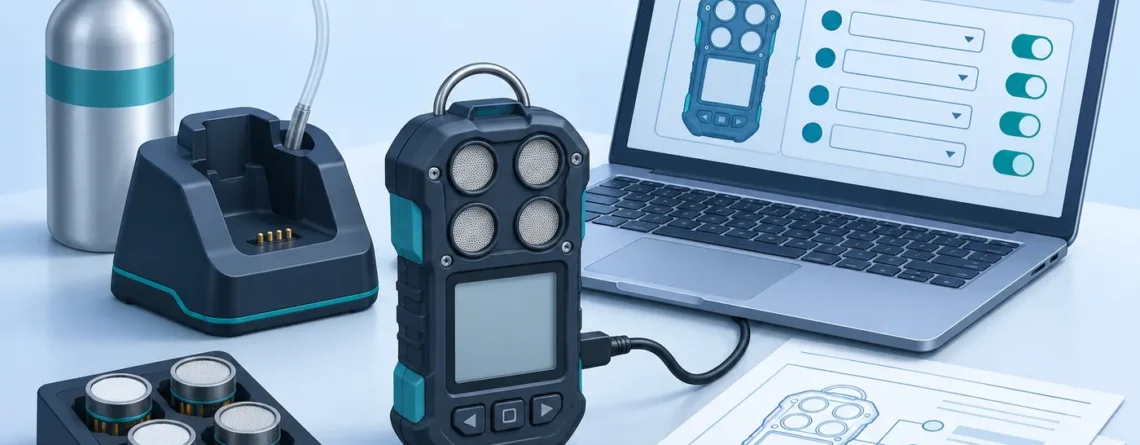
A multigas detector is correctly specified only when the installed sensors, firmware, enabled channels, gas selections, calibration basis, sampling accessories, and reported outputs all match the intended measurement task. A channel name on a brochure is the beginning of that check. It does not prove what a particular instrument measures, how it responds to other gases, or whether a receiving system interprets its output correctly.
The most useful review follows the data from gas reaching the inlet to a person interpreting an alarm or record. At every boundary, ask what identity, unit, configuration, or quality information could be lost. This approach catches errors that a simple list of channel names misses, including incompatible accessories, a changed response factor, a disabled measurement, and an export associated with the wrong serial number.
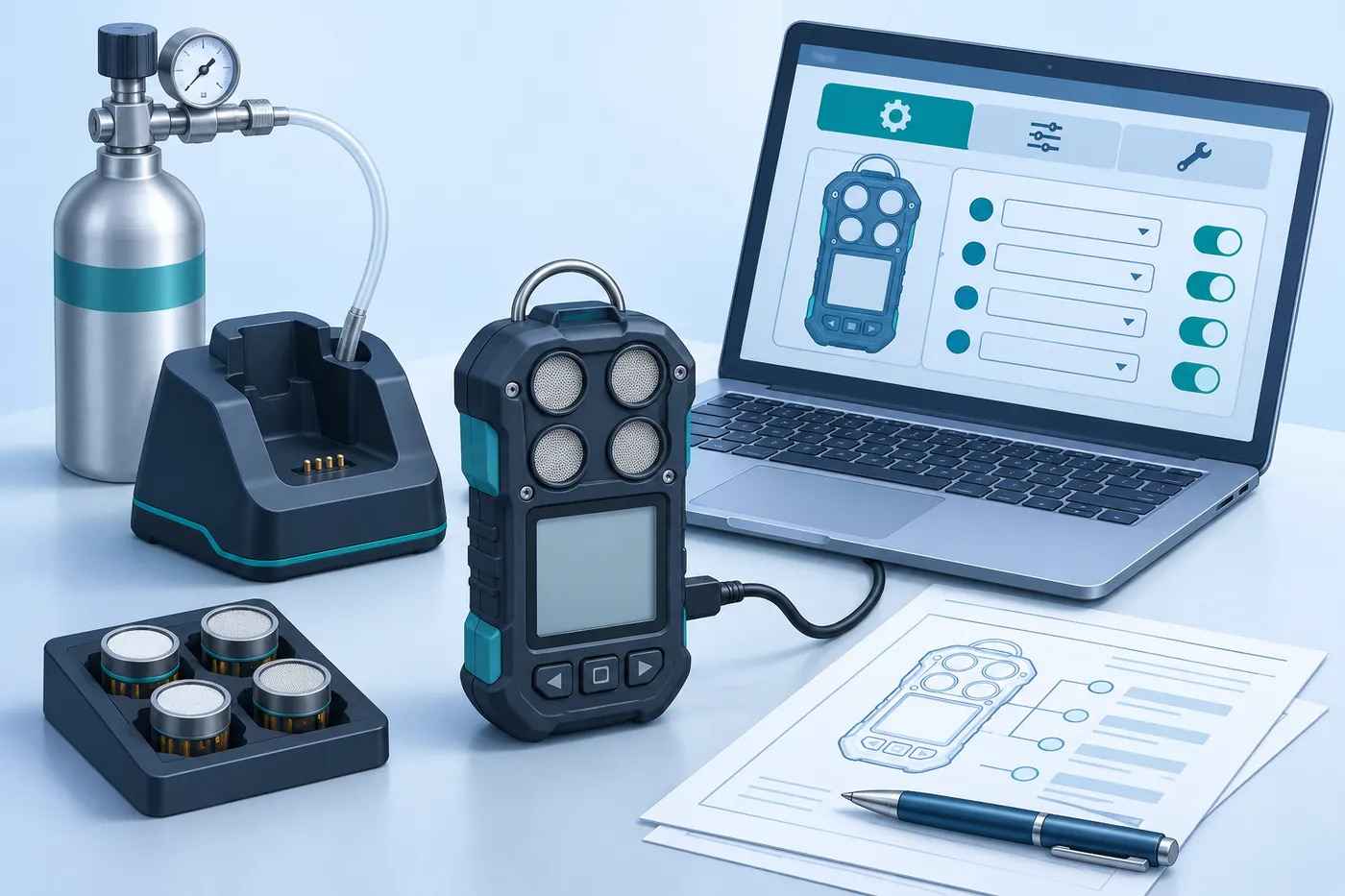
Begin with the delivered configuration
A product family may support several sensor combinations, ranges, and options. A quotation using the family name does not identify the delivered instrument. Request the complete orderable configuration, including the relevant sensor part numbers, option codes, sampling arrangement, firmware identity, and documentation revision. Where a supplier uses a shortened commercial description, require a cross-reference to the manufacturer's actual identifiers.
Separate three records: what the project requested, what the supplier offered, and what was delivered. These can differ without an obvious change to the enclosure. A substitution may preserve the number of displayed channels while changing technology, interference response, or supported accessories. The acceptance review should reconcile the records before interpreting any calibration or test certificate.
This is especially important for replacement instruments. “Same model” can conceal a changed sensor range or firmware feature. The owner should be able to determine whether the replacement remains within the approved application and whether configuration restoration is valid. Copying a file from an earlier instrument is not evidence of compatibility unless the manufacturer supports that process for both configurations.
Installed, enabled, displayed, and transmitted are different states
A sensor may be physically present while its channel is disabled. A channel may be active locally but absent from a remote display. A logging option may retain only some measurements. A transmitter output may represent a selected gas rather than every sensor in the enclosure. Treat these as separate questions.
For each required measurement, record the installed sensor, enabled state, local label, output assignment, and logging behavior. A configuration export is useful when it includes enough identity information to connect those fields to the actual instrument. A screenshot with no serial number or revision may document an example screen rather than the accepted unit.
The same distinction applies to alarms. A reading may be visible while a particular notification mode is disabled or configured differently. The review should identify which alarm functions are required by the project and what evidence will demonstrate their configuration. Do not assume a factory default fulfills the application's requirements. Conversely, avoid changing settings simply to make several instruments look alike without reviewing why their functions differ.
Firmware belongs in the evidence record
The official Dräger X-am 3500/8000 technical manual, whose opened document identifies Edition 11, provides a current manufacturer example of separate sensor slots, device status, configuration and device/sensor settings. Those distinctions support a structured evidence request; they do not make its settings applicable to another model or establish the suitability of any unreviewed accessory combination.
Firmware can affect available sensors, configuration fields, communications, diagnostics, and file compatibility. Record the installed version and the manufacturer's relevant release information where it affects the project. An assertion that the firmware is “latest” is difficult to audit and may be irrelevant to the approved configuration.
The useful question is whether that version supports the required hardware and functions, and whether any known restriction affects the intended use. A newer version is not automatically evidence that every existing accessory, integration, or configuration file remains suitable. The change process should identify which documents and acceptance checks need review after an update.
Avoid turning the article into an unauthorized firmware installation procedure. Updates should follow the exact manufacturer's instructions and the organization's authorization process. From a specification perspective, the necessary deliverable is traceability: the version before and after, the reason for change, relevant compatibility evidence, and confirmation that required configuration and outputs still agree with the approved baseline.
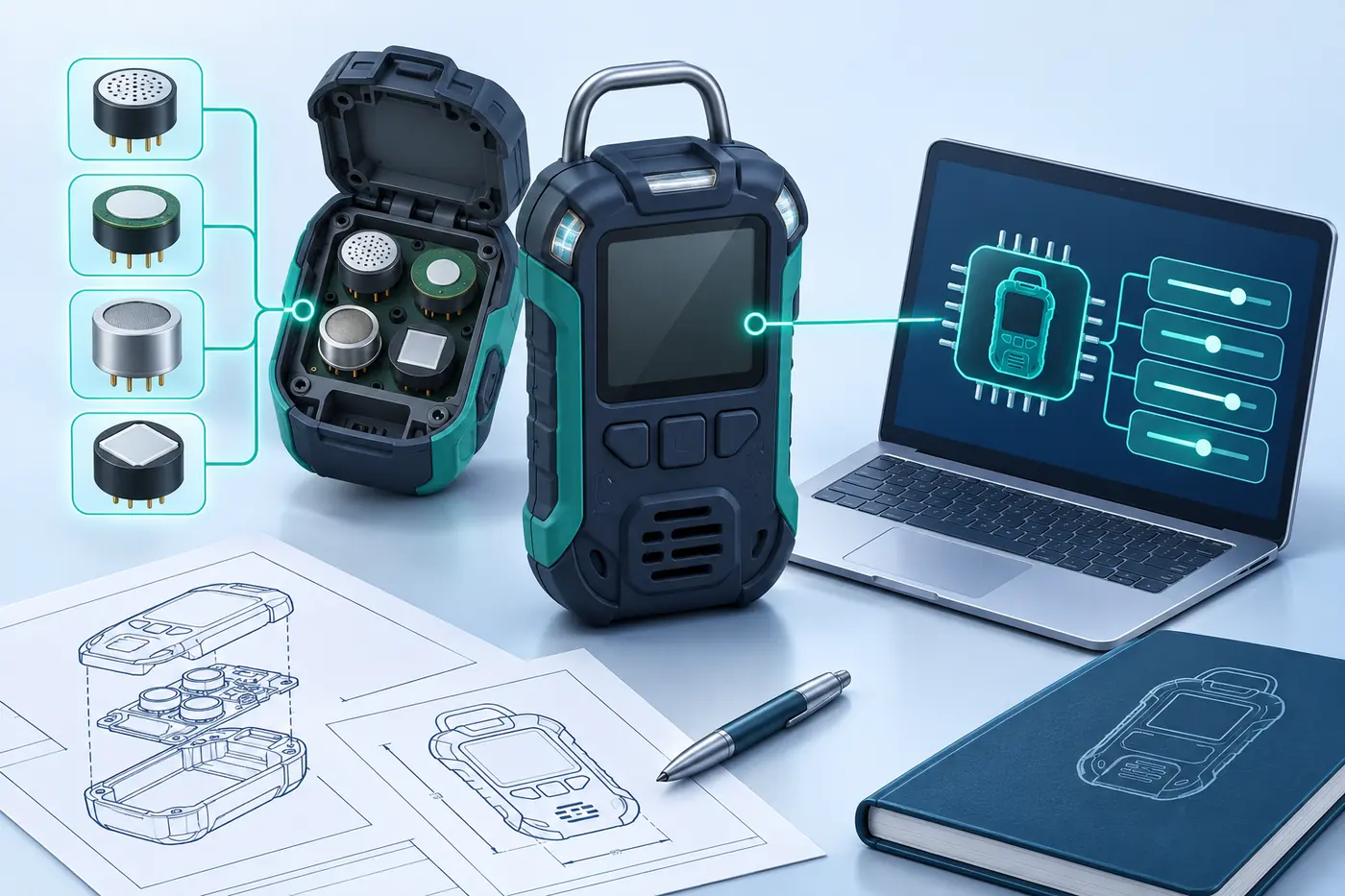
A gas name does not describe selectivity
A detector may respond to substances other than the gas printed beside its reading. The direction and magnitude of that response depend on sensor design and conditions. A multigas enclosure does not inherently separate a mixed atmosphere into independently identified chemical components. Several channels can react to the same release, while some substances may remain outside the supported measurement capability.
Request the manufacturer's interference or cross-response information for the exact sensor. Distinguish a measured response table from a broad sales claim such as “detects VOCs.” Look for the test gas, concentration, environmental conditions, sensor variant, and stated limitations. A blank table cell is not proof of zero response, and a response observed under one condition is not a universal conversion factor.
Where the expected atmosphere includes an interference, the responsible assessment needs to determine whether it could cause misleading indications, missed detection, or unnecessary alarms. Do not subtract an estimated interference from a safety reading using an improvised spreadsheet. First establish whether the manufacturer supports the proposed interpretation and whether the method addresses the actual mixture and uncertainties.
Response factors require a known basis
Some instruments use gas selections or response factors to express a response relative to a particular calibration gas. That can be a supported feature, but selecting a gas name does not make a nonspecific sensor chemically selective. The correct interpretation depends on the technology, calibration basis, target identity, and applicable manufacturer instructions.
A photoionization detector provides a useful example of the distinction. A supported response factor can help interpret a response to an identified substance under the manufacturer's stated conditions. It cannot identify an unknown mixture merely because the display lists a chemical name. The actual lamp and configuration also matter; a generic reference to “PID” leaves essential information unresolved.
An older MSA ALTAIR 5X PID manual, dated 2015, illustrates how gas selection, response factors, sensor options, and lamp settings form one configuration problem. It is a model-specific historical example, not the qualification basis for a currently supplied unit. Obtain the current instructions matched to the actual instrument before making any operational or acceptance decision.
Do not confuse calibration gas with every gas of interest
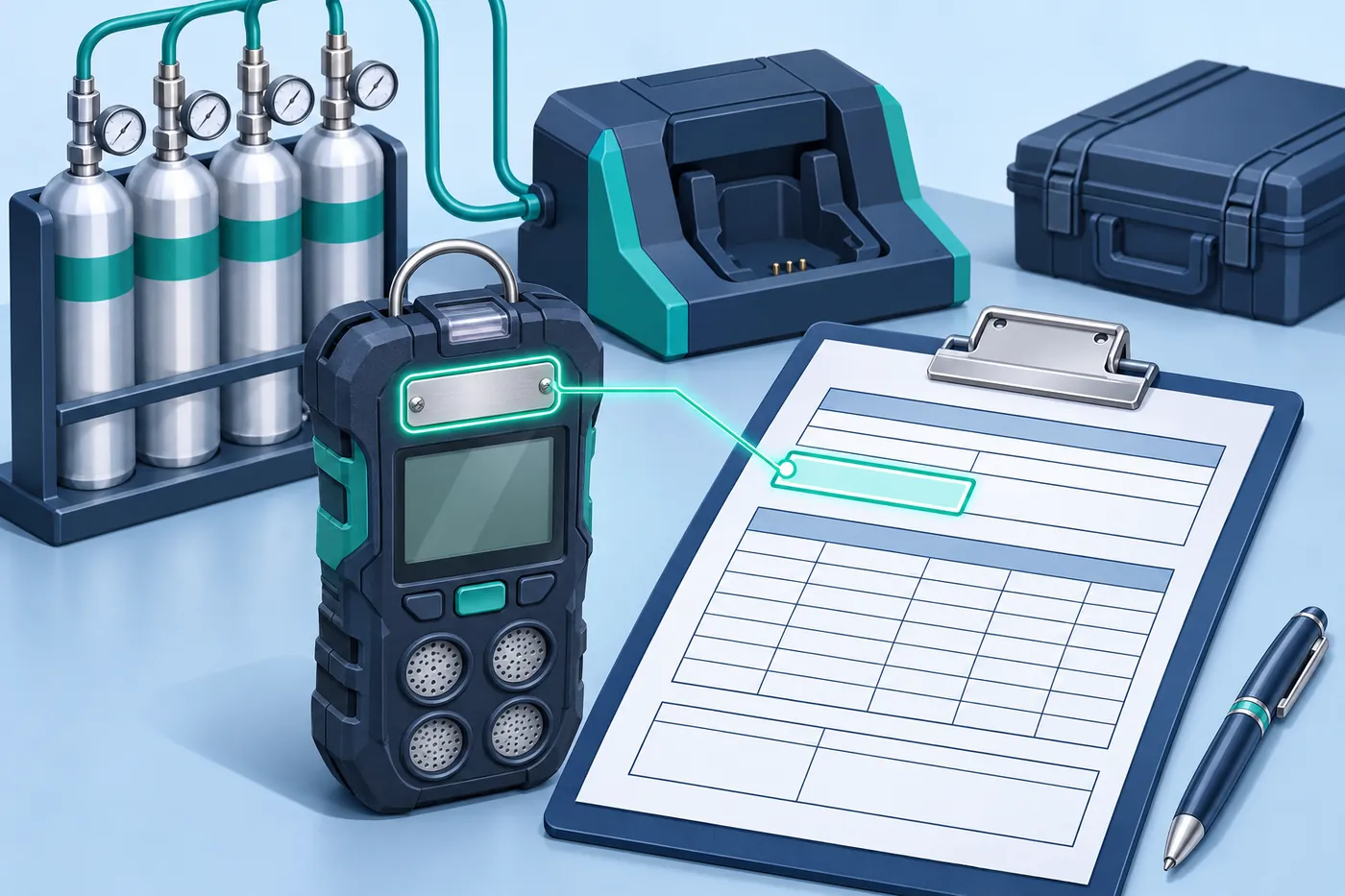
Calibration establishes a relationship using a known reference under specified conditions. It does not automatically establish accurate response to every gas that can stimulate the sensor. A certificate should identify the instrument, channels, reference gas or mixture, relevant concentration basis, date, result, and applicable procedure or acceptance criteria.
The reference-gas certificate and the instrument calibration record are related but different documents. One characterizes the supplied reference; the other records what was done to the instrument. A generic certificate for a gas cylinder does not prove that a specific detector was tested. A detector certificate that omits the reference identity leaves part of the evidence chain unresolved.
這 OSHA direct-reading monitor bulletin distinguishes a qualitative function check from checks of accuracy and calibration adjustment. It also emphasizes manufacturer instructions and suitable traceable test gas. The bulletin is advisory, not a regulation that creates a new universal schedule. Use its distinctions to describe the requested evidence precisely rather than calling every activity “calibration.”
Sampling accessories can change the measurement
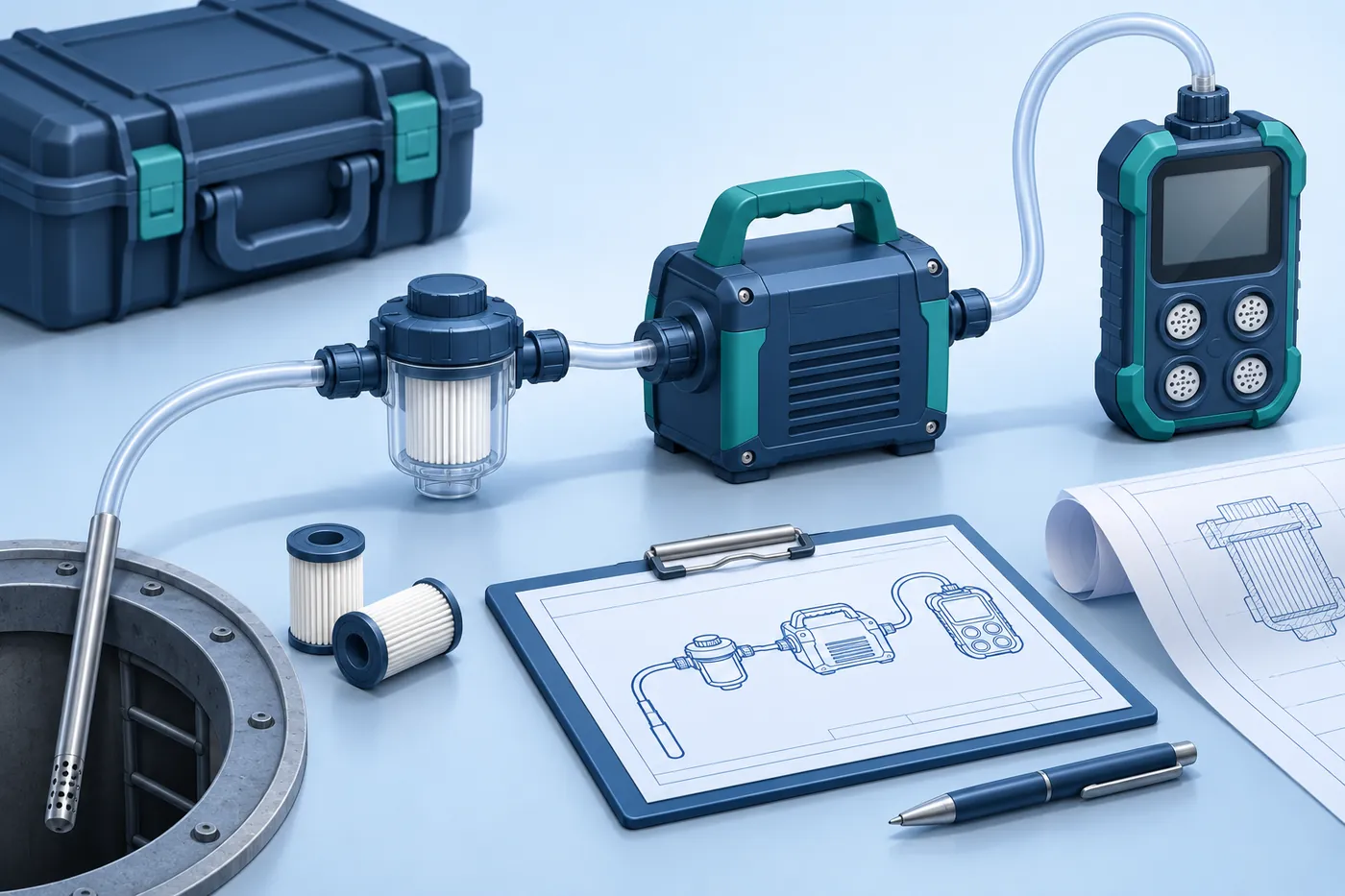
The instrument does not measure gas that never reaches the sensor. A sampling tube, filter, water barrier, regulator, probe, or pump can alter delivery, add delay, introduce leakage, or remove part of the substance of interest. Physical compatibility with an inlet is insufficient evidence of measurement compatibility.
Identify every accessory by part number and intended role. Confirm that the manufacturer supports the gas, material, dimensions, and arrangement. A filter that protects one application may interfere with another. A tube suitable for a relatively unreactive gas may behave differently with a gas that adsorbs or reacts on surfaces. Avoid extrapolating a single accessory recommendation across all channels.
這 HSE flammable-gas detector guidance discusses sample transport delay and sample-line material effects within its industrial flammable-gas scope. That supports treating the sampling route as part of the system; it does not supply universal tubing specifications for toxic-gas or CO2 instruments. Obtain the relevant manufacturer limits for the exact task, then document the installed sampling route so that later replacements can be reviewed against it.
Detector response time is not the full warning time
A sensor response specification usually describes a defined test arrangement and response criterion. A remote sampling system adds transport and other delays. A controller may apply filtering, averaging, scan timing, or alarm delays. Notification and communications add further dependencies. These terms should not be collapsed into one brochure number.
The design review should identify the timing objective and request evidence for the relevant installed path. This may require manufacturer information, configuration details, and project-specific assessment. It is not enough to compare nominal sensor response times if one proposal samples locally and another uses a long transport route or multiplexed points.
Record the conditions associated with each quoted time. A figure without the test gas, concentration change, response definition, sampling mode, and applicable environmental conditions is difficult to compare. Do not create a homemade waiting-time rule from tube length alone. The installed system must be assessed with the supported configuration and the actual response requirement in view.
Unit and range mistakes often appear downstream
The local instrument may show the right gas and unit while a receiving system applies the wrong scale. A configured analog output, digital register, or exported field can be interpreted as ppm, volume percent, or percent of a flammability reference. These quantities are not interchangeable. Even when a numerical conversion exists, its basis must be explicit.
Build an interface schedule containing channel identity, source parameter, engineering units, configured range, output assignment, valid-value handling, and fault representation. Review the schedule with the person responsible for the receiving system. A point name such as “gas sensor 1” is insufficient when the same installation contains several gases and different measurement bases.
For records, retain the timestamp basis and quality information. A stale last-good value may look plausible during communications loss. A blank field may mean no data, disabled channel, or an export error. The recipient needs documented rules to distinguish these states. A numerical trend without configuration context cannot prove what the instrument was measuring during the event being reviewed.
Configuration errors and evidence that exposes them
| Misunderstanding | 為什麼這很重要 | Evidence that resolves it |
|---|---|---|
| Family name identifies all installed sensors | Options can differ within one enclosure | Full order code and delivered sensor list |
| A visible gas label proves selectivity | Other substances may affect response | Exact sensor cross-response documentation |
| A selected gas name identifies a mixture | A factor may only change interpretation | Calibration basis, supported factor and known target |
| A fitting accessory is a suitable accessory | Sample delivery can change | Manufacturer-approved accessory configuration |
| A calibration certificate proves the whole system | Outputs and notifications may be outside its scope | Defined calibration scope plus installed-system evidence |
| A restored configuration file is automatically valid | Hardware and software may differ | Compatibility check and approved baseline reconciliation |
| A correct local value proves remote accuracy | Mapping and scaling can be wrong | End-to-end interface acceptance record |
| A zero value proves healthy operation | A fault or stale value may be represented badly | Documented diagnostics and data-quality handling |
The table is a way to organize review questions, not a declaration that a particular detector is suitable. Some equipment may not expose all the requested fields. In that case, identify the limitation and determine what other evidence supports the required function. Do not invent unavailable diagnostics in the acceptance plan.
Keep approvals tied to the actual assembly
An approval or certificate has a defined scope. It may address electrical equipment in a hazardous location, a measurement performance requirement, or another specific characteristic. A mark on an enclosure does not establish detection capability for every gas named in a catalogue. Nor does it automatically cover any sensor or accessory that can be installed inside it.
Request the certificate number, applicable model variants, restrictions, and relevant conditions. Confirm that the delivered assembly remains within that scope. A photograph of a mark is useful for identity, but the underlying certificate and instructions explain its meaning. Avoid describing an assembly as universally approved when the evidence concerns only a particular aspect or configuration.
The same principle applies after repair or substitution. A different battery, sensor, or accessory can require review even if basic operation appears unchanged. The manufacturer determines supported combinations; the project review determines whether the supported combination fulfills the intended application. Those are complementary questions, and neither should be replaced by an unsupported supplier assurance.
A hypothetical configuration handover problem
Imagine a facility receiving replacement portable multigas instruments. The purchase description lists the intended gases and a sampling kit. The supplier provides a general manual, a batch test statement, and a configuration screenshot. During document reconciliation, the owner finds that the screenshot lacks serial identity and the sampling tube part number differs from the accepted submittal.
No hazardous test is needed to establish that the paperwork is incomplete. The owner asks the supplier to connect each delivered serial number to its installed sensors, software version, approved accessory list, and actual configuration record. The manufacturer is asked to clarify the substituted tubing's suitability for the intended gases. These are evidence requests, not assumptions that a physical mismatch necessarily proves a performance failure.
Next, the owner discovers that the data export uses a generic channel label. The receiving software's import mapping is therefore reviewed against the actual channel identifiers and units. Acceptance remains tied to the approved criteria and resolved exceptions. This hypothetical example shows why a tidy certificate folder may still lack the links needed to establish what the instruments and records represent.
Preserve the baseline after acceptance
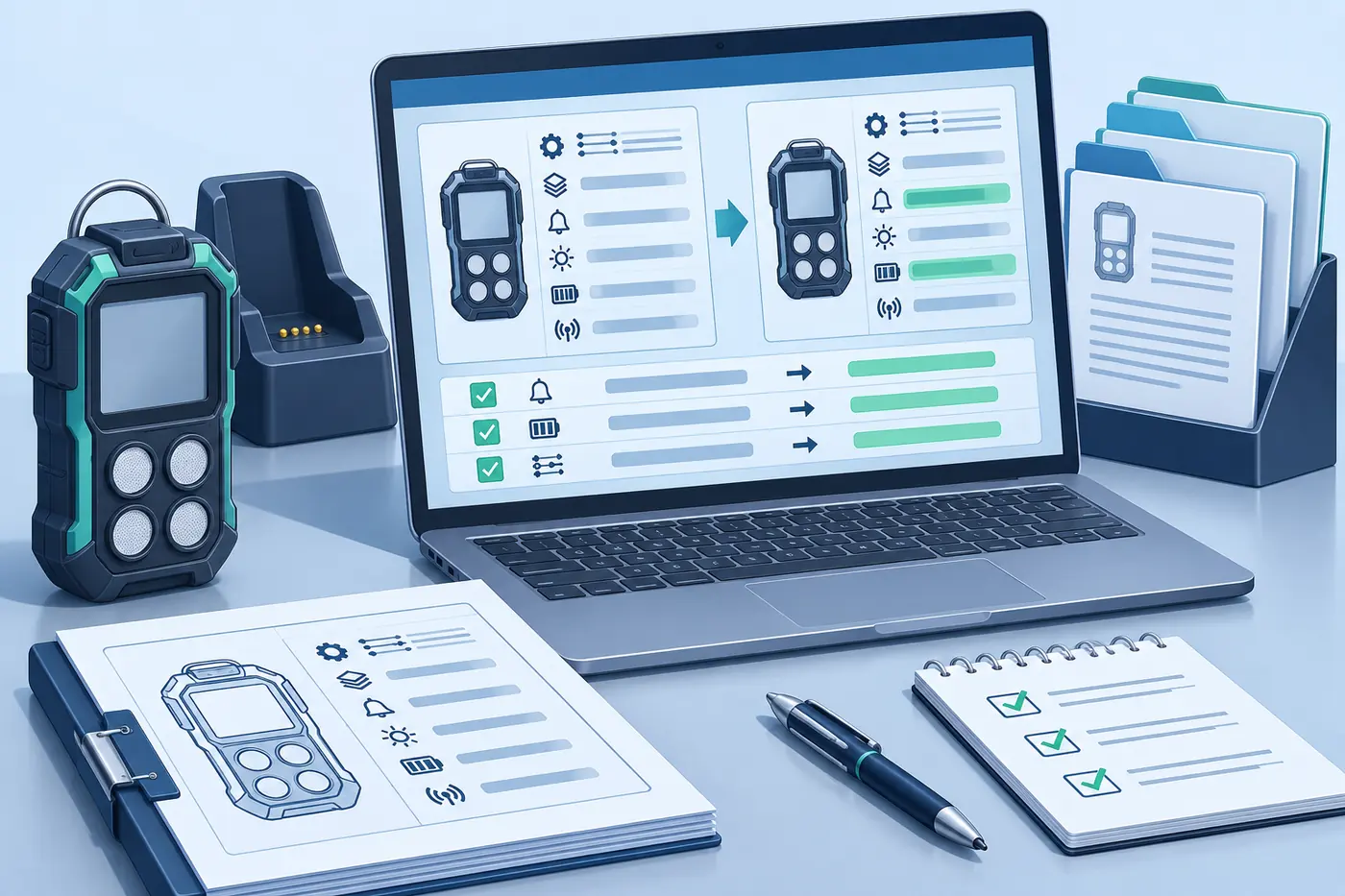
The baseline should describe the accepted hardware, software, sensors, sampling components, channel settings, alarm functions, outputs, and relevant documents. Store it where the people responsible for service and integration can retrieve it. A file kept only in the original salesperson's email is a fragile operational dependency.
Changes should identify both the technical difference and its consequences. Replacing a sensor with an identical supported part may have a different review scope from changing its range or technology. A firmware update may affect an export format even when the local display looks familiar. Moving a sampled point changes the installed path even if the detector itself is untouched.
After a change, reconcile the relevant evidence instead of merely preserving the old acceptance label. The record should show which requirements remained applicable, which documents changed, what verification was required, and who authorized return to the intended role. This makes future troubleshooting more efficient because the investigator can distinguish a genuine change in atmosphere from a change in how the system measures or reports it.
Questions to ask when the reading looks wrong
First establish whether the disagreement is about the same gas, unit, location, time, and configuration. Two instruments may be doing different jobs even when their displays use similar language. One may report a direct concentration, another a response expressed relative to a calibration gas. A remote value may be averaged or delayed relative to the local screen.
Then review recent changes: sensor replacement, software updates, new gas selections, accessories, calibration records, export settings, or changes to the process atmosphere. These records help define the investigation; they do not authorize continued use of an instrument whose fitness is uncertain. Follow the organization's arrangements and the manufacturer's instructions for an instrument suspected of malfunction.
Avoid resolving a discrepancy by adjusting settings until two numbers agree. Agreement can be manufactured by an incorrect scale or response factor. The useful outcome is an explained relationship between the intended measurement, supported configuration, and available evidence. Where the relationship cannot be established, document the uncertainty and obtain the necessary manufacturer or engineering clarification.
Compare configuration exports as structured evidence
A configuration export is most useful when it records both settings and identity. Preserve the instrument serial number, model variant, software version, export date, and the tool used to obtain it. Where the file format omits one of those fields, connect it to a controlled accompanying record. Avoid renaming an anonymous file with a serial number and treating the filename alone as proof of origin.
For a comparison, distinguish deliberate differences from unintended ones. Two instruments used for different tasks may correctly have different channels, output mappings or alarm functions. The reviewer should compare each against its own approved duty before comparing the instruments with each other. Standardizing every field across a fleet can erase application-specific decisions that were intentional.
Use a readable change summary for material settings. A raw file difference may include ordering, timestamps or software-generated metadata that do not change the function. Conversely, a single changed gas selection or scaling field may have a large interpretation consequence. The record should explain which differences affect measurement, notification, logging, compatibility or service, and which are administrative.
Retain the accepted export with its supporting records after changes. If a later investigation relies on a trend, the investigator needs to know which configuration applied at that time. Overwriting the only stored export with the latest version loses that context. Version history does not need to be elaborate, but it should connect an effective configuration to the relevant instruments and dates without ambiguity.
Include the calibration station and receiving software in the review
A fleet may depend on a docking or test station, configuration application, cloud portal, or local data-management system. These are part of the evidence chain when they set parameters, select gas references, assign instruments, or generate records. A station's successful communication with an instrument does not by itself establish that every expected channel was tested or that the correct configuration was applied.
Identify the supported combinations and relevant software versions. Check how the station identifies the instrument and how its records identify channels and outcomes. If the fleet contains several sensor configurations, the process should avoid applying one instrument's assumptions to another. The supplier should explain supported workflows and known limitations rather than relying on the appearance of a green completion indicator.
Record generation and record interpretation are separate responsibilities. A generated report may contain a summary result without explaining excluded channels, disabled functions or unavailable data. The owner should understand the fields and retain enough detail to establish what occurred. If a report is imported into another system, verify that identifiers, units and result states survive that transfer. A successful import is not evidence that the imported fields retain their original meanings.
Access control also affects configuration integrity. The organization should know which authorized roles can change material settings and how those changes are documented. This is not an argument for a particular password policy; it is a requirement to make the accepted baseline maintainable. A configuration protected from all maintenance can become as difficult to sustain as one that anyone can alter without a record.
For service outsourcing, define what the service provider returns. The instrument may come back with a new sensor, updated software, reset preferences or a revised certificate. Ask for the changes and resulting configuration, then reconcile them with the intended duty. A service label establishes neither that the old baseline was preserved nor that a changed baseline has been accepted. The completed review should connect the returned instrument to the owner's actual application.
How should a configuration exception be recorded?
Describe the difference in terms of the intended function. A statement that the delivered sensor is different from the order code is a useful start, but the record also needs to identify whether its range, supported gas response, accessory compatibility or qualifications change. Obtain evidence for those consequences rather than assuming that a different part number is either harmless or unacceptable.
Identify the affected records. A changed sensor may require a revised equipment list, configuration export, calibration record, output mapping or manual. If only the purchase description changes while the controller schedule retains the old range, the documentation can remain inconsistent after the commercial issue is closed. The exception process should connect the disposition to every material downstream dependency.
State the acceptance basis and the responsible reviewer. A supplier can explain the supported configuration, while the project's responsible party determines whether that configuration fulfills the intended duty. Preserve both parts when they are necessary. A brief email saying “equivalent” without an identified technical basis is difficult to use during a later service or incident review.
After resolution, retain the old and new identities with the effective configuration record. That allows the owner to interpret older logs and avoid restoring an obsolete file after future maintenance. The objective is not to collect a signature for every administrative difference; it is to preserve enough information that someone can establish what the instrument measured, how it reported it, and which evidence supports that conclusion.
常見問題
Does multigas mean the instrument can identify any gas mixture?
No. It has defined sensors and response limitations. Multiple channels can provide useful information, but they do not make every mixture chemically identifiable. Determine the required substances and measurement purpose before interpreting a collection of readings.
Can I reuse a configuration from an identical-looking device?
Only a supported compatibility process can establish that. Compare actual hardware, sensors, ranges, software, and options. A successful file transfer proves transfer, not suitability. The resulting configuration still needs reconciliation with the approved application and records.
Is calibration enough to prove the sampling kit works?
It depends on the calibration procedure's scope. A check performed directly at the instrument may leave the installed sample route untested. Define what the record demonstrates and request separate evidence where the application depends on accessories or a remote path.
Why does a historical manual appear in this discussion?
It provides a concrete example of configuration dependencies, not current qualification. The official MSA documentation entry for operation leads into the manufacturer's documentation environment. The exact currently supplied configuration needs its own applicable instructions and version check.
How does this differ from choosing the gases in a four-gas monitor?
Channel selection asks which hazards need measurement. Configuration control asks whether the ordered, delivered, enabled, sampled, calibrated, transmitted, and recorded measurements remain the same intended functions. Both reviews are necessary, but they resolve different failure modes.




發表評論