

To verify a gas sensor quantitatively, retain documentation that identifies the actual reference mixture, its assigned concentration and units, balance gas, uncertainty, traceability, validity conditions and compatibility with the intended instrument method. Match the cylinder or source identifier to the certificate, and link that evidence to the verification record. A label saying “calibration gas” or a nominal concentration on a purchase order is not enough to establish the value that reached the sensor.

A gas-source certificate and a safety document serve different purposes.
The documentation has two jobs. It establishes what the supplier assigned to the gas under stated conditions, and it helps the user determine whether that reference is appropriate for the measurement. It does not establish the performance of an improvised delivery arrangement. This article is a document-review and measurement-basis guide; actual gas handling, equipment selection and verification follow the gas supplier's and instrument manufacturer's approved methods.
Which document answers which question?
A gas order, cylinder label, certificate of analysis, safety data sheet and instrument service certificate describe different things. They may repeat some identifiers, but their roles should not be merged. A safety document addresses hazards and handling information. A concentration certificate assigns or reports composition. A detector service certificate describes a particular instrument comparison or service event. None automatically replaces the others.
| Document | Main question it answers | What to cross-check |
|---|---|---|
| Purchase specification | What mixture and documentation were requested? | Target component, range, balance, uncertainty and intended method |
| Cylinder or source label | Which physical source is present? | Identifier, mixture, dates and supplier |
| Certificate of analysis or reference-material certificate | What values and qualifications are assigned? | Actual values, units, uncertainty, traceability and conditions |
| Safety data sheet | What hazards and handling information apply? | Product identity and current supplied formulation |
| Supplier application instructions | Under what conditions is the reference valid? | Storage, stability, pressure limits and compatible equipment |
| Instrument procedure | Is this reference suitable for this device? | Target, matrix, allowed concentration and approved accessories |
| Verification record | What happened during this comparison? | Source ID, readings, conditions, method and decision |
A certificate file with the right gas name but the wrong cylinder number is not a minor clerical issue. It breaks the link between the assigned value and the source used. A supplier may certify a batch rather than every cylinder individually; that can be appropriate, but the record must explain the relationship. Do not infer it from similar packaging or consecutive invoice lines.
For digital records, preserve the certificate as a controlled attachment rather than only a hyperlink that may later change. Record its issue date and revision if supplied. If the supplier replaces the certificate, retain the original and the reason for the revision. The historical verification should remain reconstructable even after the supplier portal or inventory system changes.
Is the printed concentration nominal or assigned?
A nominal value describes the requested or labeled mixture category. An assigned value is the value supported by the certificate under its stated method and conditions. They can differ. For example, a source ordered as nominally 1000 ppm may have a certificate value slightly above or below that number. Use the value required by the applicable verification procedure and preserve the certificate value in the record.
Read the wording carefully. A manufacturing tolerance, analytical tolerance, certified uncertainty and acceptance band are not interchangeable. A preparation tolerance describes how close the produced mixture is allowed to be to its target. A measurement uncertainty describes information about the assigned value. An instrument acceptance band describes an allowed result under a decision rule. Using one as another can create a false pass or fail.
NIST's work on value assignment and uncertainty evaluation for certified reference gas mixtures illustrates that gas-reference values are supported by analytical comparisons and uncertainty evaluation. The practical implication for a user is to retain the assigned value and its uncertainty statement, rather than reducing the certificate to a nominal cylinder label.
A source described as suitable for a functional response test may not provide the documentation needed for a tighter quantitative verification. Coregas's gas-detector calibration-gas page distinguishes applications and documentation options. Select the documentation from the measurement requirement. Paying for a more elaborate certificate does not make an incompatible mixture suitable, while a basic functional-test supply should not silently support a precision claim beyond its documentation.

A source identifier connects the physical gas supply with its assigned value.
What exactly do ppm and percent refer to?
For gas mixtures, a certificate may express composition as amount fraction, commonly in mol/mol, µmol/mol or a corresponding percentage. One µmol/mol is one part per million on an amount-fraction basis. The record should preserve the supplier's actual quantity and unit, including any stated relationship to a volume fraction. A bare number without its basis is incomplete.
Mass concentration is a different quantity. Converting a gas amount fraction to mg/m³ requires appropriate physical assumptions and, typically, molecular mass, temperature and pressure conditions. A report using standard or normal cubic metres must identify its reference conditions. Two documents can display the same numerical concentration while describing different quantities, so matching the printed digits is not sufficient.
Percent of lower explosive limit is another separate scale. Its relationship to a gas amount fraction depends on the target gas, adopted LEL value and instrument configuration. A certificate stating methane amount fraction should not be rewritten as a universal %LEL value without documenting the relevant conversion and model requirements. The same caution applies to surrogate gases and correction factors.
In the inventory record, use separate fields for component, assigned value, unit and basis. Avoid a single free-text field such as “50 gas.” That shorthand might mean 50 ppm, 50%LEL or half of a bottle's capacity to different readers. Explicit fields are especially valuable when records move between purchasing, maintenance and laboratory teams.
Why is the balance gas part of the reference?
The balance gas is the remainder of the mixture after the listed components. It can affect the sensor response, the physical measurement or the chemical stability of the mixture. Nitrogen, air and another carrier are not automatically equivalent simply because the target component has the same nominal concentration. The instrument's approved procedure determines which matrix is appropriate.
For some sensing principles, oxygen availability or background composition matters. Optical measurements can also have model-specific background-gas compensation. A mixture intended for one detector technology may be unsuitable for another. The document review should therefore connect the certificate matrix to the exact sensor or monitor method, rather than checking only the target gas name.
The Coregas page provides a concrete supplier example: common detector mixtures can use nitrogen or air balances, but nitric oxide has a stated reactivity reason for its nitrogen balance. That illustrates why composition is a chemical specification, not merely a purchasing preference. It should not be generalized into a complete compatibility table for every gas, cylinder material or detector.
Multicomponent mixtures require every relevant component to remain visible in the record. A mixture used for several channels may contain an oxygen level and combustible or toxic components with different functions in the test. A cross-sensitive sensor can respond to more than the intended component. Record the full stated mixture and the manufacturer's allowance for using it; do not extract one number and assume the rest is irrelevant.
How do dry and wet concentration bases differ?
A dry-basis concentration excludes water vapor from the denominator. A wet-basis concentration includes it. If water is added without removing the target gas, the target fraction of the total wet mixture becomes smaller. This is a basis effect, separate from any direct humidity influence on the sensor. A sensor can have both effects at once.
For a conceptual amount-fraction conversion, let x be the water-vapor fraction in the wet gas. Then Cwet = Cdry × (1 − x), and Cdry = Cwet/(1 − x). The equations assume the target amount is preserved and the relevant quantities share a consistent basis. They do not describe a method for making a reference mixture or account for dissolution, adsorption or chemical reaction during conditioning.
Checked hypothetical example: a dry-basis value of 1000 µmol/mol with a wet-gas water fraction of 0.020 gives 1000 × 0.980 = 980 µmol/mol on the wet basis. Conversely, 980/0.980 = 1000 µmol/mol dry. The 20 µmol/mol difference is 2% of the dry value. These invented values demonstrate denominator arithmetic; they are not a correction prescribed for a particular instrument.
Relative humidity is not the same as water-vapor amount fraction. The relationship depends on temperature and pressure, among other relevant definitions. Do not insert “50%RH” as x = 0.50 in the equation. That would confuse a saturation-related humidity quantity with the fraction of water molecules in the gas. Record the actual humidity quantity and conversion basis used by the approved method.

Background composition belongs in the mixture identity, even when target concentrations match.
What should the uncertainty statement include?
A useful uncertainty statement identifies the quantity, value, units and meaning of the interval. If it is an expanded uncertainty, retain the coverage factor and any coverage information stated by the supplier. Do not assume every plus/minus statement has the same statistical meaning. If the certificate gives only a tolerance or compliance statement, preserve that wording rather than relabeling it as a standard uncertainty.
NIST Technical Note 1297 explains standard and expanded uncertainty and the role of a coverage factor. For a certificate that explicitly states expanded uncertainty U = 10 ppm with k = 2, the corresponding standard uncertainty contribution is 5 ppm under that stated convention. This division is not valid merely because a document contains “±10”; the certificate must establish what that interval represents.
A reference uncertainty is one contribution to a comparison, not the entire verification uncertainty. The delivered sample, instrument repeatability, resolution, environmental conditions, timing and any conversion can also matter. A small certified uncertainty does not eliminate a poorly characterized sampling arrangement. Conversely, a well-documented application may not require the smallest uncertainty commercially available if the decision margin is much larger.
For planning, list contributions and their sources before combining them. Contributions are not always independent, and some are limits rather than standard uncertainties. A competent uncertainty evaluation chooses appropriate distributions and dependence assumptions. This article's examples illustrate document interpretation; they should not be copied as a complete uncertainty budget for a gas-detection service.
What does traceability establish, and what does it leave open?
Metrological traceability links a measurement result to a reference through a documented chain of calibrations, each contributing uncertainty. NIST's traceability guidance emphasizes that traceability alone does not guarantee fitness for a particular purpose. A reference can have an excellent documented chain and still have an uncertainty too large for a very tight decision.
Look for the actual chain or stated reference system, certificate identifiers and uncertainty information appropriate to the supplied reference. A generic “traceable” logo is less informative than a certificate that identifies what was assigned and how. Accreditation can support confidence within its defined scope, but the accredited organization's name does not expand the gas mixture's concentration range, validity period or application compatibility.
NOAA's Central Calibration Laboratory uncertainty information is a useful example of a clearly defined atmospheric-gas calibration context. It describes assigned values, uncertainty and calibration episodes in relation to its scales. Do not assume an atmospheric scale assignment is identical to every industrial reference requirement; retain the scale name and version when the application relies on them.
Avoid statements that a sensor is “NIST approved” because it was compared using a traceable gas. The chain supports the reference value and the resulting measurement under its conditions. It does not establish an endorsement, a complete instrument certification or correct performance after every future maintenance event.
Which dates and validity conditions matter?
Separate manufacture or filling date, analysis date, certificate issue date, validity or expiry date, and any cylinder inspection date. These dates answer different questions. A new PDF issue date does not necessarily mean a new gas analysis. A physical cylinder's inspection status does not establish the current validity of its assigned mixture concentration.
Reference validity can depend on storage, remaining pressure, temperature and other supplier conditions. Record the conditions that apply to the actual source. A cylinder that has passed its concentration certification period should not be treated as a valid quantitative reference merely because gas remains inside. A damaged, contaminated or improperly stored source may also be unsuitable before its printed expiry date.
Measurement Canada's G-23 requirements provide a formal example of documenting composition, certificates, uncertainty and traceability for natural-gas-mixture test data in that program. Its specific certificate requirements belong to that defined scope. They are useful evidence of the importance of document completeness, not a universal expiry rule for all sensor reference gases.
If a supplier recertifies or reassigns a source, preserve the new evidence and its effective scope. Do not extend a date locally without an approved basis. A procurement delay is not metrological evidence of mixture stability. The inventory system should distinguish “available physically” from “released as a valid reference for this task.”
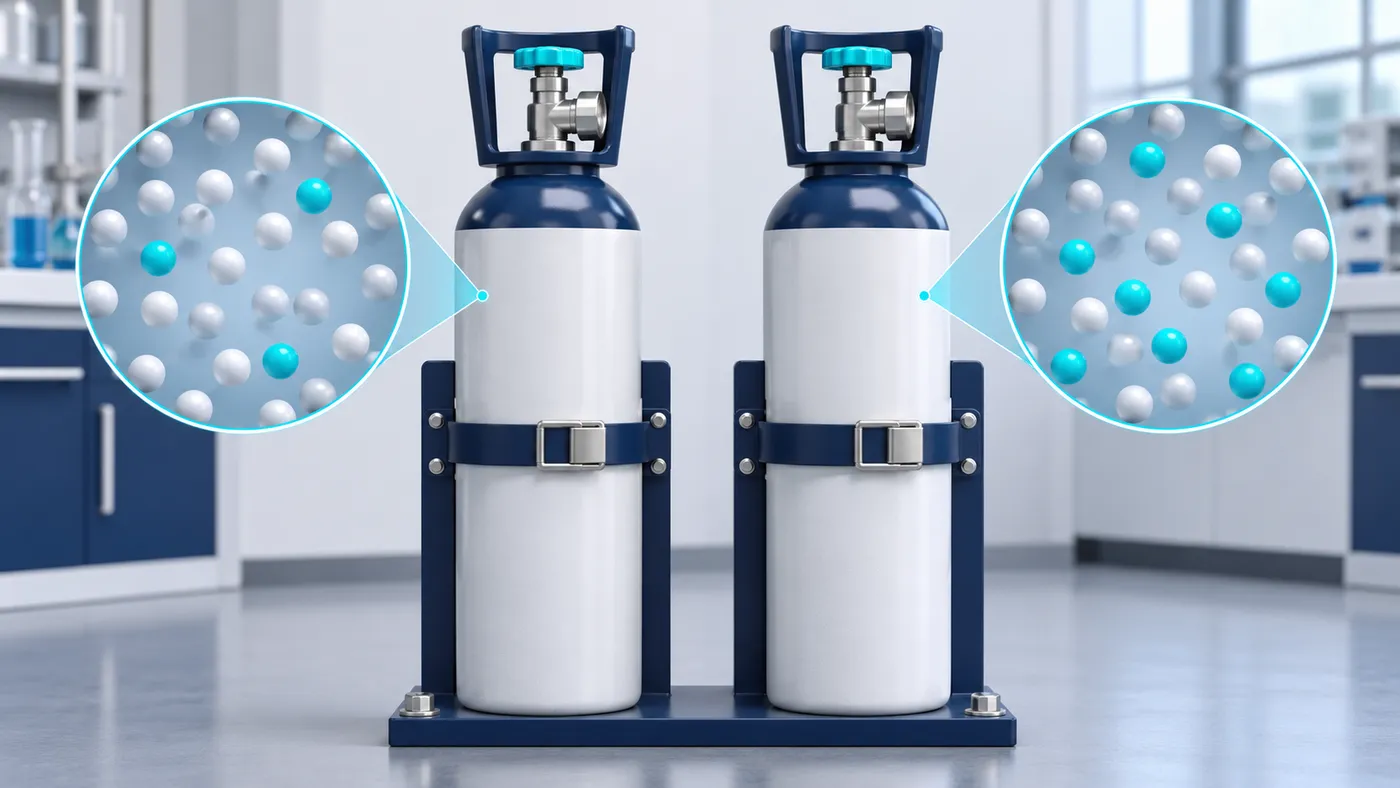
Dry and humid gas have different denominators; the molecular illustration is qualitative.
How do you check compatibility without designing a gas setup?
Document compatibility at three levels: the reference mixture, the instrument method and the approved delivery equipment. The gas supplier addresses mixture stability and materials suitable for the source. The instrument manufacturer addresses target gas, matrix, allowed concentration, accessories and method. The service procedure connects those requirements for the actual comparison.
Record the approved regulator, adapter, sample path or other equipment identifiers where the method requires them. This is a traceability task, not an instruction to assemble a new system. Substituting a convenient hose or regulator can affect purity, response or safety. A certificate for gas inside a source does not automatically certify the gas composition at an instrument inlet after arbitrary components.
這 OSHA bulletin on calibrating and testing direct-reading monitors emphasizes following manufacturer instructions and maintaining appropriate test records. Its direct-reading-monitor context is distinct from laboratory reference-material certification. Together, the two forms of documentation answer different questions: whether the source is supported and whether the monitor was evaluated appropriately.
A compatibility review should have an explicit unresolved status. For example, “certificate acceptable; balance-gas suitability awaiting model confirmation” is more precise than either passing the entire source or rejecting a good certificate. Keep the source out of the quantitative verification workflow until the relevant method question is resolved by an authoritative instruction or competent approved review.
What does a complete document-review worksheet look like?
Use one record for each physical source or clearly identified certified batch, with a separate use log for each verification event. This prevents repeated transcription and makes it possible to locate all instrument checks affected by a later certificate correction. A source inventory and an instrument service history should be linked, not collapsed into one unstructured file.
| Field group | Required information | Release question |
|---|---|---|
| 身分 | Supplier, product, cylinder/source ID, batch and certificate ID | Does the certificate match the source? |
| Composition | Every stated component, assigned value, unit and balance | Is the full mixture appropriate? |
| Basis | Amount/mass/volume definition, dry/wet and reference conditions | Will the compared readings use the same quantity? |
| Uncertainty | Interval type, value, units, k and stated coverage | Can the reference support the intended decision? |
| Traceability | Named references, scale or chain and supporting evidence | Is the claim documented and relevant? |
| Validity | Relevant dates and supplier conditions | Is the reference currently valid for use? |
| 相容性 | Exact device method and approved equipment | Is the delivered reference method supported? |
| 控制 | Reviewer, release status, attachments and revision | Can another reviewer reconstruct the decision? |
Leave a comment field for exceptions rather than forcing every source into a pass/fail cell. A missing certificate attachment, unreadable identifier and incompatible balance gas need different corrective actions. The release status should identify whether the source is accepted for quantitative verification, accepted only for a stated functional test, or held pending clarification. These categories are examples to adapt to the organization's actual quality system.
How should the reference connect to the final sensor result?
The instrument verification record should identify the source used at each point, the reference value adopted, relevant conditions, instrument readings and the decision rule. Keep the certificate value distinct from the value entered into the instrument during an authorized adjustment. If the instrument accepts only a rounded entry, preserve both the entered value and the original certificate value so that the rounding remains visible.
Hypothetical document check: cylinder CG-014 has an assigned value of 1002 ppm, expanded uncertainty 10 ppm with k = 2, and a stated valid period that includes the service date. The monitor reads 1020 ppm before intervention. Its indicated difference from the assigned value is 1020 − 1002 = +18 ppm. Comparing with a nominal label of 1000 ppm would instead give +20 ppm. The two-ppm discrepancy comes from choosing the wrong reference value, not a change in monitor behavior.
That calculation does not establish pass or fail. Acceptance needs the relevant tolerance, uncertainty evaluation and decision rule. If the certificate and procedure support the comparison but the result is too close to a boundary, a review may be needed rather than silently ignoring uncertainty. Record the chosen decision basis before using the result to support an accuracy statement.
A later certificate revision should trigger a defined review of affected uses. The source ID and use log make that possible. Without them, a team may know that a reference value changed but be unable to identify which monitors were checked with it. Good documentation is therefore part of ongoing measurement control, not simply paperwork collected at receipt.

Validity depends on the source documentation and its stated conditions, not merely gas remaining in the cylinder.
How should purchasing hand over a reference to maintenance?
A useful handover starts before the source arrives. The purchase specification should identify the intended instrument method, full required composition, concentration basis and documentation needs. It should distinguish a quantitative reference requirement from a functional-test supply. Maintenance can then confirm the method rather than discovering after delivery that the selected balance gas or concentration is unsuitable.
At receipt, compare physical identification, order and certificate. Record any difference in component value, unit, validity or supplied documentation. A small difference between a nominal ordered value and an assigned value may be entirely normal, while a different balance gas may require a substantive compatibility review. Treat the type of difference explicitly; do not reject or accept everything through a single “matches order” checkbox.
Release the source into the approved inventory only after the document questions are resolved. The release record should identify the intended uses and any limitations. A source accepted for one device method should not automatically become a general reference for every monitor at the site. Shared inventory is helpful only when suitability remains linked to the actual application.
During use, link each verification event to the source ID and exact certificate. Where the approved method requires observations about source condition or remaining pressure, retain them with the event. Record a suspected contamination, damaged identifier or questionable storage history promptly so the source can be reviewed before another instrument comparison depends on it.
At retirement or replacement, preserve the use history and certificate attachments. Removing a cylinder from the store does not remove the evidential role of its earlier assigned value. A later investigation may need to find every comparison performed with that source. The handover process is complete when purchasing, reference inventory and instrument service records can follow the same identifier without guessing from a gas name or invoice date.
What should you do when certificate details disagree?
Hold the source for the affected quantitative use and identify the exact discrepancy. A mismatched cylinder ID, missing uncertainty statement and unexplained unit change are different issues. Ask the supplier for a controlled clarification or replacement document that identifies the affected source and the reason for correction. Preserve both versions and the communication reference in the inventory record.
Do not edit the supplier's certificate to make it agree with the inventory. Correct the inventory through its own change process when appropriate, keeping the original evidence visible. If the source has already been used, identify the linked verification events and assess whether the discrepancy changes their interpretation. A corrected spelling may have no technical effect; a reassigned concentration can require a substantive review.
常見問題
Is a safety data sheet a concentration certificate?
No. It provides hazard and handling information for the product. A quantitative reference needs the appropriate composition and value-assignment documentation. Retain both where relevant and match their product identities.
Can I use the nominal label value instead of the certificate value?
Use the value and method specified by the applicable procedure, and retain the assigned certificate value. Do not substitute nominal and assigned values silently. The difference may matter for a tight verification or an entered adjustment value.
Does nitrogen balance always work for a gas sensor?
No. Suitability depends on the sensor principle, target gas, instrument configuration and approved method. A target concentration alone does not establish compatibility. Confirm the full mixture against the exact device instructions.
Does an unexpired certificate guarantee good reference gas at the inlet?
No. Validity also depends on supplier conditions and correct use. The certificate describes the supported source, while delivery components and sample conditioning can affect what reaches the instrument. Both parts of the measurement chain need documentation.
Can I correct wet and dry basis using relative humidity directly?
Not by substituting the RH percentage as the water fraction. The conversion requires an appropriate water-vapor fraction or a justified conversion from the measured humidity quantity using relevant conditions. Preserve the basis and calculation in the record.
What is the most useful identifier to put on the verification form?
The actual source or cylinder ID linked to the exact certificate revision, along with the adopted concentration, unit and basis. That link lets a later reviewer recover the reference evidence and locate other checks affected by the same source.







發表評論