
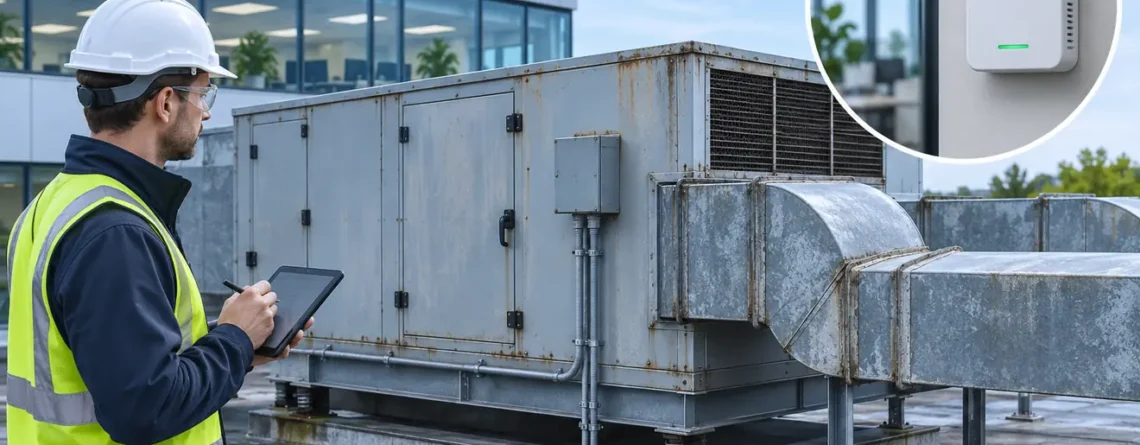
Add CO₂ monitoring to an existing HVAC system in stages. First map the actual outdoor-air path and choose representative spaces. Install and verify a read-only measurement, then observe it alongside occupancy and equipment operation. If the project needs CO₂-based ventilation control, confirm that the existing equipment can deliver the required outdoor airflow and that the approved sequence, fallback and functional tests are ready before allowing the new point to change HVAC operation.
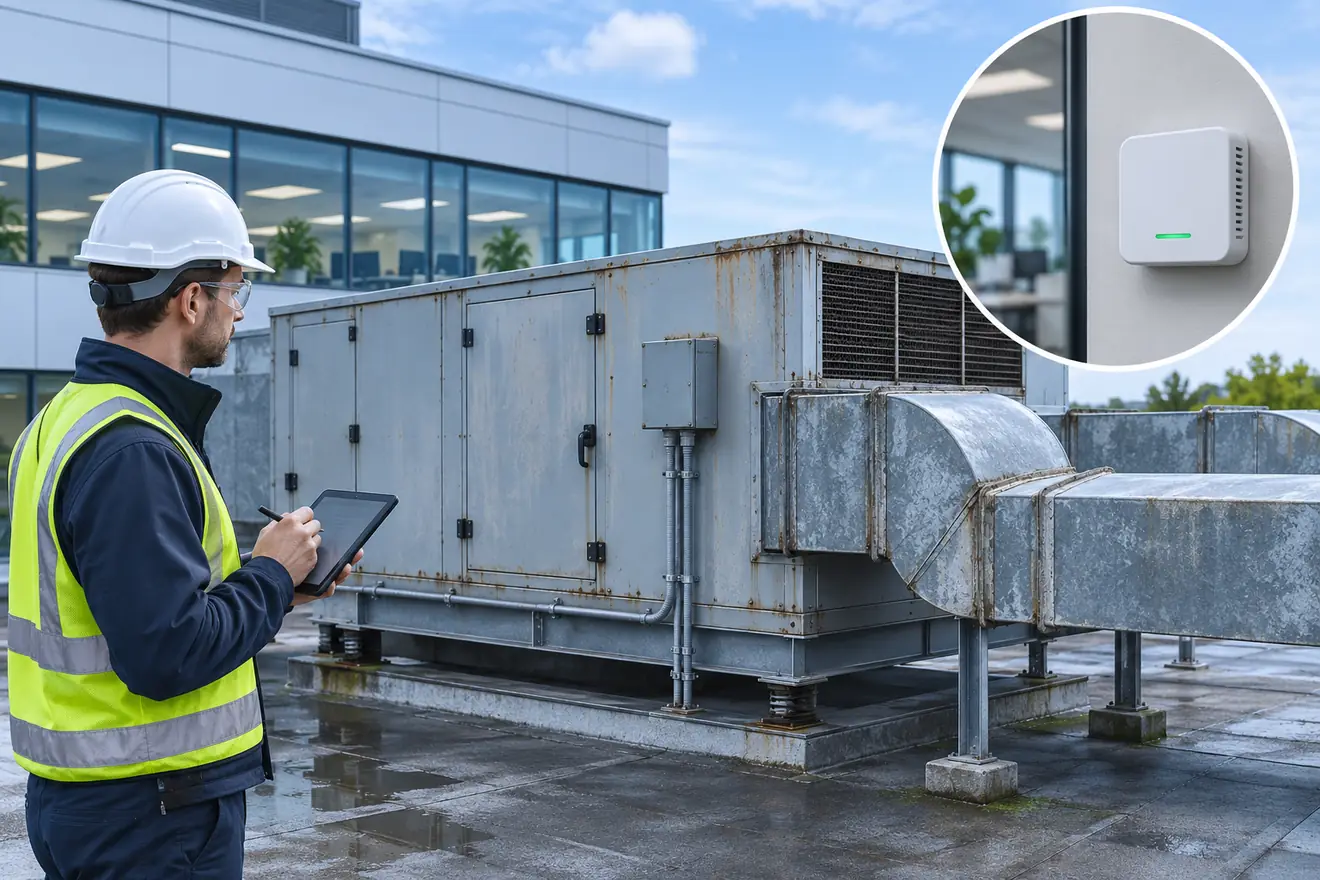
The existing air path and control authority determine what a retrofit can accomplish.
Start with the existing outdoor-air path
Find the actual source of outdoor air and how it reaches the occupied space. A supply diffuser confirms air delivery through a duct, but the air may come from recirculation, outdoor intake or a mixture. A wall-mounted unit may heat and cool recirculated air while a separate system supplies ventilation. A rooftop air handler may have a modulating intake that also serves an economizer sequence. A central unit may supply several zones through terminal units, each with different schedules and airflow. Check the route in the field and compare it with the current drawings.
答案会影响现有二氧化碳信号的作用。在没有可控室外空气路径的独立房间中,监测可以帮助确定何时调查通风或审查现有程序。它不能产生外部空气输送。具有工作室外空气进气口的中央空气处理器也许能够调节进气量,但其中央风门本身并不能解决区域之间的分配问题。专用的室外空气系统可以将通风与合理调节分开,但其终端或中央控制装置仍然需要将指定的空气输送到每个区域。
查看设计意图、最新的测试和平衡 (TAB) 报告以及自大楼启用以来的任何顺序更改。确定所需的占用操作、预期供应和室外气流、预期风扇模式以及进气和终端命令的现有权限。对于现有建筑物,图纸和平衡报告可以描述先前的配置。在将这些文件视为当前基线之前,请验证已安装的控制装置、管道变更和实际操作。 美国能源部通风评估和行动指南
| 现有安排 | 有用的第一个监控边界 | 考虑控制之前的问题 |
|---|---|---|
| 开窗或手动室外空气程序 | 占用房间并观察开放状态 | 是否存在一条经过设计的可控路径? |
| 带调节室外进气的单区装置 | 室内二氧化碳、风扇防护、进气模式和室外气流 | 设备能否在运行模式下保持所需的进气量? |
| 多区域中央系统 | 代表性占用区域、航站楼气流和中央运营环境 | 区域需求将如何影响系统室外空气和分配? |
| 专用室外空气系统和房间单元 | 房间二氧化碳和专用通风输送 | Which controller owns outdoor flow, and can it prove each zone's delivery? |
| 再循环风机盘管或分体系统 | 具有独立通风环境的二氧化碳室 | 室外空气实际上从哪里进入,哪些设备会影响它? |
选择一个阶段并定义其权限
A local data logger or BAS read-only point is usually the simplest way to establish a baseline. Its purpose is to reveal patterns, provide context for complaints or compare times and locations. The room CO₂ value can be accurate and useful even if the existing system has no actuator that responds to it. Define who will review the trend and what investigation should follow a meaningful event.
An advisory stage can add a notification or trend-based recommendation without letting the CO₂ point change the equipment. For instance, staff could review a repeatable rise during meetings against the existing schedule and air delivery. An advisory should state the measurement, location, conditions and expected response owner. It should distinguish an unavailable sensor from an occupied-room observation, and it should be tested for both. Give users a clear action path so the notification produces operational evidence.
Enabled control is a project change. Determine the approved ventilation requirements and applicable project and jurisdiction conditions, then decide where the new demand signal is allowed to act. Identify how the signal coexists with required outdoor-air minimums, existing priorities, economizer operation, thermal and moisture constraints, and applicable equipment protection. An automatically written value should have a documented scope and an owner who can verify and restore operation. Use a reviewed change process rather than connecting a room output directly to a field actuator based on a ppm threshold alone.
| 阶段 | Authority of new point | Gate to advance |
|---|---|---|
| Monitor-only | Read and trend | Representative placement, usable data and observed baseline |
| Advisory | Notify responsible staff | Context, quality and notification response verified |
| Enabled control | Affect approved demand or sequence | Design review, verified airflow, fault/recovery tests and operator release |
An advisory phase can be skipped when the project has the evidence needed to validate control and an approved implementation path. It is useful where a portfolio owner wants several weeks of comparable monitoring before changing equipment. The distinction is the authority of the point, not whether it appears on a sophisticated dashboard.

Inspect the installed controller and verify available inputs, compatible interfaces and existing control ownership.
Survey the spaces, equipment and interfaces
List the zones served by the equipment and identify which rooms have variable or concentrated occupancy. Note the approximate volume, intended occupancy, schedule, outdoor-air path and any local CO₂ sources. Focus the initial survey on spaces where a point can answer a meaningful question. A conference room with short dense meetings and a large open office can have different concentration patterns even when they share a mechanical system. A mixed return signal can conceal a high-concentration zone if the other return streams dilute it.
Review each candidate location for exposure to supply air, windows, doors, exhalation, thermal effects and servicing access. Portable comparisons can establish whether a convenient wall site behaves like representative occupied air. Photograph the exact location, record mounting height and label the zone. If a duct point serves a legitimate system-level question, identify whether it samples a particular return, mixed return or supply stream and document what conclusions the measurement can support. HSE guidance on using workplace CO₂ monitors
Review spare inputs and network capabilities in the existing controls. Determine whether the transmitter uses an analog output, supported network interface or a dedicated logger. Compare the expected transmitter output mode and scale with the receiver input. Confirm sensor power, installation environment, configuration access, supported device and firmware versions, and capacity to trend values at the needed resolution. If the controller exposes no appropriate live status, document how the BAS can distinguish bad data from an ordinary concentration.
Think through replacement before installation. A serviceable transmitter should have identifiable wiring or network mapping, a location record, a settings baseline and a documented comparison method. Verify the manufacturer's requirements for warm-up, maintenance and calibration. For any automatic baseline feature, confirm the conditions it expects and whether the occupied space actually encounters them. Long operating hours, limited vacancy or unusual background levels can affect the suitability of a baseline feature. Apply model-specific guidance rather than assuming the same behavior across transmitters.

The location and its intended sampling boundary should be recorded together.
Establish a monitoring baseline before changing the sequence
Trend room CO₂ together with occupancy context, the relevant equipment mode, fan proof and available airflow or position evidence. A monitor alone can reveal repeatability but may leave several explanations open. If the equipment schedule transitions at 07:30 and occupants enter at 08:00, capturing both events is more useful than comparing daily averages. Cover representative occupancy periods and environmental conditions. Record whether windows, partitions or portable units changed during the baseline.
Confirm that the installed sensor and its BAS reading agree under a documented comparison method. Check the physical measurement separately from controller scaling and trend delivery. Preserve the local reading, BAS reading, timestamps, status and reference condition. A live number can match while the historian uses a different point or stores too coarsely to show the events of interest. Test exports early enough to correct the trend settings before collecting a representative baseline.
A repeatable increase after meeting occupancy could be consistent with higher generation or limited dilution. Compare the time of the increase with the fan mode and ventilation delivery. An unexpected pattern during equipment downtime may instead indicate a schedule or occupancy exception. A central air handler may show normal outdoor intake while the terminal serving the room is below its intended flow. Treat the CO₂ trend as an investigative lead. Use measurement of the relevant airflow where the project requires it.
A baseline should record configuration as well as concentration. Note the operating schedules, thermostat and economizer modes, signal averaging and any outstanding HVAC deficiencies. Otherwise a later comparison could ascribe a change to the new sensor or sequence when occupancy, weather or a separate repair changed. If significant repairs are needed to establish the intended existing operation, document the before and after states separately. This keeps a monitoring improvement from being mistaken for an airflow improvement.
Coordinate control authority and failure behavior
If the project decides to use CO₂ for demand-controlled ventilation (DCV), specify what the CO₂ input requests and how the existing equipment executes it. The sequence may adjust a zone demand, outdoor-air intake or another project-defined control variable. Identify the effective command owner and how it handles other priorities. A room sensor should not silently become authoritative over unrelated protection or ventilation requirements simply because its output is present on the network.
The ASHRAE ventilation chapter describes occupancy-based reset and explains why air-handler and zone behavior matters, especially in systems with variable primary airflow. In a multizone project, a demand seen in a conference room may need both a zone airflow response and a coordinated outdoor intake change. The project designer should establish the relevant minima, fan and damper ranges, distribution method and any constraints imposed by the system and adopted requirements. ASHRAE Fundamentals chapter on ventilation and infiltration
An equipment application note from Amphenol Telaire describes examples involving existing direct digital control (DDC), rooftop systems and variable air volume (VAV). Those arrangements illustrate plausible interfaces. The installed outdoor-air path and approved operating requirements determine what the project can actually implement. Amphenol Telaire application note on using CO₂ for zone ventilation
Write the failure behavior before activation. If the sensor is unavailable, stale, outside its valid range, under approved test or warming up after power returns, identify what the sequence should use instead, what should be logged and who should be notified. An automatic return to CO₂ control may require restored quality and a defined recovery check. Document how a temporary operator override is visible, how it expires or is removed, and which state should be present after any test. The fallback must come from the approved design and project requirements.
Consider what a small pilot can prove. A single zone with an independent outdoor-air path may demonstrate point integration, fault behavior and delivery in its operating envelope. It says little about aggregation logic on a central multizone unit. Select representative conditions for each equipment family rather than extending results across unlike systems. Keep the limits of the verified scope with the handoff.
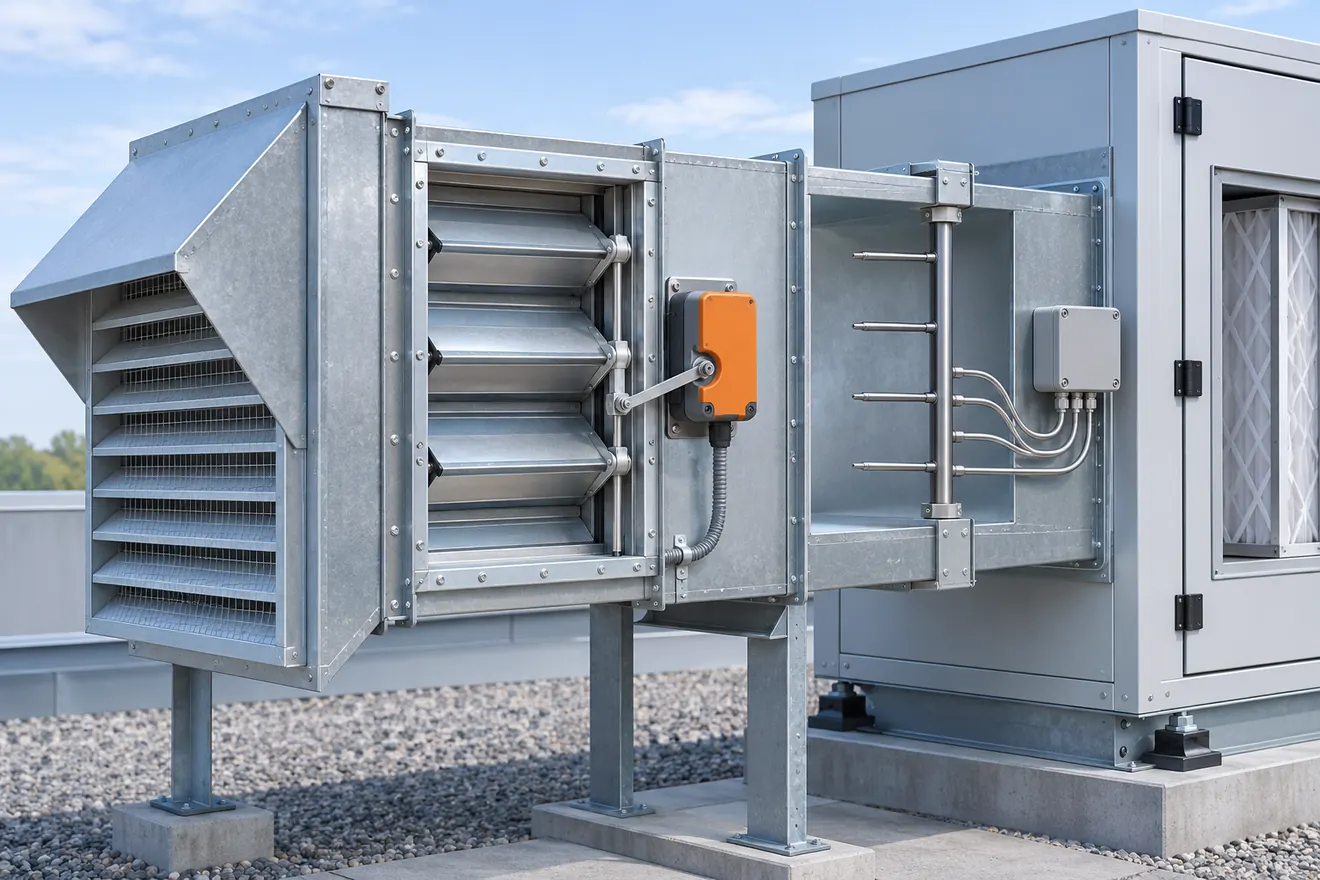
The actuator changes the air path. A separate measurement can help establish the flow delivered under test conditions.
Verify the retrofit at three boundaries
第一个边界是测量。验证安装的传感器是否代表预期的空气,并且其读数在记录的比较条件下是合理的。记录安装的型号和配置、参考信息、观测值和商定的公差。测试与使用相关的任何点丢失或陈旧状况。在此边界和下面的数据边界处可以接受仅监视阶段,而无需更改控制。
The second boundary is data delivery. Compare the local output with the receiving point, readout, history and any advisory. Verify engineering units, update behavior, timestamp and quality. If a point is supplied to a local or supervisory sequence, check the exact input the sequence sees. A test from the graphics layer can miss a different source used by the controller. Preserve the authorized test method and whether a value was measured, simulated or temporarily selected.
The third boundary is functional ventilation performance. An approved test should compare expected sequence response, effective command, proved equipment state and actual airflow where required. Verify normal low and increased demand under applicable modes, then test invalid inputs and restoration. A damper percentage is not a measured volume flow. Check the project method for verifying intake and delivery at the relevant boundaries. In a multizone system those boundaries may include both the air handler and affected terminals. ASHRAE Applications chapter on controls design and application
Consider a hypothetical existing office with one rooftop unit serving a training room and two adjoining offices. The training-room CO₂ trend rises during dense classes. The operator sees the unit's damper command, but the existing balance report predates duct alterations. Monitoring can be accepted once the room point, its context and history are verified. Enabling a control change requires identifying which zones share the unit, confirming minimum and achievable outdoor airflow, and testing how the training-room request affects distribution and all applicable operating modes. If airflow at the needed conditions cannot be verified, record the gap and keep the monitoring project separate from the proposed control work.

验收记录将添加到 BAS 的数据与已验证的系统操作更改区分开来。
为操作员提供可重复的切换
The turnover package should include an as-built equipment and zone map, sensor locations, model and serial information, settings, point names and units, controller backup or revision, reference comparisons, trend exports and the scope of accepted use. For an approved control change, include the final sequence, valid and fallback behavior, functional tests, unresolved conditions and the rollback or restoration procedure. Identify the people responsible for the measurement point, the HVAC equipment and review of any advisory.
浏览一项正常趋势、一项无效输入和一项针对特定地点的后续行动。展示如何区分禁用的传感器和安静的房间。确认谁可以查看气流证据、更改设置和清除受监督的覆盖。运营团队应该知道新信息是否仅用于诊断、建议或允许驱动序列。
在控制飞行员之前制定启动决定
Write a short gate record for the proposed sequence. It should identify the equipment and affected spaces, the approved ventilation criteria, what the new point can change, and the independent evidence of delivery. Include the configuration revision that will be tested, the authority responsible for accepting it, and the scope of any temporary operating conditions. A contractor's checkout and a control designer's approval cover different parts of that decision.
| Gate evidence | What to look for | When to hold activation |
|---|---|---|
| Outdoor path and distribution | Verified route and current documentation | Supply path or served zone still uncertain |
| Sensor and BAS point | Representative site, valid reading, history and quality | Point is unstable, mislocated or cannot identify stale data |
| 系统响应 | Effective command, proof and airflow at required conditions | Position changes with no verified outdoor-air response |
| Sequence interactions | Normal, constrained and transition modes reviewed | Economizer or another required priority is unaccounted for |
| Failure and recovery | Approved fallback, status and restoration verified | Input loss leaves equipment response undefined |
| Handoff | Responsible owner, evidence and rollback access | Staff cannot identify approved state or retrieve records |
A rooftop unit example illustrates how the gates differ. Imagine the survey finds a spare analog input and a working economizer actuator. That confirms a possible connection and a moving component. The team still needs to verify the correct signal range and whether the occupied ventilation sequence and actual outdoor-air delivery operate as intended at relevant fan states. If the approved minimum airflow cannot be maintained at a lower fan speed, adding a faster sensor will not resolve the underlying limitation. Complete the read-only monitoring scope if it is verified, then route the equipment issue to the appropriate project owner.
另一个假设的系统使用中央通风装置加上局部加热和冷却终端。该团队发现本地恒温器控制器有空闲输入,但通风控制器在其他地方。将二氧化碳发射器添加到本地恒温器可以创建有用的趋势数据,但任何未来的通风需求都需要记录到实际拥有它的控制器的路径。确认任何跨控制器使用都传达了数据质量和年龄。如果链路不可用,则应在接收控制器上运行商定的后备。设计不能假设到达监控显示器的值也会到达负责外部空气的设备。
测试这座建筑中重要的互动
A clear sequence test compares expected and actual behavior under documented conditions. Review normal occupied operation first. Verify the point and the effective control request, then compare mechanical response and airflow where required. Under the relevant range of fan operation, check how the ventilation system establishes its required delivery. The fan may maintain a lower speed under partial load, changing intake behavior at the same damper angle. An approved test at one speed can leave that question open at another speed.
Next consider relevant operating transitions. An economizer may increase outdoor intake for temperature control, while a different mode limits operation to a minimum or disables equipment according to the approved sequence. Document how the request is arbitrated in each applicable condition. Include status that distinguishes an active CO₂ request from one limited or superseded by another mode. In a building with significant exhaust or specialized pressure relationships, refer to the applicable design and test criteria. Adjusting outdoor air independently may affect the balance that those systems depend on.
Verify the agreed unavailable state using the project procedure and capture the effective behavior, not just an alarm on a screen. If the reading remains cached during a communications loss, confirm that it becomes unusable for the sequence within the specified conditions. When the transmitter restarts, check that warm-up and recovery are handled as specified. For each test, save evidence that temporary changes have been removed and normal approved operation is restored. State which equipment or seasonal conditions could not be tested and where follow-up is recorded.
Decide how a portfolio rollout will stay comparable
If the first installation is a pilot, name what counts as success before the trend begins. One useful deliverable is a complete occupied-period dataset that can be tied to equipment and occupancy context. Another is a demonstrated installation and comparison method that staff can repeat. For a control pilot, the criteria also need the scope and conditions of functional verification. Record any meaningful differences in installation time, data loss, repairs and operator workload. Avoid generalizing a short observation window into a performance claim for dissimilar buildings.
Standardize the fields that allow later comparisons, such as room identity, monitoring location, equipment association, time source and whether the point is monitor-only. Preserve building differences rather than forcing every installation into one physical design. A lightly occupied office with continuous ventilation and a training room used in short bursts may require different logging context, representative positions and review windows.
Include a maintenance check after initial operation. Review whether the installed point remains accessible, whether the trend and quality are available, and whether known occupancy or equipment changes altered its intended interpretation. If the device or configuration is replaced, preserve the prior trend period and verify the new state. Sensor1stop's guide to CO₂ monitor accuracy specifications explains how to read a manufacturer accuracy statement when comparing a field monitor or replacement. Use the approved field comparison method and the installed system's requirements when making an acceptance decision.
常见问题
Can monitoring help if my existing HVAC system has no BACnet?
Yes. A suitable logger or compatible hardwired input can support a monitoring baseline. The project still needs representative placement, valid readings, usable timestamps and an agreed process for reviewing the data.
Can I use one return-air monitor for the entire building?
It can describe the air sampled at that return if the location and operating conditions are suitable. A mixed return can obscure zone differences. Use representative zone measurements when the question concerns particular occupied spaces.
Does a CO₂ monitor prove required outdoor airflow?
It can provide contextual evidence about concentration and dilution. Verifying required outdoor airflow needs the approved measurement or verification method and knowledge of the system's operating conditions and delivery boundary.
Do I need to change ventilation controls to benefit from CO₂ data?
No. A read-only trend with occupancy and equipment context can identify conditions that deserve investigation. A controls change is a separate decision with its own design and verification requirements.
When can I call the retrofit accepted?
Define acceptance for the stage being delivered. For monitoring, verify placement, measurement, data and operator access. For enabled control, also verify the approved sequence, airflow performance where required, fault recovery, restoration and handoff.








发表评论