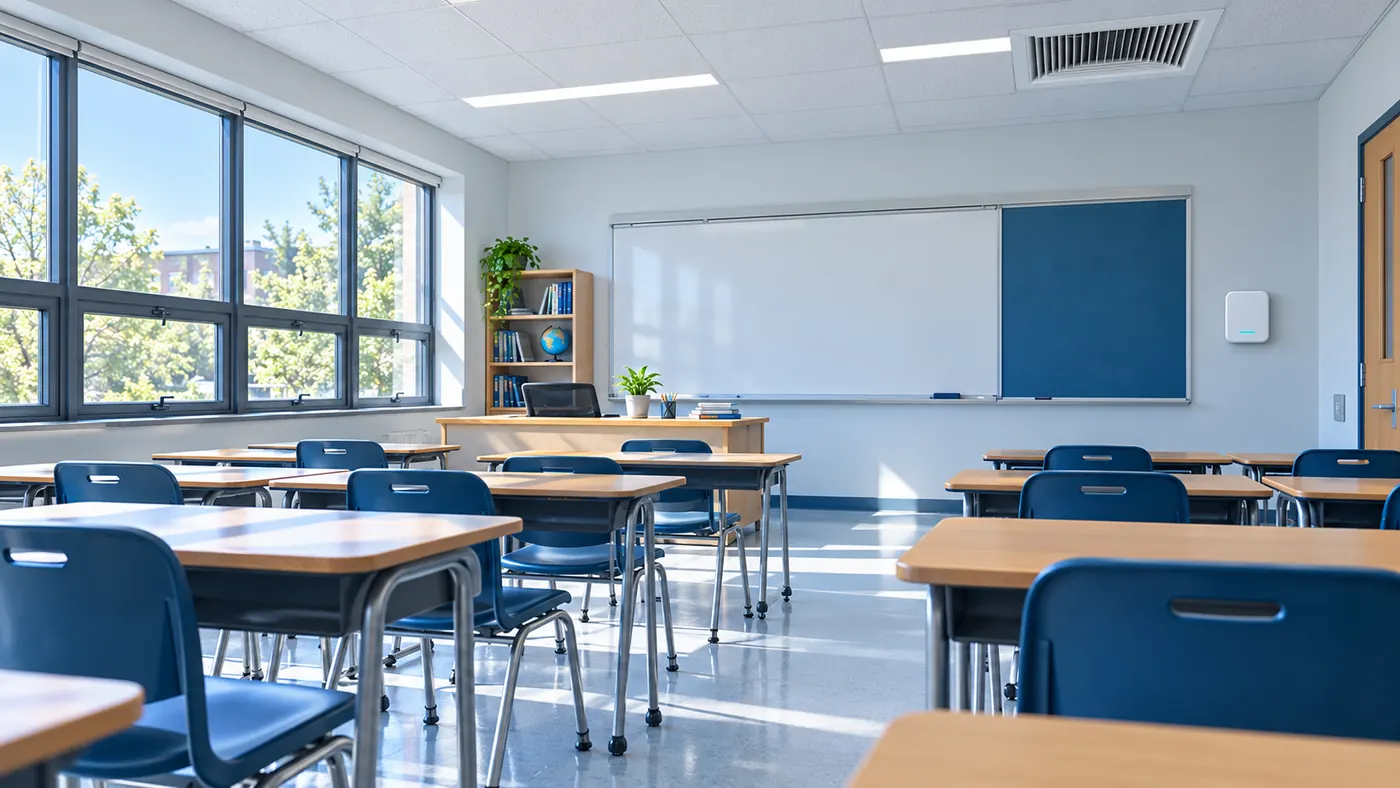
在教室放置二氧化碳监测仪,可以对学生和教职员工通常居住的空气进行采样,并准确记录其位置。 在一个典型的课堂上, UK Department for Education's ventilation guidance 建议将非色散红外 (NDIR) 监视器放置在大约就座头部或桌子的高度,远离门、窗和通风口,并距离人员至少 0.5 m。这是一个有用的起点,而不是通用安装规范或保证一个读数代表每张桌子。一个好的位置还具有明确的目的、无障碍的入口、安全的安装以及可重复的方法来检查其读数在占用的课程中是否有意义。
The position matters because a classroom is not a perfectly mixed box. A student exhales a short-lived plume. A window can produce a stream of incoming or outgoing air. A supply diffuser, radiator, corridor door and densely occupied corner can all produce local conditions. Moving the same instrument by a few metres may change the displayed value without any change in the building's ventilation plant. Placement is therefore part of the measurement method, not a decoration chosen after the purchase order.
本指南适用于教师、设施工作人员和学校领导制定日常工作 通风观察。它不能取代当地的建筑规范、委托通风测试或专家评估。如果需要正式的合规决定,学校应使用指定的当地测量方法和合格的从业人员。有关结果数字的含义,请参阅我们的 课堂二氧化碳读数解读指南。
在挑选墙之前先明确问题
询问监视器将支持什么决定。老师可能需要立即指示教室在上课期间变得闷热。设施团队可能会在时间表更改之前和之后的相似日期中比较同一教室。一个学区可能会筛选几个教室,以决定在哪里进行进一步调查。这些工作可以使用相同类型的直接二氧化碳监测仪,但不一定使用相同的采样计划或报告。
为每台设备写一句话目的: 观察12号教室占用课程的趋势, for example. Record whether the unit is fixed or rotates among rooms, whether staff will read the display or review a time-series log, and who responds to recurring readings under the applicable school guidance. A portable display placed on a teacher's desk is easy to see but can be moved without documentation. A fixed unit preserves a consistent position but may hide behind a new cabinet or become inaccessible for maintenance. Neither format solves the placement question by itself.
显示的频道应该是 直接二氧化碳测量 suitable for this use, rather than an “eCO₂” estimate derived from volatile organic compound response. Read the finished monitor's manual for its inlet, measurement method, warm-up, logging interval and calibration method. The DfE calls out NDIR technology as an effective choice. A separate 直接 CO2 与 eCO2 的解释 在检查产品说明时很有用。不要认为以“空气质量监测仪”名义销售的产品根本可以测量二氧化碳。
精心挑选房间
从持续使用的房间开始,通风观察可能会改变真正的决定。这 Welsh Government's education-setting guidance 描述了使用二氧化碳监测仪来识别通风不良的占用空间,并建议适当时在空间之间移动设备。时间表、房间容量和投诉历史记录可以帮助对有限数量的仪器进行优先排序。记录选择房间的原因,以便工作人员不会将受监控的子集解释为对学校的完整调查。
| 空间 | 有用的第一个问题 | 取样注意事项 |
|---|---|---|
| 标准占用教室 | 反复出现的课程时间模式是否表明需要检查室外空气供应? | 注意班级人数、课程时长和入口位置。 |
| 小团体房 | 短暂而密集的时段是否会产生可重复的趋势? | 距离一个人非常近的显示器可能会夸大房间读数。 |
| 教学空间大或不规则 | 被占领分区的情况是否有所不同? | 有一点可能特别不具有代表性;评估空气路径并测试多个点。 |
| 实验室或车间 | 日常使用会产生通风问题吗? | CO2 不测量工艺气体、烟雾或化学品暴露;使用所需的专业控制。 |
| 走廊、楼梯间或临时大厅 | 是否正在调查特定的空运问题? | A transit reading is usually a weak proxy for a classroom's occupied ventilation. |
| 无人居住的房间 | 起始条件或背景条件是什么? | 它没有描述教学负荷下的房间。 |
具有异常活动、潮湿或化学来源的房间可能需要进行除二氧化碳以外的室内空气质量调查。不要让方便的显示器取代对湿度、燃烧器具、清洁产品、过滤或室外污染的检查。这 US EPA's school IAQ reference guide 将这些问题与通风一起解决,而不是将它们简化为一种气体。

学校计划图像只是优先顺序的说明;它不是测量的通气图。真实的房间列表需要 ID 和实际的建筑区域信息。如果单位轮换,请保留部署登记册,以便在设备移动后,一个房间的图表不会分配给另一个房间。
绘制一个简单的气路草图
Before choosing a spot, walk the room while it is used normally. Locate openable windows, external doors, corridor doors, mechanical supply and return openings, fan units and any spaces where people cluster. Identify the normal student seating pattern, teacher position and likely obstructions. Ask how those conditions change across the day. The preferred position samples broadly representative occupied air, not a local jet or one person's breath.
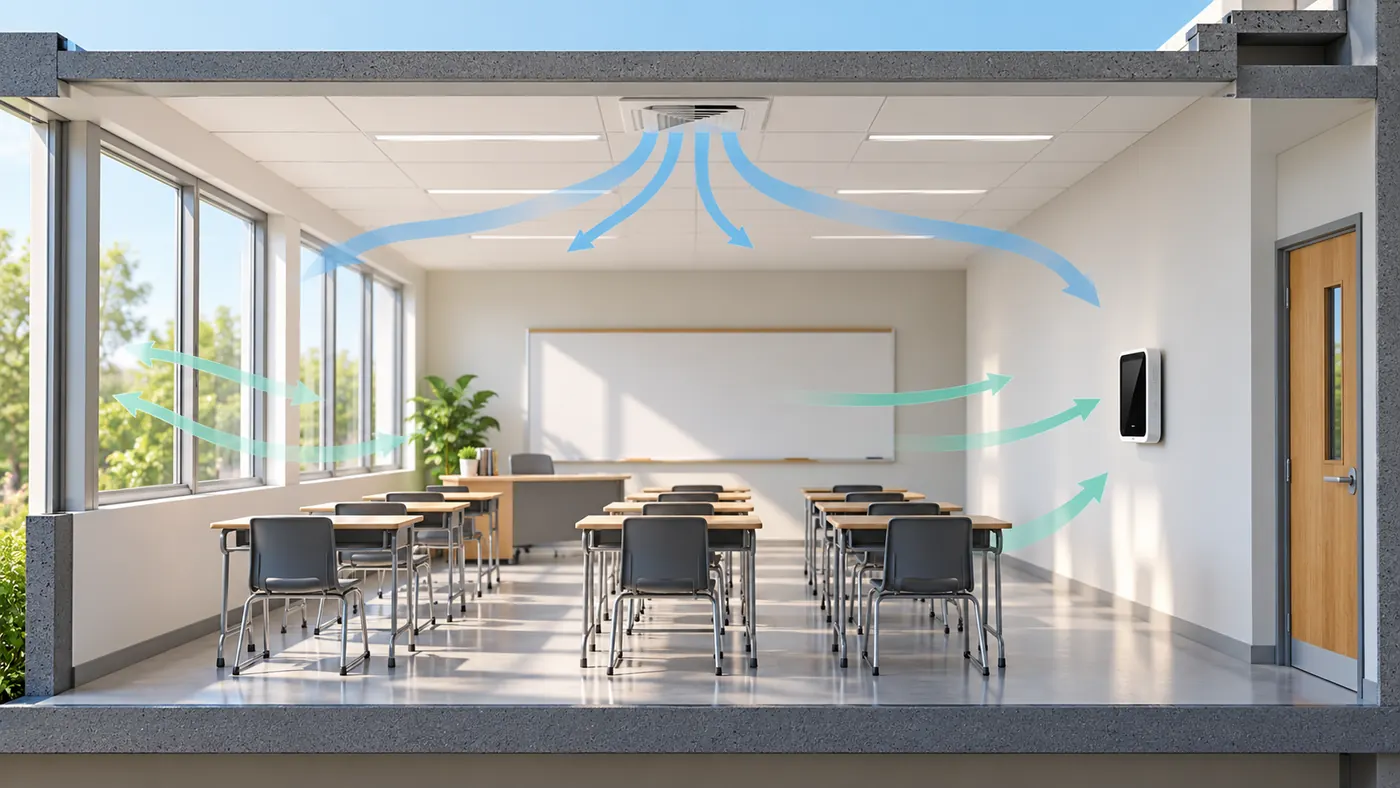
图像中的蓝色路径表示空气可能的运动;实际方向、速度和混合必须在房间内观察或测量。窗户并不总是入口,打开的走廊门不一定是室外空气。机械通气可能会根据时间表或占用情况改变模式。吊扇可以混合空气而不输送室外空气。如果监测仪旨在评估通气策略的变化,这些区别很重要。
这 UK Health and Safety Executive's CO₂-monitoring advice 注意不要放置在门窗和通风口旁边,也不要将设备放置在靠近人的地方。供气喷气机中的监测器可能会报告比占用区域更低的二氧化碳,而直接在呼出羽流中的监测器可能会报告更高的二氧化碳。这两个极端都不是对房间的诚实总结。如果唯一可用的电源插座位于此类位置,请使用合适的电池供电装置或安排安全安装,而不是在没有记录的情况下接受明显偏向的位置。
使用占用的呼吸区作为起始参考
对于坐着学生的普通教室,桌子或坐着的头部高度是英格兰 DfE 指南中的实用起始高度。它将入口放置在人们实际使用的空气附近,同时避开天花板、地板和局部供气喷嘴。该指南还指出,设备与人的距离至少为 0.5 m。这个特定的距离属于那个指导,不应该默默地变成世界范围的技术法则。同一份文件建议使仪器远离门、窗和通风口。
What counts as “away” must be judged in the actual room. A position can meet a tape-measure distance yet still sit directly in a window draft or under a high-velocity diffuser. Conversely, a wall unit may be useful if it is near the occupied area, unobstructed and checked against a second position. Read the manufacturer's installation instructions for clearance and orientation around the inlet. A display behind curtains, under a shelf or inside a closed display case measures the microenvironment of that obstruction. A unit at arm's length from the nearest desk can be safer from tampering, but the staff must still be able to see or retrieve its data.
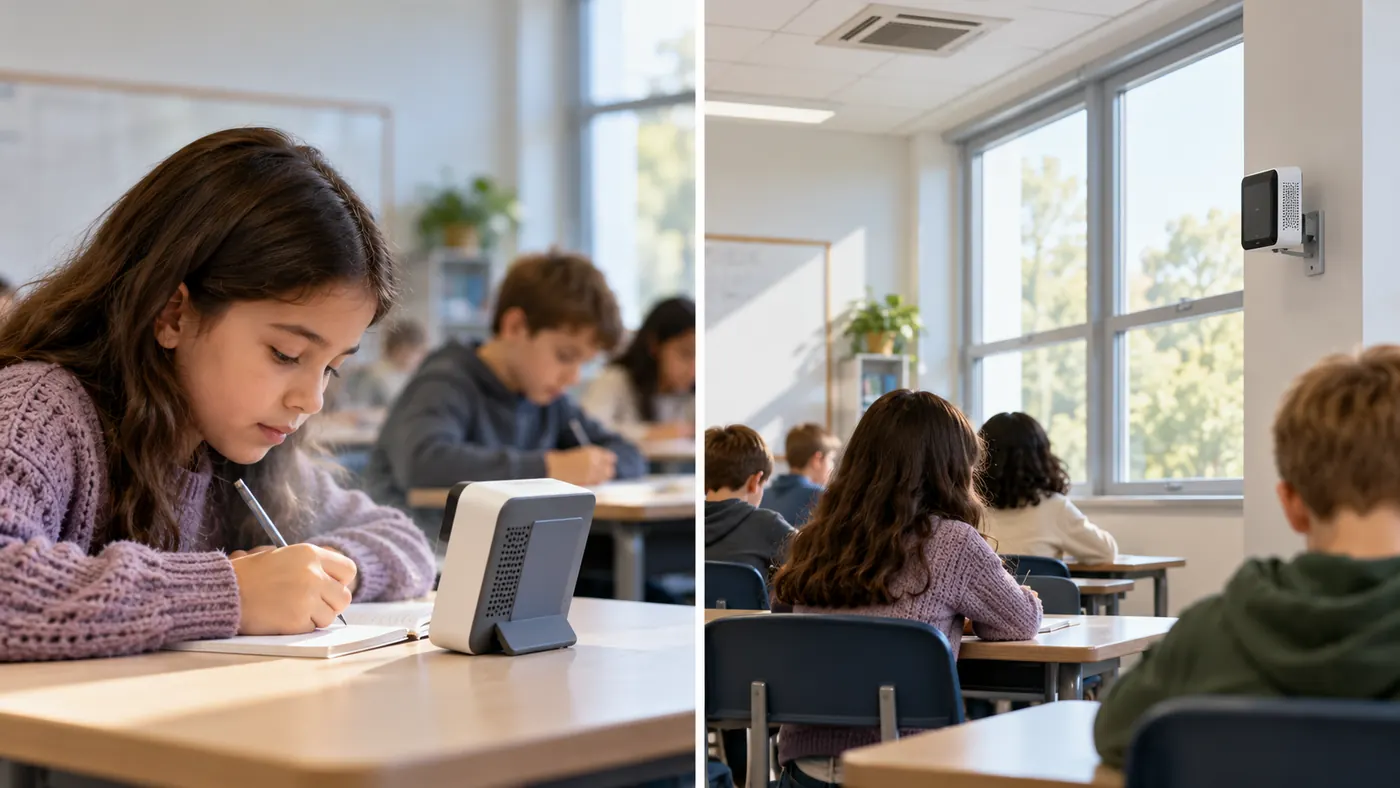
The breath plume in the illustration explains a local sampling error, not a fixed plume size. People move and talk. If a unit is used on a table, note whether a pupil routinely sits close to it. If a wall location is chosen, record the inlet height and distance from nearby seats, window and outlet. Take a photograph for the school's internal facilities record if permitted, but a public article does not need a classroom photograph or pupil image.
需要额外小心的情况
非常高的天花板、分区布局或狭长的房间可以产生单点隐藏的空间格局。自然通风经常随着风向和窗户位置的变化而变化。原创的 自然通风教室的实地研究 investigated spatial CO₂ differences; its lesson for practice is to examine whether the particular room is sufficiently represented, not to copy one “best” wall position into every building. A monitor near a teacher's desk may represent that area well while missing a densely occupied back corner. A classroom adjacent to a busy road may also have a trade-off between opening windows and outdoor pollution that CO₂ alone cannot settle.
Portable HEPA cleaners are another source of confusion. A particle filter may change air movement and particle levels, but it generally does not remove CO₂ or provide outdoor air. Do not put the CO₂ inlet in a cleaner's discharge stream and then treat a falling or unchanged number as proof that the cleaner is working or failing. Our 空气净化器和二氧化碳指南 将两个测量问题分开。
将“每个教室一个”作为初始抽样计划
One unit can be useful in a typical room; it cannot prove that every location has the same concentration. The DfE's suggestion of one device for a typical classroom is a manageable starting point. An unusual room may require a second location, a temporary rotation or a specialist assessment. The ASHRAE 关于室内二氧化碳的立场文件 将传感器位置和测量质量描述为解释读数的条件。它还警告不要将二氧化碳数值转换为通用的 IAQ 判定。
A practical placement trial can answer whether the chosen point is adequate for the school's purpose:
- 使用上述指导建立候选位置并记录粗略的房间草图。
- 在可比较的占用期间,在该位置以及一两个其他可能的占用区域位置获取读数或记录数据。仅当占用和通风足够稳定以进行比较时才顺序使用相同的仪器;否则同时使用合适的仪器。
- 记录时间、人数、打开的门窗、系统模式以及设备的任何移动。移动设备后立即进行的快速现场读数可能仍会反映其先前的位置和响应时间。
- 比较时间序列形状和任何持续的差异,而不仅仅是一个最大值。如果较大的差异改变了预期的决定,请保留多个地点或获得合格的评估。
- 选择并记录最终位置。当房间布局或通风布置发生变化时重新检查。
There is no universal numerical tolerance for two positions in this informal screen. Instrument uncertainty, response time and the room's dynamics must be considered before deciding whether a difference is meaningful. A school cannot use a casual five-minute walk-around as a formal proof of outdoor-air flow. The point is to reveal obvious local bias before a dashboard turns one sensor into an authoritative room label.
比较位置之前检查仪器
并排放置在同一空气中的两台仪器通常应在其规定的规格范围内表现出大致一致的行为。这是一个 共置检查, not a field calibration or certification. Allow both instruments to warm up as required, place their inlets in similar air without blocking each other, synchronize clocks and review readings over enough time to see their trend. If they disagree substantially, do not assume that two positions in the classroom caused the difference. Review the product's accuracy statement, service history, automatic baseline settings, calibration instructions and data-processing intervals.

这 CO2 监测仪精度规格指南 explains why a display that increments by one ppm may still have a much larger measurement uncertainty. A direct CO₂ channel can also drift or behave poorly when its baseline-correction assumptions are wrong for a space. Do not reset or recalibrate equipment merely to make two screens match. Follow the manufacturer's procedure, document what was done and seek support if a discrepancy persists. For networked devices, ensure the time zone and clock are correct before comparing logs.
如果用不同的模型评估几个学校房间,明显的房间排名可以反映仪器的差异。首先将它们放在一起,记下型号和序列号,并在可能的情况下故意旋转设备以查看图案是否遵循房间或设备。这 办公区域比较法 对其他占用的建筑物描述了相同的原则。
安装供学校日常使用
The final position must be safe and sustainable. Follow the manufacturer's mounting instructions and the school's electrical, fire and safeguarding policies. Secure a fixed unit so that it cannot fall or obstruct movement. Route power and data cables safely. Do not wedge a fire door open, change a controlled HVAC setting or place a unit where its maintenance would expose staff or pupils to a hazard. If the monitor has a display for teachers, make it readable without inviting frequent handling that changes the sample. If it is a logger, ensure authorized staff can actually retrieve and interpret the time series.
Give every installation a simple record: room ID; device make, model and serial number; CO₂ measurement method; inlet height; exact wall or table position; nearby openings; installation date; logging interval; time zone; calibration or verification status; responsible owner; and a photo or sketch stored in the school's own system. Record changes as new versions, not by overwriting the original. A subsequent furniture move, new divider, sealed window or diffuser adjustment can make yesterday's representative point a poor one.
必须对设备进行维护。定期检查电源、显示和数据传输。查看制造商关于校准、维修和更换的建议。确定谁注意到了扁平线图、不可信的值或长时间的数据缺失期。一个无标签的监控器默默地停止报告可能比根本没有监控器更具误导性。学校还应避免公开展示或报告,让个别学生在室内阅读;入住人数和房间环境通常足以进行通风工作。
调试清单
在接受该职位之前,请与将使用数据的人员确认以下内容:
| 查看 | 记录或演示什么 |
|---|---|
| 目的 | 显示器支持的房间和决策。 |
| 测量 | 直接 CO2 方法、产品说明和当前使用状态。 |
| 地点 | 入口高度、距常规座位、窗户、门和供/回水出口的距离。 |
| 气路 | 课程期间的正常门窗和机械模式。 |
| 无障碍 | 安全安装、电源、可视性或日志记录访问和指定所有者。 |
| 时间 | 正确的时钟、时区、记录间隔和占用时间表。 |
| 交叉检查 | 当决定需要时进行共置或空间试验,但有例外情况。 |
| 跟进 | 审查安置的当地指导/行动流程和日期。 |
这 美国 EPA 学校通风检查表 is a broader facilities companion. It asks staff to examine ventilation operations and maintenance instead of expecting a sensor alone to diagnose a system. The installation record should connect to the school's maintenance and IAQ process. If a particular reading becomes important, staff should be able to reconstruct where it came from and what the room was doing.
常见安置问题
Should the monitor go on the teacher's desk?
It may be a practical temporary location if the inlet is in representative occupied air, clear of the teacher's own breath and away from a window, supply jet or obstruction. A desk also makes accidental relocation easy. Mark the exact position and assess whether a fixed spot or logger would make comparisons more reliable. A desktop unit tucked under papers or behind a computer is a poor placement.
安装在天花板上是否会因为暖空气上升而更好?
Not for routine seated classroom CO₂ observation. The reading should answer a question about occupied air, and the DfE's starting guidance points to seated head or table height. The actual vertical pattern depends on ventilation and room geometry. If a high-mounted building sensor is used for a control system, interpret it according to that system's design and commissioning rather than assuming it is interchangeable with a breathing-zone observation.
我们可以把它放在打开的窗户旁边看看通风是否有效吗?
That might tell you about the local window stream, not the room's occupied air. Use a representative room position to observe the class, and separately document window status. If a formal study of the window's effect is required, compare occupied conditions carefully and consider other sampling positions. Opening a window can also change temperature, noise and outdoor pollutant exposure.
每个教室应该有两个显示器吗?
不是自动的。正如教育部建议的那样,典型的教室可以从一个合适的单元开始。复杂的几何形状、不寻常的空气路径或高风险的决策都可以证明额外的分数是合理的。在没有计划的情况下添加屏幕之前,将有限的资源花费在可靠的设备、合理的布局、维护和有意义的后续工作上。
如果移动设备后读数发生变化怎么办?
记录移动的时间和新位置。考虑仪器响应和改变的当地空气样本,然后比较类似的占用时间。搬家后发生变化并不能证明房间通风发生变化。如果差异持续存在并影响决策,请调查空间变化和仪器一致性。
保持展示位置与决策挂钩
A useful classroom monitor is a documented observation point. It helps staff see patterns in occupied time and test whether a reasonable action has changed those patterns. It does not certify the whole room, measure every contaminant or identify the cause of a problem without supporting evidence. The best placement is one that can be defended from the room's occupancy and air paths, maintained safely, and revisited when conditions change.
为了重复读数,将房间、设备、位置、占用时间和通风状态一起记录。这些详细信息使设施团队能够区分房间变更和仪器移动、时间表变更或数据丢失间隔。
技术来源
How to Choose and Install a Dew Point Sensor
Choose a dew point sensor by measurement basis, pressure, technology, location and sampling design. Learn what to verify before using the reading for control.
阅读更多
When Does Automatic Baseline Correction Fit a CO₂ Application?
Learn when CO2 automatic baseline correction fits a building, the fresh-air assumption it needs and how to verify an installed sensor.
阅读更多