
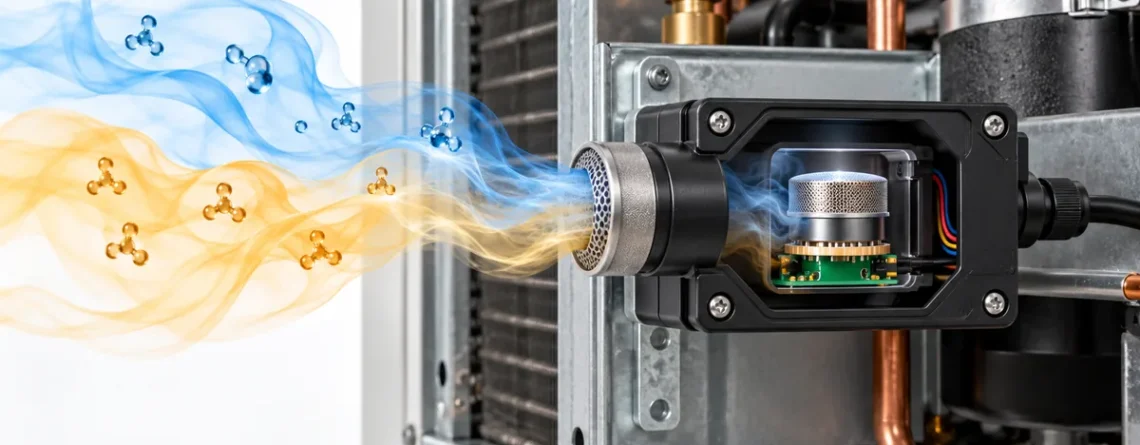
Yes. A refrigerant detector can respond to a substance other than its intended target, but the response belongs to a particular detector, gas profile, interferent, concentration, exposure and test method. A label such as “NDIR,” “semiconductor” or “refrigerant compatible” is not a complete selectivity claim. A different gas can also suppress or delay a response rather than produce a positive one. When a detector alarms, suspected cross-sensitivity is a question to investigate under the site's safety procedure, not a reason to dismiss the indication.
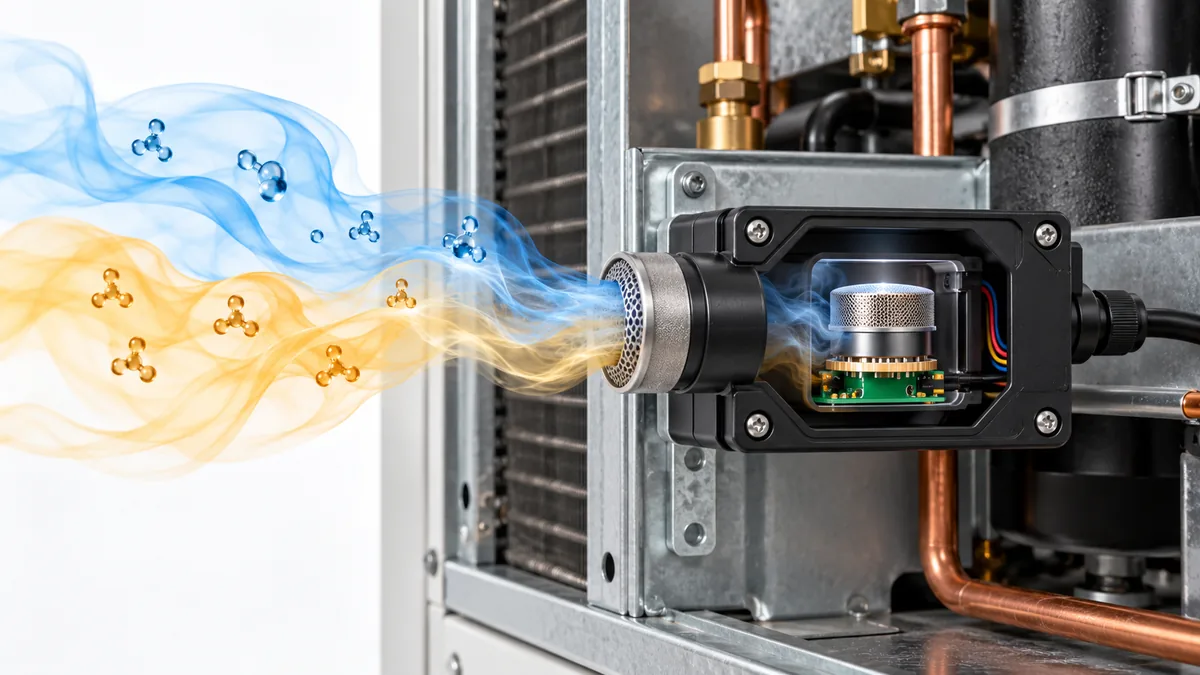
This guide is for HVAC equipment integrators, facilities engineers, product buyers and qualified service teams comparing refrigerant detection systems. It explains what cross-sensitivity means, why test conditions matter and how to request useful evidence from a supplier. It does not identify a particular site's alarm as false or provide a field method for releasing refrigerant. The installed detector's manual, applicable standard and approved response plan govern an actual event.
探测器规格中的“交叉敏感”是什么意思?
检测器经过校准或配置,可将信号解释为一种目标气体或定义的制冷剂分布的浓度或警报条件。 交叉敏感性 意味着另一种物质以与该解释相关的方式改变信号。结果可能是显示读数、警报、零偏、对目标气体的响应降低、故障或延迟恢复。这个词本身并不能告诉你发生了哪种结果。
Selectivity is the narrower claim that a device responds sufficiently to its target while responding less to specified alternatives under defined test conditions. “No false alarms” is incomplete without knowing the alternate substances, their concentrations, exposure time, environmental conditions, acceptance criterion, sample size and device state. A device might pass one set of interfering-gas tests while remaining vulnerable to a chemical that was never tested. A laboratory result for a module also does not automatically establish the installed system's ventilation or notification performance.
There are at least three broad sources of an unexpected signal:
- Another refrigerant or refrigerant blend. The sensor's optical band or sensing surface may respond to more than one refrigerant. A multi-gas profile can be intentional, but the displayed number may not have the same meaning for each gas.
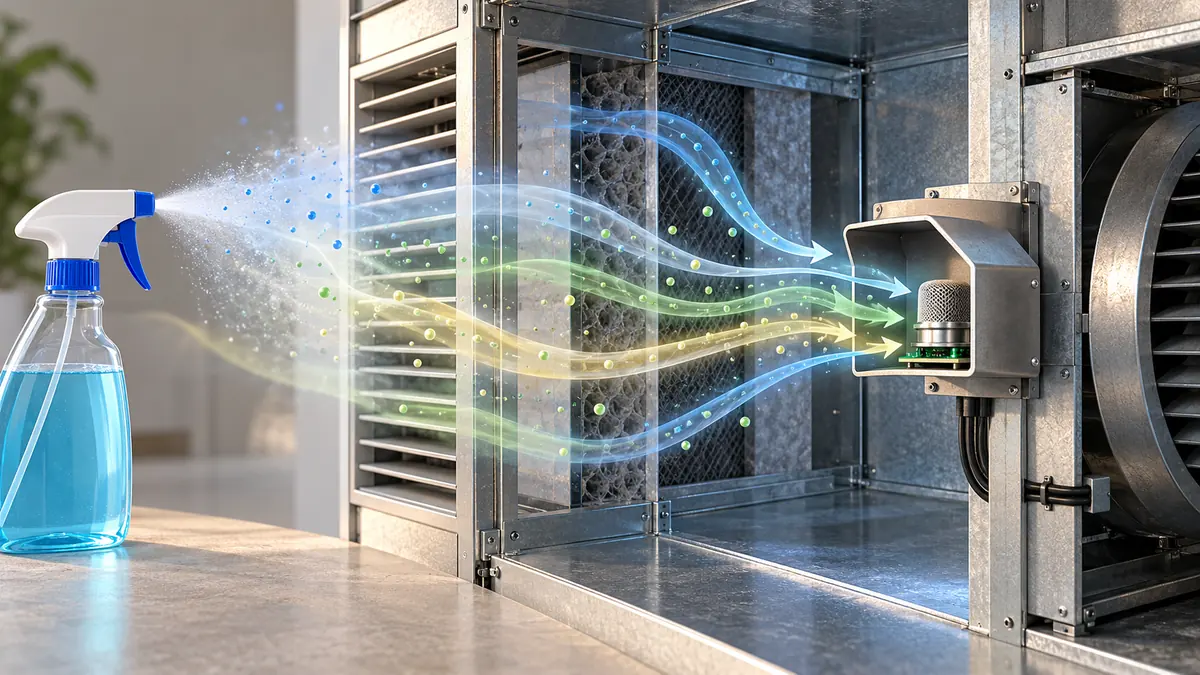
- An unrelated vapor or process gas. Cleaning products, solvents, fuels or other airborne substances may affect some technologies. Which ones matter depends on the exact device and exposure, not a generic workshop-chemical list.
- An environmental or equipment effect. Temperature, humidity, condensation, airflow, contamination, power issues or a damaged sensor can change the output without being a true response to an alternate gas.
These possibilities can coexist with a real refrigerant release。技术人员可能会在密封件泄漏的同时注意到检测器附近的清洁活动。似乎存在干扰物并不能证明不存在目标气体。根据现场程序的要求调查警报,然后使用事件记录、设备状况和制造商批准的检查来确定原因。
| 供应商索赔中的术语 | 这可能意味着什么 | 要求提供的证据 |
|---|---|---|
| “检测多种制冷剂” | 配置文件或算法支持指定的气体 | 气体响应、单位、阈值基础和精确配置 |
| “选择性” | 对列出的一组替代方案的反应有限 | 干扰物清单、暴露和通过标准 |
| “交叉敏感性低” | 一种测试方法下的小响应 | 每次测试的实际响应幅度、时间和恢复 |
| “没有误报” | 测试曝光下无警报 | 之后是否检查了哪些曝光、设备状态以及目标灵敏度 |
| “自我监控” | 某些内部故障会产生故障 | 故障覆盖率、响应行为以及控制器如何处理信号 |
气体报警和故障之间的区别尤其重要。有故障的仪器不能被视为可靠测量零气体的探测器。我们的指南 制冷剂传感器测量任务 讨论目标气体、装置和安装角色如何影响选择决策。
将事件报告中听起来相似的五个解释分开
真正的目标气体释放。 The intended refrigerant reaches the sensing point. The indicated concentration still depends on the detector's position, airflow, calibration and response time. A low reading elsewhere in the room does not erase a local high reading.
对另一种气体的反应。 另一种物质到达检测器并产生类似于目标气体响应的信号。它的方向和大小是特定于设备的。交叉敏感性表可以帮助解释这种可能性,但该表必须与确切安装的型号和配置文件匹配。
校准或配置文件不匹配。 The sensor may produce a legitimate physical response while the displayed units or alarm threshold are interpreted using the wrong refrigerant profile. A percentage of the lower flammability limit, or %LFL, depends on the particular gas's reference value. A ppm reading for one gas cannot be relabeled as the same %LFL for another without the correct basis and validated conversion. A blend can further complicate the interpretation.
Temporary inhibition or poisoning. An interferent may reduce the sensor's later response to the target gas, even if it did not cause an immediate alarm. Recovery may occur or service may be required, depending on technology and exposure. In a Purdue conference study of tested metal-oxide-semiconductor refrigerant sensors, contaminant exposures did not produce false alarms under that protocol, yet temporary poisoning was observed. That result applies to the tested samples and conditions; it is not a clean bill of health for every MOS detector.
Instrument or installation fault. Water at an inlet, a blocked diffusion path, damaged cable, supply-voltage problem or failed module can create a misleading value or fault. It may be tempting to label an alarm “cross-sensitivity” when the actual issue is a wet enclosure or a configuration change. The event record should preserve the detector's health status and maintenance history so these explanations can be compared.
该框架可以防止两个相反的错误:假设每个警报都是实际泄漏而不检查仪器,并假设化学暴露使警报无害。第一个可能会浪费精力;第二个可能很危险。警报应触发批准的响应,同时合格人员确定原因。
为什么传感器技术改变了问题,但永远无法单独解决问题
光学或 NDIR 制冷剂检测
An infrared detector measures absorption at selected wavelengths through an optical path. Some designs use a reference path or channel to compensate for source and environmental changes. The gas's absorption spectrum, filter selection, path length, optical condition and interpretation algorithm determine which substances can affect the measurement. A broad category label such as NDIR does not disclose the filter bands or provide a tested interference matrix.

Texas Instruments' A2L detection application brief describes an example optical approach and its design considerations. It is useful for understanding the signal chain, but an example electronic design is not a certification of every finished detector. A supplier should provide the exact product's target-gas response, environmental limits, diagnostics and relevant qualification report. The optical inlet and path also remain vulnerable to physical contamination or condensation where the design does not tolerate them.
Metal-oxide-semiconductor detection
A MOS element changes an electrical property as surface reactions occur. Heater operation, humidity and prior exposure can influence response and recovery. The material can respond to multiple reducing or oxidizing vapors, so a model's gas profile and interference evidence matter. A general claim that MOS is always “bad” at selectivity would be as unsupported as a claim that every MOS sensor responds identically. The Purdue results above demonstrate why a product-level exposure and post-exposure sensitivity check is more informative than a technology stereotype.
便携式检漏仪
Portable service detectors are often optimized to help a technician locate a suspected leak, while a fixed refrigerant detection system monitors an area and can drive alarms or mitigation functions. The instruments may use different sensing principles, settings and acceptance criteria. A service instrument's known-interference list is useful for that instrument's use; it should not be copied into the fixed system's specification. For example, the JB Industries LD-5000 operating manual discusses its own operating environment and possible sources of interference. Its statements do not establish the behavior of another fixed detector.
The practical comparison is therefore model against model, in its installed role. Ask for the exact part number, firmware or gas-profile revision, test standard edition and controller integration before using a test result to make a procurement or maintenance decision.
How to read a cross-sensitivity or interference matrix
A vendor matrix is helpful only if its rows and columns preserve the conditions behind each result. Start with the tested gas's chemical identity. A refrigerant blend designation is not the same thing as a pure component; concentration and mixture composition matter. Then read the exposure unit. A result in ppm of the test gas cannot automatically be compared with %LFL of the target refrigerant. If the table reports “equivalent target-gas ppm,” ask how that equivalence was obtained and whether it applies across the range or only at one point.

对于每个干扰物,要求:
- Exposure level and duration. A one-minute challenge can miss slow accumulation or delayed recovery; a very high concentration can cause behavior unlike normal background conditions.
- Temperature and humidity. Environmental extremes and condensation can change both the sensor and the delivery of the test gas.
- Device age and conditioning. A new sensor may behave differently after months of operation or after an earlier chemical exposure.
- Response criterion. Was the reported number a peak display, steady-state reading, alarm occurrence, fault, or percentage change in sensitivity?
- Time to response and recovery. A detector that avoids a false alarm but takes much longer to detect target gas after an exposure still raises a performance question.
- Post-exposure target test. 去除干扰物后,设备是否保留了对其预期制冷剂所需的响应?
- 配置文件和软件版本。 固件或配置文件更新可能会更改阈值和信号处理,而无需更改外壳或营销名称。
空白单元格应表示“未提供”,而不是“零响应”。明确的“未测试”单元格比空白单元格有用得多。如果供应商提供单一通用交叉敏感性百分比,请询问基础气体、浓度和程序。如果结果来自组件测试,请询问有关完整系统的已知信息,包括故障处理和控制器输出。
Intertek's explanation of refrigerant detection system testing shows that evaluation can cover intended detection, unwanted output and susceptibility to physical or chemical damage. A certification claim should identify the actual product, scope and standard edition. It should not be expanded to untested gases or installation conditions.
What about R-32 and R-454B multi-gas claims?
The transition to lower-GWP refrigerants makes multi-refrigerant detector claims attractive. The right question is not merely “Can it detect both?” but “How is each gas represented in this exact model and profile?“如果一个模块适用于 R-32 和 R-454B,请请求每个模块的目标气体响应和警报依据、所选配置文件、发送到控制器的单元以及配置错误配置文件时的行为。澄清一台设备是否被批准用于在不同时间包含制冷剂的空间或用于具有不同制冷剂的并发设备。这些是不同的用例。
这 文森ZRT512E产品信息 是列出 R-32/R-454B 应用、其自身范围和环境限制的模型级文档示例。确实如此 不是 prove that all optical detectors share those specifications, or that this module is suitable for every enclosure and control system. Its “no condensation” operating qualification also matters when a detector sits near cold HVAC equipment. The exact product data sheet and certification package should be checked against the proposed installation.
For a blend, ask how the response and displayed value relate to the refrigerant's mixture behavior. A sensor may respond to one or more components differently. It is unsafe to infer a blend's response from a pure-gas result without supporting test evidence. Likewise, a controller setpoint expressed in %LFL must be tied to the applicable gas basis and the approved system design; it is not a free-floating percentage that can be copied from one application to another.
Investigating an alarm without prejudging it
First preserve the event. The detector's original reading, status, gas profile, alarm transition and timestamp are more valuable than a later screenshot after the alarm has been reset. Follow the site's response procedure for personnel safety and equipment action. A suspected cleaning solvent or service activity can be recorded as context, but it does not override the alarm response.

When the approved procedure allows qualified investigation, compare the detector's status and trend with other independent evidence: equipment operating state, nearby fixed channels, ventilation operation, recent work, and a suitable portable measurement where the procedure calls for it. Record the portable instrument's gas setting, unit, location and condition. Different locations and technologies are not expected to show identical numbers; a disagreement calls for analysis rather than an automatic choice of the lower reading.
Next check the installed model and configuration against the claimed interference evidence. Was the sensor exposed to the substance that the supplier actually tested? Was the concentration or duration remotely comparable? Has the sensor been serviced, replaced or updated since the relevant test? Were humidity or condensation conditions outside the model's specification? If these questions cannot be answered, the cause remains uncertain. The maintenance plan should state how the device is evaluated and returned to service after a suspected interfering or poisoning exposure.
Avoid casual resets or sensor substitutions. A cleared display can erase useful event context, and an unapproved substitute may change gas response, fault behavior or controller mapping. If a qualified team finds a recurring nuisance source, it can consider controls at the source, an approved placement change, a different qualified detector or revised work practices. Any design change should be evaluated against target-gas detection performance, not only its ability to reduce nuisance alarms.
Questions to ask before buying or integrating a detector
An integrator can request a compact evidence pack rather than relying on a broad brochure claim:
- Which exact refrigerants, concentrations and units are supported by each selectable profile?
- 测试了哪些干扰气体或蒸汽、测试水平如何以及持续多长时间?
- 报告的结果是否为误报、指示浓度、故障、灵敏度损失或恢复时间?
- 每次干扰暴露后是否检查目标气体敏感性?
- 实际装配和入口适用哪些温度、湿度、冷凝和污染限制?
- 哪些固件、传感器模块、校准状态和标准版本产生了证据?
- 警报、故障、通讯中断和报废状态如何发送到控制器?
- 什么样的安装和维护程序可以保持测试的性能?
These questions expose the difference between a scientifically meaningful product qualification and a blanket adjective such as “highly selective.” They also help a purchaser compare complete detection systems rather than bare sensor elements. For a broader explanation of gas-sensor interference mechanisms, GasNose's cross-sensitivity guide is useful background; the refrigerant-specific decision still requires the selected product's evidence.
Work through one supplier claim without overreading it
Imagine a supplier states that its detector “showed no false alarms during solvent exposure.” That sentence is a starting point, not a complete suitability decision. First ask which solvent was tested, at what concentration, in what carrier air and for how long. The solvent in a plant-room cleaning product may be different, and the amount reaching a wall-mounted detector may depend on ventilation and distance. Next ask whether the alarm threshold and refrigerant profile were the same as those proposed for the site. A test at one configuration does not validate every menu option.
Then ask what the test observed. “No false alarm” may mean that the relay did not trip, while the display still drifted upward. It may also mean that the sensor entered a fault state rather than an alarm. Request the raw trace or at least the maximum indicated value, timing, fault history and recovery period. Most importantly, ask whether the device was challenged with the target refrigerant after the solvent exposure. A detector that avoids a nuisance alarm but temporarily loses target sensitivity presents a different risk from a detector that returns immediately to its prior response.
Finally identify the boundary of the report. Was a bare sensing module tested, a complete detector with enclosure and inlet, or the integrated detector-plus-controller system? Were temperature and humidity controlled? Was the sample a new unit or a conditioned device? Does the report identify the part number and firmware revision being purchased? If an independent certification is cited, confirm that the certificate actually covers the model, gas profile and standard edition in question. This sequence turns a broad marketing statement into a specific evidence request without assuming the product will fail.
同样的原则也适用于“零交叉敏感性”表。零可能意味着在一组条件下低于显示分辨率或低于警报阈值;它很少意味着每个浓度和温度的物理响应恰好为零。空白单元格可能未经测试。如果消极反应掩盖了后来的目标气体事件,那么消极反应可能与积极反应一样重要。采购决定应基于测试方法、预期安装以及错过或滋扰警报的后果,而不是基于手册中的最短声明。
常见问题
NDIR 是否意味着制冷剂探测器不能对另一种气体发生反应?
不会。光学选择性取决于所选的波长、光学器件、算法和测试气体组。精确的产品可能对其预期应用具有高度选择性,但 NDIR 标签本身并不能提供干扰矩阵。
如果使用了清洁产品,警报会被称为误报吗?
不仅仅是从这个事实来看。保留警报,遵循现场程序并调查实际的制冷剂系统和探测器证据。清洁产品可能会产生干扰,但同时可能会发生真正的释放。
所有制冷剂在 %LFL 设置中都可以互换吗?
No. The percentage is relative to the lower flammability limit of a defined gas under a defined basis. Different refrigerants and blends require their own supported profile and approved system configuration. A ppm display and a %LFL alarm are not interchangeable labels.
Can an interferent cause no alarm yet still matter?
Yes. It may temporarily reduce later response, alter the baseline or produce a fault. A complete test should check target-gas performance after the interferent exposure, not only whether a false alarm occurred during it.
Can a portable leak detector verify a fixed alarm is wrong?
当合格人员根据现场程序使用时,它可以提供证据,但它会在特定地点和时间进行采样,并具有自己的气体设置和限制。它本身并不能证明固定警报是假的或者整个机房是干净的。
交叉敏感性最好被视为 测量的、特定于模型的性能问题。询问测试了什么,保留气体和剖面背景,并保持警报、故障和实际泄漏的可能性,直到批准的调查解决这些问题。与全面信任或全面解除警报相比,这种方法可以提供更好的探测器选择和更可靠的事件审查。








发表评论