
室内-室外二氧化碳差异是室内读数减去进入该空间的室外空气浓度(以 ppm 表示)。对于该配对观察,一个浓度为 1,050 ppm 且吸入浓度为 450 ppm 的房间的浓度超过 600 ppm。差异描述了传入背景之上的累积。要使用它来估计室外气流,房间、来源和通风也必须满足计算的假设。
The same indoor reading can have different meanings with different outdoor backgrounds. The same indoor–outdoor difference can also occur in two rooms with different occupant activity and airflow. Use the difference first as a paired observation. Advance to an airflow estimate only when the air paths, time history and source assumptions support one.
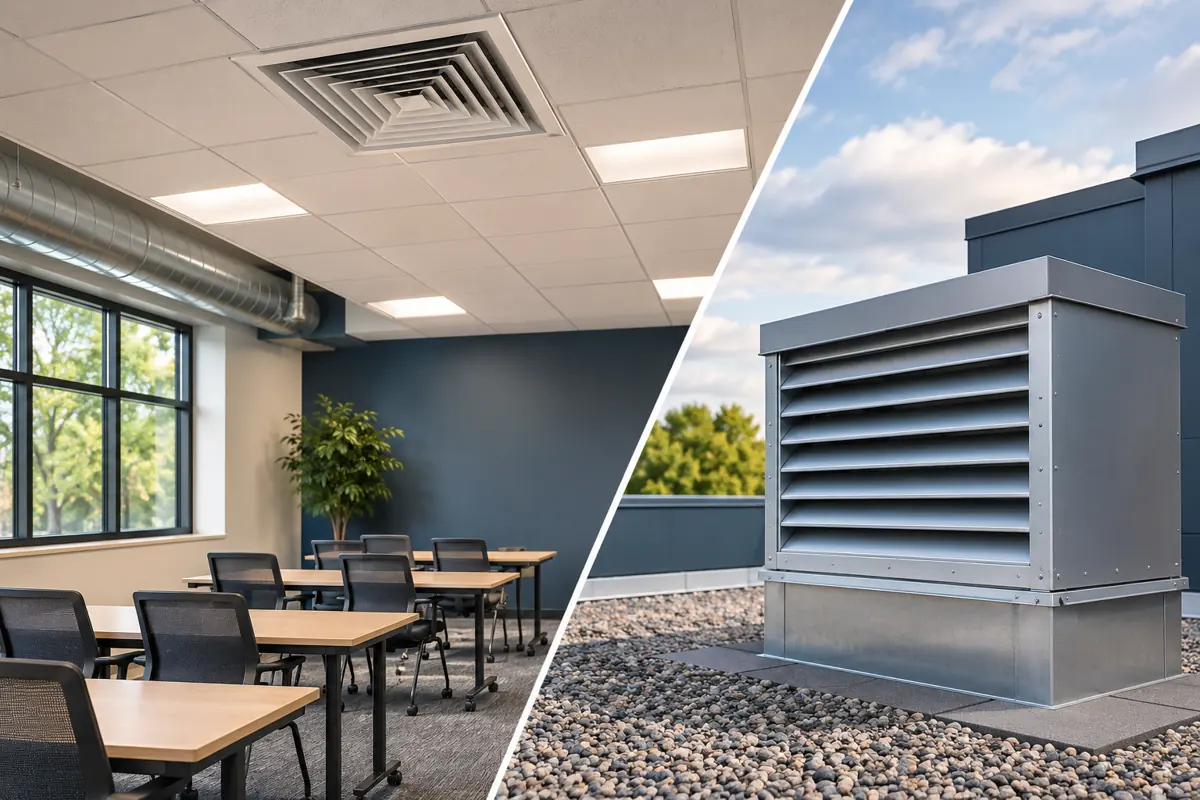
The indoor sample and the outdoor reference describe two different air masses. Take both readings for the same operating interval.
Pair the indoor reading with the air that actually enters
Choose a representative indoor location for the zone being assessed. A room monitor exposed to a jet, an opening or a nearby person's breath can produce a reading that is accurate for its inlet and unsuitable for describing the room. In a large or stratified room, compare multiple occupied locations before choosing a representative value. Identify whether the task is to describe conditions where people sit, characterize a return stream or evaluate a specific mechanical ventilation system.
For a mechanically ventilated room, an outdoor reference should correspond to the intake serving the room. An air quality station across town may describe regional conditions while missing a local plume near that intake. A street-level reading may be unrepresentative of a roof intake. Conversely, a monitor at roof height can miss air entering through a ground-floor entrance. Document where the incoming air originates and whether different paths are active during the observation.
避免将废气污染误认为是普通背景。如果废气重新进入进气口,进气口处的样本可以准确地捕获被吸入的空气,同时揭示单独的通风缺陷。比较受遮蔽的逆风位置和进水口可以帮助确定局部上升的来源。对于即时质量平衡,如果可以可靠地采样,请使用输入流的浓度。为了进行诊断,请将第二次室外观察保留为单独的点。
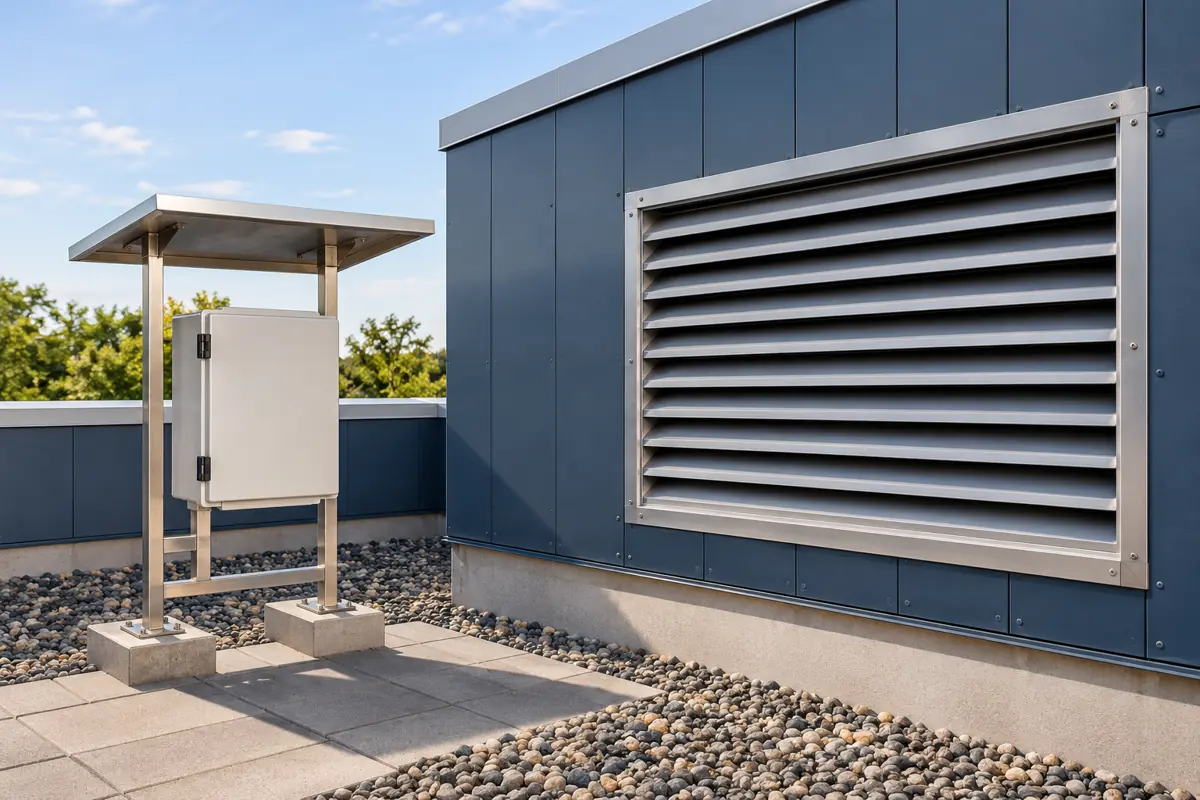
在选择参考之前,确定哪个进气口服务于房间,并注意附近的废气或燃烧源。
固定背景可能适合专门批准的控制或建模程序。对于调查现场比较,并发测量避免假设两次访问之间的背景保持不变。如果只有固定的背景可用,请将其识别为假设的并计算合理变化的影响。假设室内值为 1,050 ppm。假设室外值为 420 和 550 ppm,则过量值分别为 630 和 500 ppm。如果稳态计算中其他条件相同,则基于这些差异的估计值将相差 630/500,即 1.26。
对齐采样和测量系统
为两台仪器设置相同的时钟并保留其本地时间戳。记录记录软件是否存储平均间隔的起点、中点或终点。标有间隔开始的一分钟值与标有结束的五分钟值的配对方式不同。如果建筑系统仅存储变化时的值,请确定长平坦轨迹是否代表稳定信号或仅代表稀疏更新。
Use sufficiently matched response times for the events being analyzed. Outdoor concentrations near a loading area may vary faster than an indoor wall sensor reports. A comparison based on matched averaging windows may be more meaningful than subtracting nominally simultaneous display numbers. Keep the original traces available so a brief local event remains visible. If a common instrument samples both streams through valves or tubing, record each sample's actual time and allow each path to stabilize after a switch.
预测试搭配可以揭示相对偏移。将室内和室外仪器在合适的条件下放在稳定的空气中,等待它们稳定下来,并比较多个间隔。如果可行,请在测试后重复。现场搭配可以在该浓度和条件下显示出相对一致性。检查第二个相关浓度的一致性或对照适当的参考回答了关于跨度和绝对性能的更广泛的问题。
在反转之前了解单区质量平衡
对于混合良好的区域,令 V 为房间体积,Q 为室外交换流量,G 为室内总二氧化碳生成率,C 为室内体积分数,Co 为进入室外的分数。在体积恒定、空气交换平衡、没有其他气流且没有明显汇的简化假设下,关系为 V × dC/dt = G + Q × (Co − C)。使用兼容的体积和时间单位。要在方程式中使用以 ppm 为单位的浓度值,请将其转换为分数,或明确包含一百万因子。
在稳定状态下,累积项 V × dC/dt 为零。重新排列得到 C − Co = G/Q 作为体积分数。如果 ΔC 以 ppm 为单位输入,则相应的估计值为 Q = 1,000,000 × G / ΔC。当所有居住者可以合理地分配相同的平均世代 g 并且所有相关世代都来自居住者时,每人 Q 为 1,000,000 × g / ΔC。这 NIST 关于其室内二氧化碳测量工具的技术说明 给出了动态方程并解释了居住者特征对发电的影响。
充分混合的假设涉及样品和离开控制体积的空气浓度。对于不同浓度的多个输入流,它们各自的流量和浓度贡献属于平衡。从走廊输送的空气可能会携带来自其他地方的二氧化碳。相同浓度的机械室外空气和渗透可能在简化计算中表现为一项有效的室外交换项,但结果不能说明有多少是通过机械进气口的。
混合良好的区域内的再循环和返回时未变化的二氧化碳可以抵消区域平衡。通过另一个占用区域传输的空气会带来不同的成分。混合供应管道浓度同样不同于室外参考。请勿在未知室外空气交换的配方中用供应 CO2 代替室外 CO2。使用测量的供给浓度和合适的回流浓度的天平可以在其自身的假设下回答不同的问题。

居住者数量和活动决定了假设的源项。仅凭人数并不能描述世代。
具有规定假设的工作示例
Take a hypothetical room with six occupants, each assigned 0.0045 L/s CO₂ generation for this calculation, and a concurrent excess of 600 ppm. Assume constant occupancy and activity, a stable incoming outdoor concentration, a representative well-mixed volume, no other sources or sinks, no transfer-air contribution and near-steady conditions. The total generation is 6 × 0.0045 = 0.027 L/s CO₂. Divide by 600 × 10⁻⁶ to obtain 45 L/s outdoor exchange, or 7.5 L/s per person. The generation rate is a selected example input. Actual activity, age, body size and related assumptions affect the calculation.
At the same 600 ppm excess, a selected generation rate of 0.0060 L/s per person would imply 10.0 L/s per person. The calculation changes because the source term changes. A reviewer should therefore report the input and its basis alongside the estimate. A result presented to the nearest hundredth of a liter per second can imply a precision the inputs do not have.
| Constructed case | Indoor and outdoor CO₂ | Assumed generation per person | Inferred flow per person under the model |
|---|---|---|---|
| Reference example | 1,050 and 450 ppm | 0.0045 L/s | 7.5 L/s |
| Higher background | 1,050 and 550 ppm | 0.0045 L/s | 9.0 L/s |
| Higher assumed activity | 1,050 and 450 ppm | 0.0060 L/s | 10.0 L/s |
| Similar difference at higher absolute concentrations | 1,180 and 580 ppm | 0.0045 L/s | 7.5 L/s |
These are inversions of a simple model. The higher-background case does not establish that a real building ventilates more whenever outdoor CO₂ rises. It shows why an indoor value alone is insufficient. The relationship can also be used forward. For a documented target flow, assigned source and outdoor background, calculate an expected concentration trajectory. Compare that trajectory with observations without assuming either tells the whole story.
Wait for a meaningful interval, or model the transient
在有人居住或气流发生变化后,空气需要一段时间才能做出反应。在简单模型中,特征时间为V/Q。如果室外交换为每小时换气1次,则时间常数为1小时。从固定输入下的室外背景开始,在一个时间常数后,超出量约为其最终值的 63%,在三个时间常数后,超出量约为其最终值的 95%。如果源或对照在该小时早些时候发生变化,则持续十分钟的稳定状态不必显示稳定状态。
For a 180 m³ room and 45 L/s outdoor exchange, the flow equals 162 m³/h. The air change rate is 0.9 h⁻¹ and the time constant is about 1.11 hours. With a final difference of 600 ppm, a 30-minute constant occupancy event beginning at outdoor background would reach about 600 × (1 − exp(−0.45)), or 217 ppm above outdoors. Inverting that early difference as if the room were steady would produce about 124 L/s, although the flow in the example remains 45 L/s.
这 NIST Quick Indoor CO₂ tool supports space-specific comparisons at steady state and after a selected elapsed time. For a real building, note whether the initial concentration, occupancy, activity, outdoor reference and airflow can reasonably be represented by the chosen inputs. An apparent mismatch can reflect changing conditions or weak mixing. It can also identify an observation worth testing with more direct methods.
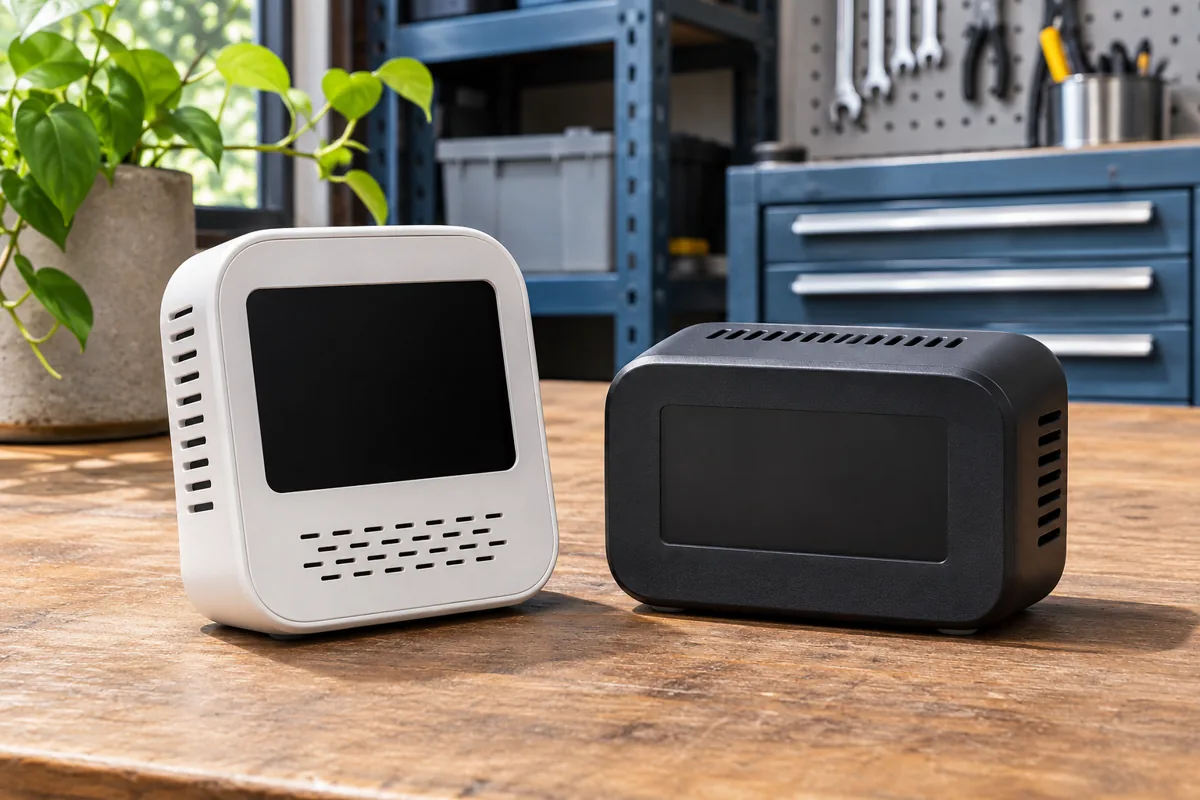
Compare instruments in the same air before using their difference to interpret a room and an intake.
Give the subtraction its own uncertainty check
如果室内传感器读数高 40 ppm,室外传感器读数低 30 ppm,则计算出的过量值高 70 ppm。如果两者都高相同的量,则共同偏移在这些读数处抵消。取消应该被证明而不是假设。独立的发射机可以具有不同的漂移和浓度依赖性。与室内相同设备相比,室外外壳、温度变化或压力差可能会改变性能。
For a simple conservative illustration, suppose each of two sensors has a possible ±50 ppm contribution under the actual test conditions. Allowing the two errors to oppose one another gives a possible ±100 ppm contribution to the difference. This is a bound for that example, without a probability or confidence statement. It excludes additional uncertainty from location, response time, averaging and assumed generation. Read each specification on its stated basis before combining limits.
对于六人示例,600 ppm 的名义差异在所选界限下变为 500 至 700 ppm。保持代数固定,四舍五入后推断的交换范围约为 39 至 54 L/s。该间隔是不对称的,因为流量取决于浓度差的倒数。如果差异小得多,例如标称 100 ppm 且具有可比较的误差容限,则分母可能接近于零。即使空气本身混合良好,所得的估计也可能过于敏感而无法做出决定。
要在做出差异之前正确评估每个设备,请参阅 如何解读二氧化碳监测仪的准确度规格。
Berkeley Lab's commercial-building DCV monitoring research examined field sensor accuracy and selected systems that measured several locations through a common instrument. Some paired differences showed smaller errors than the absolute readings. That observation demonstrates a possible benefit of common instrumentation. It depends on shared error behavior and suitable sampling, with transport delay, leakage and carryover still worth checking.
Deal with near-zero and negative differences
At true steady state under the simplified model, a nonnegative indoor source produces a nonnegative difference. A negative observation should prompt a check of assumptions. An outdoor spike can arrive at the reference before it appears in the room. Indoor and outdoor clocks may be misaligned. An outdoor monitor may be sampling an exhaust plume that does not enter the room. A sensor offset can account for small apparent reversals. These possibilities call for different follow-up measurements.
If the indoor room begins below a changing outdoor background, the difference can briefly be negative during a physically reasonable transient. The steady-state inversion is invalid in that interval. Keep the observation in the data record along with its flags. Removing it solely because it disagrees with expectations can hide an outdoor reference problem.
A small positive excess can also have several meanings. A lightly occupied space may emit little CO₂. A space can have high outdoor exchange, or a local supply current may dilute the indoor sampling point. In a nearly empty space there may be too little signal to use occupant generation as a tracer. The useful response is to compare against the full operating context or use an independent method, rather than divide by a poorly determined number.

The one-zone calculation treats the room as one mixed volume. Multiple air streams or uneven concentrations call for additional evidence.
将测量记录与决策联系起来
从观察开始,并单独标记下一个推论。实用记录包括时间窗口、室内和室外位置、仪器 ID、平均和质量标志、占用和活动、室外空气模式、相关门窗以及浓度是否发生变化。它还记录了考虑到不确定性而哪些差异是合理的以及哪些问题仍然悬而未决。如果同一调查随后依赖于新的通风设计,则保存的记录允许重建比较。
| 证据级别 | 有用的结果 | 记录的条件 |
|---|---|---|
| 时间对齐的配对观察 | 室内样本比传入参考值高出规定的 ppm 数 | Sample locations, times, units, instrument checks |
| Comparison of repeat periods | Excess changed under a documented occupancy and operating context | Comparable instrument response, source activity and room state |
| Forward model comparison | Observed rise is broadly consistent or inconsistent with a specified airflow and source | Starting concentration, source, room volume, outdoor concentration and airflow assumptions |
| Conditional airflow estimate | A bounded one-zone exchange estimate for a near-steady period | Source magnitude, mixing, air paths, equilibrium and measurement error |
| Mechanical ventilation acceptance | Outdoor airflow or delivery meets the project method and criterion under tested modes | Appropriate independent measurements, equipment boundaries, system state and governing criteria |
对于由可变系统服务的房间,先分别绘制室外浓度和室内浓度,然后再绘制它们的差异。否则,差异的变化可能会被误读为室内趋势。添加已知的 HVAC 模式和占用事件。如果控制器在此期间改变气流,总结每种模式持续的时间。避免将一种模式的摄入基线与另一种模式的室内数据相结合。
Consider a room assessment with 520 ppm outdoors and 1,110 ppm indoors during a crowded hour. That is an observed 590 ppm excess. The same room gives an apparent excess of 710 ppm if an earlier 400 ppm background is used. A good record shows both the actual paired result and any comparison scenario that uses a fixed assumption. The specific flow question comes after reviewing whether the occupants and airflow remained stable long enough, and whether the sampled air represents the occupied volume.
When another method is needed
Use the CO₂ difference to target the next measurement. If the question concerns whether an outdoor damper meets a specified flow, measure outdoor air at the relevant equipment boundary using the applicable procedure. If the question concerns room distribution or interzone exchange, use additional sampling or a suitable tracer method. If the question concerns particles, odors or an indoor source other than human respiration, use measurements that address those hazards or emissions directly.
这 ASHRAE 室内二氧化碳立场文件 和 ASTM D6245 public scope explain why a single CO₂ number does not describe ventilation and overall indoor air quality in every space. An indoor–outdoor difference is more interpretable than a lone indoor reading when its reference and assumptions are documented. A mass-balance result still describes the boundary and conditions selected for the analysis.
Decide which part of the time series supports the comparison
A practical analysis can begin with a table of candidate intervals. For each interval, summarize the source activity, outdoor reference variability, sample validity, HVAC mode and whether the indoor value still has a sustained slope. Choose the analysis window based on the assumptions before looking for agreement with a desired number. If no candidate satisfies the conditions for inversion, report the observed differences and use the data to select a better measurement.
For example, consider a steady indoor concentration during an hour when people continue to enter and the outdoor-air damper opens in response. A stable value could reflect increasing generation balanced by increasing outdoor flow. A second hour might show the same average concentration with fixed occupancy and flow. The two windows have the same mean while carrying different evidence about steady operation. Review time-aligned occupancy and mode rather than treating low variability in concentration as proof that all model inputs were constant.
Outdoor variation also requires attention. When the incoming reference rises suddenly, the room responds over a mixing and air-exchange timescale. Subtracting the latest outdoor reading gives the concurrent difference at the sample points, which is useful to record. Treating that subtraction as a steady-state quantity immediately after the rise ignores the room's earlier background and accumulation. If a forward model includes varying outdoor concentration, use the measured input time series and state the model resolution.
Record concentration basis and units
Instrument outputs often use the convenient display abbreviation ppm. Confirm that the two points represent carbon dioxide on the same basis and use the same effective scaling. A controller could report an analog range conversion while a portable instrument displays its own compensated measurement. Verify documented environmental compensation and any correction applied upstream. A meaningful subtraction starts with comparable quantities and a clear record of how each value was obtained.
Similarly, keep the units of G and Q paired. If generation is entered in liters of CO₂ per second, express ventilation in liters of air per second before converting to another unit. An airflow calculated in cubic meters per hour cannot be compared directly with a design in liters per second. For a report, carry full precision through the arithmetic, then round the presented result to reflect uncertainty in generation and concentration.
Interpret a trend comparison between different room uses
Imagine two sessions with nearly equal occupancy counts and ventilation operation. The first is mostly seated work. The second alternates talking and movement. An observed rise in excess during the second session can reflect a larger source term even if the outdoor flow is unchanged. A repeat study can use a more detailed activity log, compare the same activity on different days, or use independent airflow evidence. That choice depends on whether the question concerns activity, ventilation performance, or both.
If the question is simply whether conditions changed after a maintenance action, a repeated comparison under similar use can be useful even without an absolute generation estimate. Name the observation precisely. For example, describe a lower occupied indoor–outdoor difference after the change during comparable sessions. This supports a narrower conclusion than a claimed increase in measured outdoor air.
常见问题
Is 600 or 700 ppm above outdoors a universal target?
Those values can appear in specific guidance or examples. The relationship depends on occupant generation, room use, ventilation requirements and the relevant edition or method. Use the governing criterion for a project and treat a generic example as conditional.
Can I measure outside after the room test and subtract that value?
A later sample can help describe background if it is stable and comes from the relevant incoming air. A synchronized sample is stronger evidence. Local emissions, wind and changes in the active intake can make the later value unrepresentative of the earlier indoor interval.
Can I calculate air changes per hour directly from the difference?
The steady-state difference yields an exchange flow only when generation and the model assumptions are available. Divide that flow by the defined room volume in compatible time units to obtain an air-change estimate. The resulting value describes the exchange represented by the model.
Does a low excess establish that a room is healthy?
It can be consistent with low occupant emissions relative to air exchange during the observation. It leaves other contaminant sources, particle filtration and uneven air distribution to separate evaluation.
What if the room has two independent outdoor air paths?
Identify both paths and their concentrations. If incoming concentrations are essentially equal, the simple model may represent their total exchange under the remaining assumptions. If the concentrations differ or one path carries transfer air, use a balance that accounts for the individual terms or use a more direct measurement.







发表评论