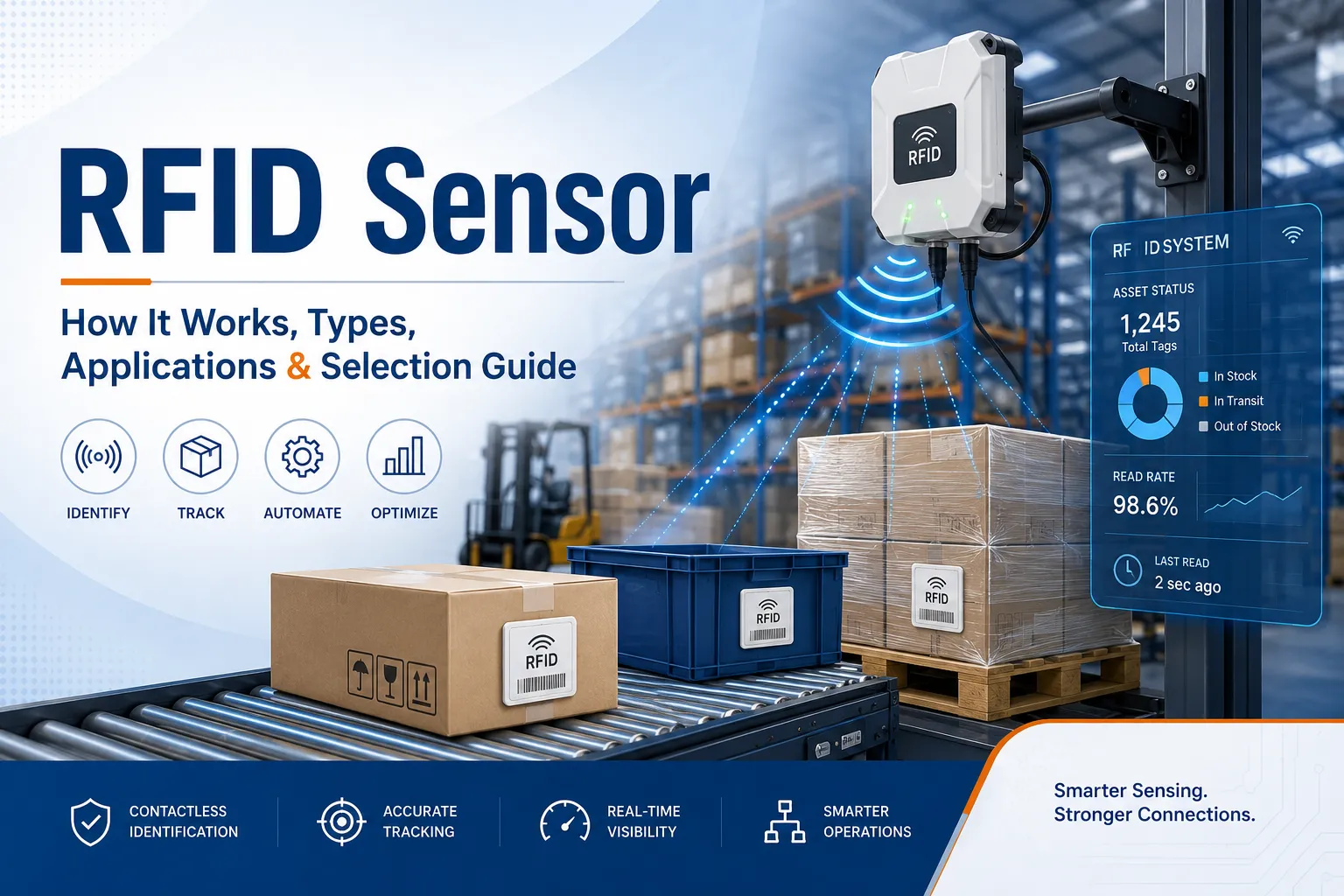
RFID 传感器将无线识别与自动数据收集相结合,使企业能够识别、跟踪和管理对象,而无需手动扫描每件物品。

它们广泛应用于仓库、制造设施、医院、零售店、图书馆、交通系统和工业资产管理项目。与传统条形码相比,RFID 系统并不总是需要直接视线,并且可以读取同一读取区域内的多个标记物体。

However, the term “RFID sensor” can have more than one meaning. It may refer to an RFID reader that detects nearby tags, or to an RFID tag equipped with a sensing element that measures temperature, humidity, pressure, motion or other environmental conditions.

Understanding this distinction is important when selecting RFID equipment for a new project.

What Is an RFID Sensor?

An RFID sensor is a wireless device or system that uses radio-frequency identification technology to detect, identify or monitor tagged objects.

A standard RFID system normally includes:

  • RFID tags attached to the objects
  • An RFID reader or interrogator
  • One or more RFID antennas
  • Communication interfaces
  • Middleware or management software
  • A database, ERP, WMS or other business platform

The reader sends a radio-frequency signal through the antenna. When a compatible tag enters the reading field, it responds with stored information such as a unique identification number.

The software then associates that identification number with a specific product, pallet, tool, document, vehicle, employee badge or piece of equipment.

RFID Reader vs RFID Sensor Tag

Although the terms are sometimes used interchangeably, an RFID reader and an RFID sensor tag perform different functions.

RFID Reader

An RFID reader communicates with nearby RFID tags. Depending on the application, it may be:

  • A fixed RFID reader
  • An integrated RFID reader
  • A desktop reader
  • A handheld terminal
  • A gate reader
  • An embedded RFID module

The reader collects tag information and transfers it to the connected software system.

RFID Sensor Tag

An RFID sensor tag contains an RFID chip, antenna and one or more sensing elements.

In addition to transmitting identification data, it may collect information such as:

  • 温度
  • 湿度
  • 压力
  • 振动
  • Shock
  • Strain
  • Moisture
  • Light exposure
  • Gas concentration
  • Open or closed status

For example, an RFID temperature sensor tag can identify a pharmaceutical package while also recording whether it has been exposed to temperatures outside the permitted range.

How Does an RFID Sensor Work?

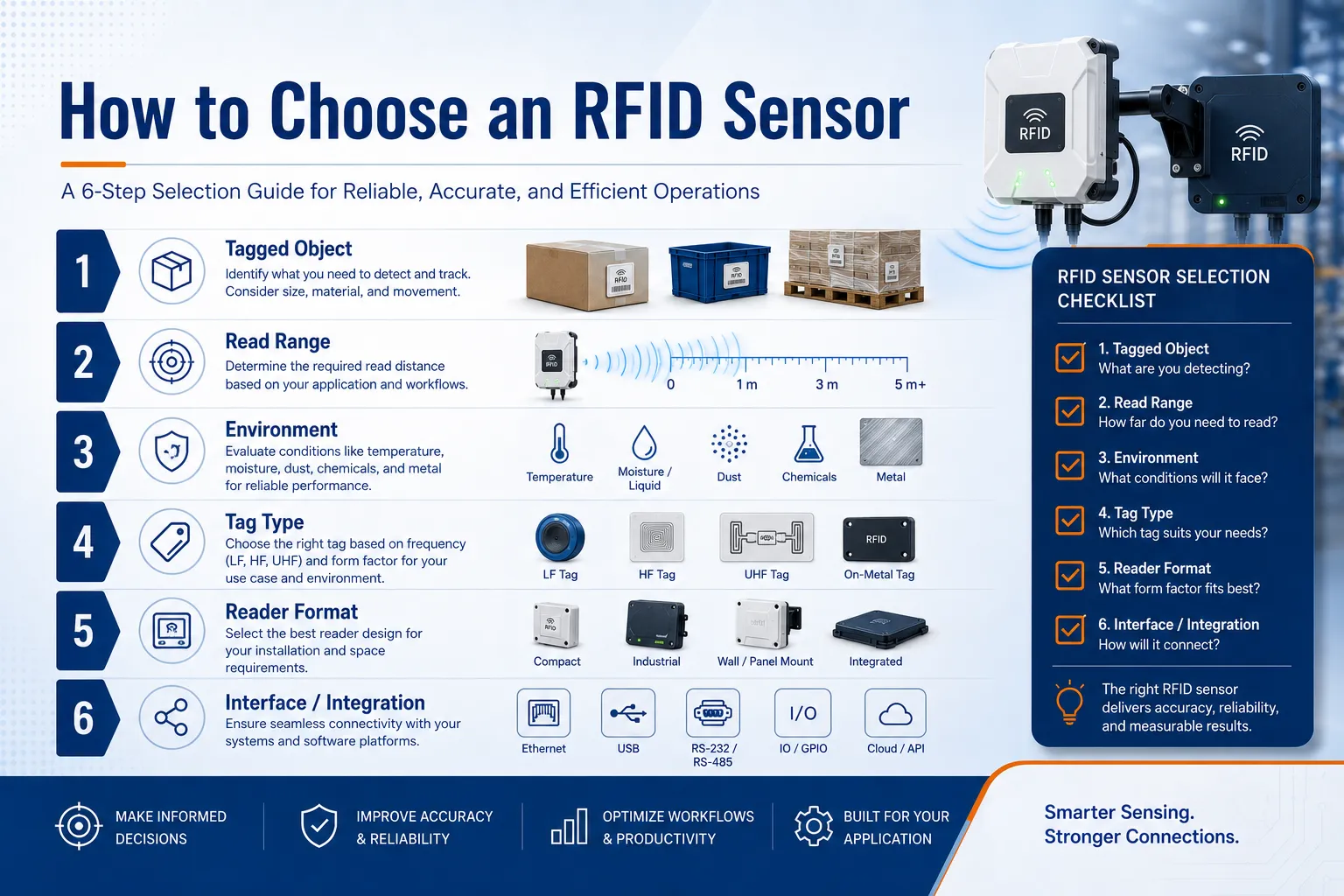
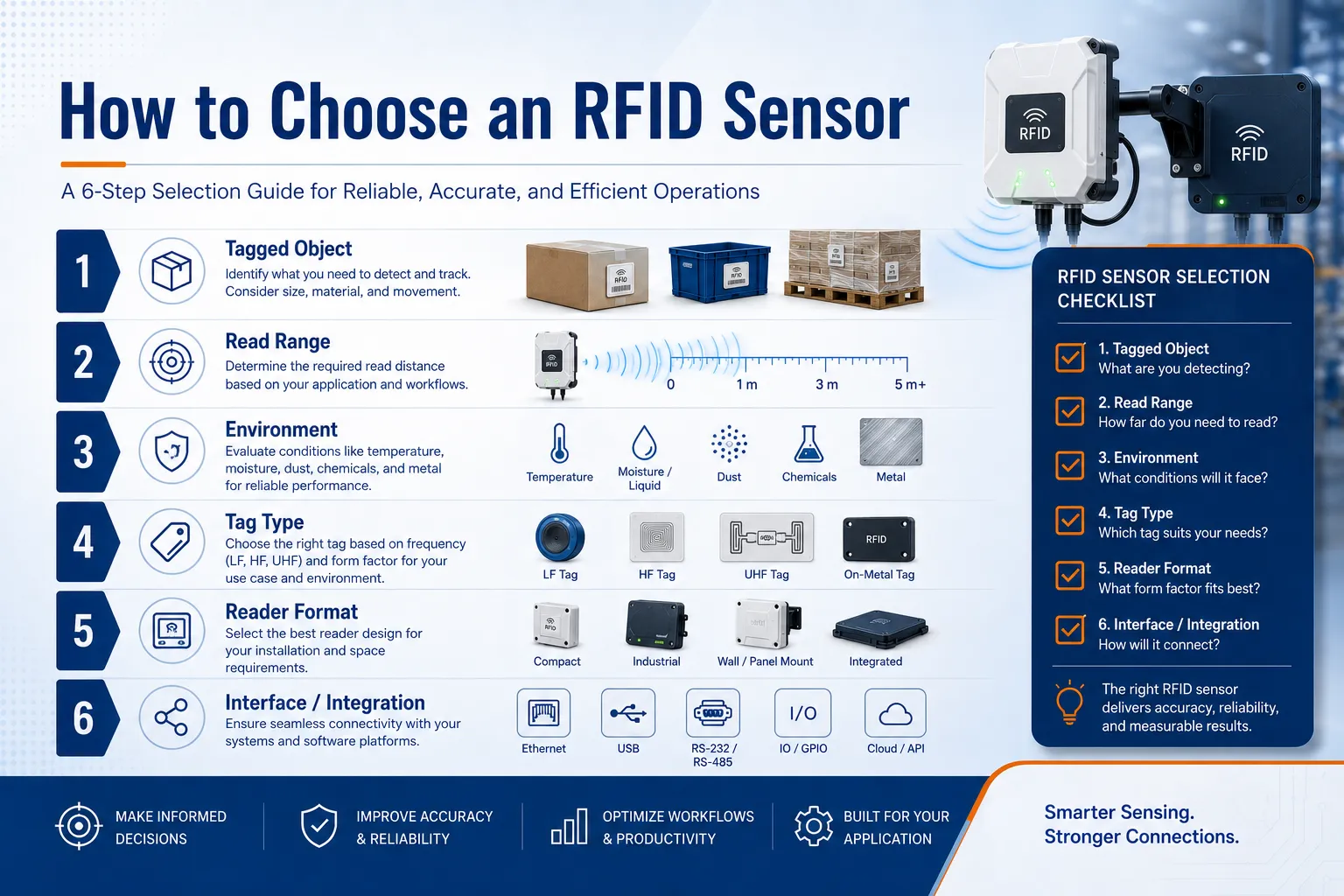
How to Choose an RFID Sensor

A typical RFID sensing process includes five stages.

1. The Reader Generates a Radio Signal

The RFID reader generates a radio-frequency signal and sends it to an antenna.

2. The Antenna Creates a Reading Field

The antenna converts the electrical signal into radio waves and creates a defined RFID reading zone.

3. The RFID Tag Enters the Field

When a compatible tag enters the reading zone, it receives the reader signal.

Passive tags obtain operating energy from the reader’s radio-frequency field. Active tags use their own internal batteries.

4. The Tag Transmits Its Data

The tag responds with information stored in its memory. Depending on the tag, this may include:

  • Electronic Product Code
  • Tag identification number
  • Product data
  • Batch information
  • Maintenance records
  • Sensor measurements

5. The Software Processes the Information

The reader transfers the collected information to a computer, server, cloud platform or industrial controller.

The software can then update inventory records, trigger an alarm, open a gate, record a production step or send information to an ERP or warehouse-management system.

Main Types of RFID Sensors

RFID sensors can be classified by power source, frequency band, reader configuration and sensing capability.

Passive RFID Sensors

Passive RFID tags do not contain an internal battery. They receive energy from the RFID reader’s electromagnetic field.

Their main advantages include:

  • Compact construction
  • Low unit cost
  • Long operating life
  • Minimal maintenance
  • Availability in many shapes and materials
  • Suitability for large-scale deployment

Passive RFID is commonly used for:

  • Retail inventory
  • Warehouse management
  • 产品标识
  • 刀具追踪
  • 文件管理
  • 图书馆系统
  • 洗衣和纺织品追踪
  • 门禁卡

实际读取距离取决于频率、阅读器输出、天线设计、标签结构、安装环境和标签材料。

有源 RFID 传感器

有源 RFID 标签包含自己的电池,可以在更远的距离内传输信号。

他们经常被选为:

  • 车辆追踪
  • 大型设备监控
  • 集装箱管理
  • 建筑工地
  • 采矿作业
  • 人员所在地
  • 实时定位系统
  • 高价值资产追踪

有源RFID标签通常提供更长的通信距离和更频繁的数据传输,但它们比无源标签更大且更昂贵。

它们的电池的使用寿命也有限。

电池辅助无源 RFID 传感器

Battery-assisted passive, or semi-passive, RFID tags contain a battery that powers the internal chip or sensing element.

Unlike a fully active tag, communication may still depend on receiving an interrogation signal from the RFID reader.

This design is useful when an application requires:

  • Improved sensing performance
  • Periodic environmental measurements
  • Longer reading distance than standard passive tags
  • Lower power consumption than active systems

Battery-assisted RFID sensor tags are frequently considered for cold-chain, pharmaceutical and environmental-monitoring applications.

Chipless RFID Sensors

Chipless RFID sensors do not use a conventional integrated circuit. Instead, the tag structure changes its electromagnetic response according to the measured condition.

Potential applications include:

  • Moisture detection
  • Structural monitoring
  • Temperature indication
  • Food packaging
  • Low-cost disposable sensing

Chipless RFID remains more specialized than conventional chip-based RFID and may require application-specific readers and signal-processing methods.

RFID Frequency Bands

The operating frequency affects reading distance, data rate, tag size, environmental performance and regional compliance.

Low-Frequency RFID

Low-frequency RFID is commonly used for short-distance identification.

Typical applications include:

  • Animal identification
  • Vehicle immobilizers
  • Access control
  • Industrial identification

LF systems generally perform relatively well around water and some challenging materials, but they normally provide shorter reading distances and lower data speeds.

High-Frequency RFID

High-frequency RFID includes systems commonly operating at 13.56 MHz.

Typical applications include:

  • Smart cards
  • 图书馆管理
  • 售票处
  • 产品认证
  • 近场通讯
  • Access control

HF RFID 提供受控的短距离通信,适用于需要有意的用户交互的应用。

超高频 RFID

UHF RFID 广泛应用于物流、零售、制造和仓库自动化。

其优点包括:

  • 读取距离更远
  • 快速标签识别
  • 高读取吞吐量
  • 支持多个标签
  • 低成本无源标签的可用性

UHF RFID 性能可能会受到金属、液体、标签方向和干扰的影响。因此必须根据实际安装环境来选择和放置天线和标签。

常见的 RFID 传感器应用
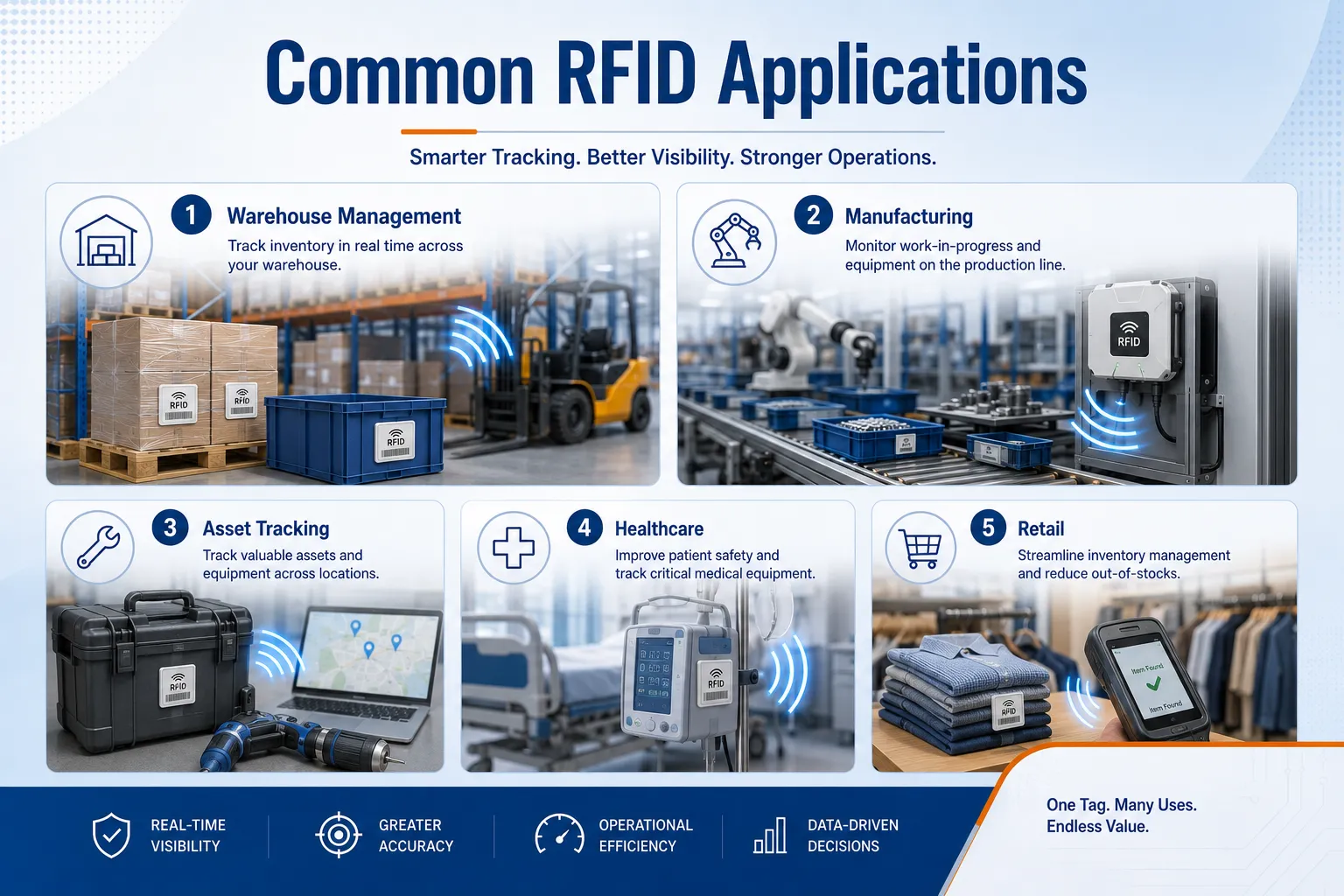
Common RFID Applications

库存管理

当带标签的产品、纸箱和托盘在仓库或配送中心移动时,RFID 传感器可以自动识别它们。

该系统可以支持:

  • 接收验证
  • 库存盘点
  • 入库确认
  • 拣货验证
  • 发货检查
  • 周期盘点
  • 库存管理

由于在一个读取区域中可以检测到多个标签,RFID 可以减少大批量操作中所需的手动扫描量。

工业资产追踪

公司可以将 RFID 标签贴在工具、仪器、模具、测试设备和其他有价值的资产上。

放置在储藏室、生产入口或车间出口的 RFID 阅读器可以记录资产何时进入或离开受控区域。

这有助于组织:

  • 更快速地定位设备
  • 减少损失
  • 提高工具可用性
  • 记录资产利用率
  • 支持校准管理
  • 改进维护计划

制造和在制品跟踪

RFID传感器可以识别不同生产站的组件、载体和工件。

收集的数据可用于:

  • 验证材料是否正确
  • 记录制作步骤
  • 防止装配错误
  • 跟踪正在进行的工作
  • 将产品与检验结果关联起来
  • 提高生产可追溯性

当条形码在生产过程中容易损坏、污染或隐藏时,RFID 特别有用。

冷链监控

RFID传感器标签可以将产品识别与温度或湿度监控结合起来。

应用包括:

  • 疫苗
  • 药物
  • 生物样本
  • 生鲜食品
  • 冷冻产品
  • 化学品
  • 温度敏感电子产品

该系统可以将每个环境记录连接到特定的货物、集装箱或包裹。

然而,RFID 传感器系统不应自动被视为经过认证的数据记录器的替代品。必须针对每个应用评估所需的精度、校准、采样间隔和监管文件。

医疗保健和实验室管理

医院和实验室使用 RFID 来:

  • 医疗设备追踪
  • 样品鉴定
  • 药品管理
  • 患者身份识别
  • 手术器械跟踪
  • 血液制品可追溯性
  • 布草管理

RFID 可以减少搜索设备的时间并提高复杂医疗保健工作流程的可视性。

零售和服装

零售商可以将 UHF RFID 标签粘贴到单个产品和服装上。

RFID 支持:

  • 快速盘点库存
  • 商品级库存可见性
  • 补货
  • 订单履行
  • 自助结账
  • 退货验证
  • 防损分析

RFID 对于同时经营实体店和在线销售渠道的企业尤其有价值,因为准确的库存数据支持全渠道履行。

访问控制和人员识别

RFID 卡、钥匙扣、腕带和徽章可用于识别授权人员。

常见应用包括:

  • 办公室访问
  • 工厂入口
  • 酒店客房
  • 活动
  • 校园管理
  • 停车系统
  • 会员制度

敏感的访问控制项目应将 RFID 识别与适当的加密、身份验证、权限管理和审计记录相结合。

洗衣和纺织品追踪

可清洗的 RFID 标签可以集成到制服、酒店布草、医院纺织品和工业服装中。

系统可以记录:

  • 纺织品所有权
  • 洗涤周期
  • 分配
  • 收藏
  • 排序
  • 替代品
  • 损失

The selected tag must tolerate the expected washing temperature, chemicals, pressure, drying process and mechanical stress.

RFID Sensor Advantages

No Direct Line of Sight Required

RFID tags may be detected without placing a printed code directly in front of a scanner.

Multiple Tags Can Be Read

A properly designed RFID system can identify multiple tags within a reading zone.

Automated Data Collection

Fixed readers can collect data as objects pass through doors, conveyor points, production stations or warehouse gates.

Unique Item Identification

Individual items can carry unique electronic identifiers, even when the products appear physically identical.

Rewritable Memory

Some RFID tags allow authorized systems to update selected memory fields.

Flexible Tag Designs

RFID tags are available as:

  • Adhesive labels
  • Hard tags
  • Cards
  • Key fobs
  • Wristbands
  • Laundry tags
  • Cable-tie tags
  • On-metal tags
  • High-temperature tags
  • Embedded tags

RFID Sensor Limitations

RFID is not automatically suitable for every tracking project.

Metal and Liquid Interference

Metal surfaces can reflect radio waves, while liquids can absorb RF energy. These effects are especially important in UHF RFID systems.

On-metal tags, spacers, specialized antennas and installation testing may be required.

Unwanted Tag Reads

A reader may detect tags outside the intended area when the reading zone is not properly controlled.

Reader power, antenna direction, shielding and software filters must be configured carefully.

Tag Orientation

The angle between the reader antenna and tag antenna can affect read performance.

当标签方向不可预测时,圆极化天线可能会有所帮助,但应用测试仍然是必要的。

系统集成

RFID 数据必须连接到业务流程。仅安装读卡器并不能创建完整的库存或资产管理解决方案。

中间件和软件必须处理:

  • 重复读取
  • 过滤
  • 事件逻辑
  • 数据验证
  • 设备管理
  • 数据库集成
  • 异常处理

隐私和安全

RFID 系统可以处理与产品、员工、客户或访问权限相关的信息。

项目应考虑:

  • 数据加密
  • 验证
  • 标签内存保护
  • Access control
  • 网络安全
  • 数据保留政策
  • 相关隐私要求

RFID 传感器与条形码

特征射频识别传感器条码
阅读方法射频通讯光学扫描
视线通常不需要必需的
多项目阅读许多系统都支持通常一次一个代码
读取距离取决于 RFID 类型和配置通常较短
标签成本一般较高一般较低
印刷可见度不需要打印的代码必须保持可读
记忆可能包含可写字段通常固定打印数据
金属和液体敏感性会影响性能通常受影响较小
系统复杂度更高降低

RFID 和条形码技术并不总是需要竞争。许多项目都使用两者。

例如,RFID 标签还可以包括打印的条形码,以便员工在 RFID 设备不可用时可以手动扫描物品。

How to Choose an RFID Sensor

How to Choose an RFID Sensor 1

在购买RFID硬件之前,明确项目条件。

1. 识别对象

确定要标记的内容:

  • 个别产品
  • 纸箱
  • 托盘
  • 工具
  • 文件
  • 车辆
  • 人们
  • 动物
  • 金属设备
  • 液体容器

标记的材料直接影响标记的选择。

2. 定义所需的读取距离

桌面编码站可能只需要较短的读取距离,而仓库大门或车辆管理项目可能需要更大的受控读取区域。

读取距离并不总是越长越好。范围过大可能会产生不需要的读取。

3.确定标签数量

估计一次读取区域中可能存在多少个标签。

高密度应用需要合适的读取器性能、天线放置和软件过滤。

4. 评估环境

考虑:

  • 室内或室外安装
  • 灰尘
  • 化学品
  • 振动
  • 影响
  • 极端温度
  • 金属结构
  • 附近的无线设备

Industrial applications may require rugged enclosures, specialized tags and protected cable connections.

5. Select the Reader Format

Choose between:

  • Embedded RFID module
  • Desktop reader
  • Integrated reader
  • Fixed multi-port reader
  • Handheld reader
  • Access gate
  • Intelligent RFID device

For projects requiring readers, modules, handheld terminals, antennas or UHF tags, the available RFID hardware solutions from Syncotek can provide a useful starting point for comparing different device formats. Syncotek’s RFID category includes UHF modules, integrated readers, fixed readers, desktop readers, access gates, handheld devices, antennas and RFID tags.

6. Confirm Communication Interfaces

Common interfaces include:

  • USB
  • RS232
  • RS485
  • 以太网
  • Wi-Fi
  • 蓝牙
  • Wiegand
  • GPIO
  • uart

The selected interface must be compatible with the control system, computer, access controller or industrial network.

7. Check Regional Frequency Requirements

UHF RFID frequency allocations and permitted transmission power differ by country or region.

Hardware must support the regulations of the installation location. Do not select a reader only according to its maximum advertised distance.

8. Conduct an On-Site Test

RFID performance depends on the complete environment.

A proper test should use:

  • The actual tagged objects
  • The intended tags
  • The planned reader
  • The planned antennas
  • Realistic object speed
  • Realistic tag quantity
  • The final installation location

Testing several tag models is often more reliable than selecting a tag only from a specification sheet.

常见问题

Is an RFID Reader a Sensor?

RFID 读取器可以被视为一种传感或检测设备,因为它可以检测 RFID 标签并与之通信。

然而,它不一定测量环境变量。真正的 RFID 传感器标签包括用于温度、湿度、压力或其他物理条件的附加传感元件。

RFID 传感器可以在没有电池的情况下工作吗?

无源 RFID 标签无需内置电池即可工作。它们从阅读器的射频场接收工作能量。

有源和电池辅助的 RFID 传感器使用电池来支持更远的范围、重复测量或自主数据收集。

RFID 传感器可以穿墙读取数据吗?

RFID信号可以穿过某些非金属材料,但性能取决于频率、墙壁材料、读取器功率、天线设计和周围环境。

未经测试,不应假设 RFID 可以穿墙可靠运行。

RFID 传感器可以用于金属吗?

是的,但标准 RFID 标签直接贴在金属上时通常表现不佳。

金属 RFID 标签包括隔离或调整天线以在金属表面上运行的结构。

RFID 传感器可以读取多远?

所有 RFID 系统都没有单一的读取距离。

读取范围取决于:

  • 频率
  • 被动或主动操作
  • 读卡器输出
  • 天线增益
  • 标签灵敏度
  • 标签方向
  • 安装环境
  • 地方法规

实际读取距离应在最终应用中进行验证。

Can RFID Sensors Measure Temperature?

Yes. RFID temperature sensor tags combine an RFID interface with a temperature-sensing element.

Depending on the design, the tag may transmit a current reading, store historical measurements or provide a threshold indication.

Is RFID Better Than a Barcode?

RFID is useful when a project requires automatic identification, multiple-tag reading, non-line-of-sight operation or more durable identification.

Barcodes remain suitable when low cost, visual identification and simple one-at-a-time scanning are the main requirements.

结论

RFID sensors provide a flexible way to connect physical objects with digital management systems.

A basic RFID system can automatically identify products and assets, while advanced RFID sensor tags can also monitor environmental conditions such as temperature, humidity, vibration or pressure.

Successful deployment depends on more than selecting a reader with the longest advertised range. Businesses must evaluate the tag material, frequency, object movement, reading zone, antenna placement, communication interface, software integration and regional regulations.

By testing the complete system under real operating conditions, organizations can build an RFID solution that improves traceability, inventory visibility, asset utilization and process automation.

发表评论

您的电子邮件地址不会被公开。 必需的地方已做标记 *