
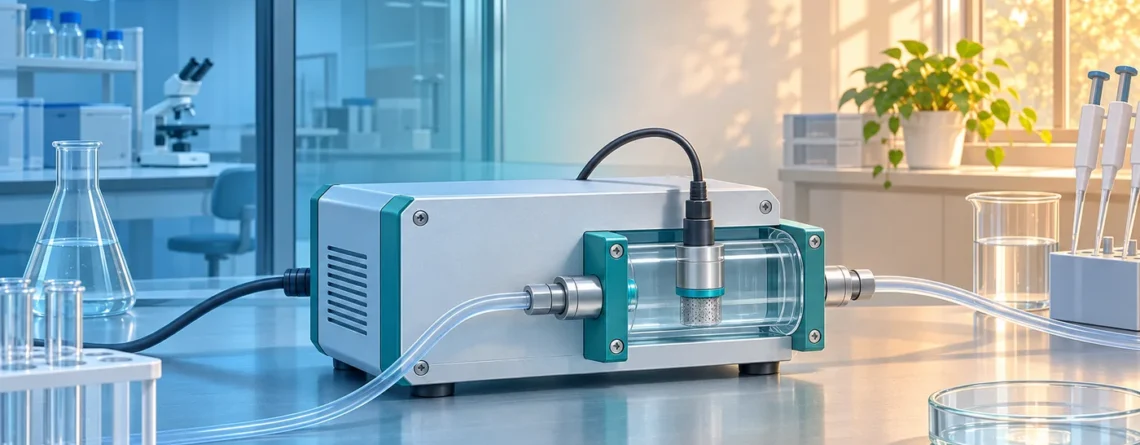
Temperature can change an oxygen sensor's sensitivity, the behavior of its compensation system and the condition of the sample reaching it. During a rapid temperature change, unequal thermal response can also create a temporary reading error that does not follow the steady-state correction curve. The direction, magnitude and recovery depend on the technology, model and installation.
较温暖的气体样品不会自动包含较低的氧气含量。成分、分压和分子密度描述了不同的量。加热可以改变一种气体,同时使另一种保持不变,具体取决于气体是密封的、压力控制的、加湿的还是发生化学反应的。在将变化的氧气读数称为温度错误之前,请确定仪器报告的数量以及气体本身是否发生变化。
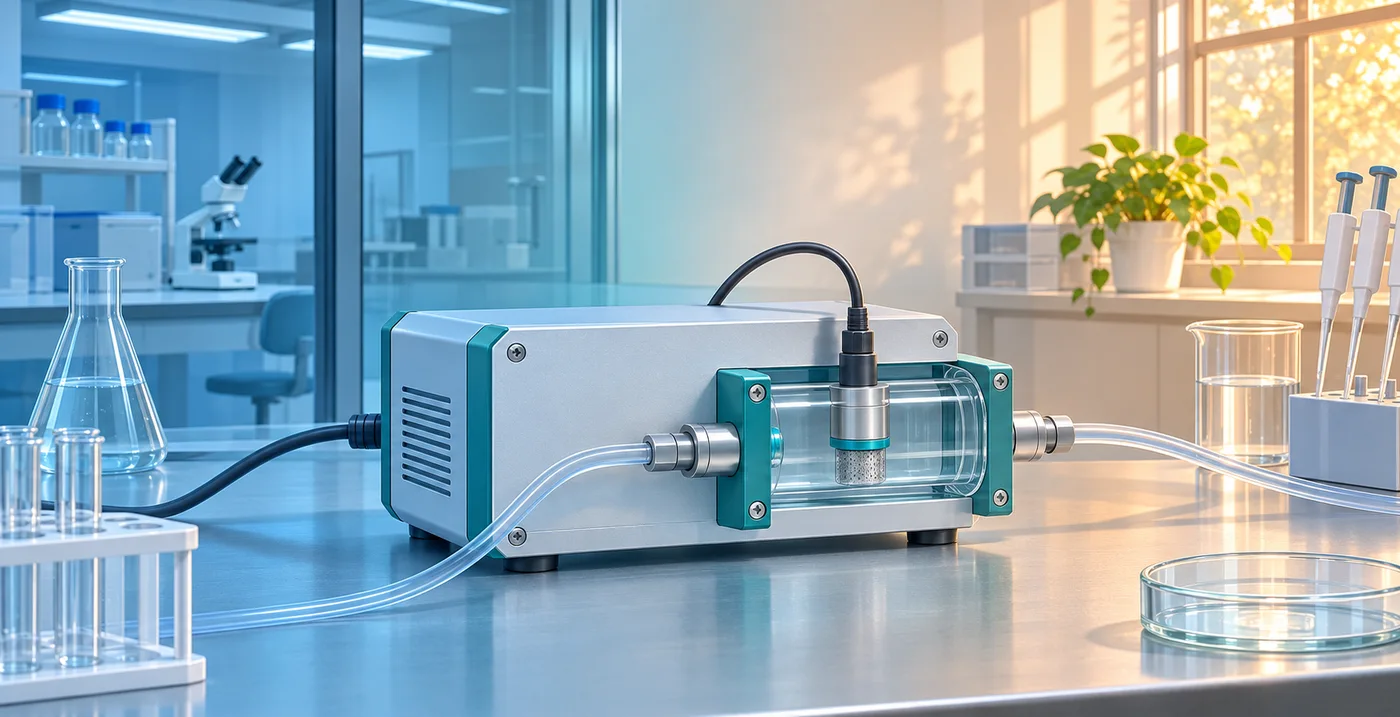
概念热转变:空气、外壳、传感元件和补偿温度计不需要一起达到新的温度。
在解释读数之前区分四个温度
氧气测量可涉及至少四个相关温度:源气体、传感元件处的气体、传感元件本身以及补偿所使用的温度。在固定安装中它们可能几乎相等。它们在过渡期间可能会有很大差异。
源温度描述了正在采样的过程或房间。池气体温度描述了气体通过管道、过滤器和室后的温度。热源样品可以在到达传感器之前冷却。冷样品可以在柜子中加热。这种差异对于冷凝以及在某些系统中的化学行为很重要。
传感器温度描述了影响其响应的物理状态。外壳可以在周围空气冷却后保留热量,并且内部加热的传感器有意在高于进入气体温度的温度下工作。因此,补偿所需的值不一定是源温度。
补偿温度是算法或电路中使用的数字。它可能来自内部元件、附近的热敏电阻或主机提供的测量。如果它遵循与传感机制不同的热路径,则在环境之间移动期间平衡后起作用的校正可能是错误的。
有用的诊断记录会列出所有四个字段,而不是存储称为温度的单个字段。如果只有一个可测量,请说明其位置。这避免了将柜式温度计视为氧电池已稳定的证据。
加热会改变实际的氧气浓度吗?
对于没有添加、去除或泄漏的非反应混合物,当温度变化时,其氧摩尔分数保持不变。气体状态仍然可以改变。在固定压力下,较温暖的气体具有较低的分子密度。在密封的刚性体积中,加热反而会提高总压力。
氧分压是氧分数乘以总压。因此,即使氧气含量不变,分压传感器也可以响应压力变化。将分压转换为氧气百分比的仪器必须使用适当的总压基础。
水创造了另一条实现真正成分变化的途径。在保持总压的情况下添加水蒸气可减少原始干燥气体所占的比例。除去水会再次改变基础。只是降低相对湿度的加热不同于增加水分子的加湿。
当过程样品被冷却时,这种区别特别有用。如果冷却导致水冷凝并被除去,则剩余气体不再具有原始的湿基成分。氧气含量可以增加,而不会产生任何传感器增益误差。如果目标气体也损失或发生反应,则简单的水分转化可能是不够的。
这 SST 氧化锆工作原理指南 明确区分其覆盖的传感器的氧分压和氧百分比。在应用任何通用温度校正之前应该解决这种区别。
为什么电化学氧传感器需要针对型号进行处理
电化学是一个广泛的技术标签。在一些设计中,氧气通过膜的传递强烈影响响应。其他设计使用小毛细管作为控制传输路径。这些布置不具有可互换的温度行为。
Alphasense 应用说明 AAN 005 contrasts these mechanisms. It relates the capillary-controlled family's response to gas transport and provides family-specific compensation information. It also explains that fast thermal changes can produce temporary currents and that compensation temperature should be sensed near the appropriate part of the cell.
设计含义比任何单一系数都更广泛:确定限制氧气传输的因素以及制造商如何表征整个传感器。膜控制电池的系数不应应用于毛细管控制产品,因为两者都会产生电流。
还可以区分原始细胞和完整检测器。检测器可能已经使用温度测量、工厂表征或附加诊断来校正电池输出。将主机校正添加到显示的百分比可以复制属于仪器内部的校正。
Long-term environmental effects are a separate question. A temporary peak after a temperature step does not by itself establish permanent damage, and a stable reading after recovery does not prove that an exposure outside the rated conditions was harmless. Use the exact model's operating, storage and recovery instructions.
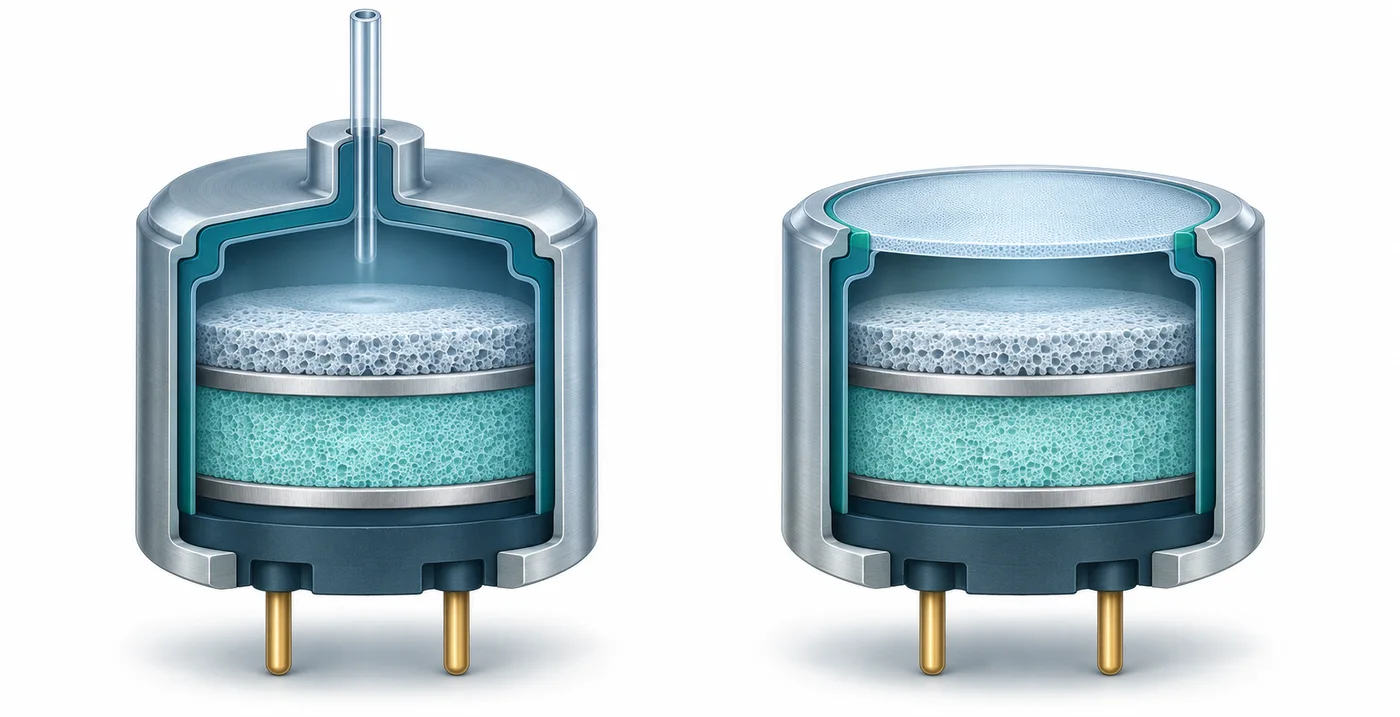
概念传输路径:毛细管控制的细胞和膜控制的细胞对温度的反应不同。该插图并非特定产品的结构图。
光学氧传感仍存在热条件
基于发光的氧传感使用氧敏感光学材料和测量的光学响应。材料响应及其与氧气的相互作用取决于温度。模块可以在内部补偿这些影响,但这并不能消除安装要求。
这 LuminOx 产品说明 识别指定模块的板载温度和气压补偿。对于积分器来说,第一个问题是接收到的输出是否已经被校正。基于外部室温的第二次校正可能会引入误差。
阅读确切的部分和文档修订版。不同的外壳、气体接口和产品代可以具有不同的允许条件。这 LOX-02 修订版 17 数据表 给出单独的操作和存储条件,识别非冷凝湿度并区分氧气、压力和温度输出规格。
气体传感器的温度场也不会自动成为校准的过程温度测量值。一些数据表将该输出描述为仅供参考。它对于观察趋势很有用,无需支持有关真实源温度或小温差的声明。
For diagnostics, ask whether the optical sensing material, internal thermometer and sampled gas share the thermal condition assumed by the module's calibration. An internally compensated instrument can still be affected by a strong gradient or operation outside its specified envelope.
加热氧化锆和顺磁分析仪提出了不同的问题
氧化锆氧传感器特意使用加热元件。其内部工作温度和允许进气温度有不同的规格。混淆它们可能会导致错误的结论,即热传感元件允许任何热样品。
Heater control, electrical supply and the manufacturer's interface form part of the measurement chain. A heater being powered does not by itself establish that the sensor is ready to meet its full specification. Use the supported readiness and stabilization criteria rather than an assumed universal waiting period.
顺磁氧分析仪使用不同的物理原理。应从完整的分析仪文档中了解其样品温度、压力、流量和背景气体要求。氧气具有顺磁性的一般说法并未提供这些安装限制。
这 SERVOPRO 4900 手册例如,将样气条件与仪器环境条件分开列出,并区分对已安装传感器的要求。即使在选择其他分析仪时,这种分离也很有用:环境容差和样品容差回答了不同的问题。
| 技术或设备层面 | 需要解决的散热问题 | 快捷方式不正确 |
|---|---|---|
| 膜控电化学电池 | 膜运输如何变化,补偿在哪里被感知? | 从另一个氧电池借用系数 |
| 毛细管控制电化学池 | 记录了哪些家庭矫正和短暂行为? | 假设原始电流与温度无关 |
| 补偿光模块 | 哪些输出被校正以及在什么条件下被校正? | 再次修正其数字氧气输出 |
| 加热氧化锆传感器 | 元素是否受控并准备就绪,是否允许提供样品? | 将加热器温度与样品额定值等同 |
| 顺磁分析仪 | 细胞和样品条件是否在指定的范围内? | 使用机柜温度作为唯一的检查 |
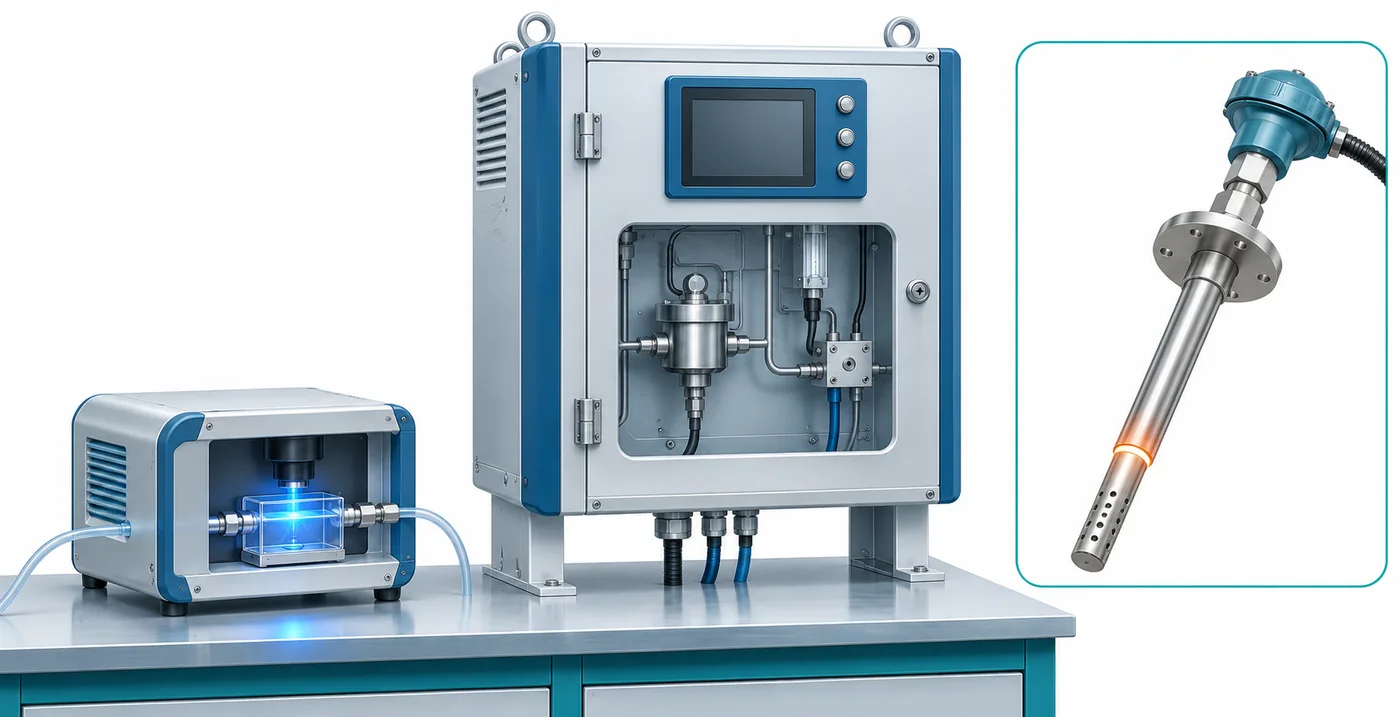
不同的制氧技术对温度控制有不同的要求。显示的硬件是概念性的且无品牌的。
Why a steady-state correction cannot solve every transition
A steady-state correction relates a settled sensor response to a settled temperature. During a fast environmental change, the cell, housing, electronics and thermometer can be at different temperatures. A single correction value may no longer represent the condition controlling the oxygen signal.
Imagine a sensor moved from a cool room into a warm enclosure while the gas composition remains unchanged. The compensation thermometer may warm rapidly while the sensing structure warms more slowly. Applying the final warm-temperature correction too early can create an apparent oxygen excursion.
在另一种设计中可以进行相反的排序。传感面可能会在埋入电子器件的温度计之前变热。因此,不存在加热传感器读数高或读数低的普遍规则。热路径和响应机制决定了符号。
AAN 005 将瞬态行为与平衡依赖性分开讨论。这种分离在实践中很重要:临时信号不应自动使用用于稳定操作的表来解释。它还解释了为什么表面上准确的稳态校准可能与运动过程中的不良行为共存。
Filtering the displayed oxygen value can reduce visible peaks but adds delay. It cannot establish whether the gas actually changed. In an application requiring a rapid response, extra smoothing may obscure relevant events. Evaluate transient performance as a system property rather than treating smoothing as proof of correction.
Where should the compensation thermometer be?
Follow the sensor manufacturer's placement guidance. In a custom cell interface, the useful temperature is the one that best represents the temperature controlling the cell's response. It may require close physical placement and a thermal response matched to the cell.
主板上的温度计可能很方便,但会产生误导。附近的调节器、处理器和显示器可能会以不同于面向气体的氧元件的方式对其进行加热。这两种测量可以在稳定的房间中相互跟踪,同时在功率变化或气流变化后分离。
光有距离是不够的。通过高导电支架连接的温度计的响应与通过气隙隔开的温度计的响应不同。外壳材料、安装、绝缘和气流都会影响热路径。
For an already compensated module, additional temperature measurements are often most useful diagnostically. Compare them to understand gradients, rather than using them to override the internal correction. Any alternative compensation scheme requires model-specific evidence and validation.
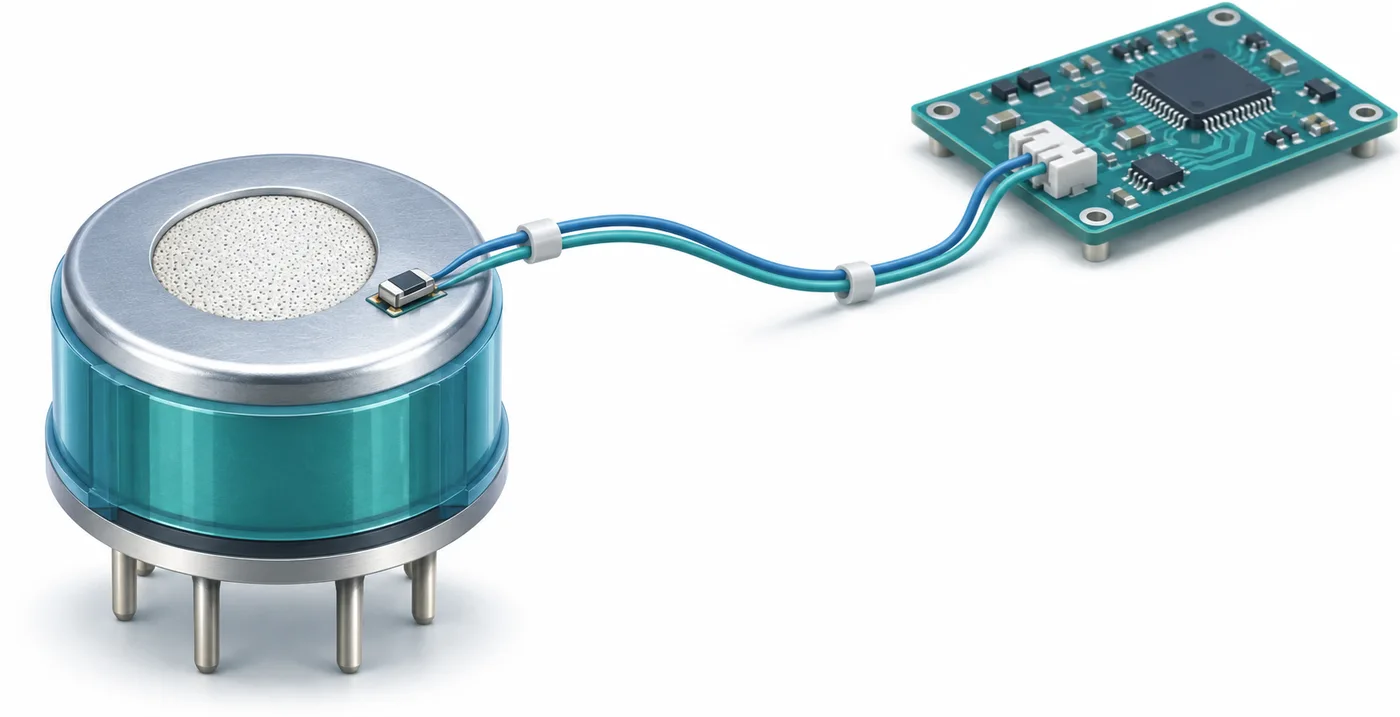
Conceptual placement: a local probe and a remote circuit-board thermometer may follow different thermal histories.
A checked example: percent of reading is not percentage points
Suppose a hypothetical oxygen instrument indicates 20.00% oxygen at one settled temperature. Its relevant specification states an additional temperature-related effect of 1% of reading across a stated change. This is an invented arithmetic example, not a specification for any named model.
One percent of the 20.00% reading is:
20.00 × 0.01 = 0.20 percentage points of oxygen.
The corresponding interval from that contribution alone would be 19.80% to 20.20% oxygen. It would not be 19.00% to 21.00%. A specification of one percentage point would be five times larger at this reading.
Now suppose a temporary peak of 20.60% occurs during movement between environments. It is not valid to claim that the instrument violated the hypothetical settled-temperature term solely from that observation. First determine whether the specification includes thermal transitions, whether composition stayed constant, and whether pressure and moisture changed.
Conversely, a return to 20.00% does not prove the transient is acceptable. If the application uses the reading during movement, the transient behavior itself needs an appropriate requirement and evidence. A settled accuracy figure cannot answer a dynamic performance question.
When comparing sensors, translate each temperature specification into the same quantity and conditions. Percent of reading, percent of full scale, percentage points, maximum error and typical behavior are different. The guide to reading accuracy specifications uses CO2 examples, but its distinction between error terms and conditions is also useful here.
Warm wet source gas can change before measurement
A warm humid sample may cool through its transport path. If the gas reaches a surface below its dew point, condensation can form. The resulting problem is not only a wet sensor: water removal can change concentration basis, and liquid can restrict flow.
源温度计无法证明每个管接头都保持足够的温度。最冷的相关表面可能是隔板、未加热的连接器或过滤器外壳。局部环境气流可以使该表面比机柜平均温度低。
如果采样系统有意干燥气体,则记录报告的氧基。干基结果不应与湿基参考直接比较。参考和电池处的湿度条件必须一致。
同样,加热后较低的相对湿度并不一定意味着水被去除。相对湿度取决于温度。气流可以具有相同的水含量,而其相对湿度在变暖过程中发生变化。
这 阿尔法感常见问题解答 separates oxygen dilution by water vapor from transient humidity effects. That distinction helps identify whether a changing result represents a real wet-basis composition change, a temporary sensor response, or both.
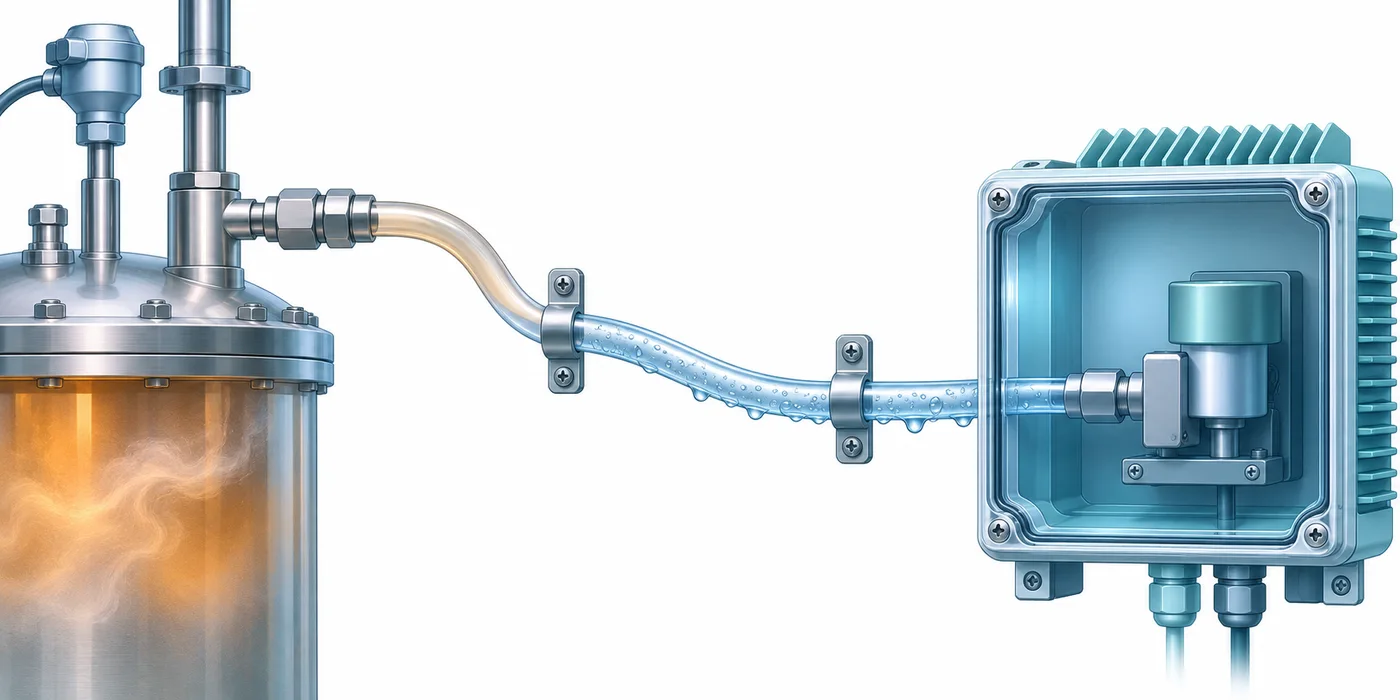
Conceptual sample path: a cooler downstream fitting can alter a warm wet sample before it reaches an oxygen sensor.
Read the exact specification before designing a correction
Collect the part number, housing variant, revision and interface details first. A family name may cover raw cells, diffusion modules, sealed modules and flow-through assemblies. Their installation conditions can differ even if the sensing principle is shared.
Separate operating temperature from the temperature range over which full accuracy is specified. A device may function over a broad range while a particular accuracy term applies over a narrower range. Storage survival provides still another type of information.
Look for stated test conditions. Pressure, humidity, gas background, flow and calibration temperature can influence the result. If a temperature curve was measured in a defined gas mixture, it should not automatically be extended to an unrelated process background.
Inspect the axis labels on graphs. A normalized output curve is not necessarily an oxygen-percentage error curve. A curve relative to a calibration temperature must be interpreted against that normalization, and typical data do not establish a maximum guaranteed error.
Determine whether the specification covers the raw sensing element or the final instrument. A compensated transmitter's environmental performance cannot be inferred simply by adding a cell coefficient to an electronic component coefficient. The complete chain may include characterization, control and diagnostic behavior.
Where documents disagree, preserve the narrower confirmed claim and seek the current specification for the exact part. Legacy optical datasheets and current product summaries can differ. Choosing the most favorable number from each document creates a fictional product that no manufacturer has specified.
Diagnose temperature-related oxygen changes with synchronized evidence
Start by describing the symptom precisely. Does the oxygen value change only during movement, remain offset after equilibrium, or track a repeating operating cycle? Those patterns point to different questions and should not be combined into a single drift label.
Record oxygen, the relevant temperatures, pressure, humidity or dew point, flow state and instrument status on a common time basis. Include state changes such as pump start, enclosure opening or heater operation. A short event log can be more informative than a long oxygen-only trend.
If the result settles back after a thermal transition while gas conditions are independently stable, thermal mismatch becomes a plausible explanation. That is an inference to investigate, not proof that the gas stayed constant. A simultaneous moisture or pressure change can produce similar timing.
If the error remains after temperatures settle, review calibration conditions, active compensation, source composition and gas-path changes. A persistent offset may be unrelated to temperature even if it first appeared during a warm-up period.
如果读数随流量变化,请检查传热和压力影响。流动可以冷却或加热传感区域,同时也改变电池压力。区分这些机制需要测量相关条件,而不是简单地重复相同的流量调节。
如果温度输出本身看起来错误,请检查它是否是过程测量、内部指示或校正的环境估计。比较两个具有不同含义的温度场可能会产生错误的诊断。
有用的资格记录应包含哪些内容?
Define the intended operating envelope before collecting comparison results. Include the temperature range, expected rates of change, source-gas moisture condition, pressure state, sample interface and required output basis. This makes the qualification relevant to actual use.
Use a documented oxygen reference suitable for the instrument and application. Record its uncertainty and gas basis along with the device output. An unknown room-air sample may support limited observations, but it does not independently establish every accuracy contribution.
Distinguish equilibrium checks from transition checks. For equilibrium, record how stable conditions were established according to the applicable procedure. For transitions, record the actual temperature history and the period during which readings are intended to be used.
Keep model-specific readiness indicators and error flags with the readings. Deleting invalid-status intervals from a plot without documenting them can make a system appear continuously available when it was not.
A useful acceptance statement names the conditions actually examined. “Agreement within the stated criterion after stabilization at the documented conditions” is meaningful. “Temperature compensated” alone says little about the behavior during movement, condensation or an untested thermal gradient.
For broader context, Gasnose's discussion of temperature effects on gas sensors separates several environmental mechanisms. Oxygen-specific coefficients and limits should still come from the exact oxygen sensor's manufacturer.
An application example: moving a portable oxygen instrument
Consider a hypothetical portable instrument carried from a cool equipment room into a warmer process area. Its first oxygen change could reflect actual gas composition, a pressure change, humidity dilution, a thermal transient or several of these together. A room-temperature reading taken before the move cannot separate them.
The useful investigation begins with the instrument's intended use. If readings are only used after the supported stabilization condition, document that condition and assess the settled comparison. If readings are required throughout movement, the qualification must include the transition itself. These are different measurement requirements.
Next identify the sample interface. A diffusion inlet exposed to surrounding air and a pumped line connected to a process do not experience the same thermal history. In the pumped case, the gas can cool in the line while the instrument housing continues warming. In the diffusion case, the inlet and body may follow separate air currents.
Preserve status and timing before changing compensation. If the instrument reports an invalid or warming state, that state is part of the result. If it reports valid readings throughout, compare the observed transition against the documented dynamic conditions rather than assuming validity implies full equilibrium.
Finally evaluate the settled state independently. A transient followed by a persistent offset may involve two problems. Correcting the final offset does not establish that the temporary excursion has been explained, and reducing the temporary excursion does not establish the final calibration.
常见问题
Does a higher temperature always make an oxygen reading lower?
No. The result depends on the sensing technology, compensation, pressure, gas composition and thermal state. A universal direction of error is not defensible.
Can I correct every oxygen sensor with the ideal gas law?
No. Gas-state relationships help distinguish density, pressure and fraction. They do not replace a model-specific correction for membrane transport, optical response, thermal gradients or heated-cell operation.
Is a compensated sensor reliable immediately after a temperature change?
Only if its specification and validated installation support that use. Steady-state compensation alone does not establish transient performance.
Can the onboard temperature output measure my process?
Check its stated purpose and accuracy. Some gas modules provide temperature for indication or internal compensation rather than as a calibrated process-temperature channel.
Should I recalibrate after every transient?
A temporary excursion is not, by itself, a reason to recalibrate. Diagnose the conditions and follow the instrument's calibration and recovery requirements. An exposure outside rated conditions needs its own assessment.
What should I investigate first?
Identify the reported oxygen quantity and the temperatures at source, cell and compensation point. Then separate a real gas change from sensor response and transport effects.








发表评论