بالنسبة لمصنعي أجهزة استشعار الغاز، والعلامات التجارية لكاشفات الغاز، وشركات تكامل الأنظمة التي تستهدف سوق أمريكا الشمالية، أصبحت الشهادة أكثر من مجرد شرط امتثال. وهو أيضًا عامل مهم في ثقة العملاء والموافقة على المشروع واختيار المنتج.
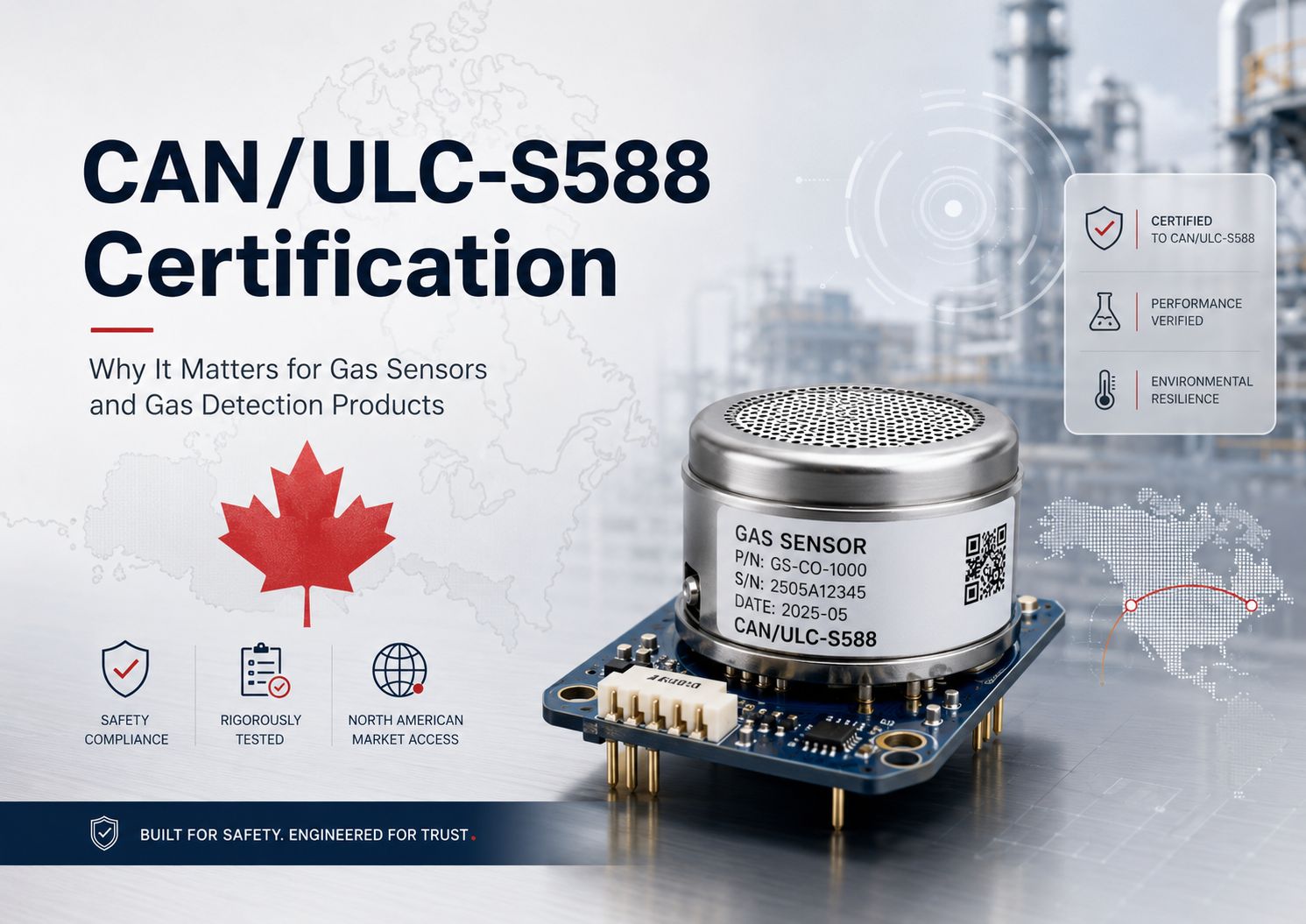
أحد المعايير التي تحظى باهتمام متزايد هو يمكن/ULC-S588، بعنوان رسميًا أجهزة الكشف عن الغاز والبخار وأجهزة الاستشعار، بما في ذلك الملحقات. تنطبق هذه المواصفة القياسية الكندية على أجهزة كشف الغاز والبخار وأجهزة الاستشعار المستخدمة للكشف عن الغازات السامة والقابلة للاحتراق، بما في ذلك المعدات المثبتة بشكل دائم والمحمولة والقابلة للنقل.
للشركات العاملة مع أجهزة استشعار أول أكسيد الكربون، وأجهزة استشعار الهيدروجين، وأجهزة استشعار الغاز القابل للاحتراق، وأجهزة استشعار الغاز السام، ووحدات الكشف عن الغازيعد فهم CAN/ULC-S588 أمرًا مهمًا عند تطوير المنتجات للتطبيقات المتعلقة بالسلامة مثل السلامة السكنية والمباني التجارية وأنظمة تخزين الطاقة وأنظمة خلايا الوقود والتحكم في التدفئة والتهوية وتكييف الهواء (HVAC) والمراقبة الصناعية.
ما هو CAN/ULC-S588؟
يمكن/ULC-S588 هو معيار كندي لأجهزة الكشف عن الغاز والبخار وأجهزة الاستشعار، بما في ذلك الملحقات. ويغطي متطلبات المنتجات المستخدمة للكشف عن الغازات السامة والغازات القابلة للاحتراق والأبخرة في تطبيقات الكشف عن الغاز العادية.
من الناحية العملية، يعتبر CAN/ULC-S588 وثيق الصلة بمنتجات مثل:
- أجهزة كشف أول أكسيد الكربون وأجهزة استشعار ثاني أكسيد الكربون
- أجهزة كشف غاز الهيدروجين وأجهزة استشعار H₂
- أجهزة كشف الغاز القابلة للاحتراق
- أجهزة كشف الغازات السامة
- Multi-gas detection devices
- Gas sensing modules used in safety systems
- Accessories related to gas detection products
The scope of the standard includes fixed, portable, and transportable gas and vapour detectors and sensors. It is especially important for products used in indoor locations, outdoor applications, or unconditioned environments where reliability and safety performance are critical.
How Is CAN/ULC-S588 Related to UL 2075?

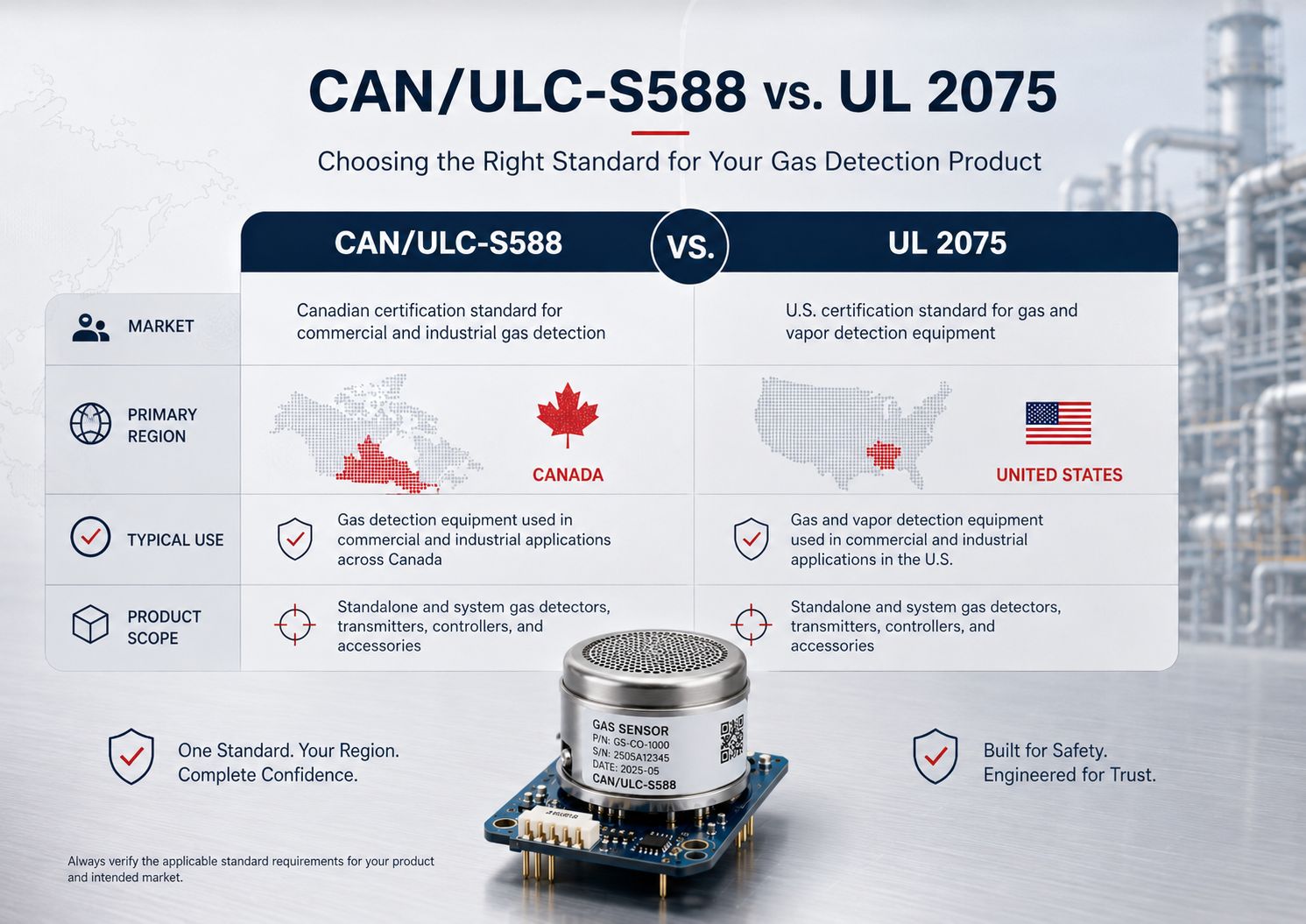
For companies entering North America, CAN/ULC-S588 is often discussed together with UL 2075.
UL 2075 is the U.S. standard for Gas and Vapor Detectors and Sensors. تنطبق هذه المواصفة على أجهزة الكشف عن الغازات والأبخرة السامة والمحمولة والقابلة للنقل وأجهزة الاستشعار الثابتة والمحمولة والقابلة للاحتراق والمخصصة للاستخدام في المواقع العادية غير الخطرة، بما في ذلك المناطق الداخلية وغير المشروطة.
هناك طريقة بسيطة لفهم العلاقة وهي:
| معيار | السوق الرئيسي | التركيز على المنتج |
|---|---|---|
| UL 2075 | الولايات المتحدة | أجهزة كشف وحساسات الغاز والبخار |
| يمكن/ULC-S588 | كندا | أجهزة كشف وحساسات الغاز والبخار، بما في ذلك ملحقاتها |
بالنسبة للعديد من مشاريع أمريكا الشمالية، قد يحتاج المصنعون إلى النظر في كلا المعيارين. يمكن أن يكون منتج الكشف عن الغاز أو مكون المستشعر الذي يدعم متطلبات UL 2075 وCAN/ULC-S588 أكثر جاذبية لعملاء OEM، ومتكاملي الأنظمة، والشركات المصنعة لمعدات السلامة.
لاحظت Intertek أيضًا أنه تمت إزالة أجهزة الكشف عن الغاز من نطاق UL 61010-1 وCSA C22.2 رقم 61010-1 وأصبحت الآن ضمن نطاق UL 2075 وULC S588، مما يوضح أن اعتماد كاشف الغاز أصبح أكثر تخصصًا في أمريكا الشمالية.
لماذا يعتبر CAN/ULC-S588 مهمًا لمصنعي أجهزة استشعار الغاز
بالنسبة لمصنعي أجهزة الاستشعار، لا يتعلق CAN/ULC-S588 ببيع كاشف معتمد فقط. يمكن أن يؤثر أيضًا على القدرة التنافسية للمستشعر نفسه عند استخدام المستشعر كمكون رئيسي داخل منتج كامل للكشف عن الغاز.
غالبًا ما يبحث مصنعو أجهزة الكشف عن الغاز عن موردي أجهزة الاستشعار الذين يمكنهم المساعدة في تقليل مخاطر الاعتماد. إذا تم تقييم المستشعر بالفعل وفقًا لمتطلبات السلامة والأداء المعترف بها في أمريكا الشمالية، فقد يساعد ذلك الشركة المصنعة للمنتج النهائي على تبسيط تطوير المنتج وتحسين الثقة أثناء التخطيط لإصدار الشهادات.
وهذا مهم بشكل خاص في التطبيقات التي يرتبط فيها اكتشاف الغاز بشكل مباشر بالسلامة، مثل:
- أجهزة إنذار أول أكسيد الكربون السكنية
- مراقبة غاز المباني التجارية
- التحكم في تهوية مرآب السيارات
- سلامة نظام تخزين طاقة البطارية
- كشف تسرب الهيدروجين
- مراقبة نظام خلايا الوقود
- كشف الغازات السامة الصناعية
- أنظمة السلامة في مجال التدفئة والتهوية وتكييف الهواء (HVAC) والتبريد
In these applications, customers do not only ask whether a gas sensor can detect a target gas. They also care about long-term stability, operating temperature range, response performance, failure behavior, end-of-life indication, calibration strategy, and certification support.
Key Technical Areas Behind CAN/ULC-S588 Evaluation
The full CAN/ULC-S588 standard is a paid technical document, so manufacturers should always work with an authorized certification body for formal testing and interpretation. However, based on public information and standards update notices, several areas are especially important for gas detection products.
1. Gas Detection Performance
A gas detection product must demonstrate that it can detect the target gas reliably under specified conditions. This may involve sensitivity, alarm threshold, response time, recovery behavior, and performance after environmental exposure.
For example, products targeting carbon monoxide, hydrogen, methane, propane, nitrogen dioxide, or hydrogen sulfide must show that they can respond to gas concentrations in a predictable and safe way.
2. Environmental Reliability
Gas detectors and sensors may be installed in non-ideal environments. Temperature, humidity, vibration, contamination, and long-term drift can all affect sensor performance.
For North American applications, customers may pay close attention to wide-temperature performance, especially in outdoor, garage, industrial, and energy storage environments.
3. Electrical and Functional Safety
A gas detection product is not only a sensing device. It is also part of a safety system. Therefore, electrical safety, component reliability, signal failure behavior, and abnormal operation conditions may be considered during evaluation.
4. Marking and Installation Instructions
The latest ULC S588 update notice includes revisions related to marking and installation instructions, which means manufacturers must also pay attention to product labeling, user guidance, installation limitations, and application conditions.
5. Combustible Gas Detection Thresholds
For combustible gas products, detection thresholds are especially important because the device may be used to warn users before a dangerous concentration is reached. The Intertek standards update notice for ULC S588 mentions requirements related to combustible gas and vapor detection threshold testing.
CAN/ULC-S588 and Hydrogen Detection
Hydrogen detection is becoming increasingly important because of the growth of battery energy storage systems, fuel cells, hydrogen energy infrastructure, and industrial hydrogen applications.
Hydrogen is a small-molecule, highly diffusive, and flammable gas. In practical systems, hydrogen may appear in battery rooms, fuel cell equipment, charging infrastructure, hydrogen production sites, or enclosed technical spaces.
For hydrogen sensor manufacturers, certification-related performance may include:
- Low-level hydrogen detection capability
- Fast response and recovery
- Wide operating temperature range
- استقرار على المدى الطويل
- Resistance to interference gases
- Output reliability for system integration
- Suitability for safety-related monitoring
Because hydrogen safety is becoming a major topic in energy transition projects, gas sensors used in hydrogen detection are increasingly expected to support recognized standards and certification pathways.
CAN/ULC-S588 and Carbon Monoxide Detection
Carbon monoxide remains one of the most important gases in residential, commercial, and industrial safety. CO is colorless, odorless, and toxic, which makes reliable detection essential.
CO sensors are widely used in:
- أجهزة إنذار أول أكسيد الكربون السكنية
- Commercial building safety systems
- التحكم في تهوية مرآب السيارات
- Boiler rooms
- Fire detection and safety systems
- Gas appliances
- Recreational vehicles and marine applications
For CO sensors, customers often focus on:
- Long service life
- Low drift
- Stable output over temperature and humidity
- Resistance to alcohol, hydrogen, and other interference gases
- Reliable performance over the full product life cycle
- Support for 10-year detector designs
For OEM manufacturers, a CO sensor with strong certification support can be a major advantage when designing gas alarms or gas monitoring systems for North America.
Component Certification vs Complete Product Certification

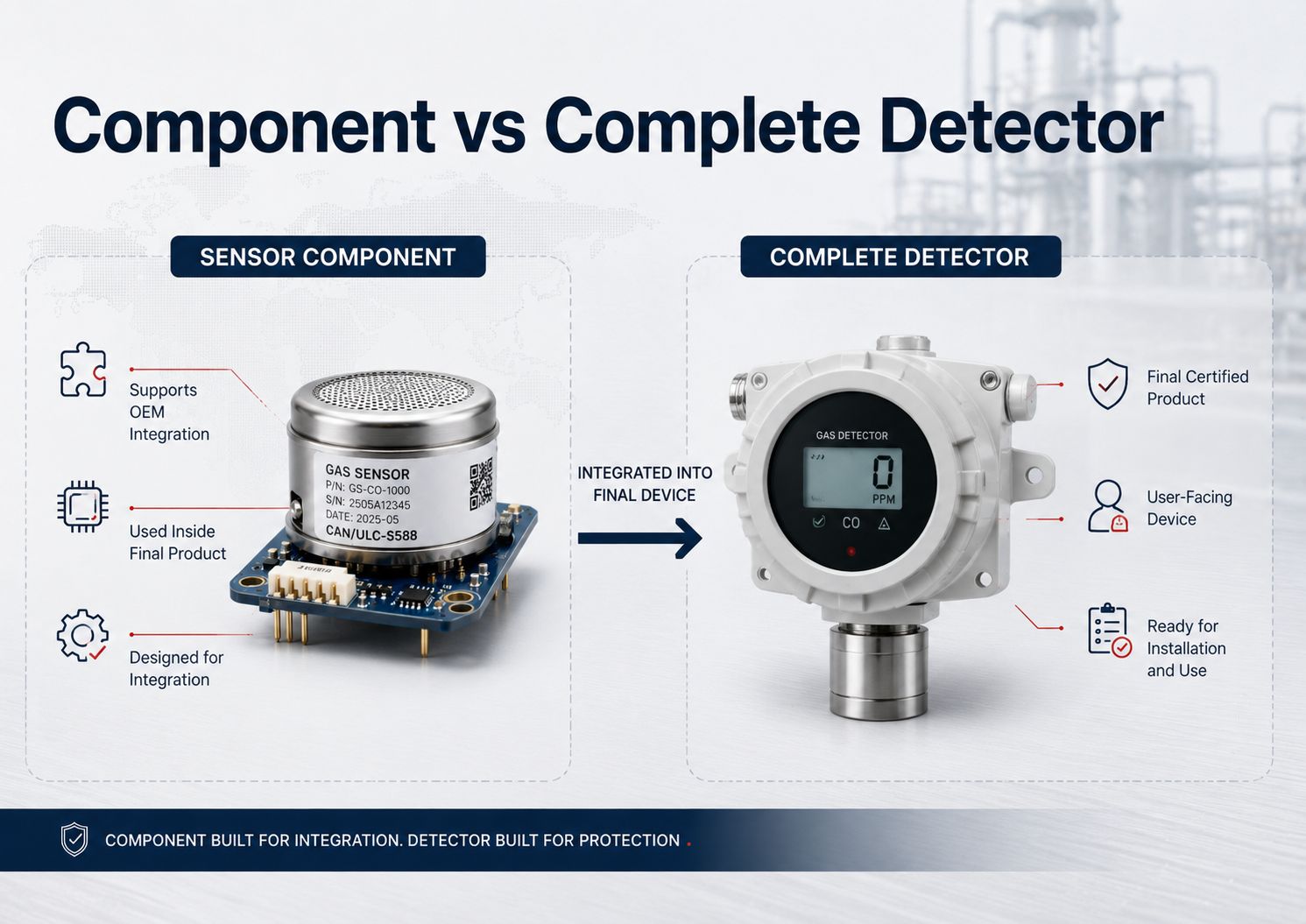
One important point should be clearly understood: a certified sensor component is not the same as a certified complete gas detector.
A gas sensor may be evaluated as a recognized component used inside a larger certified product. In this case, the sensor supports the certification of the final product, but the complete detector or alarm still needs its own evaluation based on final design, enclosure, power supply, software logic, alarm output, user instructions, and installation conditions.
This distinction matters because gas detector manufacturers often ask sensor suppliers for documentation that can support their own certification process. A well-prepared sensor supplier should be able to provide:
- Sensor datasheet
- Performance test data
- Lifetime and aging data
- Environmental test data
- Interference gas data
- Calibration information
- Quality control documentation
- Application notes
- Certification-related technical support
Why This Certification Is Becoming a Market Advantage
In the gas detection market, technical performance alone is no longer enough. Customers increasingly want products that are easier to approve, easier to integrate, and easier to certify.
CAN/ULC-S588 can create value in several ways:
For Sensor Manufacturers
It helps show that the product is suitable for serious safety-related applications and can support North American customer projects.
For Gas Detector Brands
It reduces uncertainty when selecting core sensing components and designing products for Canada or the broader North American market.
For System Integrators
It provides confidence when gas detection devices are used in building safety, energy storage, industrial monitoring, and ventilation control systems.
For End Users
It supports safer gas monitoring by encouraging more reliable performance, proper installation, and clear product marking.
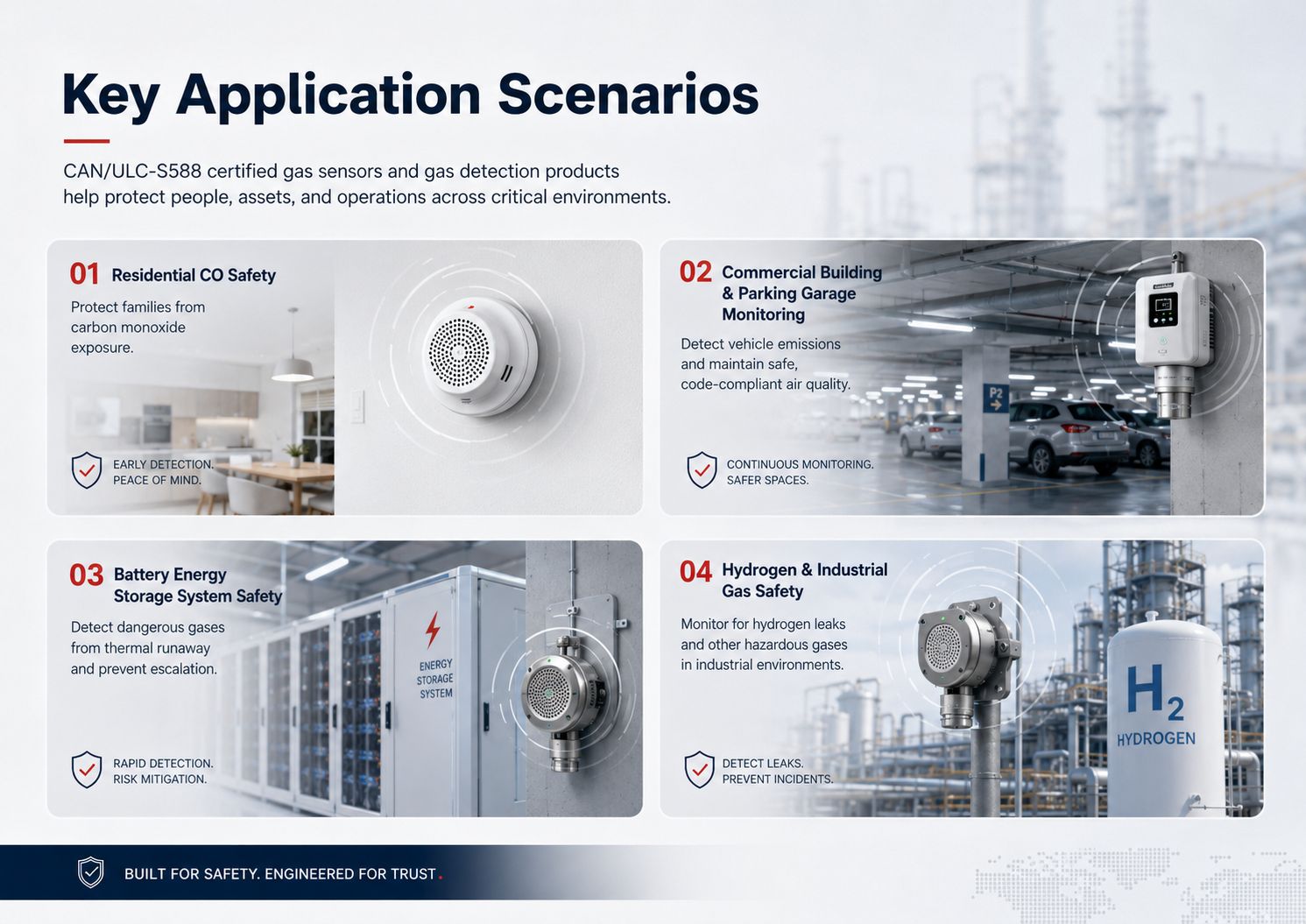
Applications Where CAN/ULC-S588 May Be Important

CAN/ULC-S588 is especially relevant to gas detection products used in the following applications:
| طلب | Typical Target Gases |
|---|---|
| Residential safety | CO, combustible gas |
| Commercial buildings | CO, NO₂, combustible gas |
| Parking garages | CO, NO₂ |
| Battery energy storage systems | H₂, CO, VOCs, electrolyte vapour indicators |
| Fuel cell systems | ح₂ |
| السلامة الصناعية | H₂S, CO, combustible gases |
| HVAC and ventilation control | CO₂, CO, NO₂ |
| Fire safety systems | CO, H₂, combustible gases |
Different applications may require different standards, installation codes, and certification routes. Therefore, manufacturers should evaluate the target market and application scenario before starting certification.
What Manufacturers Should Prepare Before Certification

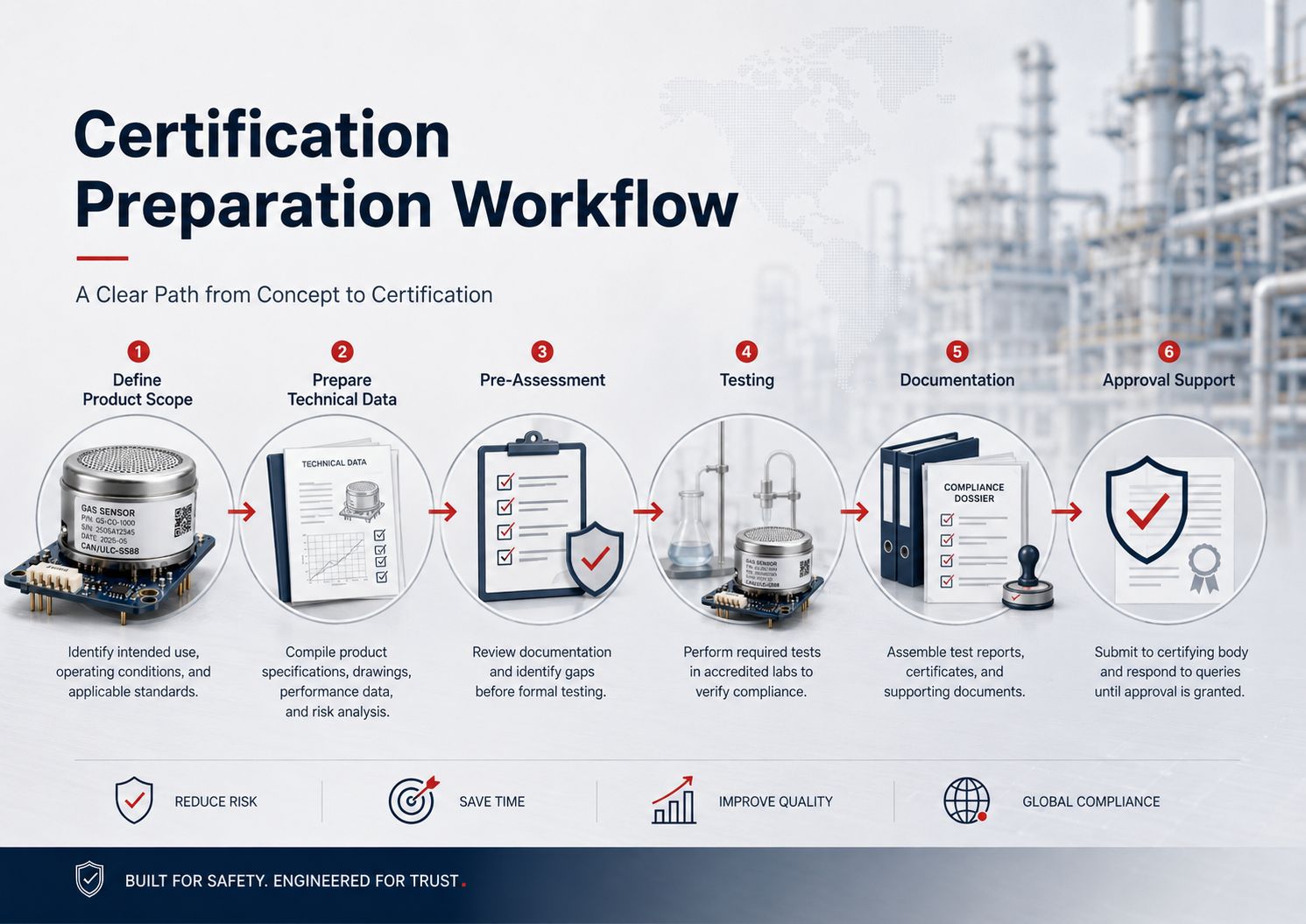
Before starting a CAN/ULC-S588 or UL 2075 certification project, gas sensor and detector manufacturers should prepare a strong technical foundation.
Important preparation work includes:
Define the product scope
Confirm whether the product is a sensor component, sensing module, gas detector, gas alarm, or complete monitoring device.Confirm the target gas and application
CO, H₂, CH₄, propane, NO₂, H₂S, and VOC-related gases may have different test requirements and customer expectations.Prepare reliability data
Long-term drift, aging behavior, temperature cycling, humidity exposure, and storage stability data are important.Review environmental specifications
Operating temperature, storage temperature, humidity range, pressure range, and installation environment should be clearly defined.Prepare quality control documentation
Certification bodies and OEM customers may review production consistency, calibration process, inspection methods, and traceability.Clarify certification route
Decide whether the goal is component recognition, module evaluation, or complete product certification.Work with a qualified certification body early
Early pre-assessment can help avoid redesign, documentation gaps, and unexpected testing delays.
خاتمة
CAN/ULC-S588 is an important Canadian standard for gas and vapour detectors and sensors. Together with UL 2075, it plays a key role in North American gas detection product certification.
For gas sensor manufacturers, this standard is not only a regulatory topic. It is also a market signal. Customers in residential safety, commercial buildings, energy storage, hydrogen safety, industrial monitoring, and HVAC systems are increasingly looking for gas sensing products with stronger reliability data and certification support.
As gas detection applications become more safety-critical, sensor suppliers that understand CAN/ULC-S588 and UL 2075 requirements will be better positioned to support OEM customers and enter higher-value markets.
For project teams evaluating CO, hydrogen, combustible gas, or toxic gas sensing solutions, choosing the right sensor technology is only the first step. Certification planning, reliability testing, and application-specific integration are becoming equally important parts of successful gas detection product development.
التعليمات
What is CAN/ULC-S588?
CAN/ULC-S588 is a Canadian standard for gas and vapour detectors and sensors, including accessories. It covers products used for toxic and combustible gas detection in fixed, portable, and transportable forms.
Is CAN/ULC-S588 the same as UL 2075?
No. UL 2075 is mainly used for the U.S. market, while CAN/ULC-S588 is the Canadian standard. However, they are often discussed together for North American gas detection products.
Which gases are related to CAN/ULC-S588?
The standard may apply to toxic and combustible gas detection products, including products for gases such as carbon monoxide, hydrogen, methane, propane, nitrogen dioxide, hydrogen sulfide, and other gas or vapour hazards depending on the application.
Does a certified sensor mean the complete detector is certified?
Not necessarily. A sensor may be evaluated as a component, but the complete gas detector or alarm usually requires separate evaluation based on the final product design and application.
Why is CAN/ULC-S588 important for gas sensor suppliers?
It helps sensor suppliers support OEM customers targeting Canada or North America. It can improve customer confidence, reduce certification uncertainty, and strengthen competitiveness in safety-related gas detection markets.