
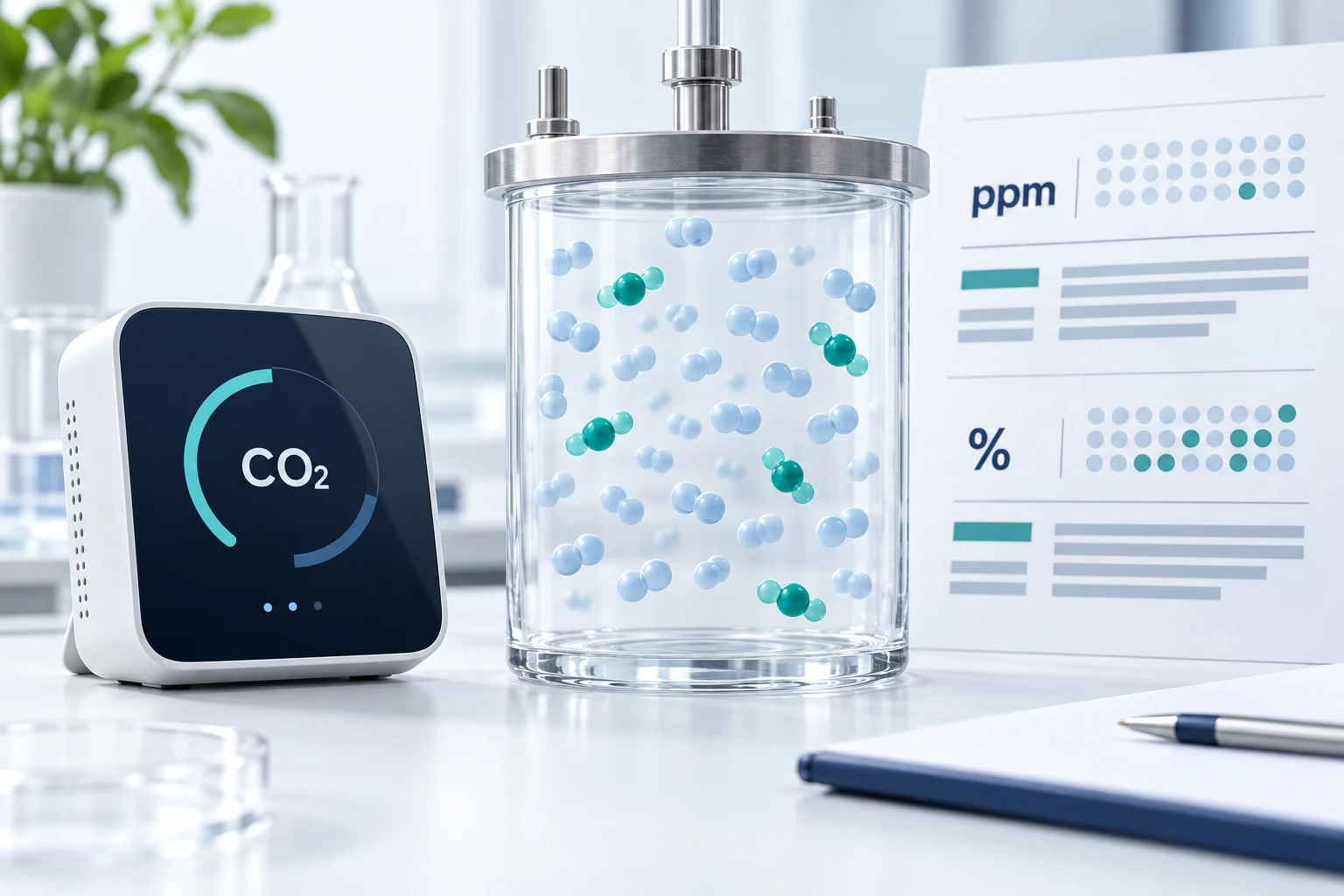
CO₂ ppm means carbon dioxide parts per million. When ppm represents a mole fraction, 1,000 ppm means 1,000 CO₂ molecules per million molecules of the stated gas mixture. That is a fraction of 0.001, or 0.1% on the same basis.
The number describes a proportion, not a universal air-quality score. To interpret an instrument reading, also identify whether it reports direct CO₂, which fraction basis it uses, whether water vapor is included, and where its performance specification applies.
The arithmetic between ppm and percent is straightforward. Most interpretation mistakes happen when the measurement basis, sample conditions or instrument output change without being recorded.
What the Million Parts Refer To
For a mole-fraction measurement, the numerator is the amount of CO₂ and the denominator is the total amount of the defined mixture. Amounts may be understood as moles or, equivalently for this ratio, molecular counts.
CO₂ fraction = amount of CO₂ ÷ amount of the mixture
Multiplying that fraction by one million gives its numerical value in ppm. If the mixture contains 0.001 of its amount as CO₂, the numerical value is 1,000 ppm.
The basis must stay attached to the number. “Parts” could otherwise refer to mass, amount of substance or a specified volume convention. Those ratios are not interchangeable merely because each can be expressed with a parts-per notation.
NOAA’s CO₂ measurement explanation uses mole fraction in dry air for its atmospheric measurements. That is a defined reporting convention, rather than an instruction that every commercial monitor necessarily reports dry-air values.
Convert CO₂ ppm to Percent
On the same fraction basis:
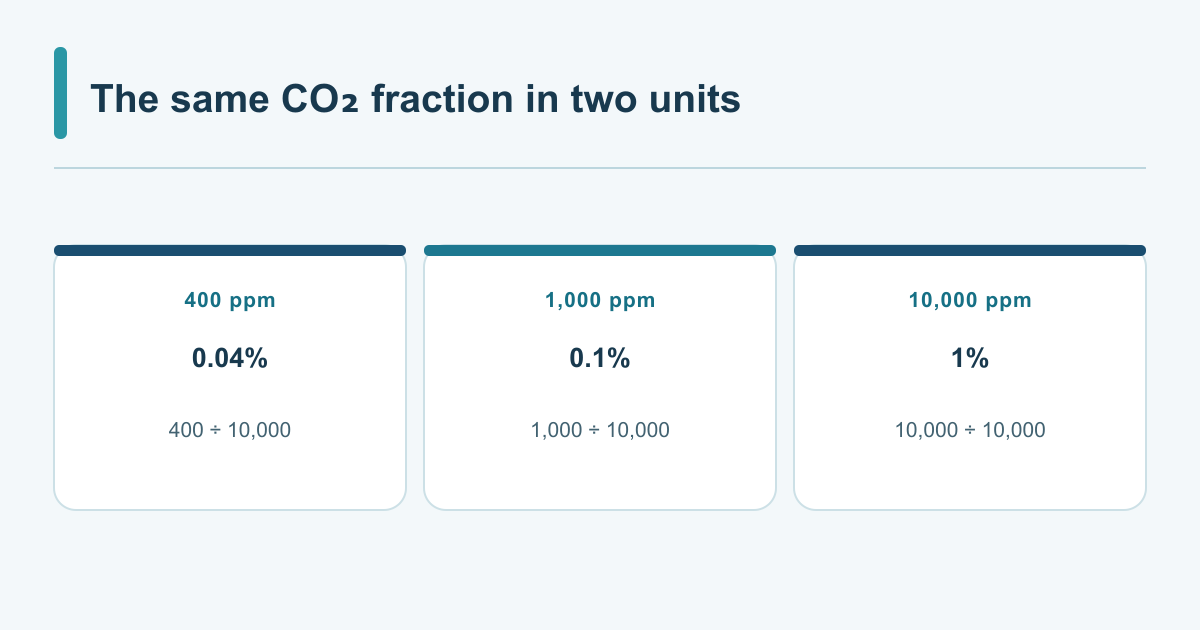
Percent = ppm ÷ 10,000
ppm = percent × 10,000
The reason is that a percent represents one part in a hundred, while ppm represents one part in a million. One percent therefore contains 10,000 parts per million.
| CO₂ fraction expressed in ppm | The same fraction expressed in percent |
|---|---|
| 400 ppm | 0.04% |
| 500 ppm | 00,05% |
| 1,000 ppm | 0.1% |
| 2,000 ppm | 0.2% |
| 5.000 ppm | 0.5% |
| 10.000 ppm | 1% |
| 20,000 ppm | 2% |
These are fraction-conversion examples. The rows do not assign health effects, ventilation adequacy or a suitable instrument to any of the values.
Conversion changes the numerical notation; it does not improve measurement accuracy or alter the sampled gas. A recorded value of 0.1% and one of 1,000 ppm describe the same fraction only if their underlying quantities and reporting bases match.
For clarity in a spreadsheet or data export, retain the unit in a dedicated field. Do not mix numerical values such as 0.1 and 1,000 in one column without identifying whether each is percent or ppm.
Mole Fraction and Volume Fraction Need a Stated Convention
For ideal gases at the same temperature and pressure, the volume proportions of a mixture correspond to its mole proportions. That familiar approximation explains why gas literature often uses ppmv or percent by volume when discussing gas fractions.
For precise work, retain the manufacturer’s or reference method’s definition. Real-gas behavior, pressure conditions and the way a volume convention is defined can matter. Do not silently substitute a volume fraction for a certified mole-fraction value in a specification or calibration record.
El NIST Guide to the SI recommends explicit quantity descriptions and unit ratios, and discourages ambiguous parts-per abbreviations in formal SI reporting. For a mole fraction, μmol/mol is a useful explicit form: 1,000 μmol/mol corresponds numerically to 1,000 ppm on that mole basis.
Commercial displays may still use ppm because the notation is familiar. The practical requirement is to document what the display means and preserve the definition when comparing it with another instrument or gas certificate.
ppm Is Not Automatically a Mass Concentration
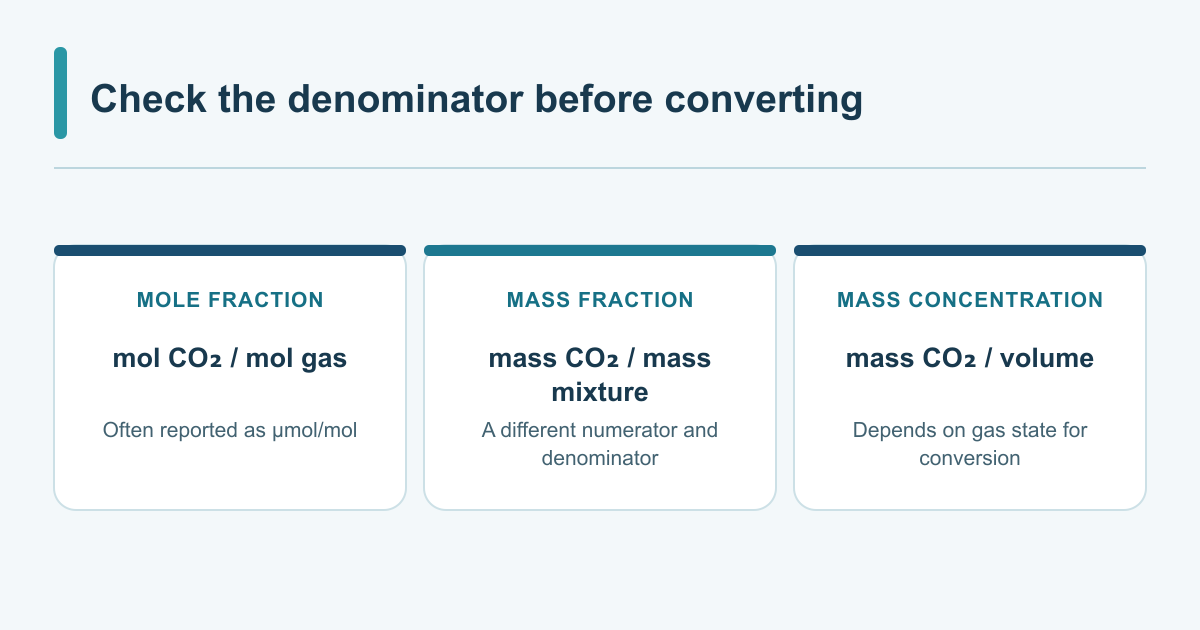
A fraction and a mass per volume answer different questions. Mole fraction asks what share of the mixture is CO₂. Mass concentration asks how much CO₂ mass occupies a volume under specified conditions.
| Cantidad | What is compared? | Example notation |
|---|---|---|
| Mole fraction | CO₂ amount to total mixture amount | mol/mol or μmol/mol |
| Mass fraction | CO₂ mass to total mixture mass | kg/kg or mg/kg |
| Volume fraction | Component volume under a defined convention to mixture volume | A stated volume fraction |
| Mass concentration | CO₂ mass to volume of sample | mg/m³ |
A ppm value on a mole basis is therefore not numerically the same as a ppm value on a mass basis. Converting between them requires information about the gas mixture, including the molar masses relevant to the definition.
For a mass concentration calculated from an ideal-gas mole fraction, pressure, absolute temperature and CO₂ molar mass enter the relationship. In a consistent set of units:
Mass concentration = mole fraction × p × M ÷ (R × T)
Here p is pressure, T is absolute temperature, M is the CO₂ molar mass and R is the gas constant. The required output units determine the unit conversions around that expression.
As a numerical illustration, at 25°C and 101,325 Pa, 1 ppm of CO₂ on an ideal-gas mole basis is approximately 1.80 mg/m³. The NIOSH CO₂ entry lists the same rounded conversion value. It is not a universal multiplier for every pressure, temperature or gas.
If a report gives mg/m³, ask whether the volume refers to actual conditions or specified reference conditions. Two mass-concentration values with different volume conditions should not be compared as if the conditions were identical.
Wet and Dry Reporting Bases Change the Denominator
Water vapor can be included in the total gas mixture or excluded from the denominator used to report another component. Those are commonly called wet and dry reporting bases.
For an idealized mixture with known water fraction:
x₍wet₎ = x₍dry₎ × (1 − x₍water, wet₎)
If a worked example uses 1,000 ppm CO₂ on a dry basis and 2% water in the wet mixture, the corresponding wet-basis value is 980 ppm. This follows from the two denominators; it is not a sensor compensation coefficient or a recommended environmental condition.
Before using the relationship, establish the gas basis and water quantity. Relative humidity alone is not the water mole fraction, and a value measured elsewhere may not describe the sampled gas. The real sampling and conditioning method must also be understood.
This distinction is especially important when comparing a conditioned process sample, a reference gas and an ambient monitor. A difference in reporting basis may explain part of a difference without proving that either instrument has a faulty sensing element.
The related guide to humidity effects on gas sensor readings separates composition changes from sensor response and condensation.
Concentration Percentage Is Different From Percentage Accuracy
A CO₂ concentration of 2% is 20,000 ppm on the same fraction basis. A specification of 2% of reading is instead a relative contribution to a measurement allowance.
At a 1,000 ppm comparison point, 2% of reading is 20 ppm. It is not a CO₂ concentration of two percentage points.
Also distinguish percent of reading from percent of full scale. An assumed 2% of a 5,000 ppm full scale evaluates to 100 ppm; that differs from 2% of a 1,000 ppm reading.
If the specification adds a fixed term, include it. For an assumed ±(50 ppm + 2% of reading), the allowance at that 1,000 ppm comparison point is ±70 ppm. These worked expressions should only be assigned to a device when its documentation states them.
For more examples and the conditions to retain, see how to read a CO₂ monitor accuracy specification.
Sensor Range and Accuracy Range Are Separate
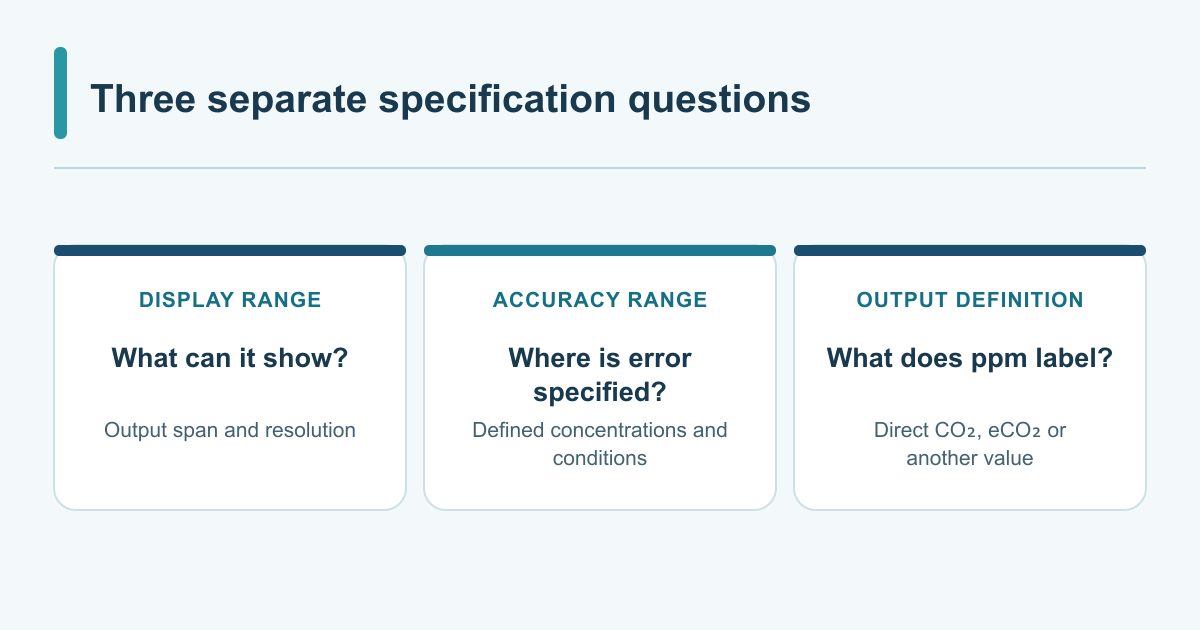
The output range of a sensor or monitor tells you which values it can represent. A particular accuracy claim may apply over a narrower interval or use different conditions and formulas across the range.
Consider three separate entries in an equipment comparison:
- The reportable or output range.
- The interval covered by the performance specification.
- The actual concentrations and sample conditions relevant to the task.
A display that reaches a high value does not prove equally useful performance near a low concentration. A low-range room monitor does not become a process analyzer when its display is switched from ppm to percent.
El Hoja de datos SCD30, for example, separately documents measurement outputs and an accuracy interval. Reading the table and its footnotes is more informative than inferring one range from another. That example concerns the component; a complete instrument needs its own documentation.
For applications involving high CO₂ fractions, review the actual sensor and sample-system requirements. Gasnose’s Guía de selección de sensores de CO₂ provides related context on the different application ranges.
Changing Pressure Does Not Redefine a Fixed Mole Fraction
If the composition of a mixture is unchanged, expressing its CO₂ amount relative to the total amount does not suddenly produce a different mole fraction merely because the mixture expands or contracts. A mass per actual volume, however, can change with density.
That does not mean an instrument is unaffected by pressure. Its physical sensing response may depend on gas density, and its compensation and valid conditions must be checked. Separate the quantity being reported from the instrument behavior used to report it.
When comparing measurements made at different pressure or temperature conditions, record the sample conditions, output basis and configuration. Do not apply a generic altitude or temperature coefficient copied from another sensor model.
For the full measurement chain, see CO₂ measurement methods and instrument selection.
A ppm Reading Alone Does Not Establish Air Quality or Safety
The ppm unit is a way to express a defined proportion. Its presence on a display does not establish the purpose, validation or safety functions of that device.
A direct room-air CO₂ channel can support interpretation of occupancy and ventilation patterns. It does not measure every pollutant, and a single concentration should not be treated as a universal pass/fail limit for all rooms. ASHRAE’s Indoor Carbon Dioxide position document explains the need for context in ventilation assessment.
An eCO₂ estimate can also use ppm notation while representing a calculation from other signals. The shared unit does not make it a direct CO₂ measurement. Check the sensing method and output definition before using the number in a comparison.
Occupational exposure criteria, process requirements and building ventilation guidance serve different purposes. Any applicable criterion needs its location, time basis and equipment context. A unit-conversion table supplies none of those requirements by itself.
Keep Units and Validity in the Data Record
For a data logger, spreadsheet or building-system interface, keep enough information to reproduce the interpretation:
| Record field | Why retain it? |
|---|---|
| Device and channel | Identifies the sensing method and actual output |
| Numerical value and unit | Prevents ppm and percent from being mixed |
| Fraction or concentration basis | Distinguishes mole, volume and mass quantities |
| Wet or dry convention | Identifies whether water is included |
| Timestamp and averaging | Makes event comparisons meaningful |
| Conditions | Describes relevant pressure, temperature and sample state |
| Status flags | Separates valid data from startup, fault or overrange |
| Configuration and revision | Identifies scaling and processing conventions |
If a channel becomes invalid, preserve the status rather than treating a default numerical value as a successful measurement. A number can fit a column while failing to represent the gas sample the user expects.
Preguntas frecuentes
What is 1,000 ppm CO₂ in percent?
It is 0.1% when the fraction basis is unchanged. Divide the ppm value by 10,000.
How many ppm is 1% CO₂?
One percent is 10,000 ppm on the same fraction basis. Multiply the percent value by 10,000.
Does 400 ppm always mean the outdoor CO₂ level?
No. It is a numerical fraction value, not a timeless outdoor measurement. Actual background and the instrument’s baseline convention need their own context.
Is ppm the same as mg/m³?
No. A gas fraction and a mass concentration are different quantities. A conversion requires the appropriate molecular and volume conditions.
Is ppmv always exactly the same as a mole fraction?
Their familiar correspondence uses an ideal-gas volume convention. For precise calibration or non-ideal conditions, retain the quantity and definition supplied by the method or manufacturer.
Why can wet-basis and dry-basis values differ?
They use different denominators for the same component. Water vapor is included in the wet mixture and excluded from a dry reporting basis.
Can a monitor’s units prove it measures CO₂ directly?
No. An estimated eCO₂ output may also be displayed in ppm. Identify the sensor and the documented calculation path.
Does a larger measuring range prove better performance?
No. Compare the concentrations and conditions covered by the actual performance claim, along with the complete instrument’s intended use.
The Useful Interpretation Rule
Read a CO₂ number as value + quantity + basis + sample conditions + instrument status. Convert ppm and percent only after those meanings are clear. That keeps a simple unit calculation from becoming an incorrect comparison of different measurements.
Referencias técnicas

¿Los purificadores de aire reducen el CO2? Filtración separada del intercambio de aire exterior
Los purificadores HEPA comunes capturan partículas pero no eliminan de manera significativa el CO2 generado por los ocupantes. Aprenda a separar la recirculación, la ventilación del aire exterior y controlar los efectos de la mezcla.
Leer más
Cómo leer un registro de CO2 en una habitación durante la noche
Interprete un rastro de CO2 en una habitación durante la noche utilizando su nivel inicial, ascenso, meseta y respuesta matutina mientras verifica la calidad del registrador, las rutas aéreas y noches comparables.
Leer más
Cómo interpretar las tendencias del CO2 en el hogar: lea el patrón, no un número
Descubra cómo la ocupación, el aire exterior, la mezcla de habitaciones y la ubicación del monitor dan forma a un rastro de CO2 en el hogar y utilice un registro repetible para probar los cambios de ventilación.
Leer más
¿Registrador de datos de CO2 o pantalla en vivo? Elija el registro que necesita su decisión
Elija un registrador de CO2, una visualización en vivo o ambos comparando la respuesta del sensor, los intervalos de actualización y registro, las marcas de tiempo, las lagunas de datos, la retención y el uso.
Leer más
Monitores de un solo gas versus monitores multiparamétricos: compare los canales, no la pantalla
Compare monitores de un solo gas y multiparamétricos según la evidencia de cada canal, ubicación de la muestra, calidad de los datos, mantenimiento y uso previsto.
Leer más
Hoja de trabajo de requisitos de medición de CO2: defina el trabajo antes de elegir un sensor
Cree un resumen práctico de medición de CO2 que cubra el propósito, la muestra, el rango, el tiempo, los datos, las fallas, el mantenimiento y la evidencia de aceptación antes de seleccionar un instrumento.
Leer más
Comentarios (4)
[…] concentration notation, see CO₂ ppm meaning and percent conversion. That notation describes how a defined quantity is expressed; it cannot establish which quantity […]
[…] NDIR measures an optical response to gas in the cell. The final display may use ppm or percent, depending on the application and specified range. For the reporting units, see CO₂ ppm, percent conversion and sensor ranges. […]
[…] mass fraction and mg/m³ are different quantities. Humid and dry gas bases also differ. Our CO₂ ppm and percent explanation shows the conversion and why the basis must travel with the […]
[…] At other water fractions, the correction changes. Do not use the 2% example as a fixed field adjustment. Measure or otherwise establish the water-vapor mole fraction and follow the instrument's own reporting definition. For a wider unit explanation, see CO₂ ppm and percent conversion. […]