

Place an office CO₂ monitor where its reading can answer a defined question about occupied room air. For a small enclosed room, that usually means a stable position within the occupied zone, away from direct breath, doors, windows and supply-air jets. For a floor with meeting rooms, open workstations and separate ventilation arrangements, plan the zones first; one attractive wall location cannot describe the whole office. Record occupancy and ventilation mode alongside the readings, and test candidate positions before committing to permanent mounting. The UK Health and Safety Executive's workplace guidance explicitly recommends trying several locations and using more than one sampling point in larger spaces.
The word representative has a specific job here. A monitor represents the air at its inlet, at the time it samples. It represents a whole room only to the extent that the sampled air reflects the occupied part of that room. A person exhaling beside the inlet, a diffuser sending fresh air directly at it, or a doorway connecting two differently occupied areas can break that assumption. A technically good CO₂ sensor in the wrong place can therefore produce a precise-looking answer to the wrong question.
This guide is for ordinary workplace ventilation screening and trend investigation. It does not specify a legal mounting position, certify compliance, determine infection risk or replace building-system commissioning. CO₂ leak alarms near storage or process equipment and carbon monoxide alarms are different devices with different siting rules. If you are buying a system rather than merely checking a room, our CO₂ measurement requirements worksheet helps define the task before comparing hardware.
Start with the decision, not the device
Ask what someone will do differently after seeing a reading. A portable survey monitor may be used to identify rooms needing closer attention. A fixed display may help occupants understand recurring patterns. A data logger may document whether a scheduled ventilation change altered occupied-hour conditions. A control-system sensor may feed a demand-controlled ventilation sequence. Those tasks can overlap, but they do not automatically call for the same location, sample interval, enclosure or maintenance plan.
Untuk screening, you want a reasonably representative occupied position and a record spanning normal use, not a dramatic maximum collected during one crowded meeting. For troubleshooting, you may deliberately take additional measurements near a diffuser, door or desk to locate a gradient; label those as diagnostic points rather than the room's representative reading. For control, the engineer must understand the air distribution, control zone, response time, failure behavior and the actual system logic. A sensor placed in a return duct may see mixed air from several rooms; its number can be useful for a system but does not describe each individual meeting room. For formal assessment, the applicable local method and competent professional determine what measurements are required.
Write the intended decision in one sentence: “We want to know whether the occupied meeting room repeatedly accumulates CO₂ under its normal ventilation schedule,” or “We want to compare two workstation zones after their outdoor-air settings change.” That sentence determines the rooms, periods and events you must observe. “We want a green number” is not an adequate measurement objective, because a single color can hide where and when the number was obtained.
Itu ASHRAE Position Document on Indoor Carbon Dioxide explains why indoor–outdoor CO₂ differences can assist ventilation evaluation while warning that performance, location, calibration and assumptions govern the inference. It also cautions against using CO₂ as a complete measure of indoor air quality. A ventilation question is narrower than “Is this building healthy?”—and a location should be chosen for that narrower question.
Draw a simple map of the occupied and ventilation zones
Start with a floor plan or a rough sketch. Mark enclosed offices, meeting rooms, open workstations, kitchen or break areas, corridors and any spaces that frequently change use. Then mark outdoor-air supply points, return or exhaust openings, operable windows, doors and partitions. Ask whether two areas share the same air-handling schedule and how air actually moves between them. A glass-walled meeting room inside an open floor is still a separate measurement situation when its door is often closed and occupancy changes sharply.
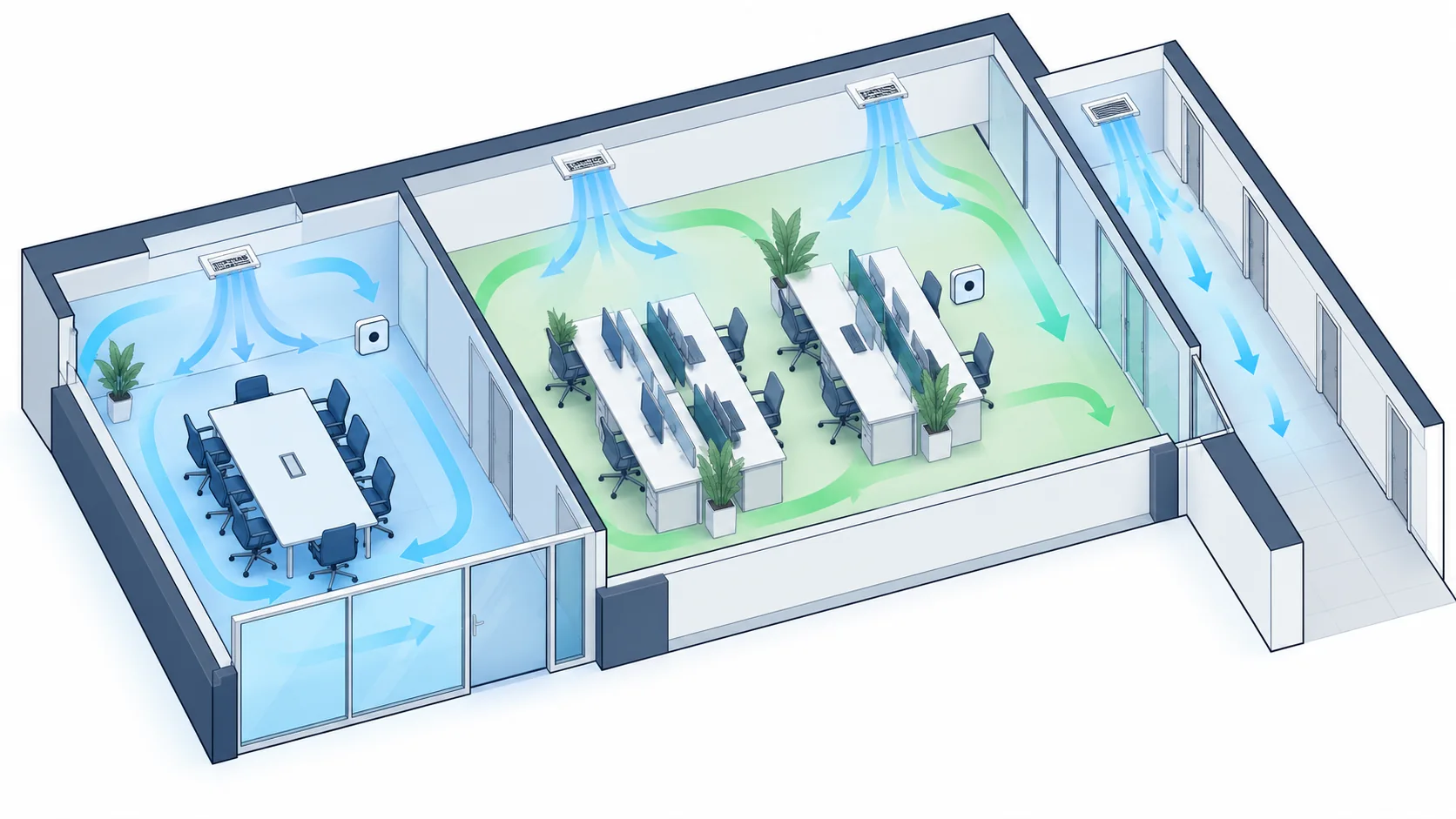
Do not turn the drawing into a false heatmap. CO₂ concentration is not reliably predicted from a desk count alone. People move, ventilation air may short-circuit between supply and return, partitions alter mixing, and a corridor may carry air from neighboring spaces. The map identifies questions, not measured concentrations. In an open office, separate a workstation cluster beside a window from one deep in the interior if the air paths and use differ. In a meeting suite, consider each frequently used room rather than assuming the shared corridor monitor sees the same pattern.
The HSE notes that concentrations vary within an indoor space and that larger rooms generally need more than one sampling location. Its guidance also describes circumstances where CO₂ is a weak proxy: very few or rapidly changing occupants, large high-ceiling spaces with uncertain mixing, and processes that create CO₂. Those limitations matter when planning an office survey. A rarely occupied copy room may show a low reading simply because people were absent, while an enclosed meeting room may show a pronounced occupied-hour rise. Neither observation alone ranks the two rooms' ventilation systems.
| Space or situation | First monitoring question | Sensible first approach | Common interpretation trap |
|---|---|---|---|
| Enclosed meeting room | What happens during a typical occupied meeting? | Log at a stable occupied-zone position and annotate start, finish and ventilation mode | Treating the one end-of-meeting peak as a complete assessment |
| Small private office | Does the normal workday create a repeatable build-up? | Keep a monitor at a consistent representative location for several occupied periods | Comparing a busy day with a mostly empty day |
| Open workstation floor | Do distant occupied zones behave alike? | Trial several points or use matched loggers after a side-by-side check | Assuming one perimeter display represents every desk |
| Corridor or reception | Is this an air-transfer path or a separately occupied zone? | Monitor only if it serves a defined question; note neighboring rooms | Treating mixed corridor air as the meeting-room value |
| Return duct or building-management point | What does the control system actually sense? | Consult the system design and served-zone mapping | Reading a blended return-air value as each room's exposure |
The table is a planning aid, not a prescribed number of monitors. The number depends on the building, decision and evidence of spatial variation. Add a point when a single trace repeatedly fails to explain an occupied zone, not merely because a product package makes multiple devices available.
Choose a position that samples room air, not a local plume
In a typical occupied office, a useful first position is within the breathing zone of people using the room, with free air access around the inlet. Avoid direct exhalation from a nearby desk, a window stream, a door gap, a supply diffuser, a fan jet, a heater and enclosed shelves. These locations can bias the measurement in different directions: breath can raise a local reading; a stream of lower-CO₂ supply air can lower it; a door may introduce another room's air; a warm surface may change instrument or mixing behavior. None of these biases has a fixed universal magnitude.
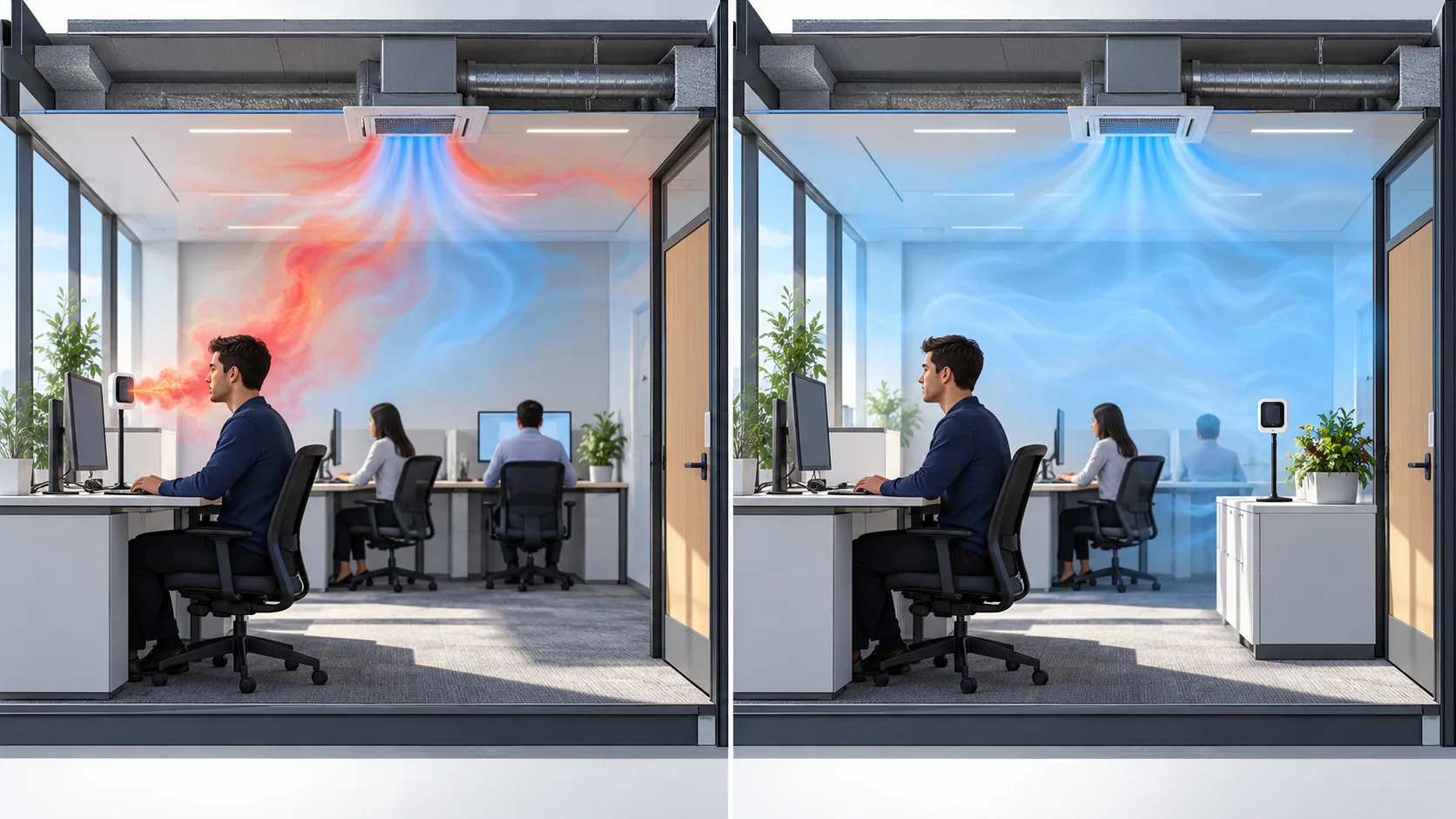
HSE's UK workplace advice says to place monitors at head height, more than 50 cm from people, and away from windows, doors and air-supply openings. Treat that as an official workplace-screening starting point, not a universal engineering mounting code for every building or instrument. Read the complete monitor's mounting and operating instructions, and check the control-system design if it is part of a building automation system. A desk logger does not need to be mounted as if it were a duct probe; a probe in a return path serves a different question.
Use practical judgment where a “perfect” site does not exist. A small room may have a table under a ceiling diffuser and a door beside every wall. Instead of pretending one point is unbiased, sample at two or three plausible positions during comparable occupancy and document the difference. A portable monitor can help screen whether the fixed location follows the room trend or mainly responds to a local jet. If a proposed location consistently behaves differently when someone sits beside it, move it or narrow the claim to “this workstation” rather than “the room.”
Mount securely enough that the location stays stable. A logger that is moved between days, hidden behind papers, unplugged for cleaning or placed beside a new fan has a changed measurement setup. Photographing or describing the position in an internal facilities record can make later comparisons meaningful. Keep the public-facing article or dashboard focused on the actual room conditions, not a false promise of universal precision.
Permanent wall, portable logger or system sensor?
A permanent wall monitor favors repeatability and continuous display, but its location may be selected for electrical convenience instead of representative air. A portable logger can investigate alternate spots and rooms, but it may have a short battery life or be carried inadvertently. A building-management sensor can provide a stable long-term feed, yet its location and averaging may be governed by control logic rather than independent IAQ assessment. Decide which trade-off serves the question.
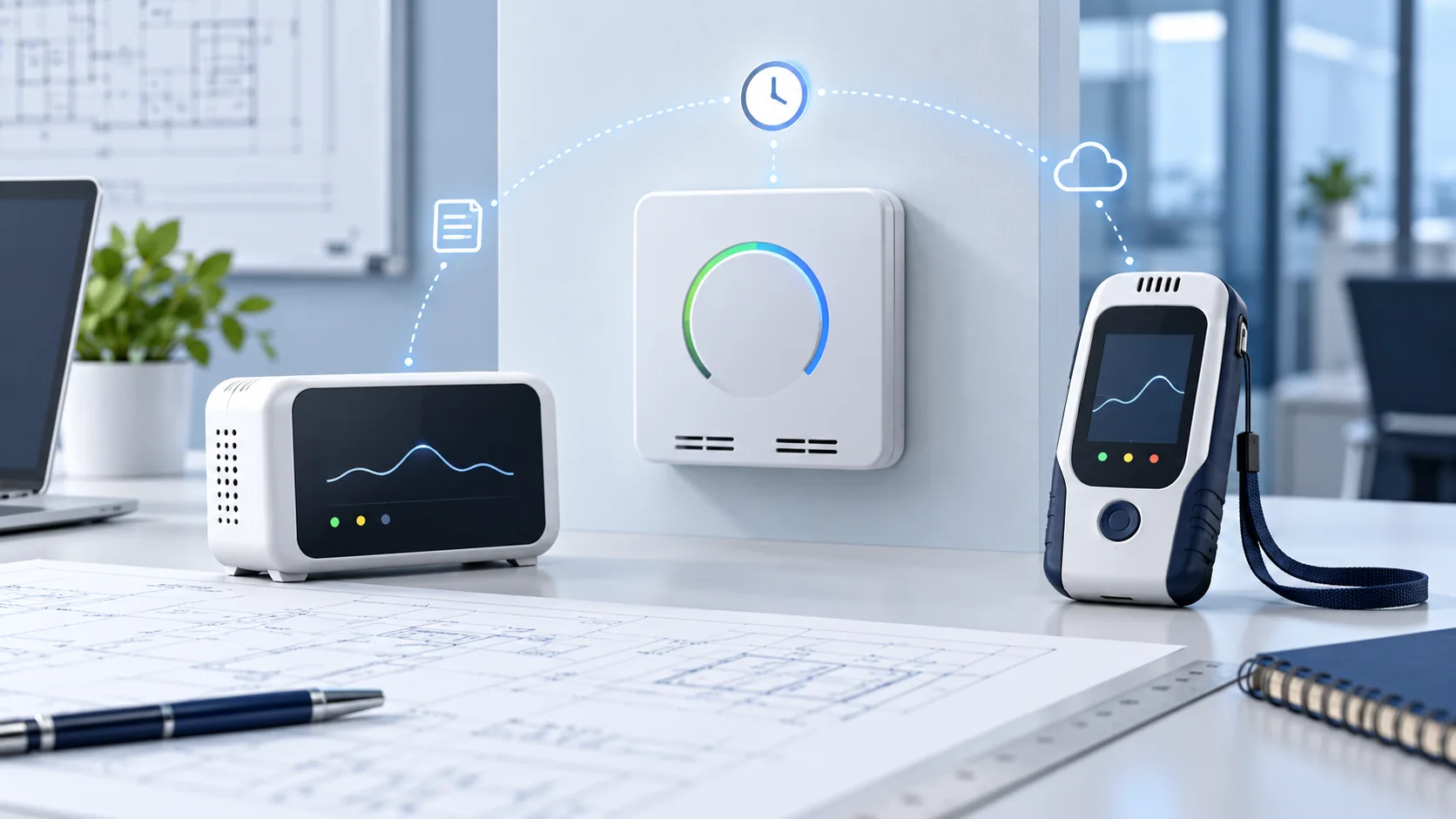
The display resolution is not measurement accuracy. A monitor showing one-ppm steps may still have a much larger specified uncertainty or slow response. Check whether it measures CO₂ directly or reports an estimated “eCO₂” derived from other gases; our direct CO₂ versus VOC-derived eCO₂ guide explains why the two are not interchangeable. For room-air ventilation patterns, a direct CO₂ channel with known measurement behavior is the sensible starting point. HSE specifically points to non-dispersive infrared devices for portable workplace use.
Device specifications are model-specific. For example, the Lembar data Sensirion SCD4x states different specified ranges and accuracy conditions for members of one sensor family and explains its automatic self-calibration assumptions. That does bukan tell you the accuracy or calibration policy of a finished office monitor built with an unknown sensor, enclosure, firmware and airflow path. Ask for the complete product manual: measurement range, accuracy definition and conditions, response and averaging, calibration method, power, clock behavior and how missing data are recorded. Our CO₂ monitor accuracy guide gives a more detailed specification checklist.
Trial the proposed location during real use
Install or place the monitor provisionally and collect normal-use data before a decision. Record the room, device ID, exact position, sample interval, clock and time zone. Note the number of people, approximate periods of use, doors/windows, scheduled outdoor-air operation and unusual events. The goal is not to make every day identical; it is to know which differences might explain the trace. A single empty-room screenshot followed by a crowded-room screenshot can show a change but cannot establish a normal pattern.
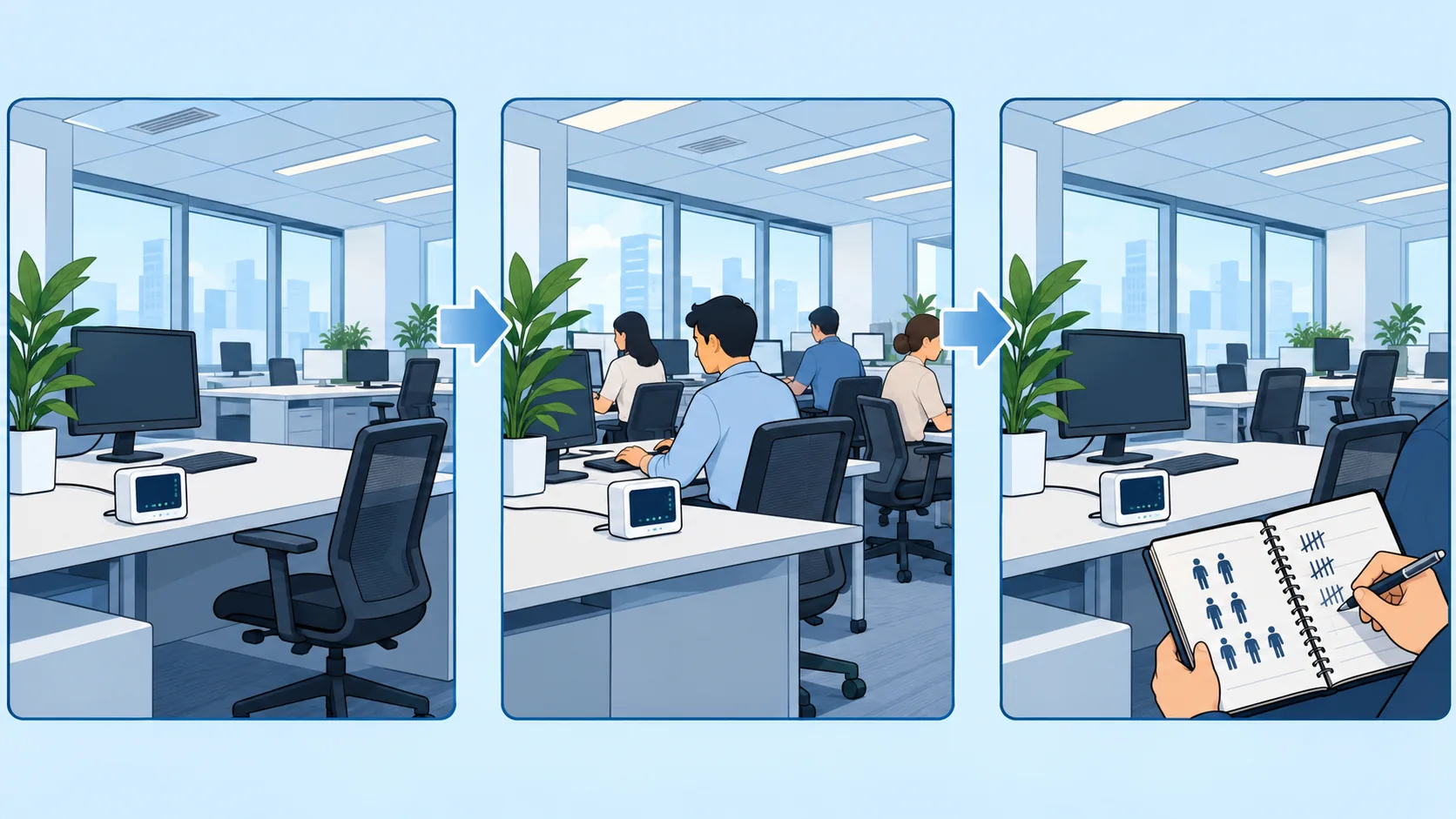
HSE recommends several measurements throughout the occupied day because activities, numbers of people and ventilation change. A logger can make this more practical, provided the exported time series is trustworthy. Our logger versus live-display comparison discusses why a screen that refreshes rapidly may still save sparse or incomplete history. If the device loses power or network access, check whether the trace contains gaps, interpolation or repeated last-known values. Set the sampling interval to resolve the event you care about, using the instrument manual rather than a universal “best” setting.
Do a short location check while the same room and occupancy remain reasonably steady: compare the candidate position with another plausible occupied spot. Watch for systematic differences, not one isolated point. If the device itself is moved, allow it to settle per the manual and mark the move on the log. A change after moving it can reflect local conditions or instrument response, so do not present it as an immediate ventilation improvement. If multiple devices are available, first place them together for an agreement check; that helps reveal large offsets or timing differences before treating later separation as a room gradient.
Repeat on different normal operating days when the question demands it. Weather can affect natural ventilation. An HVAC schedule may differ between weekdays, evenings and weekends. An office with a flexible seating policy may shift occupancy between zones. A useful record says which conditions were present, not just which number appeared.
Interpret the trace without overclaiming
A rising occupied-room trace can indicate that people are adding CO₂ faster than it is being removed from the sampled air at that time. A stable or falling trace can arise from outdoor-air exchange, people leaving, an open connection to another room, or a sensor artifact. The same concentration can occur through different combinations of generation and removal. A low reading when the office is empty is not evidence that its occupied ventilation will be adequate. A high local reading beside one person's breath is not a building-wide diagnosis.
For an office survey, compare like with like: similar occupancy, room setup, monitor location, sampling period and ventilation schedule. Look at the pre-occupancy value, direction and persistence of the occupied rise, response to a known air-path change and repeatability on another day. Keep indoor and outdoor concentration separate where an outdoor reference is genuinely measured. ASHRAE describes tracer-gas methods that can estimate outdoor-air rates, but those methods require assumptions about source rate, mixing, outdoor concentration and state of the system. Do not convert one ppm snapshot into an airflow rate by a rule of thumb.
| Trace observation | Plausible explanations | Useful next check |
|---|---|---|
| Very sharp short spike when a person approaches | Direct breath or a local plume | Observe distance and relocate or shield the inlet as instructed |
| Lower value beside a supply diffuser than at desks | Fresh-supply jet or different local mixing | Measure a representative desk-area position during the same use |
| Different readings on two devices together | Offset, calibration, response or averaging differences | Check manuals, settings and side-by-side history before deployment |
| Repeated occupied rise in one enclosed room | Source–exchange imbalance under those conditions | Verify occupancy, outdoor-air schedule and room air path |
| Corridor remains lower than meeting room | Mixing with larger or differently ventilated areas | Do not substitute corridor data for the meeting room |
| One day falls after a window opens | Outdoor dilution may contribute; other events may coincide | Record weather, occupancy, exact time and repeat if practical |
Use the table to decide what to inspect, not to issue a diagnosis. CO₂ does not measure particulate matter, formaldehyde, carbon monoxide, humidity or all odor sources. A recirculating air cleaner may improve particle levels while room CO₂ still rises; our air purifier and CO₂ explanation separates those functions. US EPA's office IAQ resources similarly treat office air quality as a broader building-management subject.
When a single monitor is not enough
Add another location when two occupied areas have different air paths or the first point cannot represent the decision. Examples include a closed meeting room inside an open office, desks separated by tall partitions, a perimeter zone with operable windows and an interior zone without them, or multiple rooms served by one mixed return-air sensor. A temporary survey may show that two positions track together under relevant conditions; it may also reveal a persistent difference. Either way, document the conditions before reducing or expanding the network.
More devices do not automatically mean better evidence. If clocks differ, devices have unexamined offsets, or occupancy is missing from the record, a colorful dashboard simply multiplies ambiguity. Keep the same instrument at the same representative position for a room trend. Before comparing separate zones, test the instruments together in one stable location, synchronize their clocks and record where each will be installed. Preserve the raw logs so a facilities reviewer can distinguish a genuine repeated spatial pattern from a one-time setup difference.
If a result will drive a building-control change, commissioning decision, legal claim or exposure assessment, involve the responsible facilities or ventilation professional. They can inspect outdoor-air flow, balancing, controls, operating schedules and other contaminants. A CO₂ monitor can show where to investigate; it cannot by itself prove that the ventilation system delivers a specified flow to every occupant.
A reusable office-monitoring brief
Before installation, fill in these seven lines and keep them with the log:
- Question: What room or zone and decision will this evidence support?
- Boundary: Which doors, partitions, supply and return paths define the zone?
- People: When and how many occupants are normally present, approximately?
- Instrument: Which complete monitor, measurement method, manual, calibration state and data interval?
- Position: Where is its inlet, and what nearby plume or air stream could bias it?
- Conditions: Which ventilation schedule, windows, weather and unusual events should be recorded?
- Comparison: What repeated occupied period or alternate point would confirm that the observation is useful?
The brief changes a ppm display into a traceable measurement. It is intentionally short enough for a facilities team to use, yet specific enough to show why two readings might not be comparable. If the answers are unknown, write “unknown” and resolve the critical ones before claiming a result.
Frequently asked questions
Can one monitor cover an entire open-plan office?
Sometimes one point is useful for a limited screening question, but it cannot be presumed representative of every desk. Occupancy, partitions, windows and air distribution may differ across a floor. HSE notes that larger spaces may need multiple locations. Start with a zone map and a temporary survey, then decide whether a fixed point or several points match the actual question.
Should it be placed near a window or the HVAC supply?
Usually not when the aim is to characterize occupied room air. A fresh-air stream can make that position read differently from the occupied zone. A measurement deliberately taken at a supply or window can help troubleshoot an air path, but label it as a local diagnostic point rather than the room value.
Is a return-air duct sensor a substitute for room monitors?
Not automatically. Return air may be a mixture from several spaces and can serve a control purpose. If the decision concerns a particular enclosed room or occupied workstation zone, verify what the duct sensor represents and whether a room-level measurement is needed.
Does a low CO₂ reading prove the office air is clean?
No. It can provide information about occupant-generated CO₂ and, under suitable conditions, ventilation. It does not measure all contaminants or eliminate the need to inspect source control, filtration, humidity and maintenance. ASHRAE emphasizes these limits.
Do all NDIR monitors need the same calibration schedule?
No. The final product manual governs its calibration or self-calibration features. Algorithms can rely on assumptions about exposure to a known low background. A constantly occupied room may not satisfy those assumptions. Do not copy another model's instructions or force recalibration to a guessed outdoor value.
What if a meeting room and the corridor disagree?
That is a reason to check the room boundary and use pattern, not to average the two numbers. The corridor may receive air from several areas; the meeting room can have a different occupancy and air path. Measure the actual room during its normal use and mark door changes.
How many days are enough?
There is no universal count. Use enough normal occupied periods to see whether the pattern repeats under relevant ventilation and weather conditions. A single snapshot is weak evidence; an unannotated month of data can also be hard to interpret. Design the duration around the decision and the variability of the space.
The practical result of good placement is not a reassuring color. It is an honest, repeatable record that says what air was sampled, under which conditions, and what question the observation can answer.
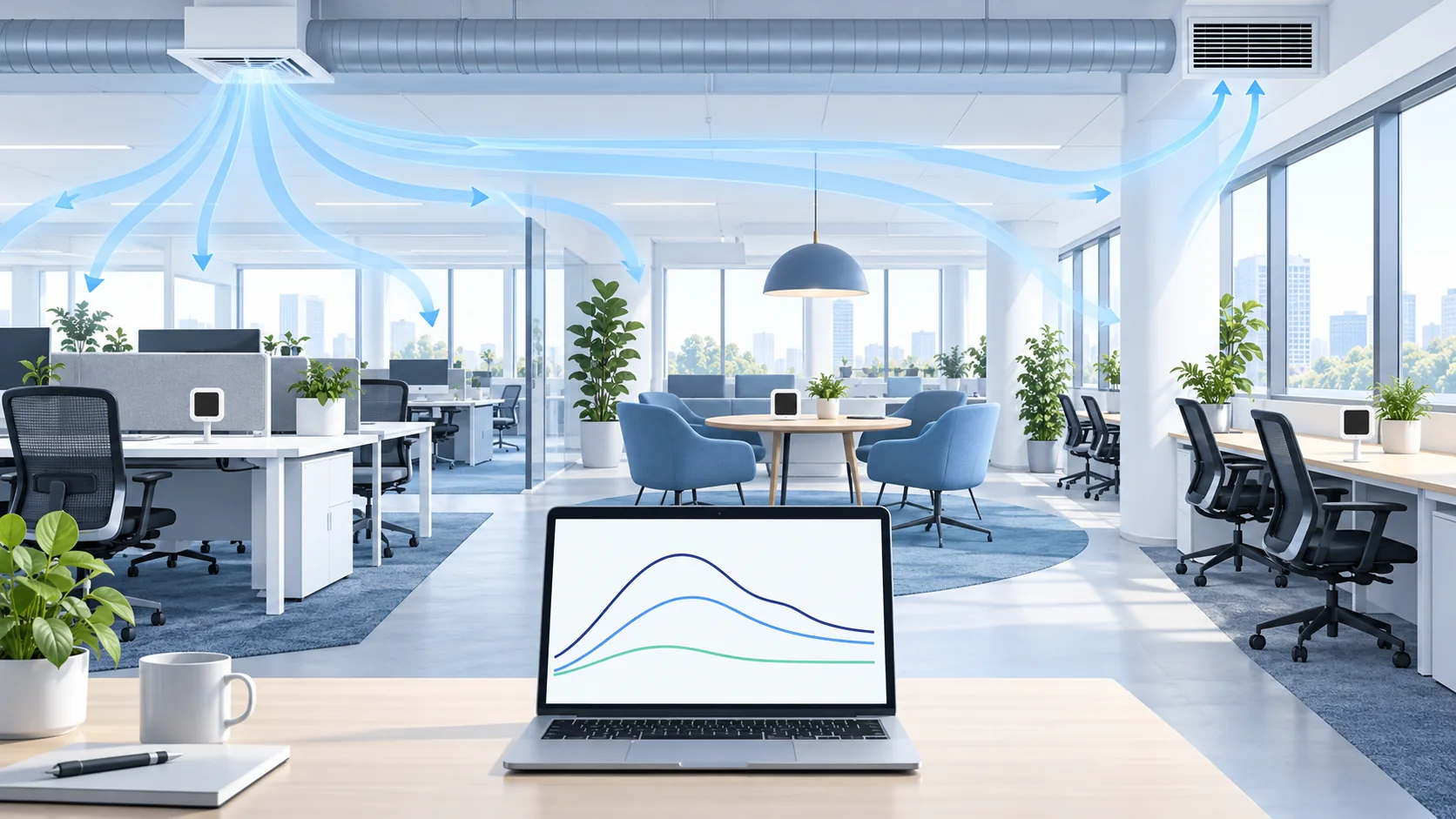
Bagaimana Membandingkan Pembacaan CO2 di Seluruh Zona Kantor Terbuka
Bandingkan log CO2 zona kantor yang disinkronkan setelah memeriksa perjanjian monitor, lokasi, hunian, dan kejadian sistem udara; pelajari kapan perbedaan zona memerlukan penyelidikan.
Baca selengkapnya
Cara Membaca Tren CO2 Ruang Rapat Terhadap Hunian
Baca tren CO2 ruang pertemuan dengan peristiwa okupansi dan ventilasi, dengan membedakan tingkat awal, peningkatan jumlah penghuni, intervensi, dan penurunan pasca-pertemuan.
Baca selengkapnya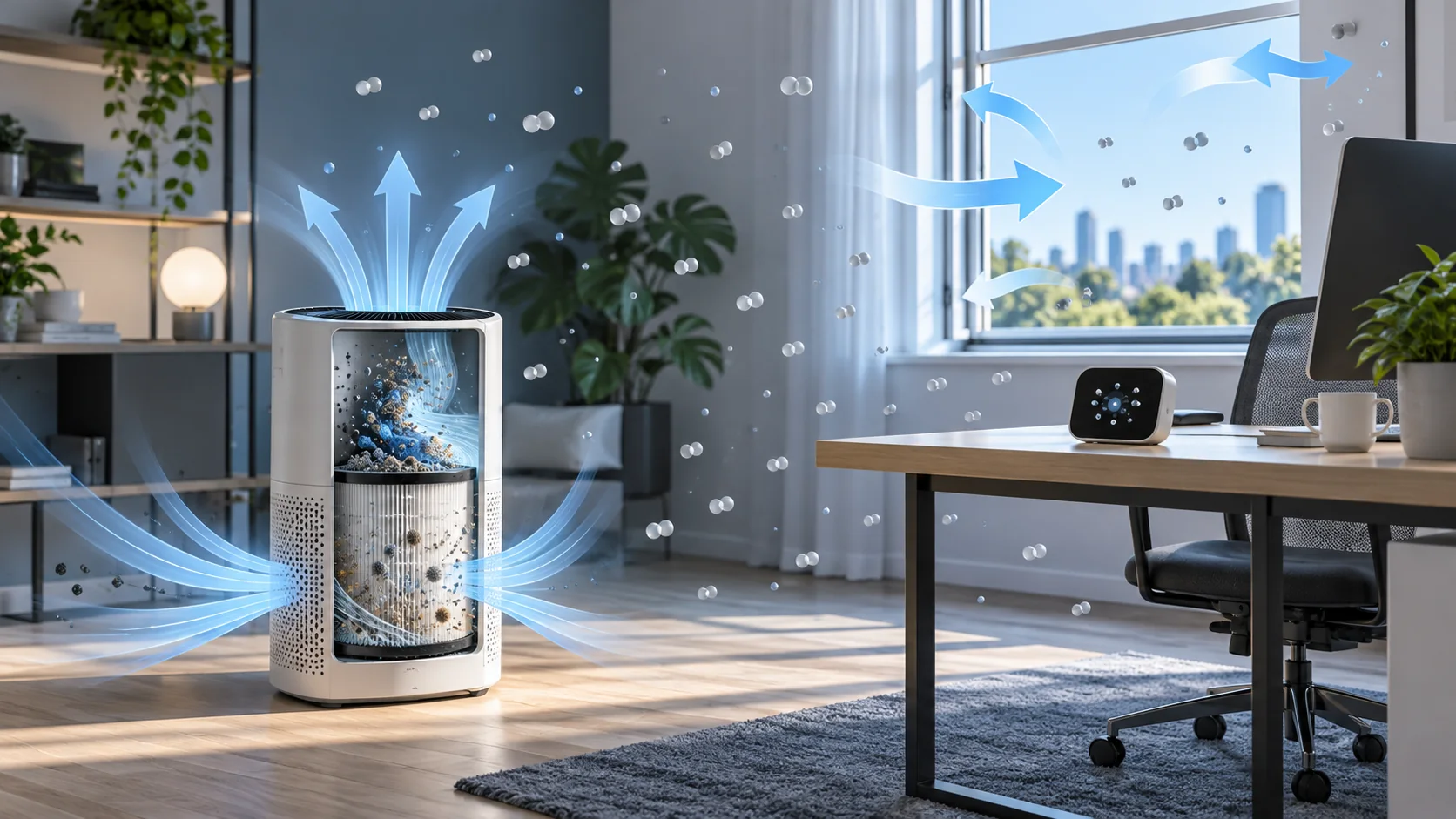
Apakah Pembersih Udara Menurunkan CO2? Pisahkan Filtrasi dari Pertukaran Udara Luar Ruangan
Pemurni HEPA biasa menangkap partikel tetapi tidak menghilangkan CO2 yang dihasilkan penghuni secara berarti. Pelajari cara memisahkan resirkulasi, ventilasi udara luar ruangan, dan memantau efek pencampuran.
Baca selengkapnya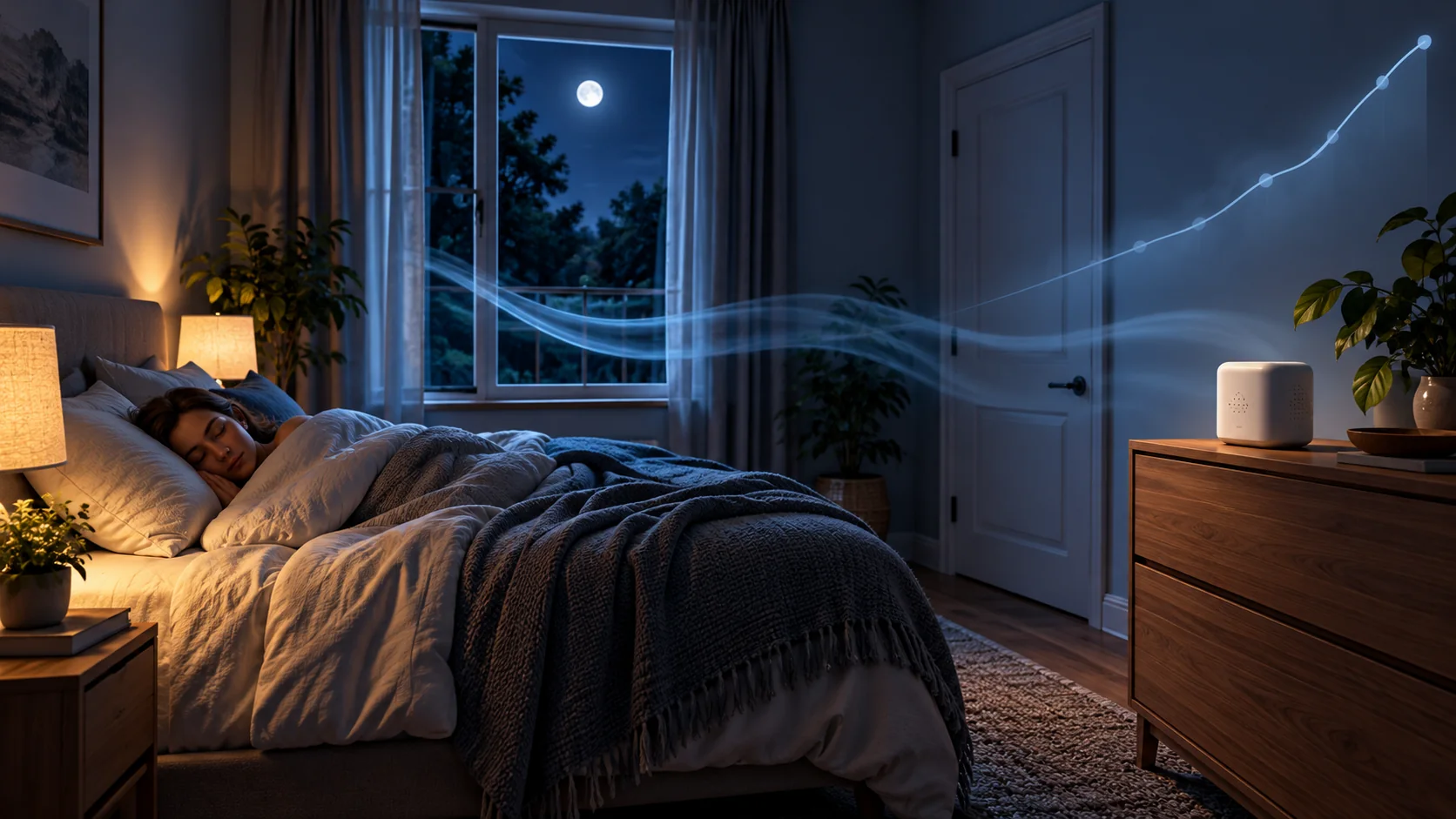
Cara Membaca Log CO2 Kamar Tidur Semalam
Interpretasikan jejak CO2 di kamar tidur semalaman menggunakan tingkat awal, kenaikan, dataran tinggi, dan respons pagi hari sambil memeriksa kualitas logger, jalur udara, dan malam hari yang sebanding.
Baca selengkapnya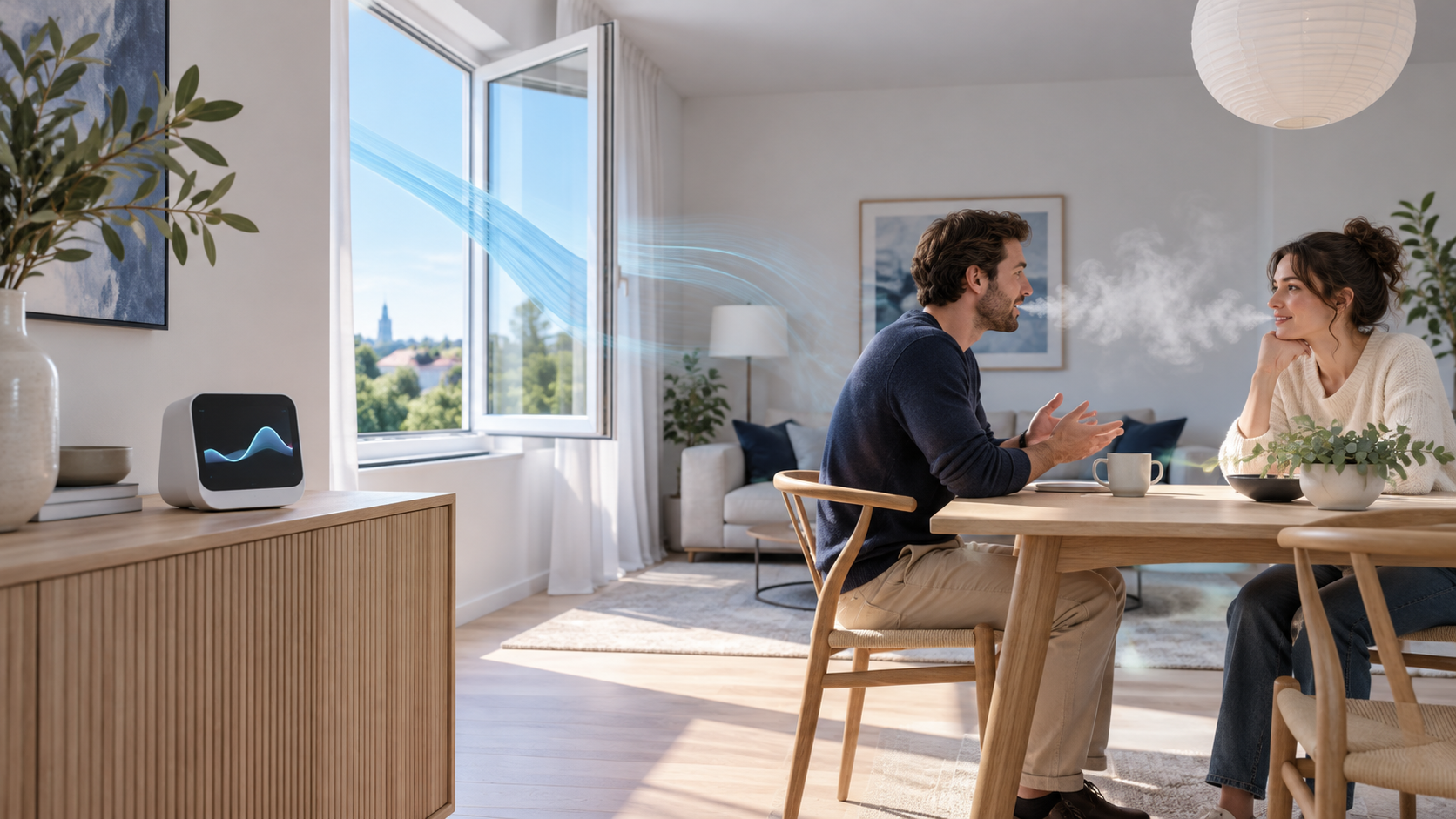
Cara Menafsirkan Tren CO2 di Rumah: Baca Polanya, Bukan Satu Angka
Pelajari bagaimana tingkat hunian, udara luar ruangan, pencampuran ruangan, dan penempatan monitor membentuk jejak CO2 di rumah, dan gunakan pencatatan yang dapat diulang untuk menguji perubahan ventilasi.
Baca selengkapnya
Pencatat Data CO2 atau Tampilan Langsung? Pilih Catatan yang Dibutuhkan Keputusan Anda
Pilih pencatat CO2, tampilan langsung, atau keduanya dengan membandingkan respons sensor, interval pembaruan dan pencatatan, stempel waktu, kesenjangan data, retensi, dan penggunaan.
Baca selengkapnya
Komentar (1)
[…] The UK HSE workplace guidance describes small meeting rooms with relatively consistent occupancy over a meaningful period as suitable settings for CO₂ monitoring. It also cautions that rapidly changing numbers of people and snapshot readings are harder to interpret. This guide turns those cautions into a practical reading sequence. For the placement decision itself, see our office CO₂ monitor placement plan. […]