
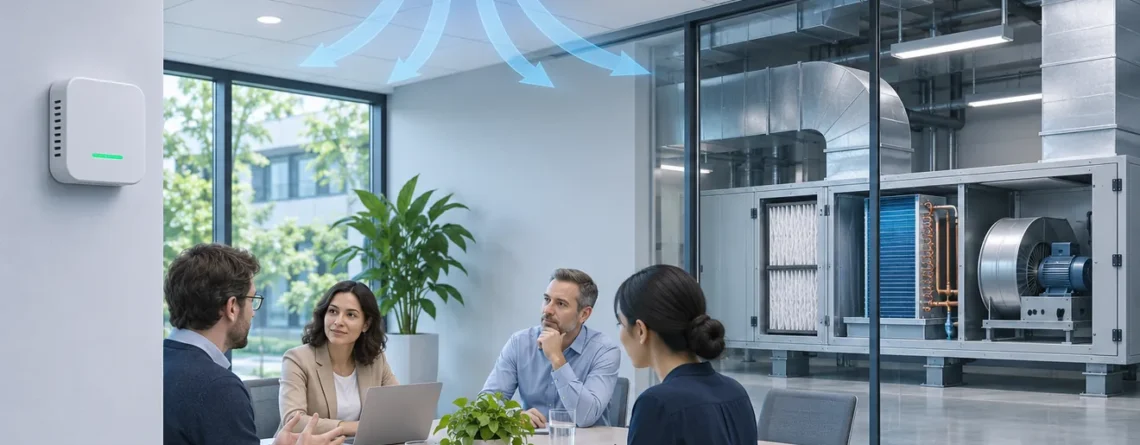
A CO₂ sensor's response time describes how its output approaches a new value after a defined change at the sensor. A ventilation control response also includes when the installed sensor encounters the change, when the controller can act, when outdoor airflow actually changes, and when that airflow affects the occupied zone. A sensor with a short T90 can be part of a system that takes much longer to change room concentration. To find the delay, record each transition on the same time axis and identify the first link where the expected change fails to appear.

Una lettura a muro, l'unità di trattamento dell'aria e la stanza occupata rappresentano fasi diverse della stessa risposta.
Identifica i sei orologi prima di cronometrare qualsiasi cosa
Una persona si unisce a una riunione, un controller aumenta la richiesta di ventilazione e la tendenza della stanza alla fine si stabilizza. Si è tentati di sottrarre il timestamp del primo evento dall'ultimo e chiamare la differenza ritardo del sensore. Tale intervallo in realtà inizia con un cambiamento nella generazione di CO₂ e termina con una condizione creata dalla generazione, dall’aria in entrata, dalla circolazione e dalla misurazione. Include diversi eventi separati che possono sovrapporsi.
Inizia scrivendo la domanda come una coppia di endpoint osservabili. Un tecnico di misurazione potrebbe chiedere quanto tempo impiega il trasmettitore per raggiungere una frazione specifica di una variazione di ingresso nota. Un ingegnere dei controlli potrebbe chiedere quanto tempo occorre a un punto valido per produrre una domanda effettiva. Un operatore di un edificio potrebbe voler sapere se una modifica della ventilazione migliora la stanza occupata prima della fine di una riunione programmata. Ogni domanda richiede il proprio segnale di riferimento e una condizione finale.
| Strato temporale | Inizia evento | Fine delle prove | Motivo comune del ritardo |
|---|---|---|---|
| Esposizione e campionamento | La concentrazione locale cambia o il campione viene cambiato | Il cambiamento raggiunge la camera di rilevamento | Posizione della stanza, sostituzione della custodia, tubi o flusso del campione basso |
| Misurazione | La fase di ingresso raggiunge la camera di rilevamento | L'uscita del sensore raggiunge la frazione specificata | Risposta fisica, compensazione interna o media |
| Acquisizione e registrazione | Il sensore riporta un valore utilizzabile | Il controllore o lo storico lo registra | Intervallo di polling, pianificazione, mancata corrispondenza dell'orologio o compressione della cronologia |
| Logica di controllo | Una misurazione valida soddisfa le condizioni definite | Modifiche della richiesta di controllo effettivo | Filtraggio, persistenza, modalità gate o priorità |
| Consegna meccanica | Modifiche effettive della richiesta | La posizione dell'attuatore e il flusso d'aria richiesti vengono verificati | Corsa dell'attuatore, rampa del ventilatore, guasto della serranda o pressione statica |
| Risposta zona occupata | Modifiche del flusso d'aria effettivamente erogato o della generazione | La concentrazione locale delle stanze segue un andamento interpretabile | Sostituzione dell'aria, ridistribuzione, emissioni continue o modifica dell'occupazione |
Un orologio può essere assente o effettivamente istantaneo per una determinata configurazione. Un ingresso cablato non ha alcun polling di rete su quel segmento, ma il controller può comunque scansionarlo e filtrarlo. Un comando può essere generato tempestivamente mentre un timer di esecuzione minimo altrove limita il momento in cui ha effetto. Uno storico può mostrare informazioni obsolete mentre il circuito locale continua a utilizzare campioni nuovi. Tratta la tabella come una mappa delle prove e utilizza solo i livelli applicabili.
Leggere le specifiche di risposta nelle condizioni di test dichiarate
Per un passaggio da 500 ppm a 1.000 ppm, l'output raggiunge il 90% della variazione a 950 ppm, presupponendo che inizi a 500 ppm e alla fine si stabilizzi a 1.000 ppm. Per un gradino discendente da 1.000 a 500 ppm, il punto del 90% è 550 ppm. T90 viene misurato dall'inizio definito dell'evento di input all'output che attraversa quella frazione. La definizione della fase di input, l'output osservato, il valore iniziale e il valore finale contano tanto quanto il tempo scritto nella scheda tecnica.
Un T90 misurato può includere parte del dispositivo di prova o dell'elaborazione del segnale a seconda del metodo documentato. Verificare se il valore descrive un modulo nudo, un trasmettitore alimentato nella sua custodia, un percorso a flusso forzato o una disposizione a diffusione. Confermare quale modalità di campionamento si applica, se il dispositivo è riscaldato e se il livello di risposta è tipico o garantito. Confrontare il comportamento al rialzo e al ribasso solo quando entrambi sono stati stabiliti. Un filtro o una disposizione di ingresso possono introdurre comportamenti che il produttore non ha mai testato con il modulo.
La specifica Senseair eSENSE FAI per l'articolo 050-8-0061 elenca un T90 inferiore a 10 secondi a 30 cc/min e un tempo di diffusione inferiore a 3 minuti. Tali cifre appartengono alle configurazioni identificate nella specifica. Non stabiliscono l'orario in cui un trasmettitore da parete vede la media di una sala riunioni reale. Specifiche Senseair eSENSE FAI
Sensirion elenca 60 secondi al punto di risposta del 63% per il modulo CO₂ SCD43. Per una risposta ideale del primo ordine, la frazione completata al tempo t è 1 − exp(−t/τ), quindi il 63,2% si verifica in una costante di tempo e il 90% in ln(10) × τ, circa 2,303 × τ. Una costante di tempo di 60 secondi implicherebbe quindi circa 138 secondi al 90% in quel modello. Questa è un'operazione aritmetica per una forma di risposta presunta. Non è un SCD43 T90 pubblicato né un sostituto dei dati del prodotto assemblato. Un puro ritardo nel trasporto, molteplici processi termici o di scambio, filtri non lineari e reporting discreto possono rendere la conversione inaffidabile. Specifiche Sensirion SCD43
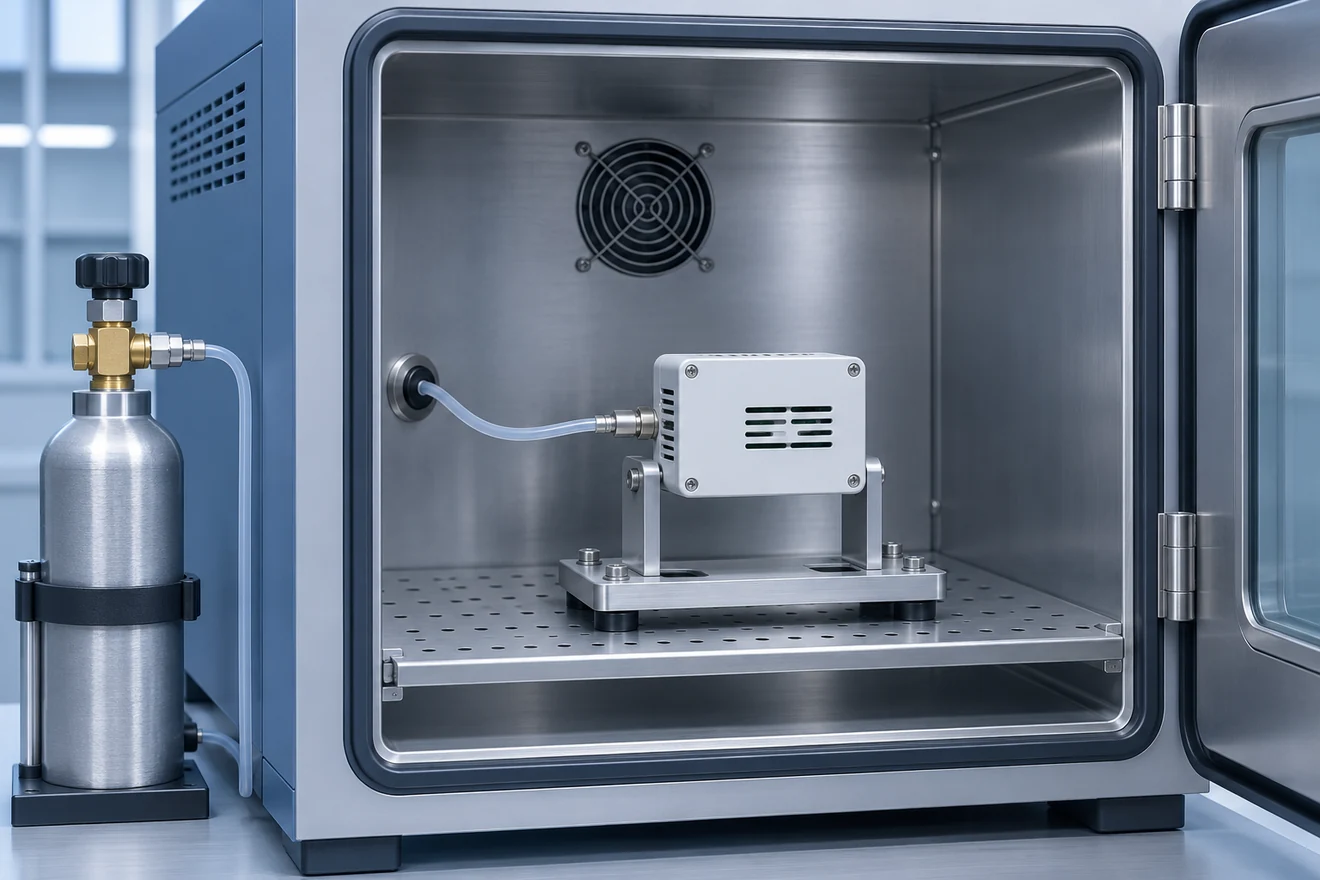
Un test del dispositivo definisce l'evento di input e l'output sotto osservazione. L'esposizione installata aggiunge le proprie condizioni.
Calcolare la scala della risposta di una stanza
Una stanza può iniziare a rispondere a un cambiamento nella ventilazione prima che la sua concentrazione di CO₂ cambi abbastanza da risaltare su un terreno. Per una singola zona idealizzata e ben miscelata di volume V, con flusso d'aria esterno Q, concentrazione esterna costante Cₒ e nessuna generazione interna dopo l'uscita degli occupanti, segue la concentrazione in eccesso:
C(t) − Cₒ = [C(0) − Cₒ] × exp[−(Q/V)t]
Utilizza unità coerenti. Se Q è espresso in metri cubi all'ora e V in metri cubi, Q/V è in ore inverse e t è in ore. Il risultato presuppone che l'aria in entrata abbia la concentrazione esterna dichiarata, che Q sia costante, che l'aria in uscita abbia la concentrazione della stanza miscelata e che lo strumento di confronto tenga traccia di tale concentrazione abbastanza bene. Un percorso di ricambio d'aria separato con una diversa concentrazione in entrata necessita di un modello diverso.
Per un ipotetico locale di 240 m³ che riceve 480 m³/h di aria esterna, Q/V è 2 h⁻¹. La costante di tempo della stanza V/Q è 30 minuti. Se la stanza inizia a 1.220 ppm e l'aria esterna è a 420 ppm, l'eccesso iniziale è di 800 ppm. Dopo 15 minuti l'eccesso è di 800 × exp(−0,5), ovvero circa 485 ppm, ovvero circa 905 ppm in ambienti chiusi. Dopo 30 minuti è di circa 294 ppm, con un rendimento di circa 714 ppm in ambienti chiusi. Sono necessari circa 69 minuti per rimuovere il 90% dell'eccesso iniziale, a quel punto la stanza idealizzata leggerebbe circa 500 ppm. Tali valori illustrano il modello con un flusso d'aria scelto e non hanno alcun significato di accettazione.
| Tempo trascorso dalla modifica del modello | CO₂ interna modellata | Frazione dell'eccedenza iniziale rimanente |
|---|---|---|
| 0 min | 1.220 pagine al minuto | 100% |
| 15 minuti | 905 pagine al minuto | 61% |
| 30 min | 714 ppm | 37% |
| 60 min | 528 ppm | 14% |
| About 69 min | 500 ppm | 10% |
With continuing generation, concentration approaches a different endpoint. In the same idealized model a constant volumetric CO₂ generation rate G, expressed on the same volume and gas basis, gives a steady excess fraction G/Q. The trajectory can rise after the damper opens if the new steady concentration is still above the current concentration. The slope may become less positive while occupants continue to exhale CO₂. Opening a ventilation path does not make people stop generating CO₂, so a successful delivery event need not coincide with an immediate declining trend.
NIST's Indoor Carbon Dioxide Metric Analysis Tool estimates a time-dependent concentration from space characteristics, people and outdoor ventilation rather than a universal concentration. ASHRAE's ventilation handbook also discusses imperfect distribution and the distinction between supplying air and delivering it effectively. In a real building, a single wall point can see a nearby plume, short-circuiting airflow or cross-zone transfer. A fitted decay from one point therefore needs the mixing, occupancy and airflow assumptions to be established before it is used to estimate ventilation. NIST Technical Note 2213, ASHRAE Handbook chapter on ventilation and infiltration

Supply air travels through an occupied space before a wall point sees a representative change. Air paths are illustrative.
Trace the signal before changing the control tuning
Compare the local transmitter output, raw BAS input, filtered value used by the sequence and historian export. A discrepancy between local and raw BAS values points toward scaling, communication, polling or source selection. Agreement at that boundary with a delayed filtered point points toward signal conditioning. If both raw and filtered points meet the trigger but the request stays fixed, inspect occupancy mode, threshold persistence, enable logic and priority. These are separate tests even when the same software supplies all four values.
A moving average adds different apparent lag depending on the disturbance. After an ideal step, a trailing average of duration W that was filled with the old value ramps to the new level over W. It reaches 90% after approximately 0.9 W in a continuous model. A 2-minute window can therefore create an approximately 108-second 90% response to an instantaneous step before any extra delay from sensor dynamics or controller timing. A real rolling average can operate on discrete samples, skip invalid values or behave differently after reboot. A threshold crossing also depends on the size and initial level of the disturbance, so this calculation gives the scale of an effect without predicting a complete sequence.
La persistenza è diversa. Se una sequenza richiede che il punto filtrato rimanga al di sopra di una soglia per due minuti, il timer si avvia solo dopo che il punto filtrato l'ha attraversata e potrebbe reimpostarsi quando scende al di sotto. Una richiesta può quindi non riuscire ad affermarsi durante un breve picco reale anche se il trasmettitore l'ha registrata correttamente. Un breve evento può anche scomparire in una registrazione storica grossolana mentre il controller agiva su ogni scansione locale. Controlla l'intervallo e la fonte del timestamp sia per la decisione in tempo reale che per la tendenza utilizzata per ricostruirla.
In a networked system, periodic acquisition adds phase-dependent waiting. If a gateway reads a changing point every 30 seconds, and readings arrive on time, the next poll could occur just after the event or almost 30 seconds later. Delays on a busy field network, skipped updates and retries complicate that range. If a historian then samples on a separate clock, its newest record may lag by another interval. Compare event timing at the source and receiver before declaring that the controller responded when the plotted line moved.
Verify the command, the motion and the airflow
Un comando della serranda identifica lo stato richiesto e un segnale di feedback di posizione identifica lo stato segnalato dal relativo sensore o attuatore. Nessuno dei due da solo stabilisce il flusso d'aria esterno. Il collegamento delle pale può essere allentato, la velocità della ventola può variare, la pressione statica del sistema può cambiare e una sequenza concorrente può alterare il comando effettivo. Lo stesso angolo della pala può produrre un flusso di aspirazione diverso in condizioni di pressione diverse. Identificare la misurazione utilizzata per confermare il flusso d'aria e l'intervallo operativo nel quale è valida.
Una misurazione dell'aria esterna presso un'unità di trattamento dell'aria stabilisce la consegna in corrispondenza di quel limite di misurazione. In un sistema multizona rimane una seconda domanda riguardante la distribuzione nello spazio interessato. Il flusso d'aria della zona primaria, la frazione esterna, la diversità di occupazione e i percorsi di trasferimento possono avere importanza. Un terminale di zona può fornire più aria miscelata ricircolata mentre la presa esterna rimane pressoché invariata. Al contrario, una modifica della presa d'aria centrale può produrre risposte diverse nell'ambiente in un edificio perché la domanda di zona e la distribuzione dell'aria differiscono.
Quando si ispeziona un evento di passaggio, separare il comando richiesto da quello che vince l'arbitrato, quindi identificare il primo cambiamento osservato nella prova della ventola, nella posizione e nel flusso d'aria. Verificare eventuali limiti di progetto e passaggio tra circuiti di supervisione e locali. Un improvviso cambiamento di CO₂ senza prova di ventola merita un'indagine diversa dal flusso d'aria nel sistema di trattamento dell'aria senza alcun cambiamento osservabile in un punto a parete. Capitolo del Manuale ASHRAE sulla progettazione e applicazione dei controlli
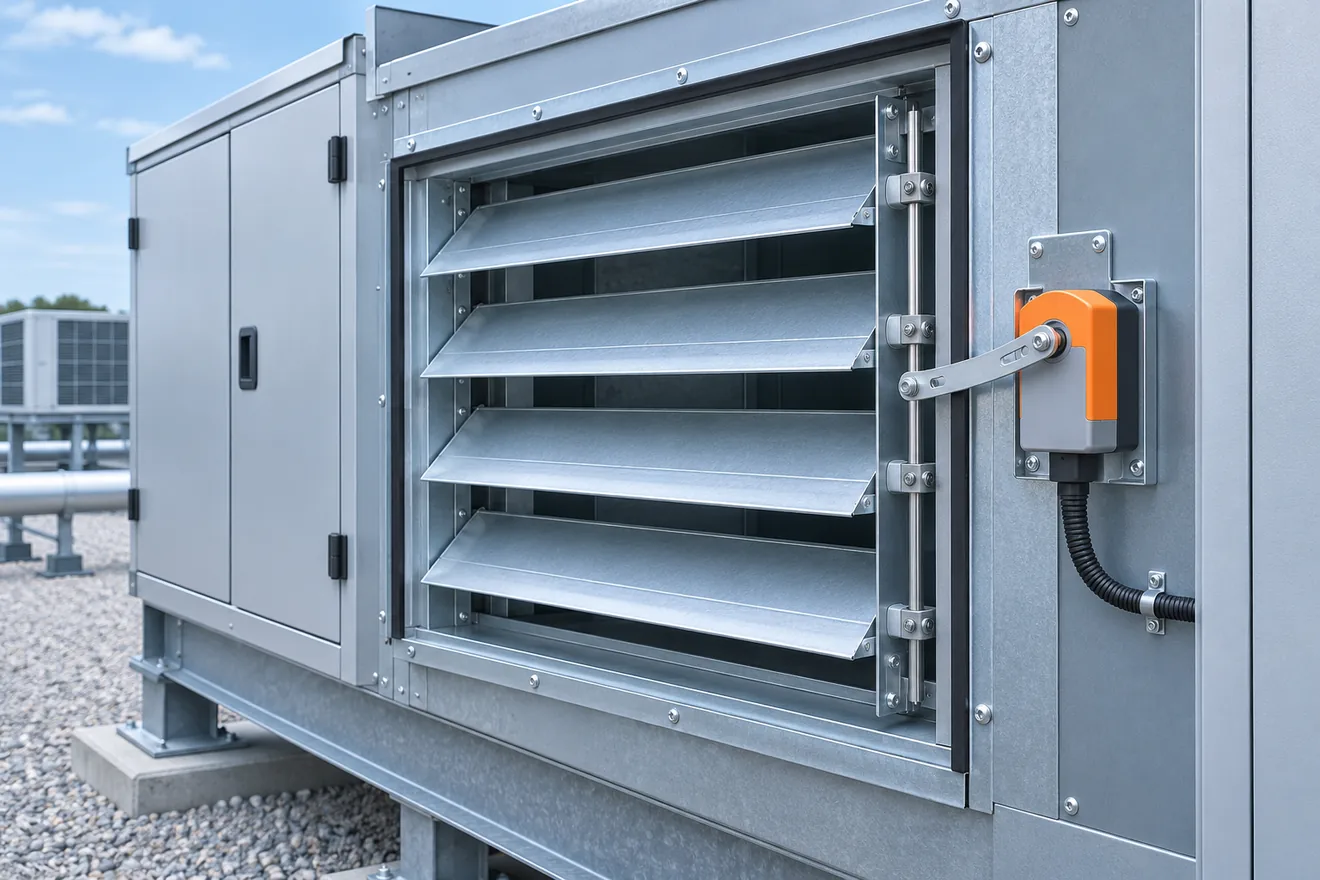
Il comando, il movimento e l'erogazione dell'aria esterna possono essere verificati ciascuno a un confine diverso.
Elabora un evento allineato
Consider a hypothetical single-zone office test with clocks checked against a common reference. The site has a direct CO₂ point, a filtered point, a demand point, damper feedback, fan status and valid outdoor airflow measurement. The procedure records the mode before the event and keeps it stable long enough to interpret the result. At 09:00 the occupancy count begins to rise. At 09:03 the raw transmitter value starts increasing and the gateway records the change. The filtered point reaches the project's test condition at 09:05. At 09:07 the controller asserts demand when its configured persistence expires. By 09:08 the actuator reports movement, and at 09:09 the airflow measurement confirms increased outdoor flow. The room trend continues rising until 09:13, then levels off as occupants and HVAC mode remain stable.
The three minutes after occupancy begins do not measure transmitter T90. The concentration change at the sensor inlet was neither observed nor a defined step. The two minutes from criterion crossing to demand are consistent with the configured persistence. The two minutes from demand to proved airflow include mechanical and delivery behavior. The remaining room trend reflects ventilation, generation, distribution and measurement. The series can support further investigation but cannot isolate a sensor time constant without a defined input test.
For a counterexample, suppose the same room's damper command changes but airflow stays within measurement uncertainty and fan status remains normal. Stop interpreting the CO₂ curve as proof of a ventilation response. Review the air path, damper feedback, effective command and reliability of the airflow measurement. If the airflow instrument is out of its valid low-flow range, the trace cannot distinguish small flow from instrument limitations. Record that gap and obtain the measurement required by the project before assigning a cause.
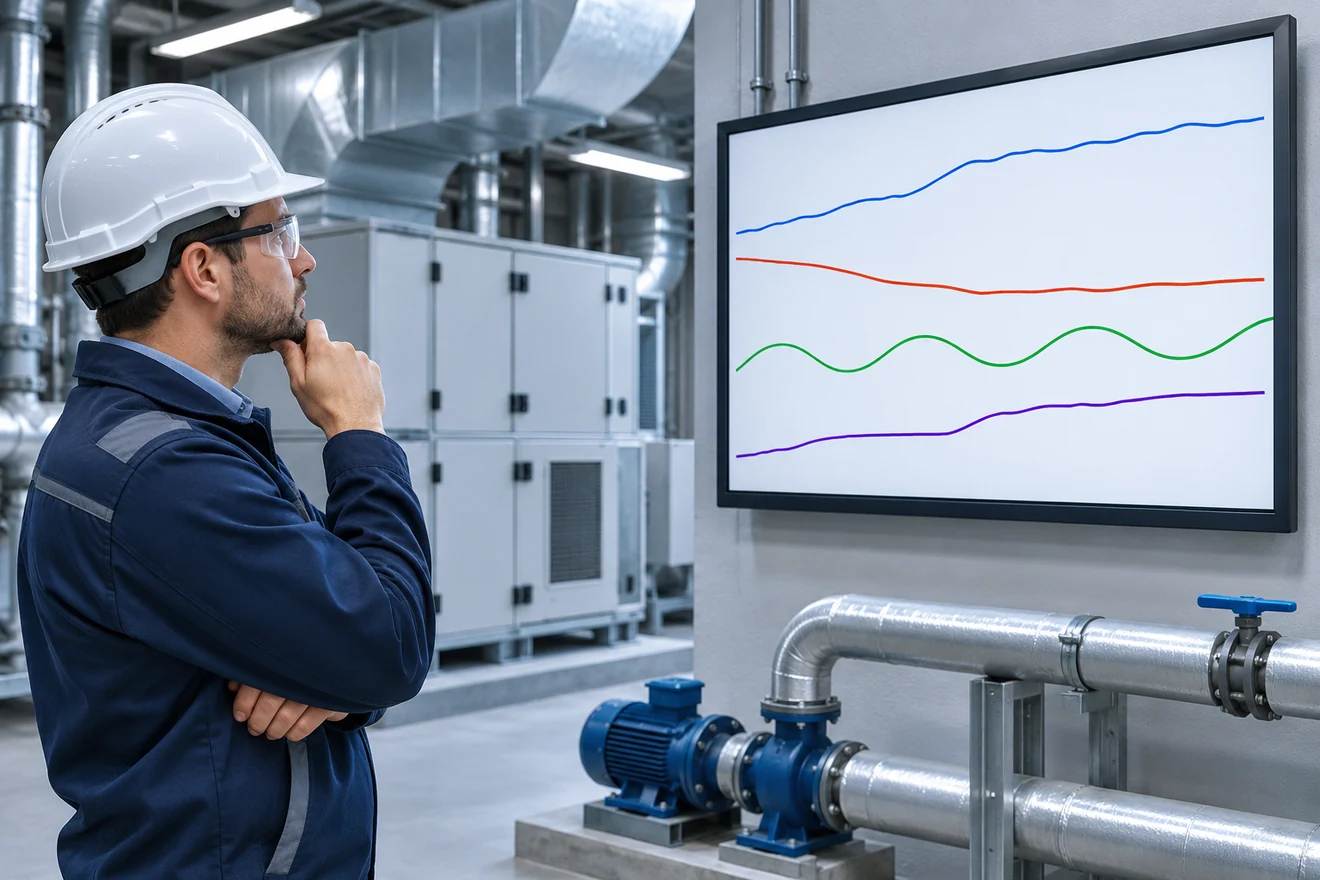
Synchronized evidence makes the order of transitions visible. The traces are conceptual.
Progetta un confronto in grado di distinguere un ritardo da un artefatto di visualizzazione
Decidere quale confine affronta il test prima di raccogliere i dati. Per un confronto delle misurazioni, selezionare uno strumento indipendente compatibile con portata adeguata, risposta nota e condizioni documentate. Posiziona entrambi gli strumenti per osservare aria comparabile senza dirigere il respiro di qualcuno nelle prese. Registra il riscaldamento dello strumento, il percorso del campione, la media dell'output e i timestamp. Quando una fase del dispositivo approvata dal produttore è appropriata, registrare il metodo di erogazione e il segnale di riferimento utilizzati per confermare la fase. Una persona che espira accanto a un sensore a parete crea un pennacchio poco definito e non è adatto per la stima di T90.
For a sequence review, retain sufficient resolution around the expected change. A one-minute history can show the order of events separated by several minutes but may never distinguish a 15-second actuator event from a 30-second acquisition delay. Select a permissible interval with adequate separation, check device and historian clocks, and record whether displayed points use event timestamps or receipt timestamps. Save the unaggregated export so later analysis can distinguish a flat line from a change-of-value archive that omitted repeated readings.
Registrare i nomi e le unità di misura, le posizioni comandate e provate, lo stato del ventilatore, il flusso d'aria esterno e di zona valido quando disponibile, il contesto di occupazione della zona, la modalità del sistema ed eventuali override. Per la verifica che coinvolge una sequenza HVAC reale, utilizzare la procedura di progetto approvata e ripristinare la modalità normale concordata. Una dimostrazione in modalità temporanea dovrebbe portare quell'etichetta attraverso screenshot, esportazioni grezze e record di test firmati. Un grafico corrispondente derivante dal normale funzionamento non dimostra di per sé che sia stata applicata la stessa logica.
Use repeated observations when normal occupancy varies. Two events can have the same maximum CO₂ and very different times to peak because the occupants entered at different rates or ventilation was available earlier in one case. Compare the event sequence rather than treating the peaks as equivalent input steps. The practical goal is to find a timing change supported by independent observations. In che modo l'umidità influisce sulle letture del sensore di gas covers a separate class of measurement changes that can complicate field comparisons.
What does the evidence let you rule in?
Timing investigations often produce two records that look inconsistent at first. A handheld reading may change within seconds while a BAS graph is flat, or a controller may show an earlier command than the export can display. Before adjusting equipment, compare measurements with the same intended meaning. A portable device in a person's breathing plume and a fixed sensor at a representative room site are observing different local air. A trend sampled on a minute boundary and a controller event recorded when the logic ran are observing different timestamps.
| Aligned finding | Where the evidence narrows the problem | What is still open |
|---|---|---|
| Local reference changes, transmitter output changes later | Exposure, sensor response or transmitter filtering | Whether the two inlets saw the same input |
| Local output changes promptly, raw BAS point updates later | Acquisition, gateway mapping or timestamps | Whether the controller uses the trended point |
| Raw and filtered values cross at different times | Controller input conditioning | Whether the filter is operating as designed |
| Effective request changes without position proof | Mechanical response or proof point | Whether the actuator actually moved |
| Proved position changes without measured flow change | Delivery, pressure or flow measurement | Whether the method resolves that operating range |
| Proved flow changes before a clear room trend | Zone dynamics, continuing generation or measurement | Which rooms and locations received the change |
When the next action depends on a short delay, define what a change means. A crossing of the new value can be caused by noise or overshoot. An endpoint that requires the signal to remain within a band for a specified period answers a different question from first crossing. A chart whose scale rounds to the nearest 50 ppm may mask an earlier shift seen in an unrounded export. Document whether the comparison uses first detectable change, a threshold crossing, a specified fraction of a step, or a maintained final condition.
A second comparison can deliberately isolate the time layer of interest. A comparison in stable, well-represented room air can test agreement and identify unexpected jumps. It cannot determine a step response because the input lacks a known transition. An authorized controller input simulation can test the persistence, arbitration and command boundary. It bypasses sensor exposure and measurement. A documented airflow response test can verify delivery under its operating conditions. It cannot attribute a room concentration change to outdoor airflow when occupancy or adjacent transfer air changed at the same time. Combine these records when the question spans several layers.
When a faster sensor would help
A faster sensor helps when the measurement channel accounts for enough delay to affect the intended decision and the installed exposure allows the change to reach it. For example, if a defined fixture step reaches the transmitter inlet quickly, the raw output is consistently late under the relevant mode, and the controller acts promptly once the new value arrives, the installed transmitter merits attention. Check whether its enclosure, inlet, flow condition or selectable output processing explains the measured behavior before treating a module specification as the solution.
A shorter acquisition interval helps when the raw sensor value becomes available quickly but the receiving point misses or delays it. It has little effect when the dominant delay is air exchange in the zone, or when the existing network cannot reliably sustain the added reads. A shorter persistence period changes the logic, which can make the sequence more responsive to both meaningful occupancy and brief local plumes. Evaluate the intended control stability and approved change process before revising that setting.
A mechanically verified airflow increase may still leave an undesirable occupied-zone pattern. Check the real air distribution, outdoor fraction, mixing and time occupied before replacing the measurement hardware. A room with furniture or partitions added after balancing can deliver differently at the observed site. Conversely, if multiple suitable locations show similarly slow dilution and outdoor airflow was independently verified, the physical timescale may simply be consistent with the room volume and flow. Compare the measured trajectory and its uncertainty against the applicable design question, using the single-zone model only where its assumptions are reasonable.
Domande frequenti
Does a 30-second T90 mean ventilation responds in 30 seconds?
It describes a defined sensor response under specified conditions. Airflow response requires evidence of actual delivery, and the occupied-zone concentration has its own dynamics after delivery. Define which interval you need to verify before using the specification.
Can two T90 values be added to estimate system response?
Separate pure waiting times can be added when their endpoints and ordering are known. The 90% times of two cascaded dynamic responses do not generally add to the combined 90% time. Their output shapes and delays matter. An end-to-end test with a defined input and observed output establishes the timing for the tested conditions.
Why can CO₂ rise after a working damper opens?
People continue to generate CO₂, and the new outdoor airflow can be insufficient to make concentration immediately decrease from its current value even though it reduces the rate of increase. Distribution, occupancy timing and averaging also affect the observed slope. Compare proved airflow, occupancy and the trajectory over a suitable interval.
How do I distinguish controller lag from historian lag?
Compare a timestamped local sequence or command event with the raw point, filtered point and stored trend. Verify clock alignment, receipt versus event timestamps and logging policy first. A historian interval can conceal a fast event that the controller used correctly.
What can one room sensor establish about air mixing?
Stabilisce la cronologia della concentrazione vicino alla posizione di rilevamento entro i limiti dello strumento. Un'interpretazione rappresentativa della zona necessita di una posizione giustificata e, laddove l'incertezza conta, di un confronto con altre posizioni e in condizioni operative rilevanti. Un decadimento matematicamente regolare non dimostra che la stanza fosse ben miscelata.








lascia un commento