

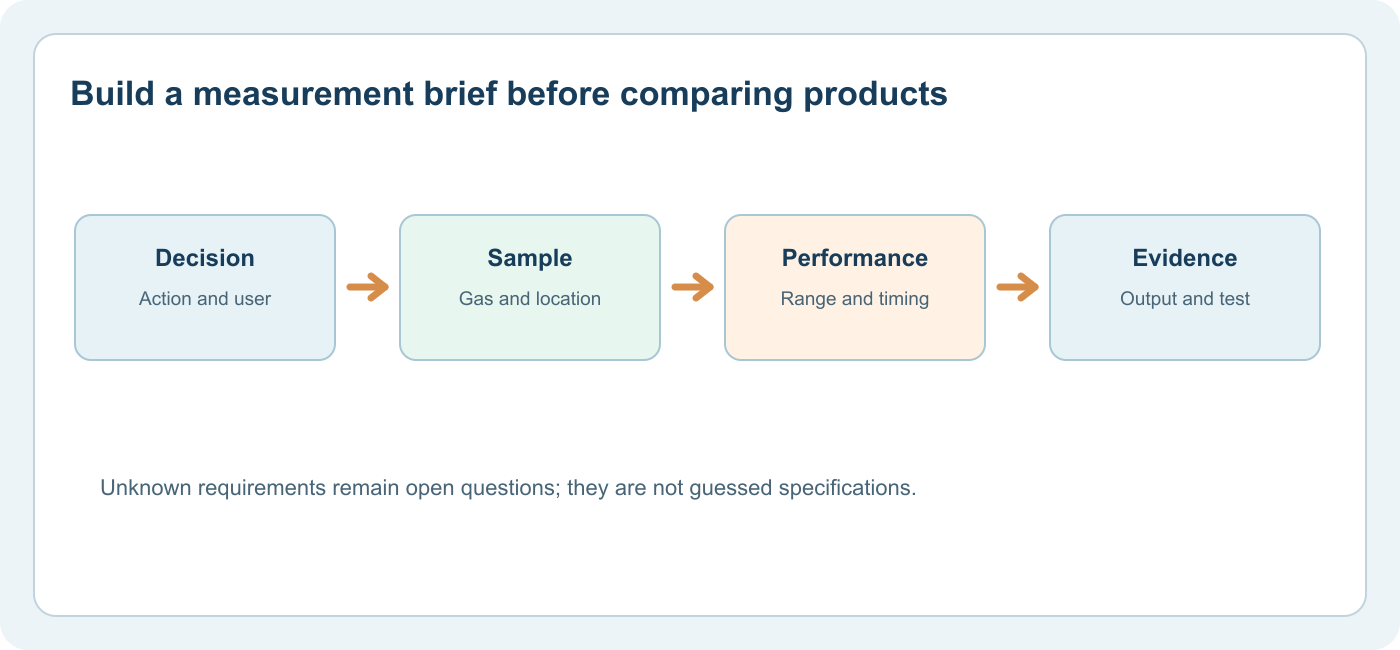
A useful CO₂ requirements sheet begins with a decision, not a product number. Write down what the reading must help someone decide, which gas mixture and location will be sampled, the expected concentration and excursions, the time scale of the event, the required evidence of performance, and what the finished instrument must do with an invalid reading. Only then compare sensors, monitors, probes and analyzers. The same word “CO₂” can describe an occupied room, an incubator, a beverage line or a worker-safety installation; those applications do not share one universal range or accuracy requirement.
The worksheet below is designed to be copied into a project brief or request for quotation. It deliberately leaves target values blank where the application must supply them. A catalog range, default alarm color or familiar 1,000 ppm number is not a substitute for a stated measurement objective. ASHRAE's position on indoor CO₂ explicitly warns against treating one indoor CO₂ value as a universal indoor-air-quality verdict.
First sentence: “We will use this measurement to…”
Finish that sentence before listing specifications. “Show occupants whether room CO₂ is rising during meetings” asks for a representative room trend and understandable display. “Control an outdoor-air damper” adds an interface, update behavior, commissioning and a defined control strategy. “Investigate a process-gas excursion” may require a very different range, sample path and recovery behavior. “Warn people about a hazardous release” requires a purpose-designed safety system, site risk assessment and applicable requirements; an ordinary room-air display does not become such a system because it can show a large number.
EPA describes indoor CO₂ as information about ventilation that needs careful interpretation. The decision should therefore name its context. Who will read the output? What will they change? What other information, such as occupancy, outdoor concentration or ventilation mode, will they need? If there is no planned response to the result, decide whether the device is for exploration rather than a control or alarm function.
Our earlier CO₂ measurement guide explains the broad measurement tasks. This worksheet turns a selected task into evidence that a particular instrument can be checked against.
Copyable requirements worksheet
| Field to complete | Write down | Why it changes selection |
|---|---|---|
| Decision and user | The action, responsible person and how soon an answer is needed | Separates a glanceable display from an archived study or control input |
| Measurand | CO₂ concentration, reporting unit and any dry/wet or background-gas basis | Prevents a CO₂ result being confused with eCO₂, CO or gas purity |
| Sampling point | Room breathing zone, duct, enclosure, line, vessel or portable survey point | Determines placement, enclosure and whether sampling hardware is needed |
| Gas matrix | Normal air or a specified process mixture; possible water vapor, dust and other gases | Environmental and background-gas effects differ by instrument |
| Expected concentrations | Typical interval, highest credible excursion and any required low end | A displayed output range may extend beyond its specified accuracy range |
| Decision tolerance | Permissible error at each decision point, including uncertainty of the reference | “Accurate” has no meaning until a consequence and test condition are defined |
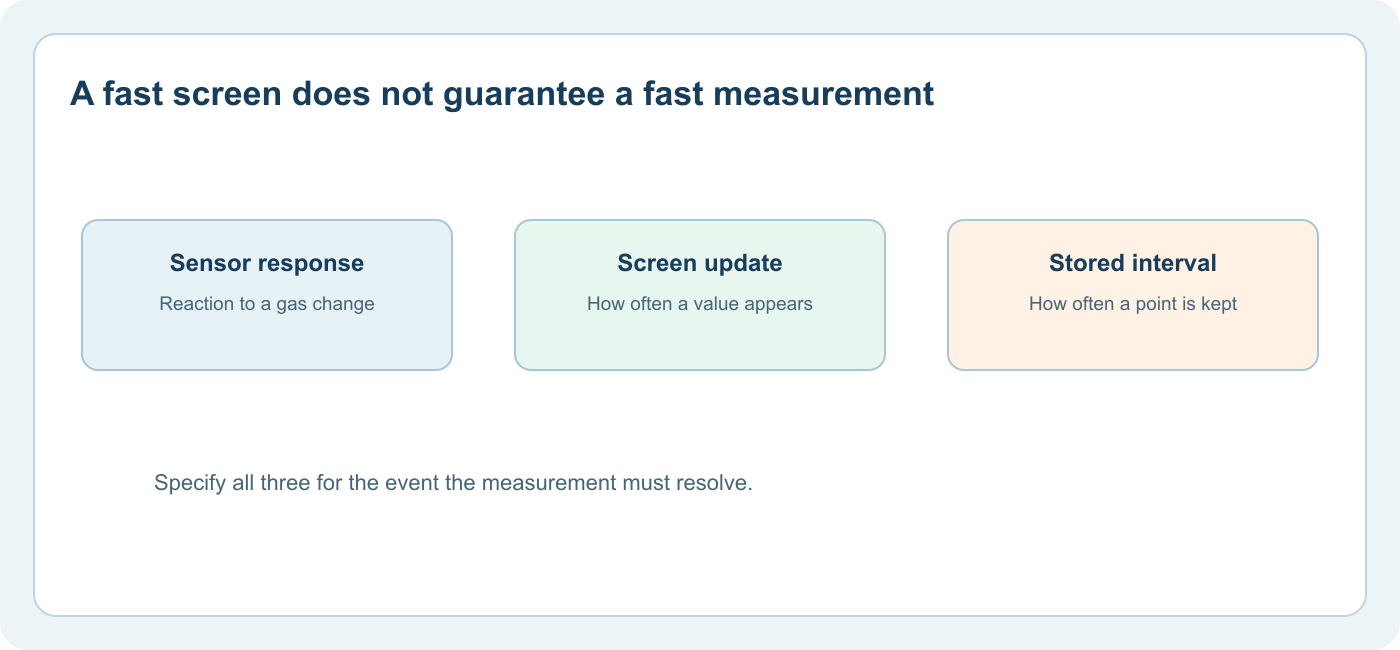
| タイミング | Event duration, sensor response, update, averaging and logging interval | Fast display refresh does not guarantee a fast sensor response |
| 環境 | Operating temperature, humidity, pressure, condensation, vibration and power | The published accuracy may apply under narrower conditions |
| Output and retention | Local display, analog or digital signal, data export, timestamp and storage duration | Determines whether a module, monitor, logger or networked instrument fits |
| Fault behavior | Warm-up, out-of-range, stale data, disconnected sensor and power loss | An old valid-looking value can be more misleading than a blank value |
| メンテナンス | Calibration or verification method, access, interval and service ownership | Long-term evidence depends on more than initial factory calibration |
| Acceptance test | Exact document revision, installation check and performance demonstration | Makes competing offers comparable on the same task |
Do not fill an unknown with a guessed “industry standard.” Put unknown—verify in the brief, identify who can answer it and keep it out of the pass/fail criteria until resolved. The EPA Enhanced Air Sensor Guidebook similarly starts sensor selection with project objectives, deployment and data questions rather than a feature list.
Specify the gas and the reporting basis
CO₂ is the target molecule. A VOC sensor's “equivalent CO₂” estimate is not a direct measurement of that molecule; our direct CO₂ versus eCO₂ article explains why the distinction matters. Carbon monoxide, CO, needs a separate sensing channel even if an instrument displays both gases, as described in our dual-gas channel guide. A number followed by ppm does not identify the gas.
Next specify the sample. Room air at the intended occupied location, duct air, exhaust, pressurized process gas and a cylinder assay are different samples. For humid gas or dry calibration gas, note whether the desired concentration is stated on a wet or dry basis. Vaisala's GMP252 guide shows why temperature, pressure and background-gas compensation settings can matter to a particular CO₂ probe. Those settings should be checked against the actual application rather than copied from a different installation. The wet-versus-dry CO₂ guide develops the reporting-basis question.
For a room trend, placement is part of the measurement. CDC notes that a fixed wall monitor can fail to represent an occupied zone if supply air, windows or poor mixing dominate its location. Record where the instrument will sit, its distance from direct exhalation and local air streams, and whether a second position is needed to test representativeness. “One sensor per room” is not a universal sampling rule.
Distinguish output range from specified performance
An instrument may emit numbers over a broad interval while the manufacturer specifies accuracy over only part of it. This is a crucial procurement check. For one documented example, Sensirion lists a 0–40,000 ppm output range for the SCD4x family but a narrower specified CO₂ accuracy interval, with SCD40 and SCD41 conditions differing. Those figures describe the cited family and data-sheet revision, not every NDIR sensor. If the credible excursion sits outside the specified interval, ask what the reported number means there and whether another instrument or range is needed.
Write decision points into the sheet. If the device will be used to compare ordinary occupied-room trends, the tolerable error near those readings may be different from the tolerance needed near a process endpoint. Ask the vendor to state accuracy at those points, including temperature, humidity, pressure, gas composition, age or calibration state where relevant. A formula such as “± ppm plus percent of reading” must be evaluated at the actual concentration. “Resolution” and “repeatability” do not replace accuracy; a display with single-ppm digits is not automatically accurate to one ppm.
Also state the intended interpretation. ASHRAE explains that CO₂ can support a ventilation investigation but is not a complete assessment of indoor air quality. If the decision concerns particles, combustion gas or another pollutant, add a named channel and its own performance requirements instead of asking the CO₂ channel to imply its presence.
Separate three clocks: sensor, output and record
A fast screen update can repeat or filter an older measurement. A one-minute log can miss a short event even when the sensing element reacts faster. Conversely, recording every second cannot recover details the sensor and signal processing never resolved. Specify three times independently: response to a defined concentration change, displayed or communicated update, and retained sample interval. Then decide whether averages, maxima or raw points are needed.
The SCD4x sheet, for example, specifies a typical response time under its stated conditions; a finished device adds airflow path, enclosure and processing delays. A device-level acceptance test is appropriate when short events matter. For longer occupied-room trends, an ultra-fast log may create large files without adding decision value.
Define data and failure behavior before purchasing
Ask exactly what leaves the instrument. A module may provide digital CO₂ values but require the integrator to supply power, enclosure, interface, clock, storage, diagnostics and user interface. A complete monitor may show a number without offering export. A logger can store a history but have a poor at-a-glance display. Our module-versus-monitor comparison explains the responsibility boundary.
For a data project, ask whether each exported record includes timestamp, time zone or offset, unit, device identity, location, quality or fault state, and calibration metadata. Ask how clock changes, power loss, filled memory and connectivity gaps appear. EPA's sensor guidebook recommends reviewing time-series data, flagging bad records and recognizing missing data rather than silently inventing replacements. A perfect-looking graph made from interpolated gaps may conceal the period a decision needed most.
For a control or warning application, write the required behavior for invalid data. Does an output hold its last value, signal a fault, go out of range or stop updating? What happens after restart? The answer must come from the finished device, not merely from the component data sheet. Safety functions need separate design and compliance review for the actual site and jurisdiction; the worksheet helps define the question but is not an alarm design certificate.
Two worked briefs with intentionally different answers
Meeting-room ventilation trend. The decision is whether a particular occupied room exhibits a repeatable CO₂ rise under known occupancy and ventilation modes. The measurand is direct CO₂ in room air; outdoor CO₂ or background context may be noted. Sampling locations should avoid a person's exhaled plume and direct supply air. The useful output could be a readable trend over the occupancy period with timestamps and a way to annotate occupancy or HVAC changes. The sheet still needs a specified concentration interval, environmental conditions and a device check. It does ない claim a single CO₂ threshold proves that all air contaminants are controlled.
Process enclosure with occasional high CO₂. The decision is whether the gas at a specific sampling point remains in a defined process interval, including credible excursions. The brief must identify the gas mixture, pressure, humidity, condensation risk, sample tubing or diffusion arrangement, required response and recovery, and whether a low-concentration room instrument is inappropriate. If people might be exposed, the safety assessment is a separate requirements path. A room trend and a process instrument can both display CO₂ yet have different accuracy intervals, sample conditioning and maintenance plans.
These are illustrative briefs, not invented field tests or ready-to-use setpoints. Their value is that each points to a different list of vendor evidence.
Questions to send to a supplier
- What exact model and document revision support the quoted range, accuracy and operating conditions?
- Which interval has a specified accuracy, and what does the device report outside it?
- Is CO₂ measured directly? What does the device do during warm-up, calibration or sensor fault?
- Where is the gas sampled, and how much delay do enclosure, tubing, flow and filtering add?
- What compensation inputs and settings are required for this pressure, humidity and background gas?
- How will the installed device be verified initially and at the planned service interval?
- Can the user obtain the data, timestamps and quality states needed for the stated decision?
- Which claims apply to the sensing component and which have been demonstrated for the complete instrument?
The answer should be a set of documents and a test plan, not merely a claim that the product is “high precision.” If two candidates cannot be compared under the same measurement task and conditions, the brief is not finished.
Frequently asked questions
Can I choose a CO₂ monitor by its maximum ppm number?
No. First confirm the required concentration interval and the narrower interval, if any, over which accuracy is specified. Then check environmental conditions, response, sample path, output and maintenance. A maximum displayed value alone does not establish measurement quality there.
Should I always request the fastest sampling interval?
No. Choose an interval that resolves the event of interest and fits the instrument's true response and processing. A fast stored timestamp cannot make a slow measurement chain faster. For long room trends, continuity, context and usable timestamps may matter more than the shortest selectable interval.
Does a room CO₂ value tell me whether the entire room is safe?
No. CO₂ can help with a specific ventilation question when placed and interpreted correctly. It does not measure CO, particles, radon, VOCs or every other indoor concern. Match each decision to its own measurand and suitable instrument.
Can a sensor module data sheet stand in for a finished-device specification?
No. The module describes a component under defined conditions. The enclosure, sample path, power, software, display, communication, fault handling and installation can all change the result a user sees. Ask for finished-device evidence when the decision relies on the complete product.
情報源
- US EPA, Enhanced Air Sensor Guidebook — planning, selection and data-use questions.
- ASHRAE, Indoor Carbon Dioxide, Ventilation and Indoor Air Quality — CO₂ interpretation boundaries.
- Sensirion, SCD4x data sheet — model-specific output, specified interval and response example.
- Vaisala, GMP252 User Guide — environmental compensation and instrument configuration.
- CDC/NIOSH, Ventilation FAQs — placement and representativeness of fixed CO₂ readings.
CO2 Data Logger or Live Display? Choose the Record Your Decision Needs
Choose a CO2 logger, live display or both by comparing sensor response, update and record intervals, timestamps, data gaps, retention and use.
続きを読む
Single-Gas vs Multiparameter Monitors: Compare the Channels, Not the Screen
Compare single-gas and multiparameter monitors by the evidence for each channel, sample location, data quality, maintenance and intended use.
続きを読む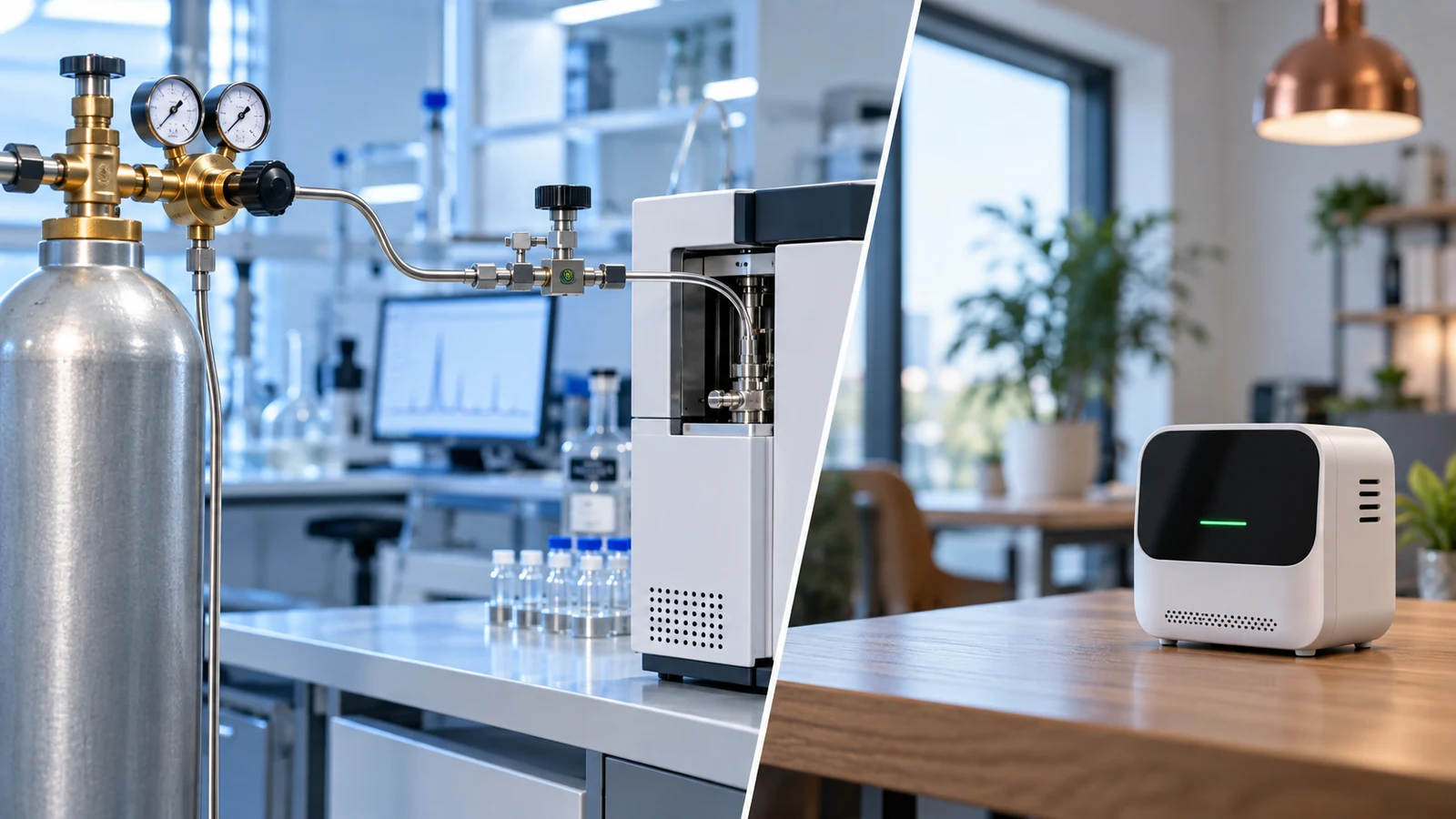
CO2 純度 vs 周囲 CO2 濃度: 2 つの異なる測定ジョブ
CO2 供給純度と周囲 CO2 ppm は、さまざまなサンプルと分析物を表します。ルームモニターがガスロットを認証できず、純度証明書が室内空気を説明できない理由を学びましょう。
続きを読む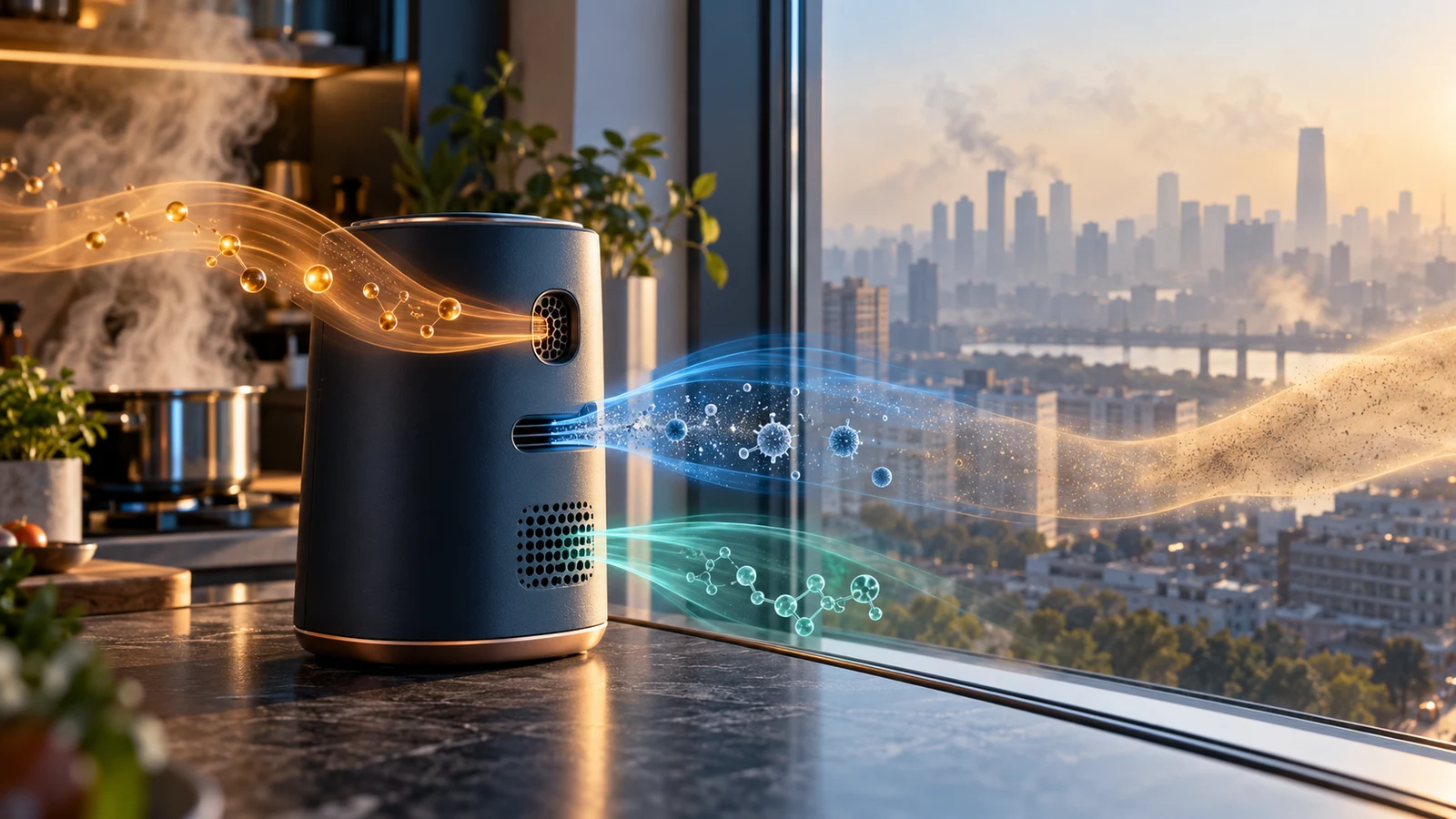
空気質スコアとガス濃度: 屋内モニターで実際にわかること
汚染物質濃度は名前付きの測定値です。空気品質スコアはマッピングです。屋内スコアを米国の公式屋外 AQI と比較し、モニターの生のチャネルを検査します。
続きを読む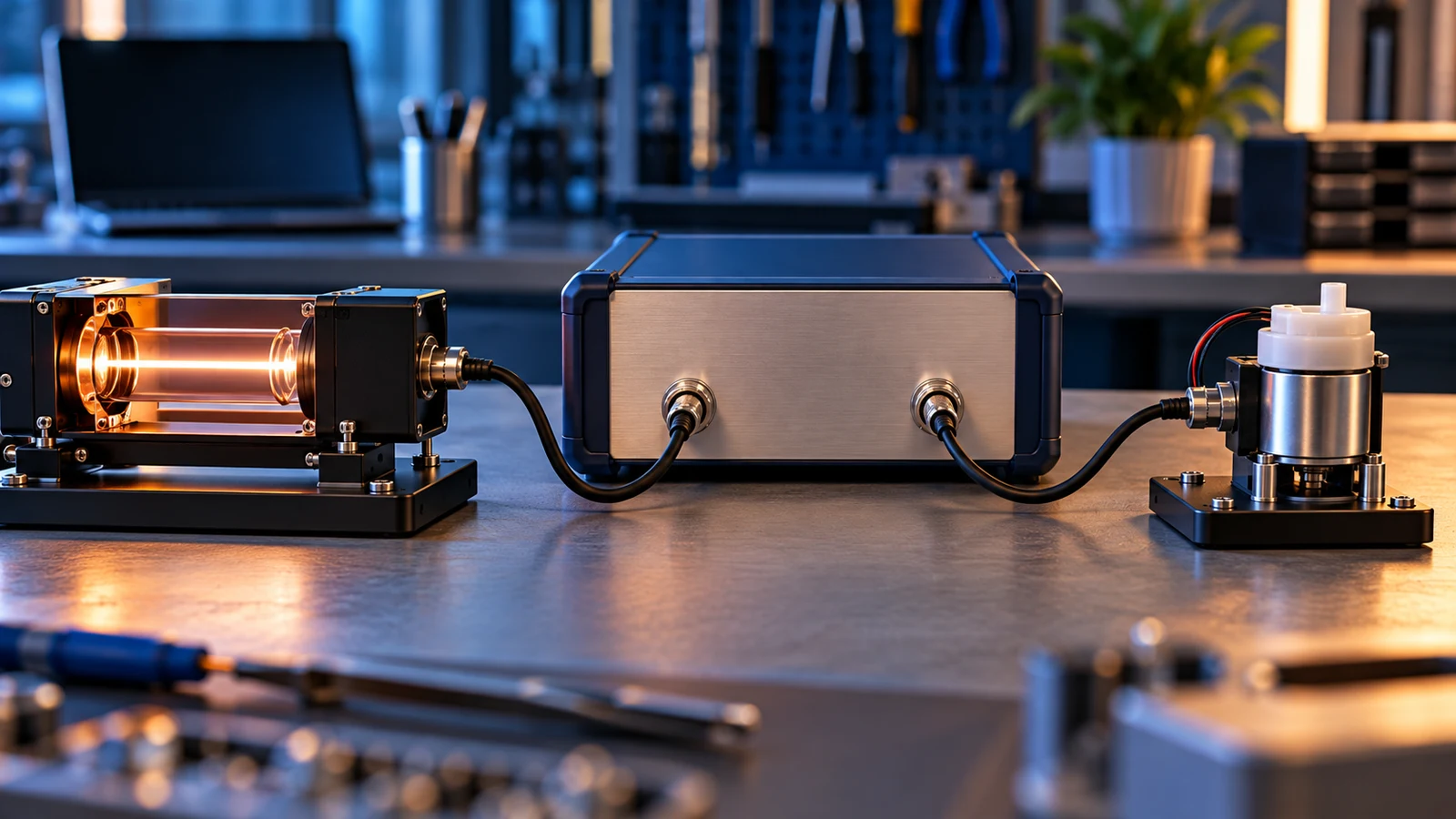
CO 対 CO2 センサー: デュアルガス機器に 2 つの測定チャンネルが必要な理由
CO センサーと CO2 センサーは異なるガスを測定します。各チャネル、そのセンシング原理、範囲、キャリブレーション、サンプリング パス、完成したデバイスの目的を検証する方法を学びます。
続きを読む
湿性 CO2 と乾性 CO2 測定値: サンプルベースによって数値が変わる理由
湿った空気と乾燥した空気の CO2 ppm は異なる場合があります。これは、水蒸気によって分数の分母が変化するためです。条件付き変換と、サンプリングされたガス システムで何を記録するかを学びます。
続きを読む
コメント(1)
[…] specialist instruments can give each measurement a better location or service plan. Use the CO₂ requirements worksheet to state the decision, sample, range, timing and acceptance evidence before selecting either […]