
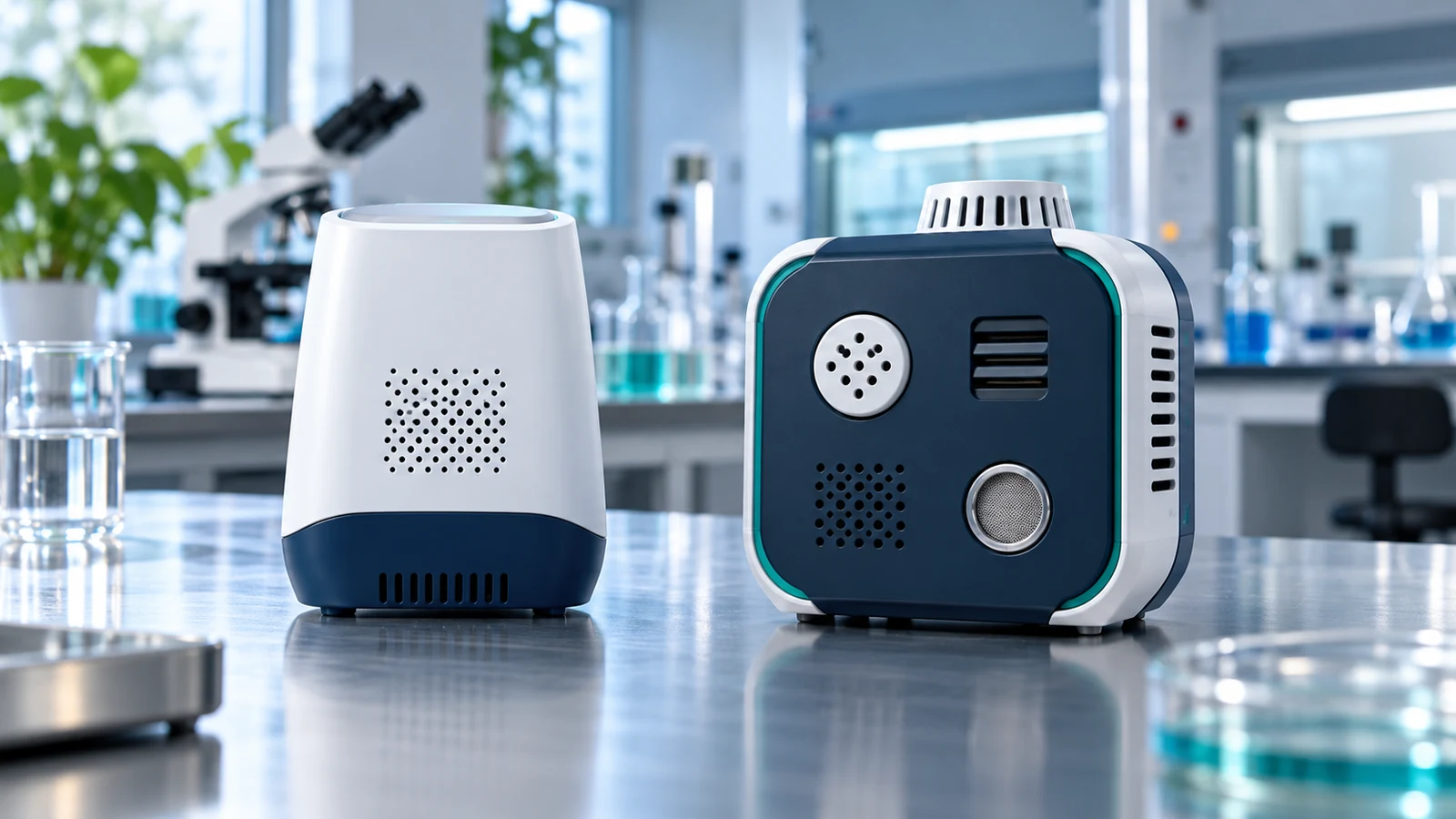
Choose a single-gas instrument when one well-defined measurand drives the decision; choose a multiparameter instrument when separate, relevant measurements must be interpreted together. More numbers on a display do not automatically mean more complete or more accurate information. For each reported value, ask what physical sensor or derived algorithm produces it, what its error and environmental limits are, and whether the device's sample location represents the question you are asking.
A room CO₂ monitor can answer a CO₂ trend question. A multiparameter monitor may add particle concentration, relative humidity, temperature or a VOC index, but each channel needs its own specification and interpretation. A composite “air quality” tile is a presentation layer; it cannot reveal a pollutant the device does not measure. EPA describes both the benefits and limits of low-cost indoor monitors: they report the pollutants or environmental factors for which they are designed and do not describe the whole indoor environment.
Start with the list of decisions, not a feature count
Suppose an office operator wants to compare CO₂ during meetings with ventilation modes. A direct CO₂ measurement, sensible placement and a good time record may be more useful than six unrelated values. If the question also concerns smoke infiltration, the brief needs a suitable particle channel. If a combustion concern is present, it needs an appropriate CO measurement and response path; ordinary CO₂ and VOC readouts do not supply it. If the task is thermal comfort, temperature and humidity have their own role but are not pollutant concentrations.
The distinction is functional rather than ideological. One enclosure can simplify installation and time alignment, while separate specialist instruments can give each measurement a better location or service plan. Use the CO₂ requirements worksheet to state the decision, sample, range, timing and acceptance evidence before selecting either format.
ASHRAE's indoor CO₂ brief is useful here: indoor CO₂ can inform some ventilation questions, yet a CO₂ value by itself is not a verdict on all indoor air quality. Adding parameters should therefore follow a named additional question, not a desire to make the dashboard look complete.
Make a channel map for every candidate
The simplest audit is a table with one row per output, including values that the seller calls “scores” or “equivalents.” Here is a generic example; it is a template, not a description of one commercial device.
| Displayed value | Possible underlying channel | What to verify | What it does not prove |
|---|---|---|---|
| CO2(ppm) | Direct optical CO₂ measurement, or in some products an eCO₂ estimate | Named sensing principle, specified range, calibration and compensation | CO concentration or every ventilation outcome |
| PM².₅(μg/m³) | Optical particle measurement with a conversion model | Particle-size and aerosol assumptions, humidity influence and validation | Identity of a gas or exact composition of all particles |
| VOC index | Broad-response gas sensor plus algorithm | Index definition, baseline behavior and target use | Concentration of every individual VOC, or direct CO₂ |
| CO(ppm) | Separate CO-targeted sensing channel | Interferences, range, response and finished-device alarm status | CO2 농도 |
| Temperature and RH | Environmental sensors | Location relative to heat, sunlight, wet surfaces and air stream | Direct measurement of a gas pollutant |
| Composite score | Software combining named inputs | Inputs, weights, averaging and missing-channel behavior | An independently measured substance |
Not every multiparameter device has all these channels. “PM,” “VOC” and “CO₂” on a product page should lead you to the exact device manual and component evidence. Our CO-versus-CO₂ channel article shows why a second gas needs a genuine second measurement. The concentration-versus-score guide explains why a colored score cannot be treated as a concentration.
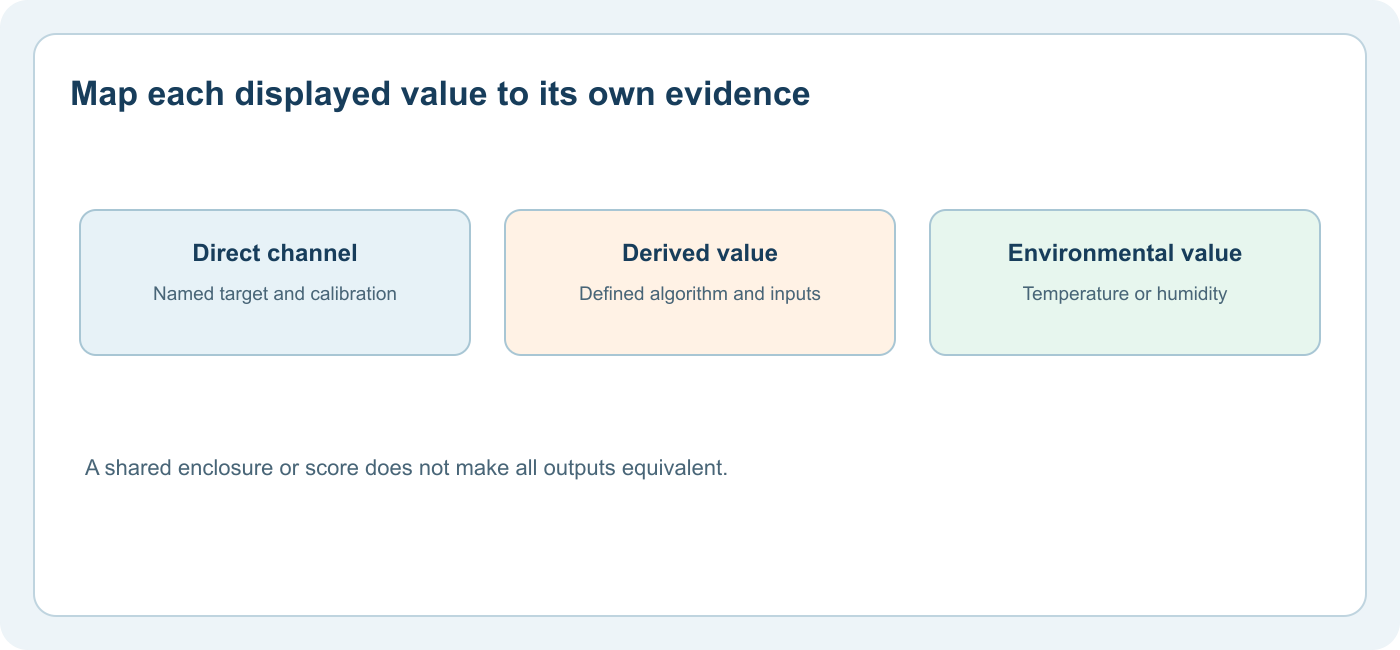
Direct CO₂, eCO₂ and VOC index must remain distinct
The language around gas channels causes frequent procurement errors. A direct CO₂ sensor aims to respond to carbon dioxide through a documented sensing principle. For example, Sensirion's SCD4x family documentation describes a photoacoustic NDIR CO₂ measurement under specified conditions. A different family can use another implementation; the point is the named measurand and evidence.
A VOC-responsive element can instead feed an algorithm that reports a relative index. Sensirion's SGP40 data sheet describes a raw VOC signal and Gas Index Algorithm. Its VOC Index is not a ppm CO₂ measurement. If a product presents “eCO₂,” ask how that estimate was generated and what it has been validated to represent; do not import the accuracy statement of a direct CO₂ sensor. Our direct CO₂ versus VOC-derived eCO₂ explanation covers the distinction in more detail.
Even within direct CO₂ products, an output range is not necessarily an accuracy interval. The cited SCD4x documentation illustrates this difference. A multiparameter enclosure can report a CO₂ value outside its best-specified range while its particle or humidity channels remain valid. The user interface should preserve per-channel validity rather than presenting one blanket “device healthy” state.
More channels also mean more environmental interactions
Different sensor types react differently to humidity, airflow, temperature, dust and contamination. An optical particle channel estimates mass from light scattering under assumptions about the aerosol. A gas sensor may rely on compensation for temperature or humidity. An environmental RH sensor placed near a warm display or electronics may not represent room RH. A single vent position that is convenient for the enclosure may not be ideal for every measurand.
EPA's Enhanced Air Sensor Guidebook recommends planning sensor siting, operation and interpretation around the intended use. CDC notes that a fixed CO₂ reading may be unrepresentative if local air currents affect the monitor. Therefore, a wall-mounted “all-in-one” device can be convenient while still leaving a spatial question: does its location represent the occupied zone for CO₂, the entry path for smoke particles and the thermal condition of interest at the same time? Sometimes the answer is yes; sometimes separate locations are needed.
This is not an argument that multiparameter devices are inherently inferior. It is a reason to assess each channel in the installation where it will be used. A paired deployment can be a good choice when sensors must occupy different locations, or when one channel needs a different calibration schedule. A shared enclosure is useful when synchronized context matters and the location genuinely suits all channels.
Compare the full cost of maintaining evidence
Keep channel comparisons in the same units and conditions
The word “accuracy” may hide unlike claims. One manufacturer may quote a CO₂ error at room conditions, another a typical value over a limited interval, and a third a laboratory repeatability number. A PM channel may be described by correlation or a particle-counting interval rather than a directly comparable concentration error. Put the units, averaging period, concentration interval and test conditions beside each quoted performance value. If the vendor provides only a colored category or marketing adjective, mark the technical evidence as missing rather than assigning an invented score.
This check is especially useful when comparing a single-purpose instrument with a multiparameter monitor. Compare the CO₂ channels to each other under your stated use, then separately assess whether the extra PM, RH or VOC channels meet their own purpose. The extra channels do not compensate for a poor CO₂ specification when CO₂ is the primary decision. Equally, a strong CO₂ instrument cannot answer a particle question it was never built to measure.
Purchase price is only one line. One box may reduce mounting and network work, but additional channels can add filters, consumables, periodic checks, replacements or data-quality review. A single-gas instrument may have simpler service, but adding another device later can create clock synchronization and data integration work. Request the maintenance instructions for each measurement channel, the availability of calibration or verification accessories, and a clear statement of which parts are replaceable.
Ask whether a failed channel is visible as failed. If PM data stops updating while CO₂ continues, does the display show stale PM, blank PM or a fault marker? Does an exported dataset preserve the problem? EPA advises that missing and invalid sensor records should be recognized rather than silently filled in. In a multiparameter dashboard, that advice applies per channel. One green summary icon must not hide a missing measurement on which a decision depends.
Three application comparisons
Meeting-room ventilation study. Direct CO₂ is the primary measurand. Temperature, RH and occupancy notes can provide context, but they do not replace a representative CO₂ location or proper interpretation. Choose a multiparameter monitor if the extra values answer a real parallel question or reduce integration work. Otherwise, a well-specified CO₂ instrument with export may be the cleaner choice.
Smoke plus occupancy in a classroom. PM₂.₅ and CO₂ answer different questions: particle events and the CO₂ trend associated with occupancy/ventilation. A device with both direct channels may be useful if placement and performance are appropriate. Separate devices may be better if the particle sampling position and occupied-zone CO₂ position differ. A single “air quality” color is insufficient unless the underlying values and validity are visible.
Combustion equipment near an occupied area. CO₂ may be useful for one ventilation question but cannot detect CO. If CO is in scope, it requires a suitable CO channel and, where applicable, a separate compliant alarm strategy. EPA distinguishes general-purpose indoor monitors from dedicated CO alarms. A multiparameter consumer display should not be promoted into an emergency device merely because its menu lists CO.
These are comparison briefs, not device endorsements or universal siting instructions. The result depends on the exact instrument revision, installation and use.
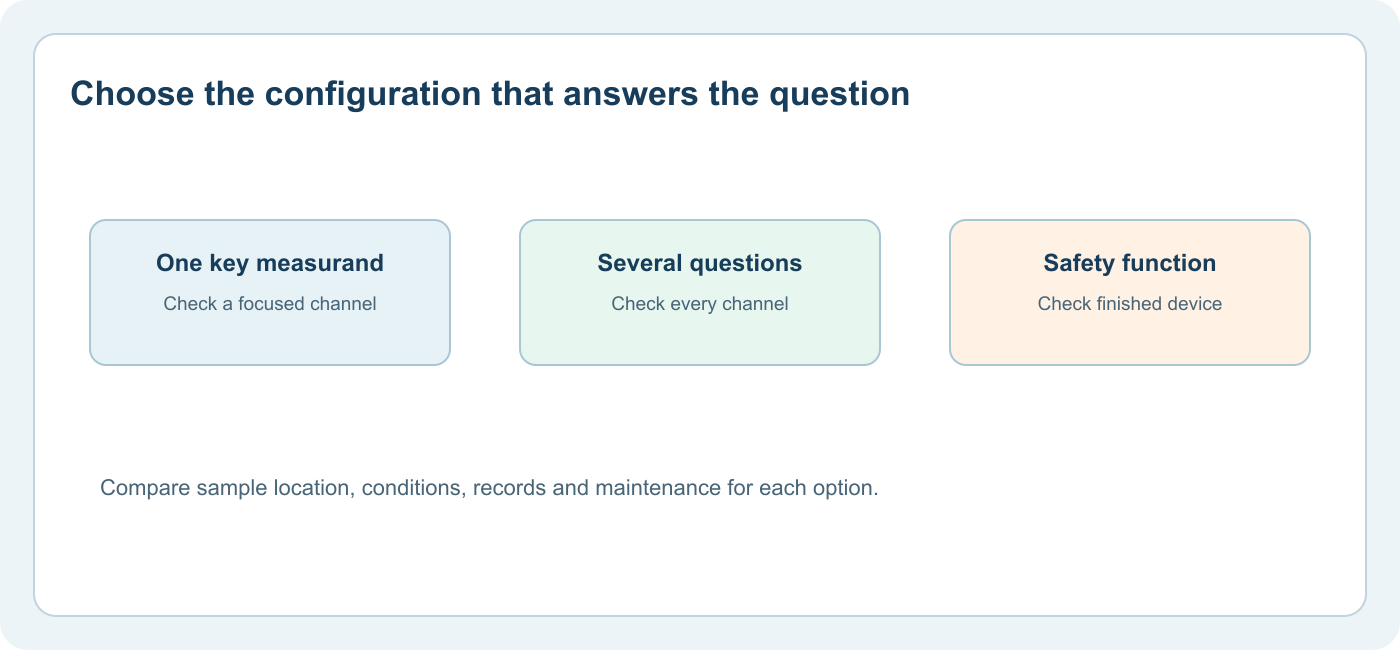
A practical side-by-side evaluation
Before choosing, obtain documents for both candidate systems and fill the same columns:
- Target: exact gas, particle fraction or environmental factor; direct or derived value.
- Measurement basis: specified interval, accuracy, response and environmental conditions for each channel.
- Sample: inlet, enclosure, sampling path, mounting height and representativeness.
- Output: visible units, update rate, historical data, export and per-channel fault states.
- 유지: verification, calibration, cleaning, drift management and replacement.
- Use claim: informational trend, control input, process measurement or safety function.
Then score only requirements that your use case actually needs. A single-gas device can lose if it lacks the needed record or interface; a multi-channel device can lose if its extra values are derived, unvalidated for the site or hidden behind an opaque score. Our module-versus-complete-monitor guide is useful when one candidate is a component and the other is a finished instrument.
Frequently asked questions
Is a multiparameter monitor always more accurate?
No. Accuracy belongs to each named channel over specified conditions. The number of outputs does not improve the CO₂ channel automatically, and a composite score has its own interpretation rather than an accuracy in ppm.
Can one VOC sensor tell me which chemical is present?
Generally, a broad-response VOC index cannot identify every component of a mixture. Check the exact sensor and algorithm documentation. If a specific compound must be quantified, define that compound and obtain a method validated for it.
Can I use a CO₂/PM₂.₅ display as a CO alarm?
No. CO₂ and PM₂.₅ do not measure carbon monoxide. Even if a separate CO number appears, the intended alarm function and applicable certification of the finished device must be verified for the specific use.
Should I buy two devices rather than one?
Buy the measurement configuration that meets the defined sampling, performance and data requirements. Two devices can place channels where they belong and be serviced independently; one device can simplify installation and synchronize outputs. The channel map and acceptance test should decide.
출처
- US EPA, Low-Cost Air Pollution Monitors and Indoor Air Quality — capabilities and limitations of indoor monitors.
- US EPA, Enhanced Air Sensor Guidebook — planning, siting and data questions.
- Sensirion, SCD4x data sheet — direct CO₂ channel example.
- Sensirion, SGP40 data sheet — VOC signal and index example.
- ASHRAE, Indoor Carbon Dioxide, Ventilation and Indoor Air Quality — CO₂ interpretation.
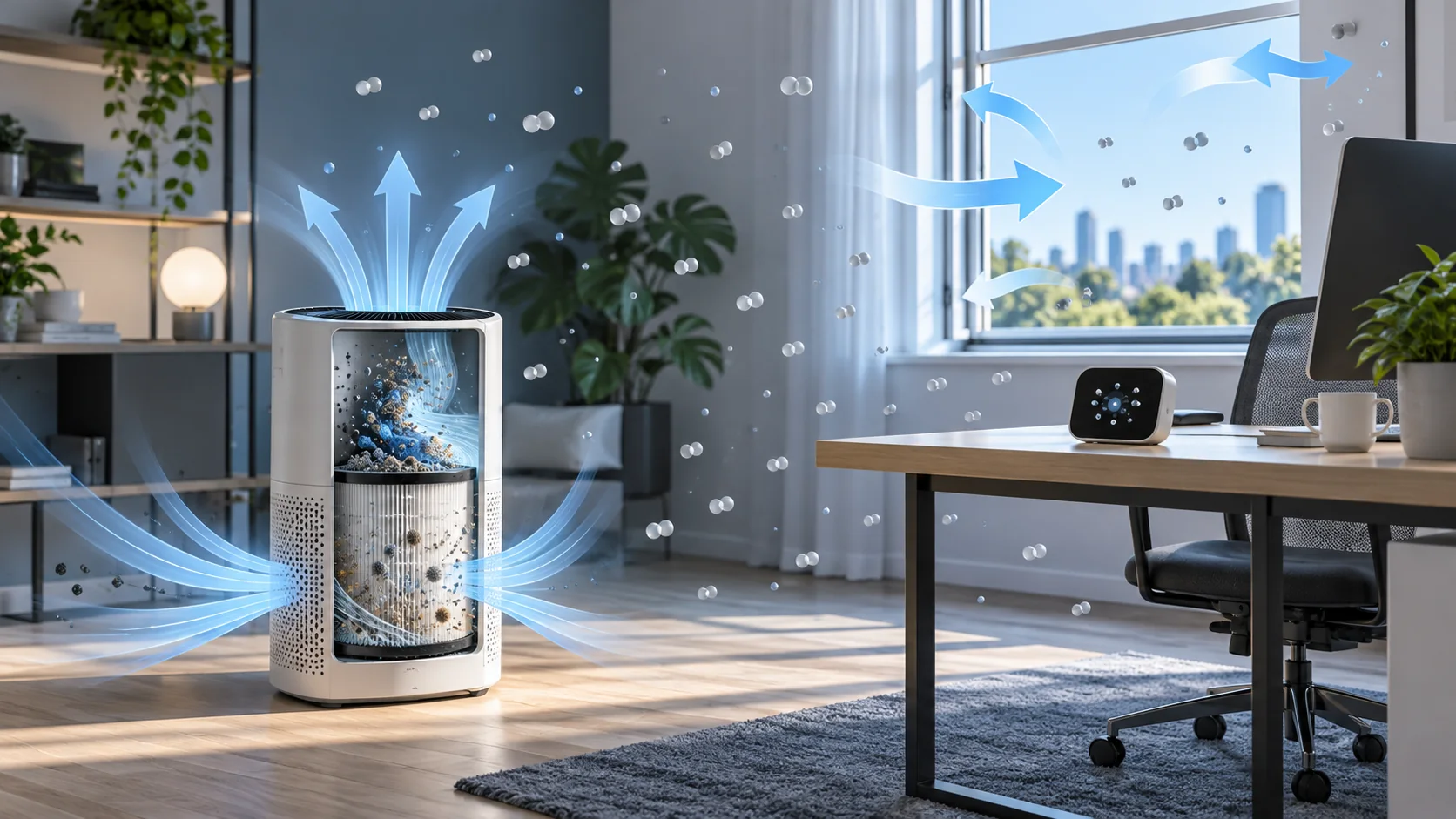
공기청정기는 CO2를 낮추나요? 실외 공기 교환과 별도의 여과
일반 HEPA 청정기는 입자를 포착하지만 거주자가 생성한 CO2를 의미 있게 제거하지는 않습니다. 재순환, 실외 공기 환기를 분리하고 혼합 효과를 모니터링하는 방법을 배우십시오.
자세히 알아보기
밤새 침실 CO2 로그를 읽는 방법
시작 레벨, 상승, 고원 및 아침 반응을 사용하여 야간 침실 CO2 추적을 해석하는 동시에 로거 품질, 공기 경로 및 비교 가능한 밤을 확인합니다.
자세히 알아보기
집에서 CO2 추세를 해석하는 방법: 하나의 숫자가 아닌 패턴을 읽으십시오
점유율, 실외 공기, 실내 혼합 및 모니터 배치가 가정의 CO2 추적을 형성하는 방법을 알아보고 반복 가능한 로그를 사용하여 환기 변화를 테스트합니다.
자세히 알아보기
CO2 데이터 로거 또는 라이브 디스플레이? 의사결정에 필요한 기록을 선택하세요
센서 반응, 업데이트 및 기록 간격, 타임스탬프, 데이터 간격, 보존 및 사용을 비교하여 CO2 로거, 실시간 디스플레이 또는 둘 다를 선택합니다.
자세히 알아보기
CO2 측정 요구 사항 워크시트: 센서를 선택하기 전에 작업 정의
장비를 선택하기 전에 목적, 샘플, 범위, 타이밍, 데이터, 결함, 유지 관리 및 승인 증거를 다루는 실용적인 CO2 측정 개요를 작성하십시오.
자세히 알아보기
CO2 순도와 주변 CO2 농도 비교: 두 가지 다른 측정 작업
CO2 공급 순도와 주변 CO2ppm은 다양한 시료와 분석물을 나타냅니다. 실내 모니터가 가스 로트를 인증할 수 없고 순도 인증서가 실내 공기를 설명할 수 없는 이유를 알아보세요.
자세히 알아보기
코멘트(1)
[…] humidity and VOC index cannot be merged into one unlabeled “air quality” time series. Our single-gas versus multiparameter comparison explains channel-by-channel evidence; the concentration-versus-score guide explains why a score […]