
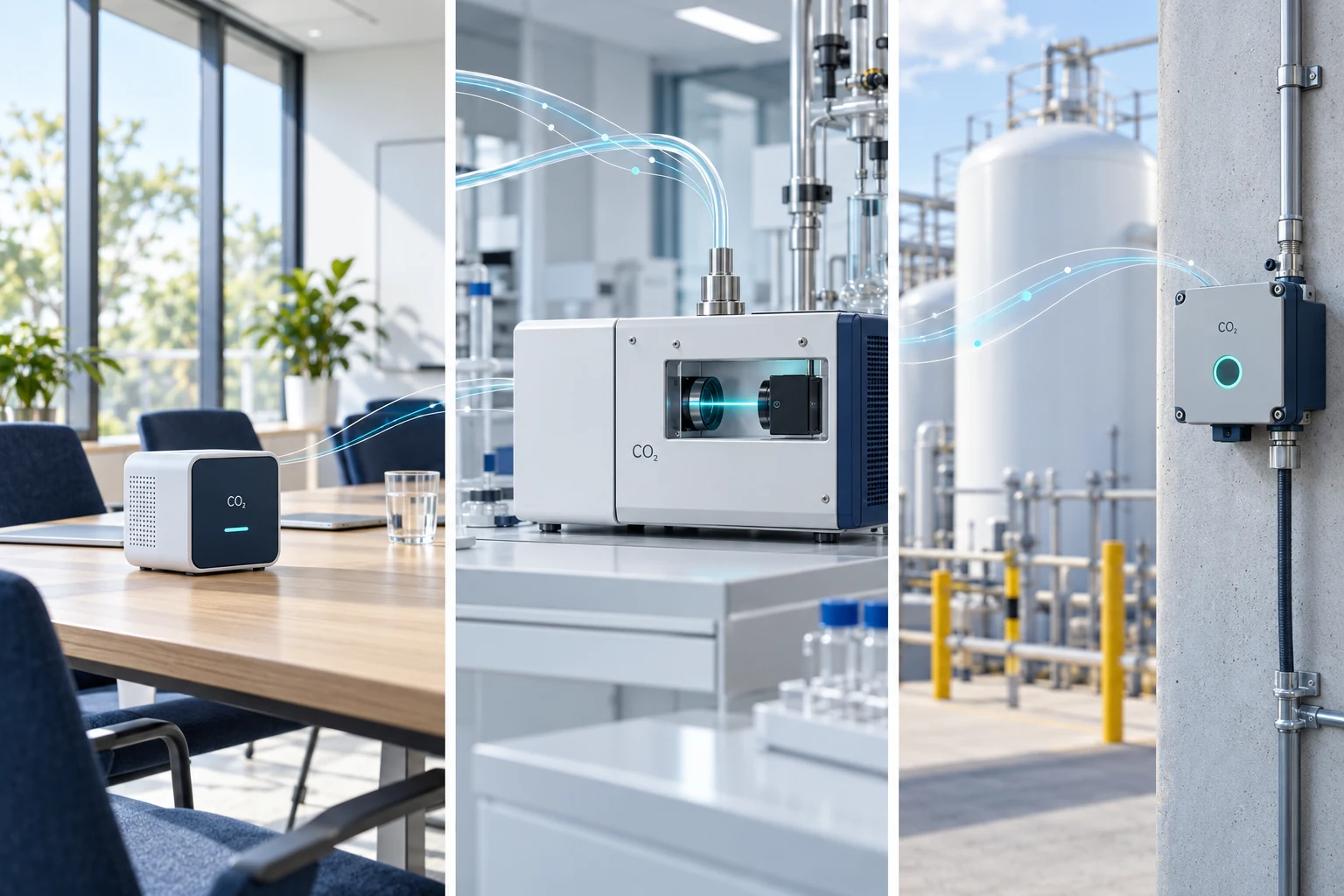
CO₂ measurement starts with a practical question: which gas sample must be measured, over what concentration range, and what decision will use the result? A room monitor, a process analyzer and a gas detection system can all report carbon dioxide, but they do not necessarily measure the same sample or provide interchangeable evidence.
For room-air monitoring, direct CO₂ measurements can help reveal occupancy and ventilation patterns. For a process, the measurement may concern a sampled gas stream, a controlled atmosphere or gas purity. For detection around a potential release, the complete equipment and its intended use matter alongside the sensor specification.
Choose the measurement task first. Then compare the sensing method, concentration range, sampling arrangement, calibration assumptions and finished instrument documentation.
Define the Measurement Task Before Comparing Instruments
The most useful starting document is a short description of what needs to be known. “We need a CO₂ sensor” leaves too many important choices unresolved.
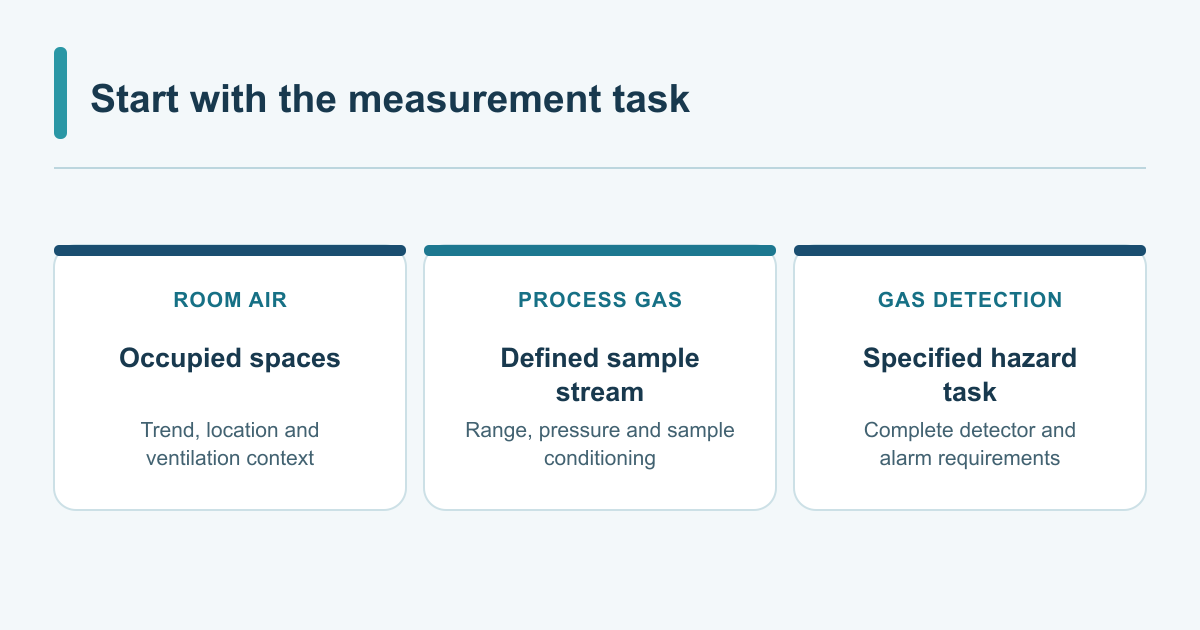
| Task | Measurement question | Important information to collect |
|---|---|---|
| Occupied room | How does CO₂ change with occupancy and ventilation? | Representative location, outdoor context, logging interval and operating conditions |
| Process gas | What is the CO₂ content of this defined sample? | Expected range, pressure, temperature, moisture, sample path and reporting basis |
| Gas detection | Is the monitoring system appropriate for a defined release scenario? | Intended use, coverage, response, alarm functions and applicable equipment requirements |
| 研究 | Can this method resolve the change being investigated? | Reference method, repeatability, calibration, timing and experimental conditions |
These categories can coexist at one facility. A fermentation process and its surrounding room may each need CO₂ information, with different sampling locations and instrument requirements. One reading should not be used to answer both questions simply because both displays show ppm.
A good requirement identifies the sample location, normal and exceptional conditions, necessary output and the person or system using that output. It also identifies what the measurement is expected to leave unresolved.
Be Clear About the Quantity on the Display
In gas measurement, ppm commonly describes a gas fraction rather than a mass per cubic meter. 1,000 ppm corresponds to 0.1% on the same fraction basis. It does not automatically mean 1,000 mg/m³, and a percentage accuracy term is not a percentage concentration.
For atmospheric research, NOAA explains its reported CO₂ quantity as a mole fraction in dry air: water vapor is excluded from the denominator. That convention illustrates why the reporting basis belongs with the number. See NOAA’s explanation of CO₂ measurements。
Read the actual instrument definition. A direct CO₂ channel, a VOC-derived eCO₂ estimate and an air-quality index can appear together in similar-looking interfaces. They represent different outputs.
Our guide to CO₂ ppm, percent conversion and sensor ranges explains the units. For estimated values, see direct CO₂, eCO₂ and VOC outputs。
How Optical CO₂ Sensors Measure a Gas Sample
An optical CO₂ measurement uses the interaction of light with the gas. In an NDIR system, the measurement chain includes an infrared source, a gas path, wavelength selection, detection and processing. Calibration and compensation connect the optical response to the reported quantity.
Two documented component examples show different implementations. Sensirion’s SCD30 資料表 describes an NDIR CO₂ module, while its SCD4x datasheet describes photoacoustic NDIR sensing. They should be compared using their own specified conditions, rather than assuming identical behavior from the shared CO₂ label.
An optical principle does not establish the performance of every instrument built around it. The complete system still has to admit the relevant gas sample, operate within its conditions and process the signal correctly.
For an OEM project, ask where the component output becomes the final reported value. For a finished monitor, ask for documentation of the assembled device. A sensor identity is useful information, but it is only part of the instrument description.
Trace the Complete Measurement Chain
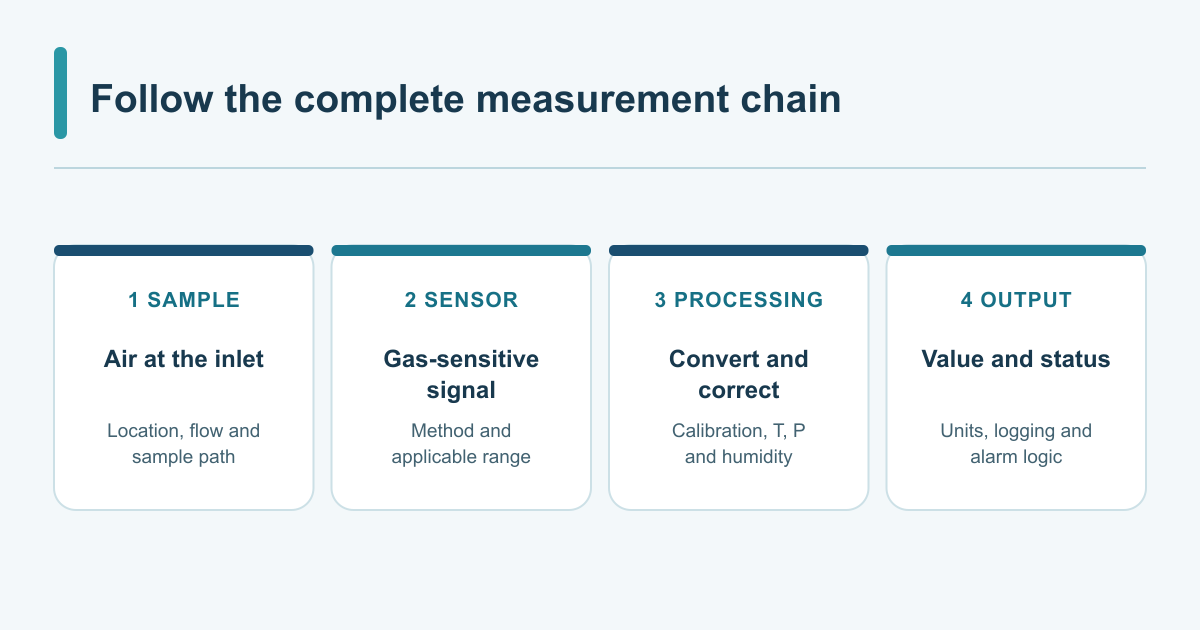
A useful way to interpret a reading is to follow the gas and the data through the system:
Sample → sensing element → compensation and calibration → processing → displayed or logged value
Each stage answers a different question. Sampling determines which gas reaches the sensor and when. The sensing element produces its response. Compensation addresses characterized influences within documented conditions. Processing may filter, average, convert units or assign status flags.
| Stage | A question to ask |
|---|---|
| Sample | Is it representative of the intended location or process? |
| 感應器 | Does the documented method measure CO₂ directly? |
| 校準 | What reference and assumptions establish the measurement relationship? |
| Compensation | Which environmental inputs are used, and within what range? |
| 加工 | Are smoothing, rounding or calculation changing the reported signal? |
| 輸出 | Are units, timestamps and validity flags preserved? |
If the displayed value is unexpected, this chain is more informative than assuming immediately that the sensor has failed. A sampling delay, an unsuitable compensation setting and a processing change are different explanations requiring different evidence.
Match the Concentration Range to the Task
Three range-related specifications should remain separate: the values an output can represent, the interval covered by an accuracy claim, and the expected concentrations at the actual sampling point.
A wide output range does not prove useful performance at its low end. A device intended to resolve occupied-room trends does not automatically have the range and intended use required for a concentrated process sample.
Write down the concentrations where performance matters. Include the expected background, ordinary operation, transitions and any condition that must be identified as outside the measurement range. Ask how the instrument represents overrange or invalid data.
For a hypothetical process normally operating around 2% CO₂, the concentration is 20,000 ppm on the same basis. That arithmetic helps compare units; it does not establish that a room-air monitor is suitable for the process. The manufacturer’s specified range, sample conditions and whole-device use must support the application.
When requirements are uncertain, document them as unknowns. A supplier can respond more usefully to a defined sampling problem than to a request for the broadest available range.
Compare Accuracy at Relevant Concentrations
A numerical accuracy statement may contain a fixed ppm term, a percentage of reading, a percentage of full scale or different formulas for different concentration bands. Compare the entire expression and its conditions.
For an assumed specification of ±(50 ppm + 3% of reading), the arithmetic allowance at a 1,000 ppm comparison point is ±80 ppm. This is a worked formula example, not a specification for an unidentified device.
Keep resolution and repeatability separate from the accuracy claim. Fine display increments do not prove equally fine agreement with a reference, and stable successive readings can still share an offset.
The detailed CO₂ monitor accuracy specification guide provides worked comparisons and a procurement worksheet. In the requirements document, retain the concentration point and environmental conditions beside every calculated allowance.
Choose Between Diffusion and a Sampled Gas Path
A diffusion instrument admits nearby gas through its designed openings. A sampled system transports gas from a defined point through a sampling arrangement. The appropriate choice depends on the task and the complete equipment.
For either approach, check how gas reaches the sensor. An enclosure, filter, inlet or tube may affect transport and the conditions experienced by the sensing element. A sensor response-time specification alone does not describe the response of a long sample path.
For a sampled system, collect the permitted flow and pressure conditions, tubing and filter requirements, moisture limits and maintenance instructions. Check whether conditioning changes the gas composition or reporting basis. The configuration should be validated for the gas and output being used.
For a room monitor, ask whether the location represents the occupied area. Direct breath, nearby air supply or a poorly ventilated recess can describe local conditions rather than the broader room. Select a location using the device instructions and the actual measurement objective.
Check Environment and Compensation Together
Temperature, pressure and moisture belong in the instrument review. Check the permitted operating environment, the conditions of the performance claim and the inputs required by any compensation feature.
A listed operating range is not automatically an accuracy guarantee across that range. A correction function also does not establish tolerance of liquid-water exposure. Review the module and complete equipment separately.
這 humidity-effects guide separates sensor response, sample composition and condensation. That distinction is useful when a CO₂ reading changes after an instrument is moved between environments.
For a field installation, record where temperature and humidity are measured. An ambient sensor elsewhere in the room may not describe a colder inlet or a conditioned process sample. Ask whether the environmental data used by the instrument represent the relevant conditions.
Understand the Calibration Assumptions
Factory calibration, a field adjustment and an automatic baseline algorithm are different parts of a measurement system. Their names alone do not establish that the installed instrument currently meets a particular performance requirement.
For example, the SCD30 documentation places conditions on its automatic self-calibration approach. That is a reason to check the actual model’s assumptions and installation, rather than to treat an automatic feature as suitable for every environment.
An environment that remains deliberately enriched or continuously occupied may need a different documented calibration strategy from one that regularly returns to its expected baseline. The appropriate method and interval come from the actual device and application.
Request the instrument’s calibration requirements, configuration and available verification records. Preserve the reference concentration, reporting basis and environmental conditions. A familiar-looking number is not a substitute for a documented comparison.
Interpret Occupied-Room Data in Context
For an occupied space, the useful record combines CO₂ with time, occupancy, location, ventilation state and relevant environmental observations. A time series can distinguish a sustained pattern from a short local event.
ASHRAE’s 室內二氧化碳立場文件 explains why a single concentration does not apply to all spaces and occupancies as a ventilation assessment. Do not turn a common reference value into a universal air-quality or health pass/fail limit.
這 EPA’s guidance on low-cost indoor monitors also explains that devices measure only the pollutants and environmental factors for which they are designed. CO₂ data do not describe every contaminant in a room.
For comparison, keep the sampling interval, averaging and location consistent. An instrument with a heavily smoothed display may show a different event shape from a logger retaining more frequent measurements. Preserve those settings in the record.
Prepare a Useful CO₂ Measurement Requirements Sheet
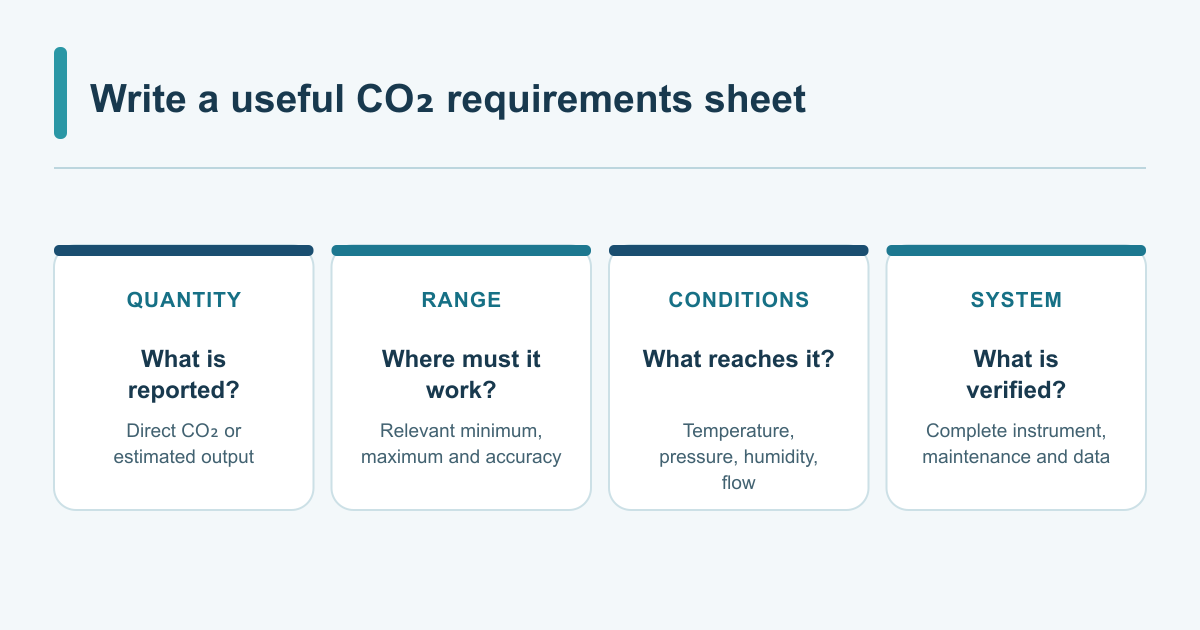
Before contacting a supplier or selecting equipment, fill in the following fields:
| 場地 | 記錄 |
|---|---|
| Measurement task | Room trend, process analysis, research or defined detection purpose |
| Sample | Location, medium and how it reaches the instrument |
| 數量 | Direct CO₂ fraction, reporting basis and required units |
| Concentrations | Points and intervals where performance matters |
| 環境 | Temperature, pressure, humidity and condensation conditions |
| Performance | Required comparison conditions, timing and applicable evidence |
| 輸出 | Display, logging, communication, timestamps and validity flags |
| 校準 | Method, assumptions, configuration and records |
| Device scope | Component, module, probe or complete instrument |
| 文件 | Manual, datasheet, revision and unanswered questions |
加斯諾斯 CO2 感測器選擇指南 provides related background on application and integration choices. Use the completed requirements sheet to make any subsequent product discussion specific.
常見問題
What is the first step in CO₂ measurement?
Define the sample and decision. Room-air trends, a process stream and detection around a potential release can require different instruments even when all report CO₂.
Is NDIR the same as a complete CO₂ monitor?
No. NDIR describes a sensing principle. The finished equipment adds its sampling arrangement, enclosure, power, processing, output and intended-use documentation.
Can one CO₂ instrument cover every application?
Do not assume that. Match concentration range, sample conditions, response and device purpose. A broad output range alone does not establish suitability.
Does a stable reading prove accuracy?
It shows little reported variation under those conditions. Agreement with a suitable reference is a separate question, and filtering can influence apparent stability.
Should an eCO₂ value be used as a direct CO₂ reading?
Only interpret it according to its documented definition. A VOC-derived estimate does not establish the actual CO₂ fraction reaching the sensor.
Is 1,000 ppm a universal indoor-air limit?
A single value does not define acceptable ventilation for all spaces or all indoor-air contaminants. Interpret the task, occupancy, outdoor context and applicable guidance.
Why include humidity and pressure in the specification review?
They help describe the sample and the conditions behind the instrument’s performance. Check the actual compensation inputs and limits instead of applying a generic correction.
Which documentation matters most when buying a monitor?
The complete-device manual and performance conditions, supported by applicable calibration and verification information. A component datasheet is useful but does not describe the entire installation.
Practical Selection Principle
Choose a CO₂ instrument by following the measurement task through the sample path, sensing method and reported output. Keep the concentration points, environmental conditions and calibration assumptions attached to the performance claim. That produces a comparison a supplier can answer and a measurement record another reader can interpret.
技術參考

How to Build a School IAQ Monitoring Record That Leads to Action
Use linked room, occupied-event and issue logs to turn school CO2 observations into reliable ventilation follow-up.
閱讀更多
Where to Place CO2 Monitors in School Classrooms
Choose representative school classroom CO2 monitor positions by occupancy and air paths, then verify, document and maintain the installation.
閱讀更多
How to Interpret Classroom CO2 Readings for Ventilation
Interpret classroom CO2 readings as occupied ventilation clues with context, local guidance, monitor checks and repeatable follow-up.
閱讀更多



評論 (3)
[…] location question, or using a convenient room monitor as evidence about a closed process. Our CO₂ measurement guide explains the full sample-to-output […]
[…] CO₂ measurement guide explains that a measurement chain begins with a defined gas sample, not with the number shown on […]
[…] earlier CO₂ measurement guide explains the broad measurement tasks. This worksheet turns a selected task into evidence that a […]