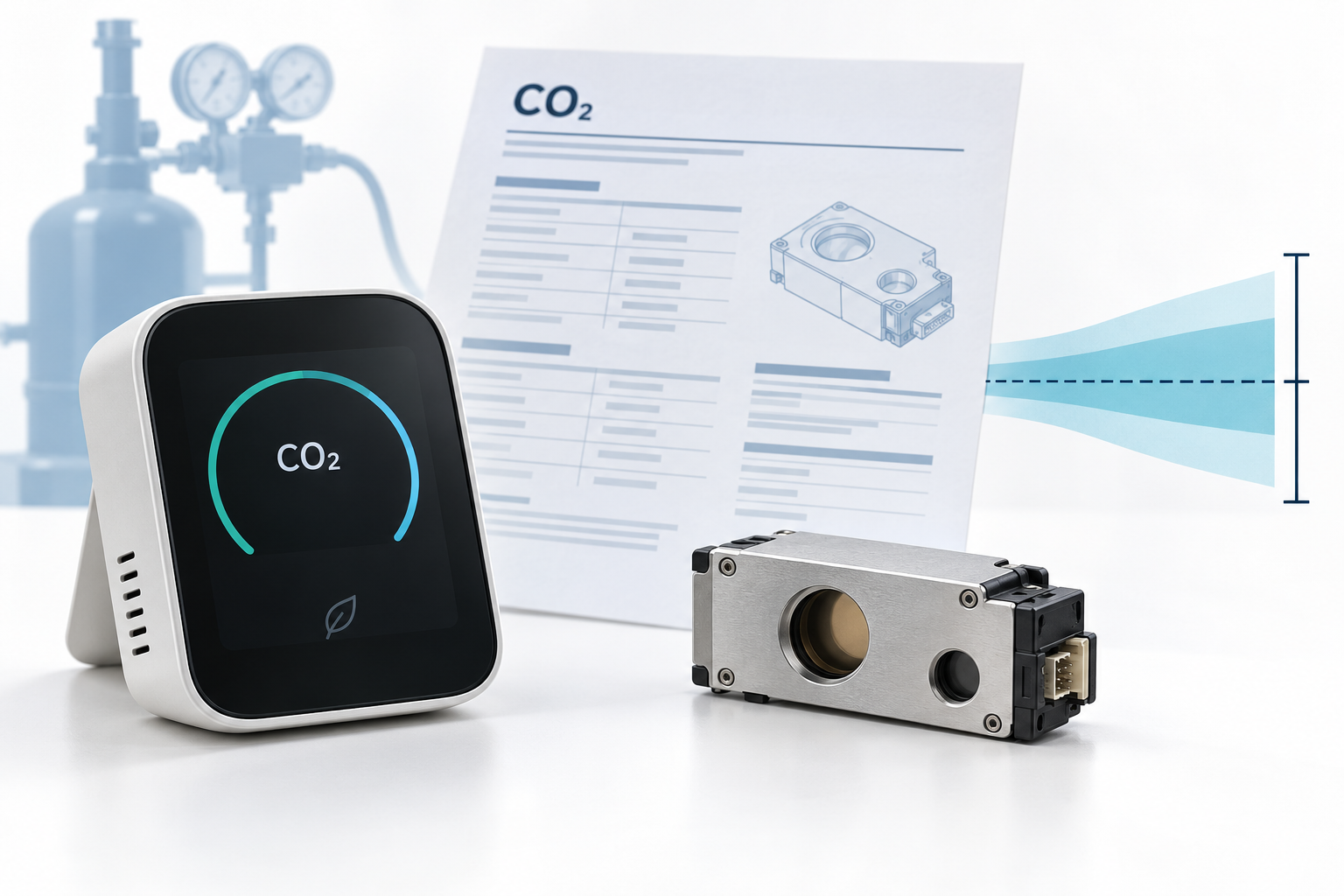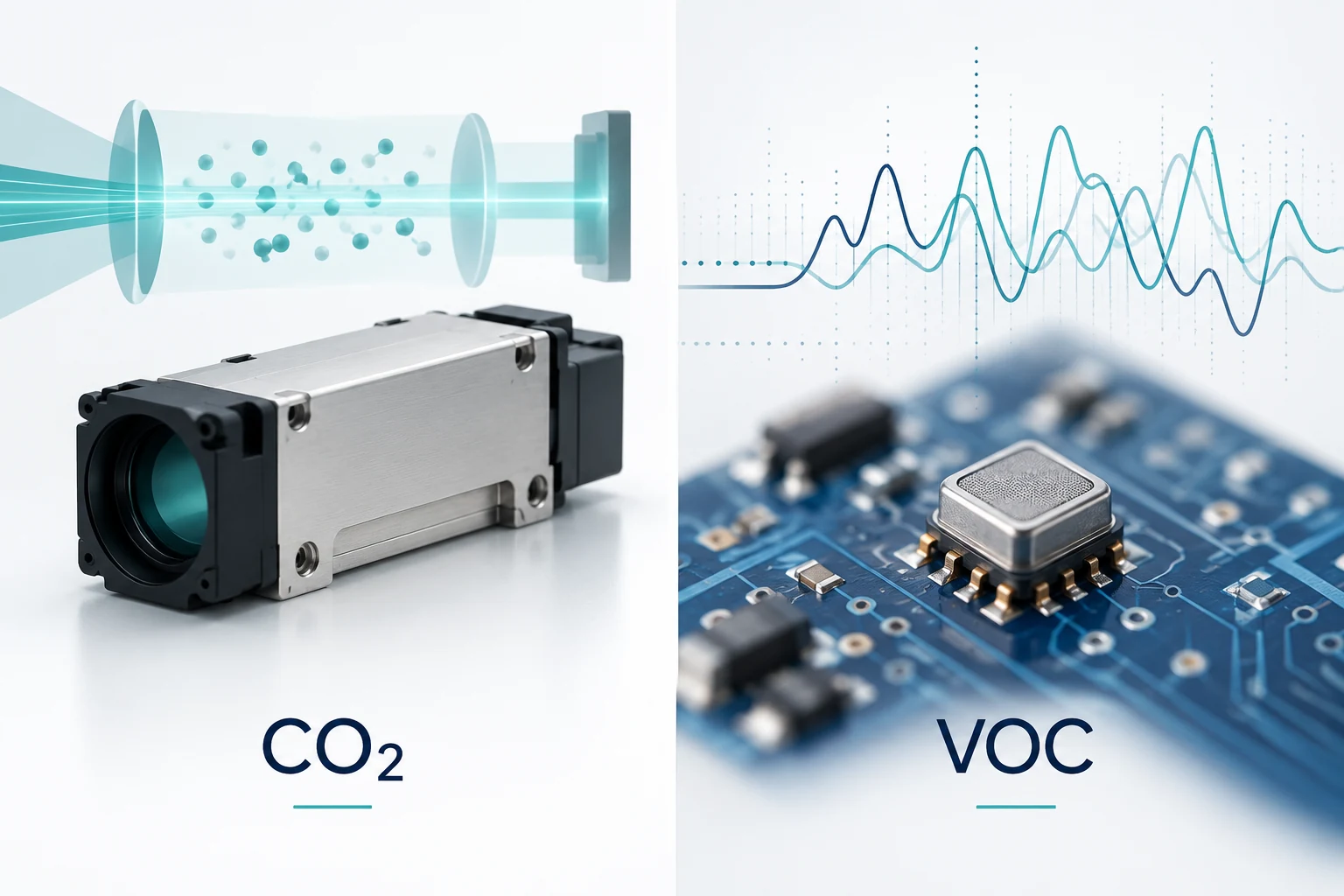
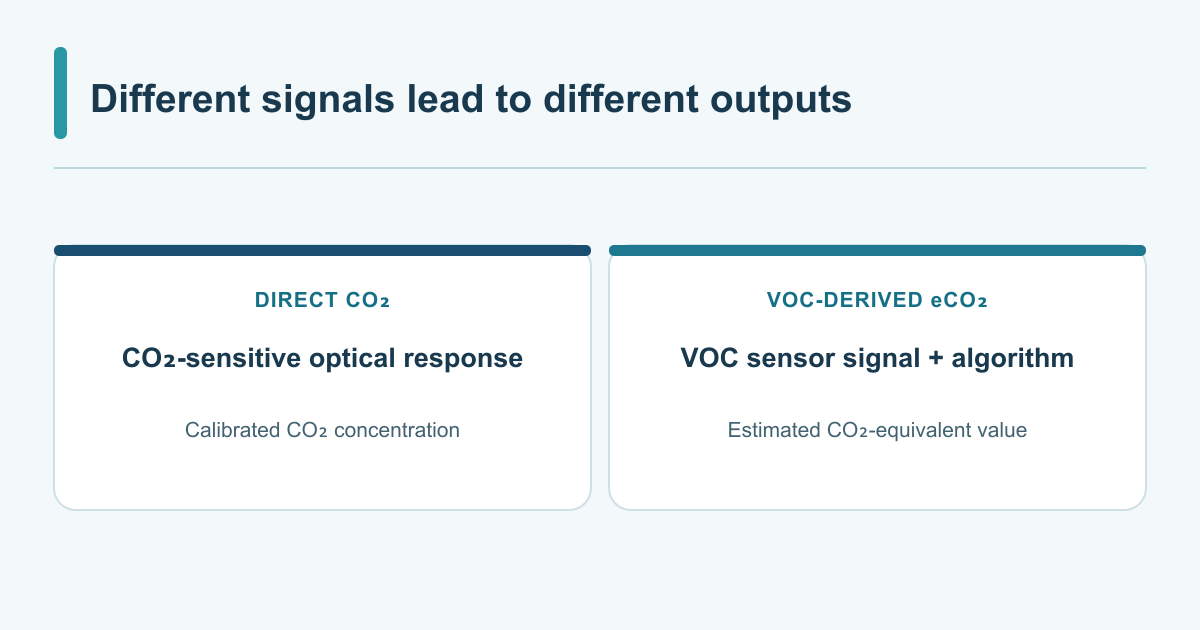
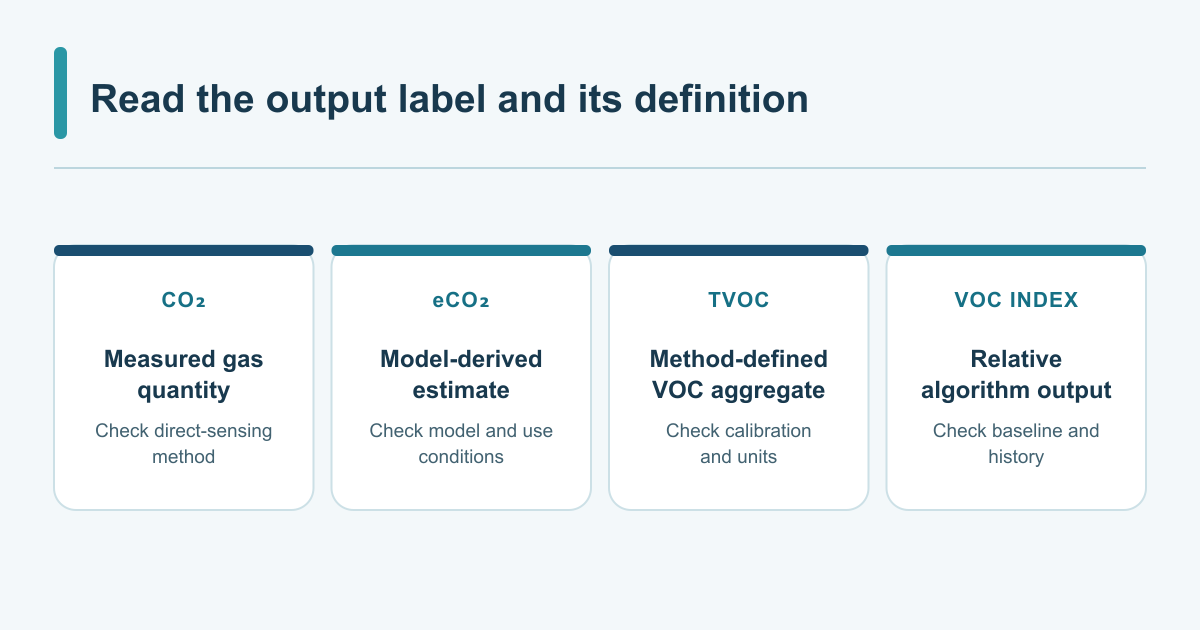
A direct CO₂ channel and a VOC channel measure different things. A direct CO₂ sensor uses a response characterized for carbon dioxide to report the CO₂ content of its sample. A VOC sensor responds to specified volatile compounds or a broader group of gases, with an output defined by its sensor and processing method.
一個 eCO₂ or CO₂-equivalent value is an estimate when it is derived from VOC-related signals. Displaying that estimate in ppm does not make it a measurement of the CO₂ molecules in the sample.
When choosing an air-quality monitor, identify the sensing element and output definition behind each displayed channel. CO₂, eCO₂, TVOC and a VOC Index can be useful, but they answer different questions and should remain separately labeled.
Compare the Measurement Before Comparing the Device
The first distinction is the relationship between the physical input and the reported result:
| 輸出 | What needs to be established? | A common interpretation mistake |
|---|---|---|
| Direct CO₂ | A documented CO₂ measurement method and valid operating conditions | Treating CO₂ as a complete air-quality assessment |
| eCO₂ or CO₂ equivalent | The inputs, algorithm and assumptions used for the estimate | Treating an estimate as the actual CO₂ fraction |
| 總揮發性有機化合物 | The method, response basis, units and processing definition | Treating unlike TVOC methods as interchangeable |
| VOC Index | The algorithm’s index definition and validity state | Reading an index as an absolute concentration |
The output name alone may be insufficient. A product interface may abbreviate a channel to “CO₂” even when its internal method is an estimate. The manual or component documentation should make the distinction explicit.
For concentration notation, see CO₂ ppm meaning and percent conversion. That notation describes how a defined quantity is expressed; it cannot establish which quantity the instrument actually determined.
How Direct Optical CO₂ Measurement Differs
An optical CO₂ channel uses the interaction between light and carbon dioxide in the sample. Its calibration and compensation then relate the sensor response to the reported CO₂ quantity.
Sensirion’s SCD30 documentation describes an NDIR CO₂ module. The SCD4x documentation describes photoacoustic NDIR sensing. These are examples of documented CO₂ measurement paths, rather than estimates constructed from a general VOC response.
Direct measurement still has conditions and uncertainty. Check the relevant range, environment, calibration assumptions, startup behavior and complete-instrument implementation. “Direct” identifies the measurement relationship; it is not a promise of perfect selectivity or unrestricted accuracy.
Our CO₂ measurement guide follows the whole chain from sample to display and explains why an element, module and finished monitor need different documentation.
What a VOC Sensor Output Can Represent
A VOC sensor may report a raw electrical response, a processed concentration estimate, a reference-gas-related value or an index. Broadly responsive sensors and compound-specific analytical methods should not be grouped together as though they produce the same result.
For a semiconductor gas sensor, the raw output can reflect changes in the sensing material’s electrical behavior. Processing may compensate environmental influences and use a calibration or baseline model to produce the final value.
For other technologies, the measurement principle and applicable compounds differ. Read the actual sensor documentation rather than assuming that the phrase “VOC sensor” establishes sensitivity to every compound, equal response to each compound or independent identification of individual chemicals.
A single TVOC number does not normally identify which substances produced the signal. Where a particular compound or concentration is the measurement objective, require a method validated for that objective and sample environment.
Gasnose’s TVOC sensor guide provides related background on technology and application choices. The component’s own documentation remains the source for its specific response and output definition.
eCO₂ Depends on a Relationship Assumed by the Algorithm
An estimated CO₂ value can use correlations between gases associated with people and CO₂ in a particular indoor context. Such a relationship is not the same as sensing CO₂ directly.
For a documented example, the Bosch BME680 datasheet, revision 1.9, describes its CO₂-equivalent output as an estimate based on the average relationship between VOCs and CO₂ in exhaled breath. It explicitly distinguishes that output from direct CO₂ measurement.
That example explains the interpretation problem. If the relationship between the VOC-related input and actual CO₂ changes, a calculated output does not independently establish the CO₂ concentration. The same displayed unit cannot repair that missing measurement relationship.
Some instruments contain both a direct CO₂ channel and a VOC-based estimate. Their channels should be named and recorded separately. One should not silently replace the other in a data export, chart or control interface.
A Second Documented Example: SGP30 Air-Quality Signals
Sensirion’s SGP30 datasheet describes calculated TVOC and CO₂-equivalent signals using its sensor inputs, calibration parameters and dynamic baseline processing. The documentation gives the CO₂-equivalent output in ppm and the TVOC output in ppb.
It also documents an initialization phase in which fixed output values are returned. In that specific command sequence, 400 ppm CO₂ equivalent at startup is not evidence that the sampled room contains exactly 400 ppm CO₂.
This is a documented design example, rather than a recommendation to choose a particular legacy component. For any actual monitor, check its installed sensor, firmware, initialization handling and output definitions. Do not transfer that component’s timing or behavior to an unrelated product.
The useful design-review lesson is broader: a valid-looking number and a valid measurement are different states. A log should retain startup or validity information instead of accepting every numerical output as a completed sample measurement.
TVOC and VOC Index Are Also Different Outputs
TVOC is commonly used to describe an aggregate VOC-related result, but the measurement method and response basis still matter. Sensors can respond differently to mixtures, and a processed output need not equal a laboratory method’s independently defined total.
這 SGP40 datasheet, for example, distinguishes its sensor signal and the processing used to obtain a VOC Index. That index belongs to a defined algorithm; it should not be relabeled as ppm or treated as the same quantity as a TVOC concentration.
Before comparing two outputs, ask:
- Are both quantities defined by the same method?
- Are the units and reference basis the same?
- Which gases or mixtures were used in characterization?
- Is the output raw, compensated, baseline-adjusted or otherwise processed?
- Which environmental and history conditions apply?
A numerical similarity can be coincidental. A numerical difference can reflect unlike definitions rather than a failed instrument. First establish what each channel reports, then decide whether a comparison is meaningful.
Why Occupancy and VOC Events Can Separate
Consider two different questions in an occupied room. One is whether CO₂ is accumulating relative to the room’s ventilation and outdoor context. Another is whether a VOC-related signal changes during a chemical-source event.
In a hypothetical room, a cleaning activity could change the compounds to which a VOC sensor responds without adding a proportional amount of CO₂. In a different scenario, occupants could change CO₂ while the relationship to the relevant VOC signal differs from the algorithm’s expectation.
These examples illustrate why the channels should not be assumed to remain interchangeable. They are not predictions of the response of every sensor or fabricated measurements from a particular room. Whether a specific device detects a particular event requires its documented response and suitable evidence.
For practical investigation, record the event, location, time, occupancy, ventilation state and instrument status. Preserve both direct and processed channels where available, with their definitions. Do not change a label or coefficient just to make two traces agree.
The Same Displayed Unit Does Not Make the Outputs Equivalent
A direct CO₂ value of 1,000 ppm and an eCO₂ estimate displayed as 1,000 ppm have the same numerical notation. They do not necessarily represent the same measurement relationship.
The first value is interpreted using the direct sensor’s sample, calibration and conditions. The second needs the model’s inputs, assumptions, baseline history and valid-use context. Their equality at one moment does not establish equality elsewhere.
The same issue appears when a general air-quality score is renamed as a concentration. Keep the original quantity and processing definition in the data record. If a dashboard combines channels, its calculation should remain visible in the system documentation.
An instrument comparison should therefore contain a “measurement or estimate” field beside the unit. Without that field, a table can make unlike products appear equivalent before their specifications have been examined.
Environment and Baseline History Need Separate Checks
For a direct CO₂ channel, review environmental compensation and the applicable calibration assumptions. For a VOC-based channel, review the raw sensing conditions and any history-dependent processing used by the algorithm.
The BME680 documentation, for instance, distinguishes raw gas resistance from algorithmic air-quality outputs and describes environmental influence on the raw signal. That makes the processing stage part of the specification review for that model.
Ask how the complete monitor supplies environmental inputs, handles power cycles and represents an output that is still stabilizing. A compensation feature named in a component datasheet does not establish correct implementation in every finished product.
Also separate water-vapor effects from condensation. See humidity effects on gas sensor readings for the relevant measurement distinctions.
Choose Channels According to the Question
| Reader’s question | Appropriate documentation to seek |
|---|---|
| What is the sampled CO₂ fraction? | A documented direct CO₂ method and its conditions |
| How do occupancy and ventilation patterns change? | Direct CO₂ data, time/location records and relevant building context |
| Does a specified VOC-related signal change? | Sensor response, output definition and environmental conditions |
| What is the concentration of a particular compound? | A validated method for that compound and sample |
| Is equipment suitable for a defined detection purpose? | Whole-device intended-use and applicable performance evidence |
For ventilation assessment, retain the task and context. ASHRAE’s Indoor Carbon Dioxide position document explains why one concentration cannot describe every space and occupancy. Replacing a direct measurement with a proxy adds another interpretation question.
For a complete indoor-air picture, choose the parameters relevant to the actual concern. The EPA’s indoor monitor guidance notes that such devices measure only the pollutants and factors for which they are designed. Neither a CO₂ channel nor a broad VOC indicator establishes the absence of all contaminants.
A Buyer’s Checklist for CO₂ and VOC Monitors
Request enough information to identify every displayed channel:
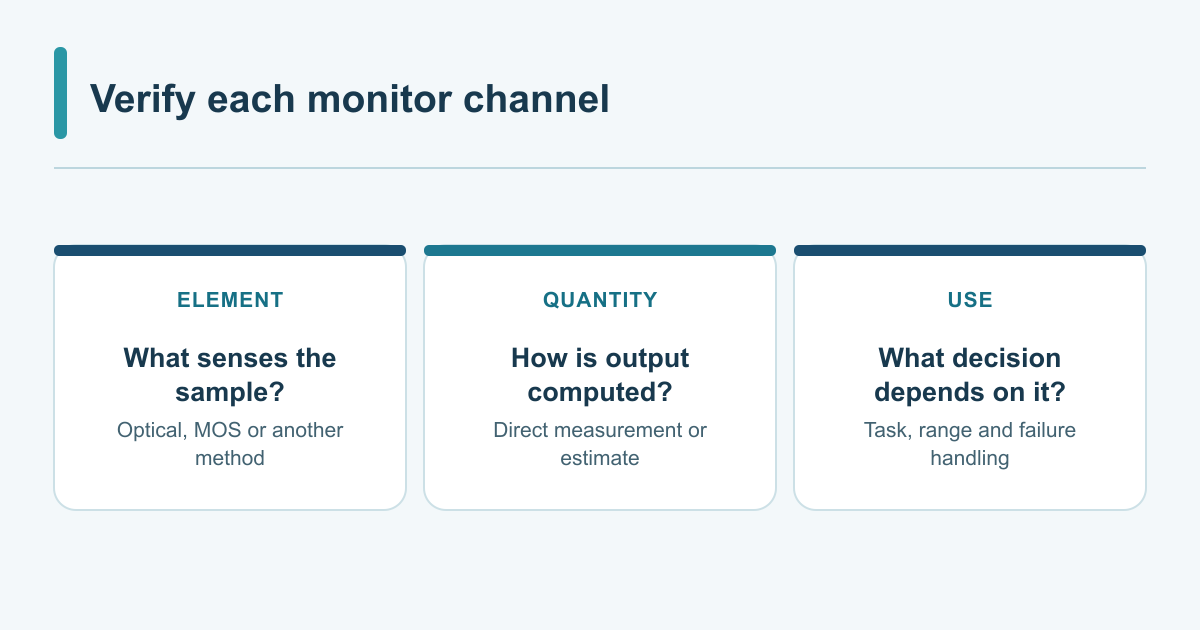
- The sensing component or documented measurement principle.
- Whether the output is directly measured, estimated or an index.
- The full quantity definition, units and response basis.
- The concentrations and conditions covered by the specification.
- Environmental compensation inputs and calibration assumptions.
- Startup, fault, overrange and stabilization reporting.
- Filtering, averaging and logging conventions.
- Evidence for the complete instrument’s intended use.
If a manufacturer does not disclose the component, it can still explain whether the CO₂ channel is direct and provide an adequate whole-device specification. Missing information should remain “not provided” in the comparison rather than being inferred from the display design or price.
For numerical performance claims, use the separate CO₂ accuracy specification guide. It shows how to calculate a stated allowance while keeping its conditions attached.
Preserve Channel Names in Logs and Interfaces
A useful data record keeps the channel identity, quantity, unit, timestamp, configuration and validity state. If direct CO₂ and eCO₂ are both available, store them in separate fields.
For a sensor gateway or building interface, verify that a register called “CO₂” matches the manufacturer’s documented output. Preserve scaling and status bits. A correct unit conversion cannot correct a wrongly identified channel.
When comparing data after a firmware or hardware change, check whether the output definition also changed. Renaming a field without recording the change can create an apparently continuous history composed of different quantities.
This is especially important for charts shared with other readers. A chart legend should identify an estimate or index clearly, so the reader does not have to guess the sensing method from the graph’s shape.
常見問題
Can a VOC sensor measure CO₂ directly?
Do not infer that from a VOC-related ppm output. The documented BME680 example derives CO₂ equivalent from other signals. Check the actual product’s measurement method rather than applying a blanket claim to every sensing material.
Is eCO₂ useless?
An estimate can serve a defined purpose within its documented assumptions. The problem is treating it as an independently established CO₂ concentration when the task requires that measurement.
Is TVOC the same as a VOC Index?
No. They can have different definitions, units, response bases and processing. Read the specific method before comparing or relabeling outputs.
Does a low VOC reading prove the CO₂ level is low?
No such relationship follows from the number alone. A direct CO₂ measurement is needed to establish the sampled CO₂ quantity independently of a VOC-based estimate.
Why does a sensor show 400 ppm at startup?
Check the output definition and initialization state. The cited SGP30 documentation includes fixed startup outputs in its specific sequence. That behavior is not a universal rule for direct CO₂ sensors or other products.
Can a broad VOC sensor identify individual chemicals?
A single aggregate response does not normally provide independent compound identification. That task needs a suitable documented method and evidence for the relevant compounds and sample.
Should an IAQ monitor contain both CO₂ and VOC channels?
Choose channels for the questions being asked. Direct CO₂ and VOC-related information can complement each other, but adding both does not establish complete detection of every pollutant.
How can I tell whether a monitor has direct CO₂ sensing?
Read its method and complete-device specification, and ask the supplier when necessary. The word ppm, a smooth graph or a CO₂ label on the screen is insufficient evidence.
The Useful Comparison
Compare sample → sensing method → processing → quantity → intended use for each channel. Keep direct CO₂, VOC-related estimates and indices separately identified. That produces a stronger selection decision than comparing display labels or accepting two similarly numbered outputs as the same measurement.