

A confined-space gas testing record is useful only when it connects the identified hazards, suitable measurement channels, instrument condition, sampling locations, time and relevant work conditions. Review those connections alongside the applicable permit and entry program. A set of plausible readings or a current calibration label cannot establish that every atmospheric hazard was evaluated or that entry is authorized.

Gas testing documents support a broader decision. The illustration does not authorize entry or show an approved sampling procedure.
This article addresses document review. It does not prescribe an entry sequence, test concentrations, alarm settings, sampling times or rescue actions. Those decisions require the applicable jurisdiction, competent hazard evaluation, approved program and specific equipment instructions. The aim is to recognize what a record demonstrates and what remains unresolved before someone relies on it.
Establish jurisdiction and the decision being supported
Start by identifying the work location, industry and applicable rules. In the United States, 29 美國聯邦法規 1910.146 addresses permit-required confined spaces in general industry and explicitly excludes agriculture, construction and shipyard employment from that section's scope. A reviewer should not present its provisions as the complete rule for every confined-space task worldwide.
Separate legal requirements from guidance, manufacturer instructions and local program controls. Each can be important, but they answer different questions. A manufacturer manual describes a device's capabilities and limits. An entry program defines the site's controlled process under the applicable requirements. A gas-test record documents observations. None should be used to silently replace the others.
Identify the actual decision under review. It may be whether a hazard evaluation is complete, whether a particular verification record supports stated conditions, whether a permit contains required information or whether an incident history can be reconstructed. Different questions need different evidence. A reading sheet adequate for one purpose may omit information essential to another.
The review should state its own boundary. Finding that a test record is traceable and internally consistent does not approve entry or demonstrate control of non-atmospheric hazards. Conversely, finding a missing field does not prove that a harmful atmosphere existed. It establishes a specific gap in the available evidence that must be resolved by the responsible program owner.
Separate hazard evaluation from verification measurements
OSHA's Appendix B to 1910.146 is explicitly non-mandatory guidance. It distinguishes evaluation of atmospheric hazards from verification that acceptable conditions exist for an entry. This distinction helps explain why a list of routine monitor readings is not a substitute for identifying what hazardous substances or conditions could be present or arise.
The hazard evaluation should establish the relevant atmosphere and credible changes associated with the space and work. The verification record should show how the identified parameters were assessed against the applicable criteria. If those documents contain different gas lists, the reviewer needs a supported explanation. The familiar channels on a standard portable monitor should not define the hazard list by default.
For example, a device equipped for oxygen, combustible gas, carbon monoxide and hydrogen sulfide does not thereby measure every solvent vapor or other toxic contaminant. Whether additional measurement is needed depends on the actual assessment. A four-channel record can be complete for its defined task or incomplete for another; channel count alone does not establish suitability.
Preserve the connection between evaluation and method selection. If the assessment identifies a substance, the record should identify an appropriate measurement method or explain its disposition within the approved program. An unexplained blank should remain a question. Filling it with a zero or “not detected” would create evidence that was never obtained.
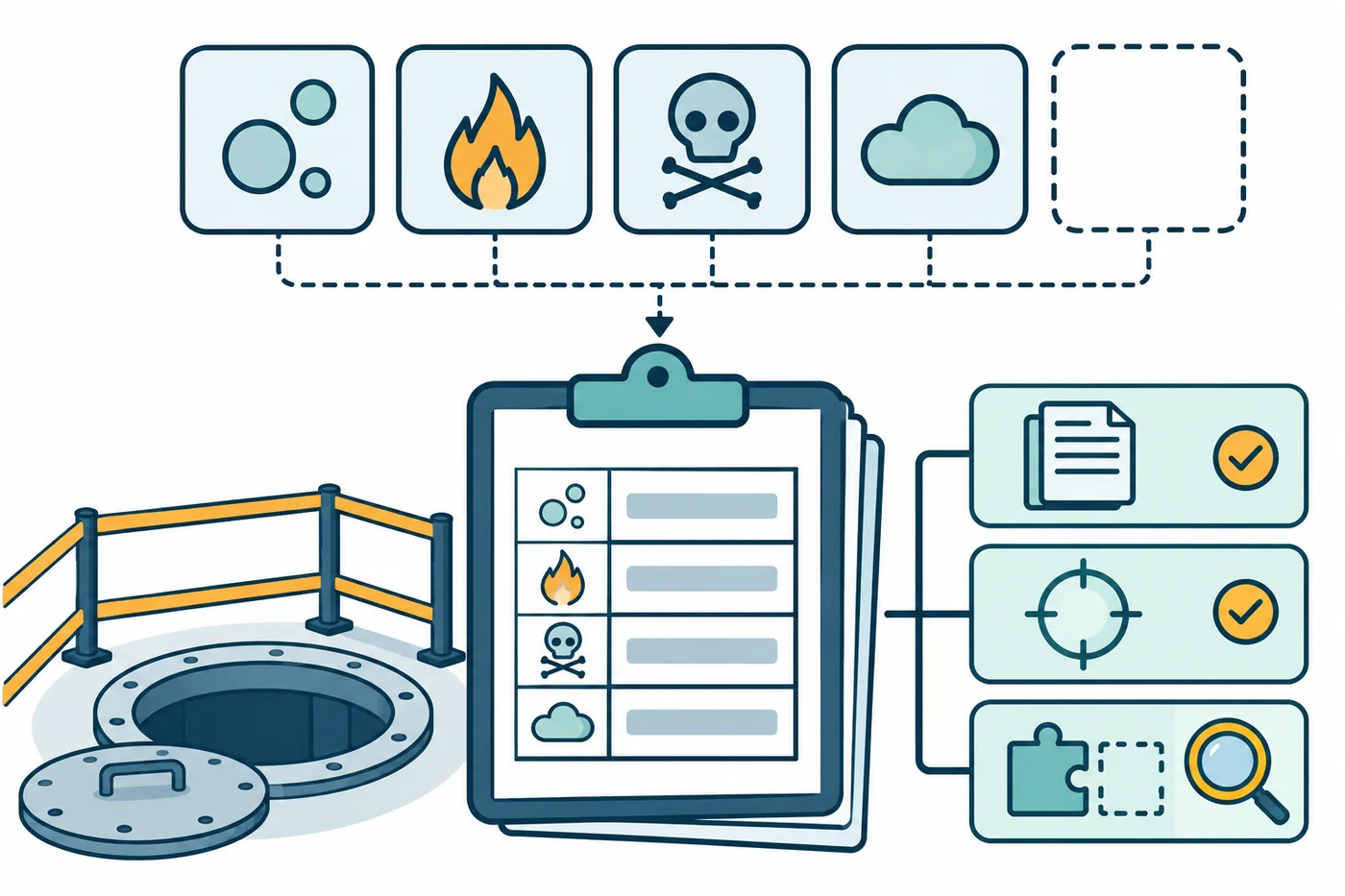
Installed channels and the assessed hazard list must be reconciled; a familiar monitor configuration does not define all possible hazards.
Match the space, task and record identities
Confirm that the space identifier on the permit matches the hazard assessment, sampling plan and test sheet. Similar tanks, vaults or vessels can have different contents, connections or work histories. A general location description such as “plant room” may be insufficient when the record needs to distinguish several spaces. Use the site's controlled naming and asset relationships.
The task matters as well as the space. Cleaning, coating, hot work, maintenance and process operations can create different atmospheric questions. A historical record from an earlier activity is not automatically representative of a new task in the same enclosure. The document set should identify the work and the relevant operating conditions rather than relying solely on a permanent space name.
Check date, time, permit identity, tester identity and instrument identity across records. A timestamp can reveal that a test preceded a process change or that an instrument service result occurred after the recorded use. These relationships do not need speculative interpretation: first establish that the records describe the same event and a consistent sequence.
Digital exports can make matching harder if they use only instrument serial numbers while permits use local asset names. Preserve a mapping that can be audited later. Where an instrument contains replaceable sensors, the installed channel configuration should be retrievable for the relevant date, rather than inferred from the configuration currently in the housing.
Review instrument suitability and condition as separate questions
Suitability asks whether the instrument and method can address the identified hazards under the relevant conditions. Condition asks whether the particular device was functioning as required when used. A current calibration record can support condition while leaving suitability unresolved. A technically suitable model can still have a failed channel, blocked inlet or overdue required verification.
For suitability, inspect target gases, measurement ranges, units, resolution where relevant, interference information and environmental limits in the actual manual. For combustible-gas measurement, determine the instrument's configured basis and limitations. Do not apply an assumed correction factor from another sensor or infer response to an unlisted gas from a broad “flammable” label.
For condition, link the instrument to the relevant service and functional-check history. OSHA's direct-reading monitor bulletin, dated November 26, 2024, discusses operational verification and the supporting records. It is advisory. Its general terminology helps distinguish a function check from a quantitative comparison, while the applicable manufacturer's instructions establish the device-specific method.
Check for unresolved faults or restrictions between the last successful service and the testing event. An instrument may have a recent calibration certificate and a later failed check. The newer unresolved event cannot be ignored merely because the certificate remains current. The review should reconstruct the available condition evidence at the time of the measurement.
| Review layer | 需要證據 | What a narrower record can leave unanswered |
|---|---|---|
| Hazard coverage | Assessment linked to measurement methods | Whether an unmeasured contaminant was considered |
| Instrument suitability | Actual model, sensors and method limits | Whether familiar channels address this task |
| Instrument condition | Traceable service and operational verification | Whether a later fault changed availability |
| Sampling context | Locations, method and relevant path details | Whether the readings represent the intended atmosphere |
| Time context | Timestamps and relevant operating changes | Whether an earlier observation remains relevant |
| Permit relationship | Applicable criteria and responsible review | Whether results were interpreted within the approved program |
Look for a sampling location that means something
A gas reading describes the sample that reached the instrument. It does not automatically describe every region of a space. The record should identify sampling locations in a way that can be related to the space and assessment. A single generic label such as “tank tested” can conceal whether the intended locations were actually addressed.
For a sampled method, identify the relevant inlet location, line or probe arrangement and instrument relationship. The record need not duplicate the entire manual, but it should make the approved method and meaningful deviations retrievable. A result obtained with a different sample path may have a different response or represent a different location even when the same monitor is used.
這 OSHA atmospheric testing fact sheet explains that gas transport and instrument response require time. For document review, the important question is whether the approved procedure accounts for those factors and whether the record supports that procedure. Do not replace manufacturer-specific timing with a generic number from another instrument or a rule based only on tubing length.
Consider whether the plan identifies locations that correspond to the assessed conditions and space geometry. Gas density can be relevant, but ventilation, source location, temperature, mixing and obstructions also affect distribution. A document reviewer should look for the basis of the sampling plan rather than convert a density rule into a universal field instruction.

Location identifiers should connect observations to the assessed space. The symbols are not a field sampling plan.
Keep sample-path limitations visible
The path can affect what reaches a sensor and how quickly it arrives. Tubing material, length, filters, moisture, leaks, pump condition and conditioning arrangements can matter, depending on the analyte and equipment. A record that identifies only the detector serial number may omit important parts of the measurement method.
這 霍尼韋爾 GasAlertMicro 5/PID/IR 快速參考指南 provides model-specific cautions and accessory relationships. It is an example of why a reviewer needs the actual device documentation. Do not assume that a pump or accessory compatible with one multigas product is appropriate for another or for every gas channel.
If a service check applied gas directly to the detector while the task used a remote sampling line, recognize the different boundaries. The service check can be valid evidence of the device's response while leaving the installed sampling path outside that event. Ask which additional evidence the approved method requires for the path rather than declaring the device result invalid or complete without qualification.
Record uncertainty honestly. If the sampling arrangement cannot be reconstructed, say that the represented location or response timing remains unresolved. A later manual-based estimate can support investigation, but it should be identified as an estimate with assumptions. It cannot be presented as an observation recorded at the original event.
Interpret units and reported results carefully
Read each parameter with its units and measurement basis. Oxygen concentration, toxic-gas concentration and combustible-gas indication describe different quantities. A number copied into the wrong column or stripped of units can lose its meaning. The receiving spreadsheet should preserve the original parameter identity rather than rely on a familiar column position.
Treat zero, blank, below detection and not measured as different statuses. A zero can be an instrument indication under a particular method. A blank can mean no entry was made. A below-detection statement depends on the method's capability. A not-measured status establishes an exclusion. Merging these statuses makes the record appear more complete than the evidence supports.
An instrument alarm setting is also different from an approved acceptance criterion. The setting can support a warning function while the program uses additional criteria or controls. Compare the documented results with the applicable basis established for the task. Do not assume that the absence of an alarm alone satisfies every atmospheric requirement.
Avoid reproducing a generic table of entry thresholds as though it authorizes work. The applicable jurisdiction, hazards, work and program determine what must be assessed. Even where a regulation defines particular hazardous-atmosphere conditions, acceptable entry involves a broader set of requirements. The record should link to the adopted criteria and their scope rather than silently universalize a familiar set of numbers.
Reconstruct time and changing conditions
An atmospheric observation has a time context. Processes, ventilation, connected equipment and the work itself can change conditions after a reading is taken. The documents should identify the relationship between testing and relevant changes. A morning result does not become a guarantee for the rest of a shift simply because it appears on the same permit.
For recorded monitoring, establish the logging interval, clock basis, channel configuration and data completeness. A plotted line can look continuous while the underlying device has gaps, invalid data or a different time zone. The review should preserve those limitations rather than interpolate them into evidence of unobserved conditions.
Separate the instrument's clock from the permit's clock when necessary. If a docking station, monitor and site system use different time settings, reconcile them before ordering events. Record the reconciliation method. An unexplained offset can make a successful check appear to have occurred before a task when it actually occurred afterward.
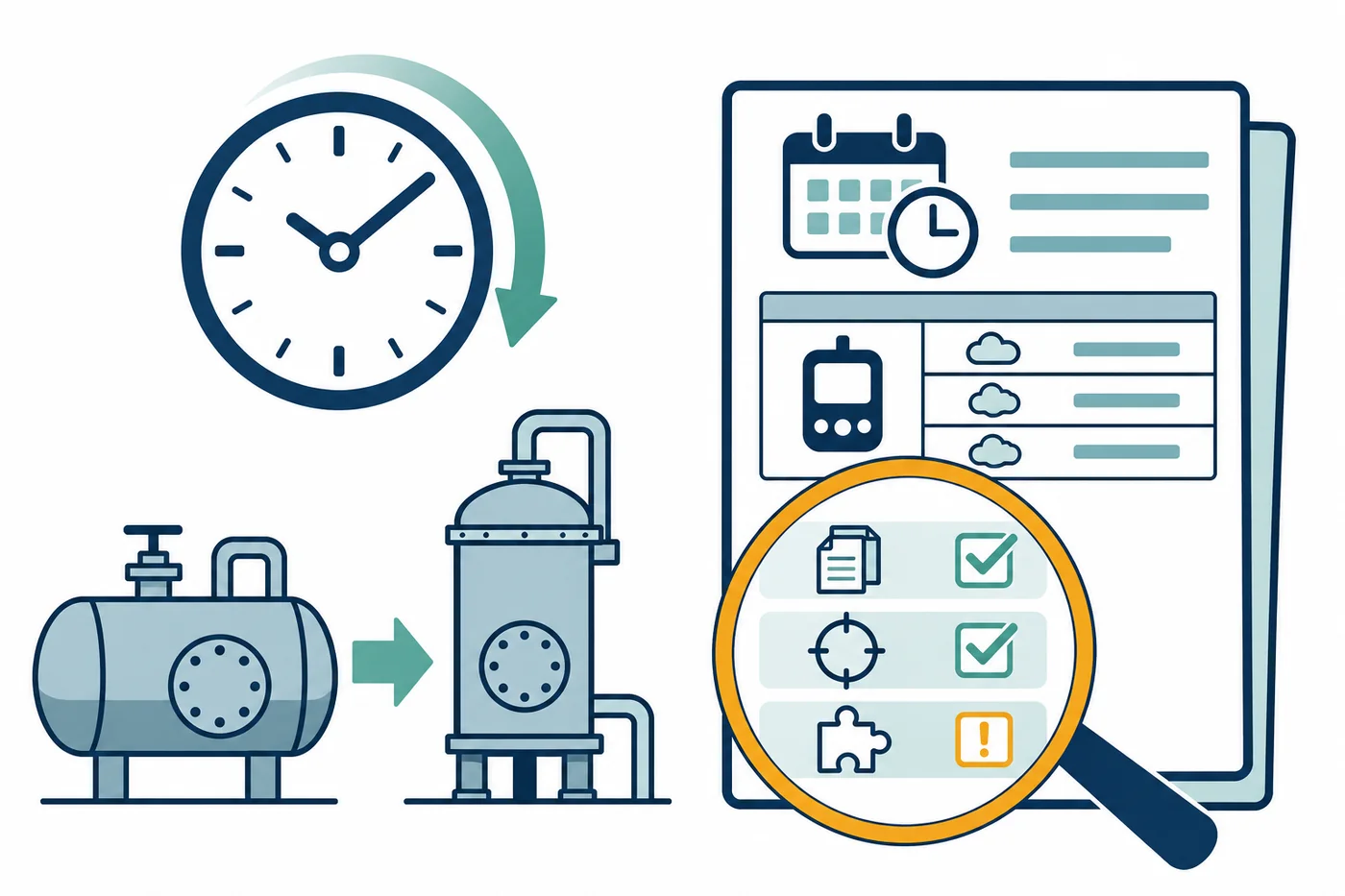
A reading belongs to a defined time and set of relevant conditions.
Connect test evidence to the permit without enlarging its claim
Under US general-industry 1910.146, the permit system and permit contents include information beyond atmospheric values. Review the relevant current provisions directly for the actual task. The atmospheric record should be traceable to the permit and the responsible evaluation, while other hazards, controls, roles and emergency arrangements remain part of the broader program.
這 NIOSH alert on preventing occupational fatalities in confined spaces, publication 86-110 provides historical evidence of severe confined-space hazards and emphasizes evaluation, monitoring and rescue planning. It is a 1986 advisory publication, not a current substitute for the applicable regulation. Its value here is explaining why a measurement sheet should never be mistaken for the whole protective system.
Read signatures with their defined purpose. A tester's entry identifies an observation or completed task; a supervisor's authorization has a different role under the program. A review signature should not silently attest to unobserved measurements or missing controls. The document system should make these responsibilities clear enough that people know what they are accepting.
Retention requirements also depend on jurisdiction and record type. Do not import a rule from a foreign guideline or a general service recommendation. For US general-industry canceled entry permits, consult the relevant 1910.146 provisions; for instrument service records, identify the applicable equipment and program requirements separately. The two records serve different purposes even when stored together.
A hypothetical review of a complete-looking packet
Imagine a hypothetical maintenance task involving a process vessel. The packet contains a permit, a four-channel gas reading sheet and a recent instrument certificate. The reading sheet lists the vessel's location but no unique space ID. The hazard assessment mentions a cleaning substance that is not addressed by the listed channels or another identified method. The calibration certificate belongs to the correct instrument body.
The reviewer should identify distinct gaps. First, space identity needs reconciliation so the records can be matched to the intended vessel. Second, hazard coverage needs an explanation from the competent assessment and program owners. The instrument certificate does not resolve either issue. It addresses a different part of the evidence chain.
Suppose the packet also includes a continuous log, but the monitor's clock differs from the permit by an unexplained offset. That creates a time relationship question. The log may still contain useful measurements, but it cannot support a precise sequence until the time basis is reconciled. The reviewer should preserve the original data and request the information needed to interpret it.
No entry decision is made in this hypothetical example. The appropriate review outcome is a list of specific unresolved claims, their evidence requirements and responsible owners. A statement that the packet is “complete” because every page has a signature would conceal the actual questions. A statement that an unsafe atmosphere definitely existed would go beyond the evidence in the other direction.
Use an evidence-gap register for review findings
Give each finding an identifier, affected space and event, document reference, unresolved question and required closure evidence. Classify it in plain language: identity mismatch, hazard coverage question, device condition gap, sampling limitation, time inconsistency or permit relationship issue. These descriptions make follow-up more actionable than a broad label such as “gas test noncompliant.”
Distinguish missing evidence from contradictory evidence. A missing sample location leaves representativeness unresolved. Two records naming different locations create a contradiction requiring reconciliation. Both need attention, but the route to closure may differ. The register should explain the issue without deciding which record is correct merely because one is more convenient.
Where evidence is added later, preserve its origin and date. A contemporaneous log differs from a later recollection, and a reconstructed estimate differs from a measured observation. All can help an investigation if labelled accurately. They should not be merged into an apparently original testing sheet that conceals when the information became available.

A clear unresolved finding is more useful than an unsupported completion mark.
A document-review checklist
The following questions help determine whether a packet supports the claim being made. They are not a field entry checklist. Each question should be answered using the actual program and equipment evidence, and unresolved items should go to the designated owner before the affected decision is relied upon.
- Is the applicable jurisdiction and industry scope identified?
- Do the assessment, permit and test records describe the same space and task?
- Are all assessed atmospheric hazards linked to appropriate methods or documented dispositions?
- Can the instrument and installed channels be identified for the event date?
- Is instrument condition supported without an intervening unresolved failure?
- Are sampling locations and relevant path details retrievable?
- Does the approved method account for transport, response and other applicable limitations?
- Are values, units, invalid states and unmeasured parameters distinguishable?
- Can timestamps be related to the task and relevant changes in conditions?
- Are the results interpreted against the applicable criteria by the responsible roles?
- Are exclusions, contradictions and closure evidence preserved?
For background on the broader subject, the existing Sensor1stop confined-space monitoring overview introduces common monitoring and program concepts. The present review framework addresses a narrower question: whether particular documents support particular claims. For legal scope and technical decisions, use the current original regulation and actual equipment instructions.
Distinguish a review finding from a reconstructed measurement
Reviewers often discover useful context after the original event. A drawing can identify a sampling point, a service database can show which sensor was installed, and a clock comparison can explain an offset. That information can strengthen interpretation, but its origin should remain visible. A later reconstruction is not a new observation of the atmosphere at the earlier time.
State the question the reconstruction addresses and the assumptions it uses. If a location is inferred from an instrument's assigned route, identify that inference and its supporting record. If the operator confirms a location from memory, preserve it as a later statement. Do not overwrite the original blank with an apparently contemporaneous entry. The evidence is more useful when its provenance is clear.
The same principle applies to missing time information. A file creation date, upload date and measurement timestamp can differ. A reviewer may be able to establish their relationship through system logs, but should not select whichever date creates a convenient sequence. Preserve the original values and document any supported reconciliation separately.
Consider what the reconstructed information still cannot establish. Knowing the likely sample location does not prove the required stabilization occurred. Knowing the installed channels does not show that every channel was functioning. A resolved identity gap can leave a method gap untouched. Close findings individually so progress on one issue does not create an impression that the whole packet is complete.
Make the final review statement precise
A useful review statement identifies the space and event, documents examined, claims supported, limitations and unresolved actions. It should describe the evidence rather than announce a broad safety conclusion. For example, it can state that the instrument identity and recorded channel values are traceable while a particular hazard-method relationship remains unresolved. The responsible program roles can then address that specific question.
Where all review questions are closed, retain the closure evidence and revision relationships. That does not turn the packet into permanent proof for future work. It establishes that the reviewed documents support the defined claim for the identified event. Later tasks and changed conditions require their own application of the applicable program.
Clear language also helps incident investigation. A statement that a record supports a measured concentration at an identified location and time is more defensible than saying the space was safe. The narrower statement preserves what the instrument actually observed and leaves the broader assessment connected to its other required evidence. Precision improves usefulness without diminishing the value of the measurements.
常見問題
Does a calibration certificate make a gas-testing record sufficient?
It supports a defined instrument service claim. Hazard coverage, sampling location, time context and the relationship to the task still need evidence. A correctly functioning instrument can measure an unrepresentative sample or lack a channel for a relevant contaminant. Read the certificate as one component of the packet.
Are four gas channels always enough?
Suitability depends on the assessed hazards and methods, not a standard channel count. The installed sensors may address the identified needs or leave a substance unmeasured. The assessment should explain that relationship. A familiar configuration should not be used as evidence that an unknown atmosphere has been fully characterized.
Can a zero reading be recorded as no hazard?
A zero is an indication under the instrument's method and limitations. It does not establish absence of every hazardous substance or every non-atmospheric hazard. Preserve the parameter and units, the method and the relevant context. Do not replace a missing measurement with a zero.
Does continuous logging establish continuous valid monitoring?
Review data completeness, valid status, clock basis, sensor configuration and relevant conditions. A continuous-looking plot can conceal gaps or invalid values. The record supports only the observations actually obtained and interpretable under the method. It does not automatically demonstrate every program requirement.
Can a previous test be reused for another task?
That requires the applicable program's assessment of the new task and conditions. A historical result has a defined time, location and method. Changed work, connected processes or ventilation can change its relevance. A reviewer should not convert historical readings into current authorization by copying them into a new form.
Who resolves an unexplained hazard or sampling gap?
Refer it to the competent assessment and entry-program roles identified by the employer's system. The document reviewer should state the unresolved claim and required evidence clearly. Technical interpretation, method selection and entry authorization should remain with the roles responsible under the applicable requirements.
來源和設備文件
- OSHA: 29 CFR 1910.146, US general-industry permit-required confined-space requirements and scope.
- OSHA: Appendix B to 1910.146, non-mandatory atmospheric testing guidance.
- OSHA: Atmospheric testing in confined spaces fact sheet, explanatory testing context.
- OSHA:校準和測試直讀監視器,SHIB 11-26-2024, advisory instrument verification discussion.
- NIOSH: Preventing Occupational Fatalities in Confined Spaces, publication 86-110, historical advisory context, January 1986.
- 霍尼韋爾:GasAlertMicro 5/PID/IR 快速參考指南, specific instrument and accessory limitations.








發表評論