
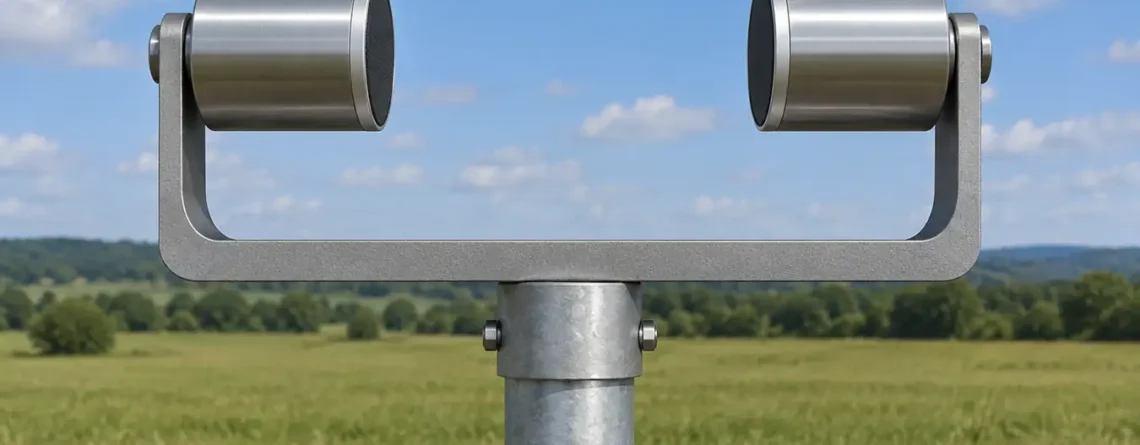
通过以下方式选择超声波风传感器 您需要的风量、测量地点的暴露情况以及数据必须保持可用的条件。检查您是否只需要水平风或垂直分量,然后比较范围、不确定性、输出率、方向约定、降水性能、功率和安装要求。没有移动部件的传感器避免了轴承和旋转叶片,但它仍然会受到障碍物、雨水、冰、电气问题和不正确对准的影响。
超声波风速计测量沿着固定传感器之间的声学路径的气流。其输出可以提供风速、风向或速度分量。最好的仪器是能够为决策提供足够代表性、及时且可追溯的数据的仪器,而不仅仅是具有最大规定风速范围的仪器。
This selection guide expands on the site's 一般风速计概述 重点关注声波测量、现场暴露和风数据处理。适用于户外管乐器;用于管道、封闭房间或移动车辆的传感器需要针对特定应用进行评估。
从测量决策开始
A weather station may need a representative average and gust. A crane or exposed structure may require a timely indication at its working location. A wind-energy study may need a documented measurement campaign and traceable uncertainty. A turbulence study may need three velocity components sampled rapidly and synchronized with other instruments. These jobs differ in acceptable siting, averaging and data quality.
| 问题 | What to specify | What a single reading cannot establish |
|---|---|---|
| Local weather conditions | Exposure, height, average period, gust definition and direction reference. | Wind at every nearby location or height. |
| Equipment operation | Relevant location, update latency, alarm logic and invalid-data handling. | Safe operation without the equipment's overall operating procedure. |
| Wind-energy assessment | 测量协议、校准、数据可用性和不确定性。 | 来自短期不具代表性的记录的长期能源产量。 |
| 湍流研究 | 三维组件、采样率、坐标系和同步。 | 来自缓慢平均输出的湍流统计。 |
写下谁将使用这些数据以及当仪器报告故障或缺失值时他们将做什么。将缺失数据视为零风的系统可能比明确报告无效测量值的系统更具误导性。作为传感器选择的一部分,设计数据路径和物理安装。
双向超声波计时如何测量气流
Sound travels between two transducers separated by a known path. Air movement along that path changes travel time: a pulse traveling with the airflow reaches the other transducer sooner than one traveling against it. In a simplified model, if the path length is l, the still-air sound speed is c, and the air velocity component along the path is v, the travel times are t₁ = L/(c + v) 和 t₂ = L/(c − v) for the chosen sign convention. Combining the reciprocal times gives v = (L/2)(1/t₁ − 1/t₂)。
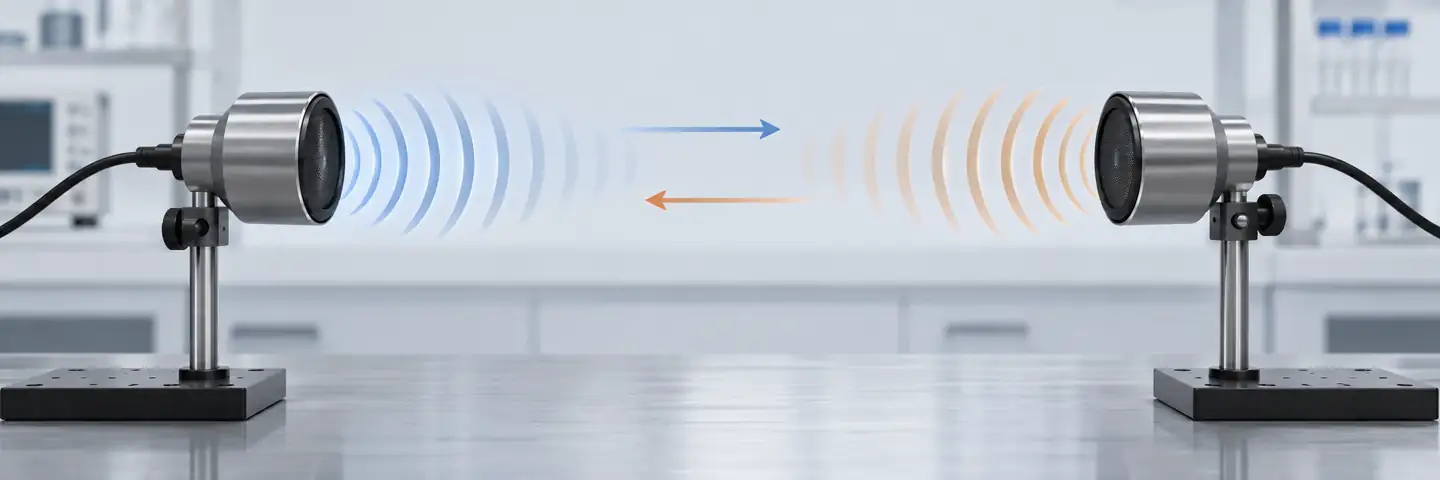
This simplified relationship explains why measuring in both directions can separate the wind component from changes in sound speed. It does not mean temperature, humidity, transducer geometry, signal processing or contamination have no effect on a real instrument. The University of Manchester explanation describes the method and notes that sensor supports can disturb the flow and precipitation can affect some devices. The manufacturer may apply model-specific corrections and diagnostic checks.
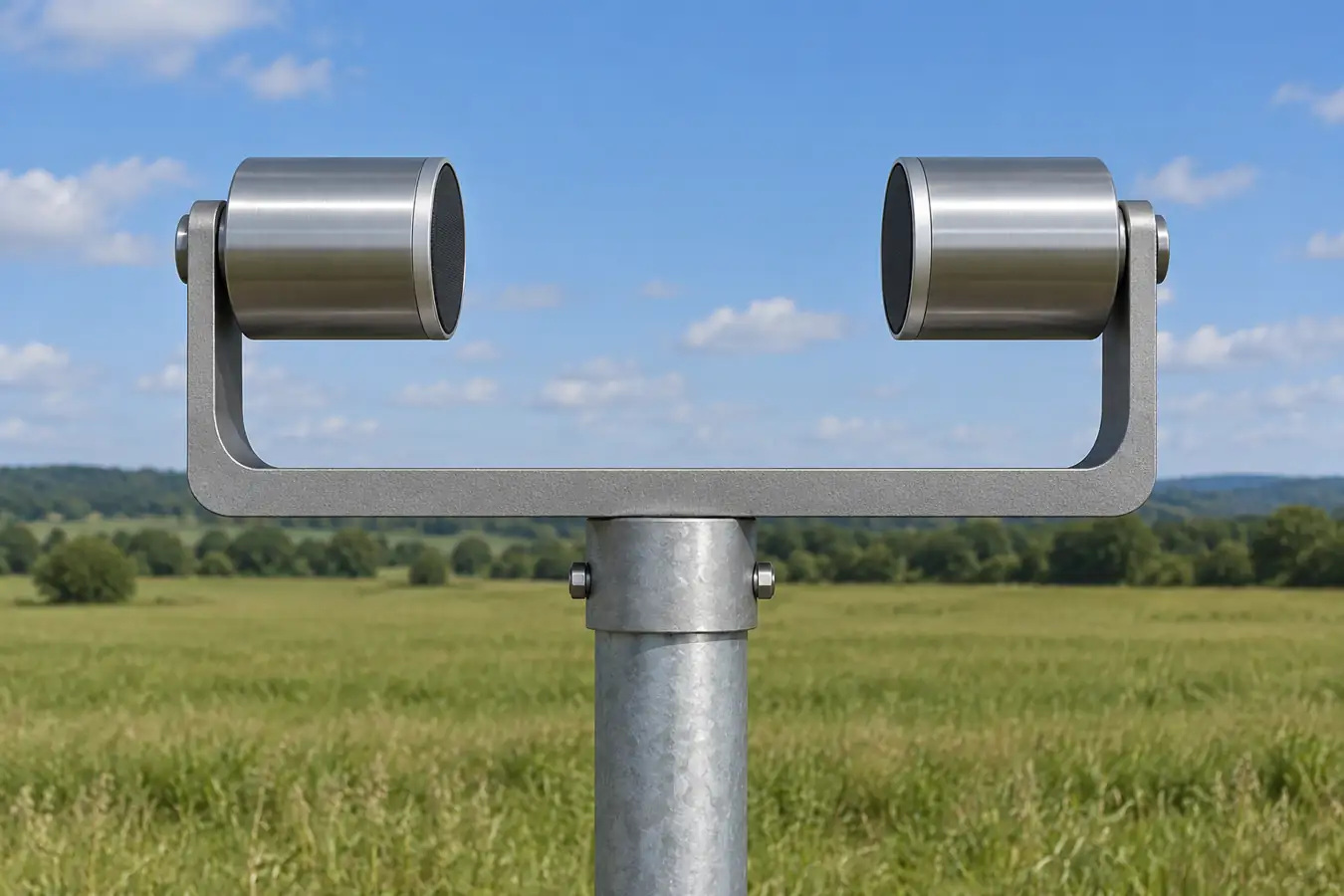
The instrument combines measurements from multiple paths to calculate velocity components. A horizontal two-dimensional system generally provides two horizontal components from which speed and direction can be derived. A three-dimensional system adds information needed to estimate the vertical component. The actual transducer geometry and algorithm differ by design; do not count visible arms in an illustration and assume every commercial device works identically.
What the measurement volume represents
声学路径在换能器之间的有限距离内对空气进行采样;输出并不是对空间站周围每一块空气的测量。湍流在空间和时间上会发生变化,并且支撑结构会扰乱局部流动。制造商可以使用校准和校正来减少对其特定几何形状的影响。适合缓慢平均的当地天气显示的位置可能不适合依赖于小湍流波动的研究测量。
比较仪器时,请注意它们的测量体积和当地气流。即使位置很近的传感器也无法采样完全相同的空气。集中在特定风电行业的一致差异可能表明暴露或支持效应;仅在强降水期间存在差异表明需要进行不同的调查。保留个人观察结果和质量标志,而不是强迫与未记录的校正因子达成一致。
速度、方向和标志约定
风速是一个大小;方向需要明确的约定。气象风向常用描述 风从哪里来,而数学速度矢量可以描述空气流向的方向。仪器或数据平台可以提供任一表示。记录数据的参考方向、单位、坐标系和符号约定。
Direction becomes unstable or less meaningful when horizontal speed is very close to zero: small component errors can produce a large change in the calculated angle. Check the instrument's low-speed direction specification and the data system's calm-handling rule. A changing direction at almost zero speed is not automatically evidence of a rapidly rotating wind.
二维还是三维测量?
当决策需要水平速度和方向并且仪器满足所需的不确定性和更新速率时,请选择 2D 设备。当垂直速度、流动倾斜或湍流分量是测量目标的一部分时,3D 仪器是合适的。三维输出并不自动适合每个气象站:它会增加成本、处理要求和选址限制,而不会改进简单的水平风决策。
对于研究,在选择设备之前确定所需的采样率、时间同步、坐标转换、校准和数据完整性。这 曼彻斯特大学仪器说明 discusses three-dimensional sonic instruments for turbulence. Its example ranges and update rates belong to the described instruments and should not be assumed for another model.
Ultrasonic versus cup and vane
A cup anemometer infers speed from rotor motion; a separate vane usually measures direction. A sonic anemometer derives wind components from acoustic measurements without a rotating bearing. Both can be useful when chosen and installed for the task. Comparing their published accuracy requires the same quantity, wind range, calibration method and averaging conditions.
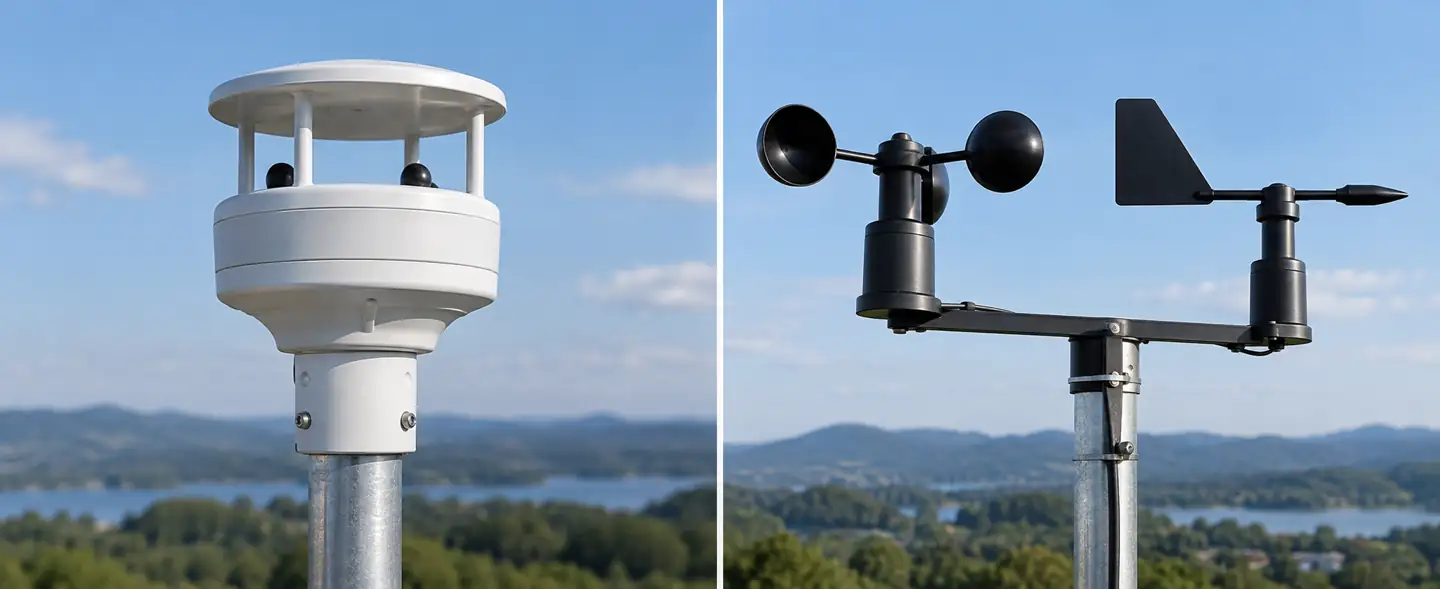
| Consideration | Ultrasonic instrument | Cup and vane |
|---|---|---|
| Moving parts | No rotating wind-sensing parts. | 轴承和运动部件需要状态监测。 |
| 输出 | 许多设备提供计算出的速度和方向;有些提供组件。 | 速度和方向通常来自不同的元素。 |
| 天气暴露 | 声学路径和电子设备可能会受到雨、雪或冰的影响;加热是特定于型号的。 | 轴承、轴承杯和叶片可能会受到磨损、污染和结冰的影响。 |
| 数据解读 | 算法、对齐、平均和诊断标志很重要。 | 转子响应、叶片对准和传感器状况都很重要。 |
| 维护 | 检查声学表面、电气连接、安装和加热器(如果已安装)。 | 按规定检查运动部件、平衡、轴承和对准情况。 |
没有活动部件并不意味着免维护或不受恶劣天气的影响。一个 荷兰皇家气象研究所实地和风洞研究 为比较设备提供有用的上下文;其研究结果适用于所研究的模型和条件。评估整个生命周期的成本、电力和数据可用性以及购买价格。
阅读工作点的数据表
The full wind-speed range tells you the instrument's stated measurement coverage, not necessarily its accuracy at the speeds that matter. Check whether accuracy is specified as an absolute value, a percentage of reading or a combination, and identify the wind range and environmental conditions behind the statement. Resolution is the output increment; it is not the same as measurement uncertainty.
Review direction accuracy and its minimum applicable wind speed, update rate, averaging options, response time and available raw components. For monitoring exposed equipment, include the full delay from measurement through logging, communications and control logic. A fast sensor can still feed a slow dashboard if the data system averages or transmits infrequently.
Ask how the instrument reports invalid measurements, diagnostics, heating status and power faults. Some instruments output a numeric substitute or repeat the last value; others flag a measurement as invalid. The integration must preserve that status. Record the output format, units, direction reference, sampling rate, firmware and any configured corrections.
Output rate, gusts and averages are different settings
An output rate of one value per second does not by itself define a one-second gust. The instrument may internally average over a different window, and the logger may apply another filter. Define the interval, statistic and treatment of missing samples before comparing two wind records. A maximum of averaged values is not necessarily the same statistic as a short-duration peak from raw samples.
Direction also requires care when averaging. Values near 359° and 1° are both close to north; their simple arithmetic mean of 180° is misleading. Use a documented circular or component-based method appropriate to the purpose, and distinguish the average of individual speed magnitudes from the magnitude of an average velocity vector. These quantities answer different questions when wind direction changes.
Preserve timing and data coverage
平均值的含义取决于包含哪些样本。如果传感器报告部分间隔的无效值,请定义最小可接受的覆盖范围,并在不满足该要求时标记间隔。一些孤立的有效样本的五分钟平均值不应被默默地呈现为与连续有效数据的平均值相同。保留设备提供的覆盖范围信息和无效样本的原因。
在比较风与降雨、设备操作或其他传感器时同步时钟。时间戳可以指示平均窗口的开始、中点或结束;记录器使用哪一个文档。即使仪器暴露在同一事件中,时钟漂移或通信延迟也会在风速快速变化的情况下产生明显的不一致。对于阵风记录,测量窗口和时间戳约定与显示的峰值同样重要。
选址是准确性的一部分
Trees, buildings, roof edges, towers and nearby equipment alter wind through sheltering, acceleration and turbulence. The sensor can measure the air at its location correctly while that location does not represent the wind needed for the decision. Choose the site, height and reference exposure before the mounting hardware. If a project uses a meteorological, aviation or energy-assessment program, follow that program's current siting and reporting requirements rather than relying on a generic distance rule.
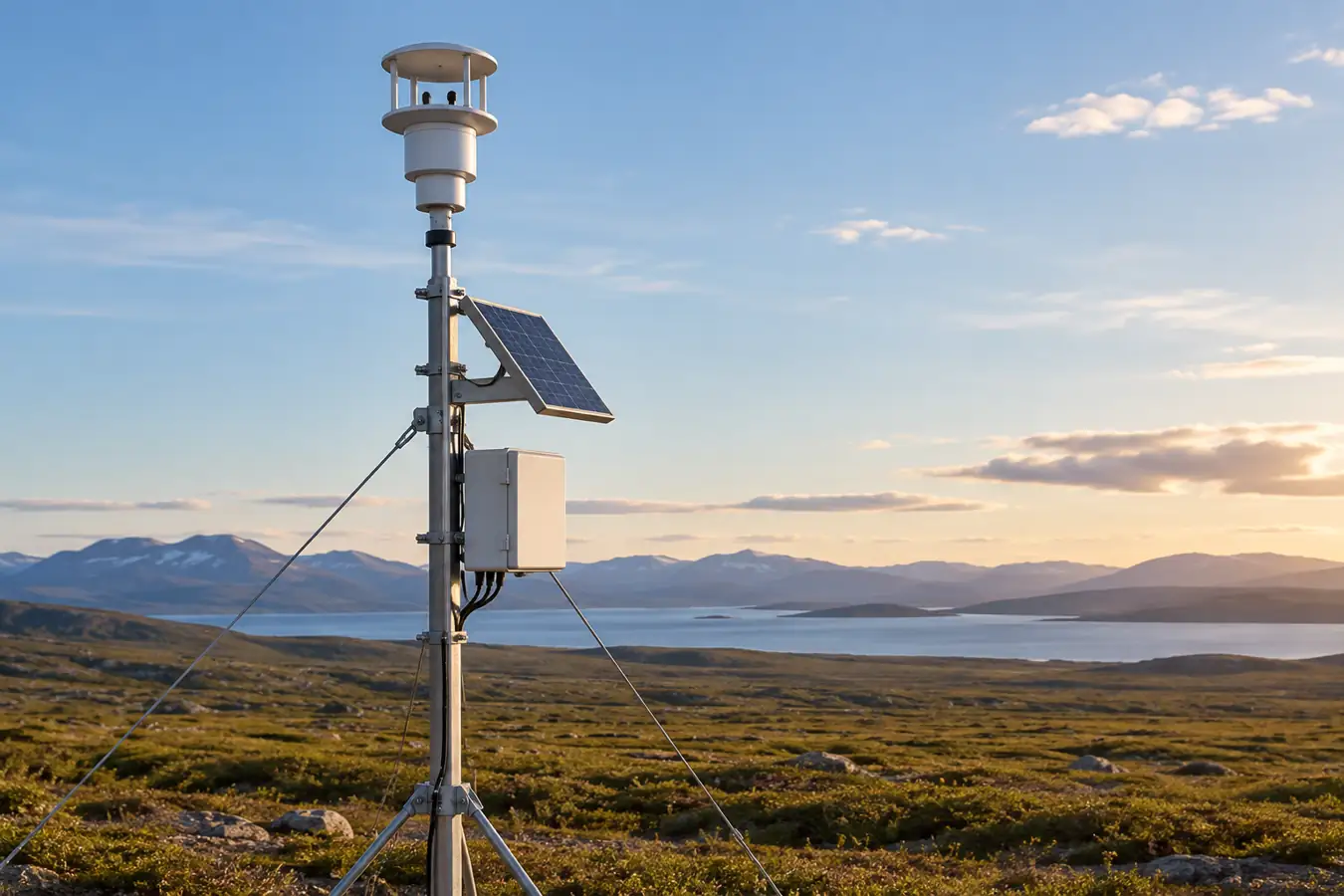
The mast and mounting arm can also produce a wake. A measurement may show direction-dependent bias when airflow passes the support before reaching the sensing path. Instrument geometry, boom orientation and prevailing wind conditions matter. Document the mast, boom, nearby obstacles and sensor position; a photograph and site sketch help future reviewers understand why a directional sector behaves differently.
这 Vaisala WM80 setup guide emphasizes unobstructed airflow and a defined alignment for that device. Its specific distances and mounting instructions belong to that model. A rooftop sensor used to control a local ventilation system may intentionally measure a different exposure from a reference meteorological station; name the intended exposure in the data record.
Alignment and direction reference
Align the sensor's reference mark to the direction required by the data system and confirm whether that reference is true north, magnetic north or a local equipment axis. Magnetic declination and nearby metal can affect a compass-based alignment. Record the alignment method, offset applied in software and any later change to the mount.
这 California Air Resources Board SOP for the RM Young 81000 describes true-north alignment for that instrument and program. Do not transfer its mounting hardware or tolerance to other devices without checking their instructions. After installation, verify that the logger applies the same convention; a correct physical alignment combined with an incorrect software offset can create a consistent direction error.
雨、雪、冰和供暖
降水会弄湿或阻碍换能器或声学路径,从而影响超声波测量。冰雪会积聚在头部和支撑物上。效果取决于仪器构造、天气和加工;声波传感器不应被描述为普遍不受雨水或结冰的影响。事件期间丢失或标记的输出可以是有用的诊断,而不是零风观察。
有些型号为传感器或其他部件提供加热功能。验证哪些表面被加热、加热器的工作条件、所需的电压和电流、控制方法和诊断输出。加热能力因型号而异,可能无法防止恶劣条件下的所有积聚。对于远程站,将加热器需求纳入功率预算、电池设计和电缆压降计算中。没有足够功率的加热器选件可能无法按预期运行。
这 University of Manchester's sonic-anemometer description 记录一些仪器的降水效应。这 KNMI评估 提供现场上下文。结合确切的设备和环境来解释两者;两者都不能提供普遍的保证。
安装、检查和验证测量链
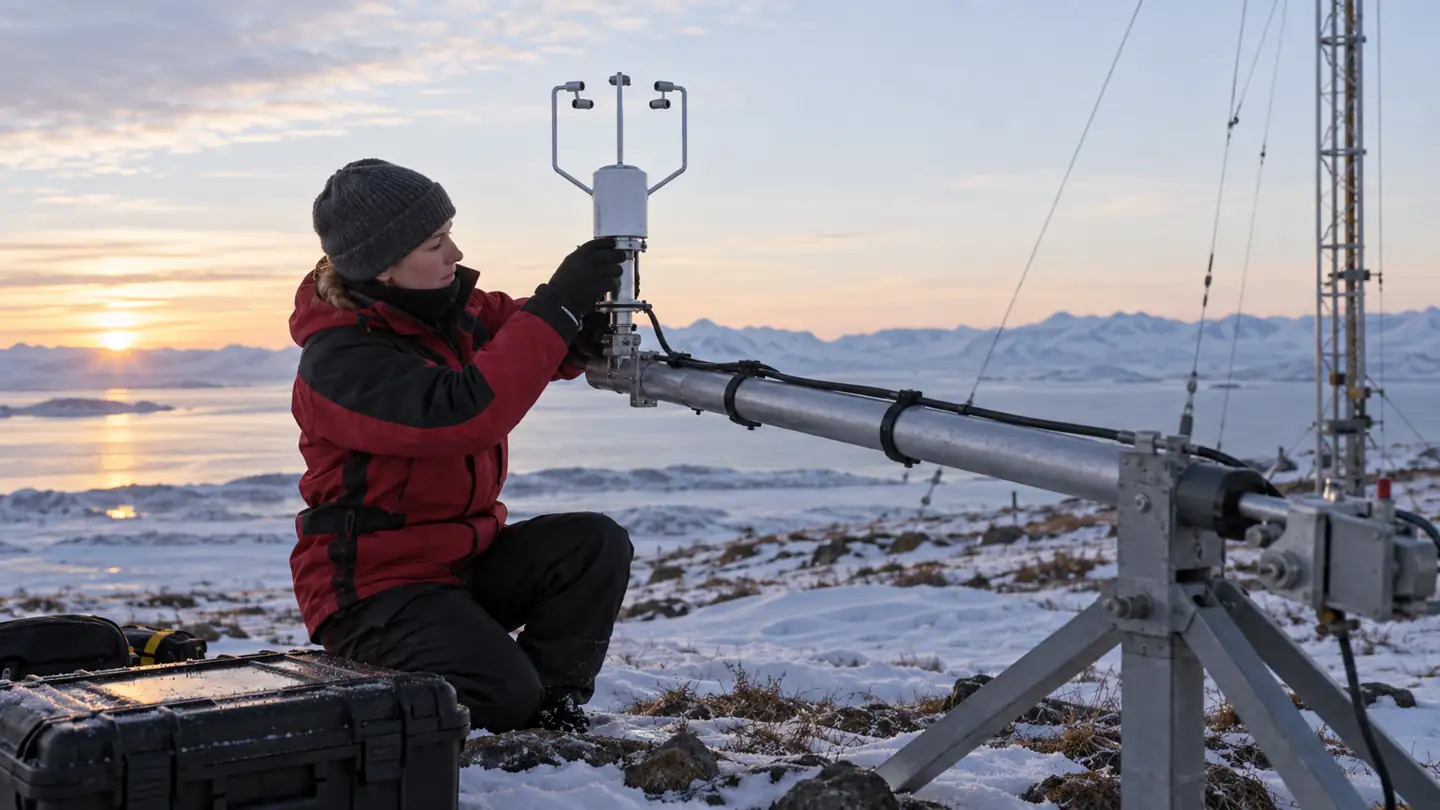
Follow the instrument manufacturer's mounting, electrical, grounding and maintenance instructions and the site's safe access procedure. Confirm the sensor's orientation, stable mounting, cable strain relief, connector protection and power supply. Ensure the mount does not block the acoustic path and that nearby equipment matches the site plan. A correct electrical connection does not establish that the wind exposure is representative.
At commissioning, record the sensor model and serial number, calibration information, installation height, coordinates, reference direction, firmware, output configuration and logger settings. Verify units and whether direction indicates wind from or wind toward. Check status flags and intentionally test how the data system displays missing or invalid inputs when this can be done safely under the system procedure.
Compare the output with a suitable reference or independent instrument when the monitoring program calls for it. Co-located sensors should observe as similar an airflow as practical without obstructing one another. Differences can arise from exposure, height, response time, averaging, alignment and calibration as well as an instrument fault. A single side-by-side reading is not enough to establish performance across all wind directions and weather.
| 观察 | Possible causes | First evidence to review |
|---|---|---|
| Direction consistently offset | Alignment, north reference, software offset or convention mismatch. | Installation record and logger configuration. |
| Zero or flat output in severe weather | True calm, iced path, power problem or invalid-value substitution. | Diagnostic flags, heater status and nearby weather observations. |
| 仅与一个风电领域存在差异 | 桅杆尾流、附近障碍物或传感器几何形状。 | 现场草图和风向相关比较。 |
| 下雨时尖峰 | 降水效应、局部湍流、电噪声或真实阵风。 | 原始数据、质量标志和参考测量。 |
| 尽管传感器有电源但仍丢失记录 | 通信、时间戳、记录器或电源中断。 | 数据和电源日志、接线和设备诊断。 |
Routine inspection should cover contamination, damaged transducers, cables, connectors, mounting and heater operation where provided. Use the manufacturer's approved cleaning method; do not scrape or apply chemicals to a transducer without checking compatibility. Record maintenance and configuration changes so a later shift in data has context.
实用的购买工作表
指定测量目的和曝光、传感器高度、2D 或 3D 要求、速度范围、方向参考和决策点的不确定性。添加所需的输出速率、平均间隔、阵风定义、通信接口、时间同步和诊断标志。描述预计的降水量、温度、结冰、供应和维护通道。
询问供应商哪些条件支持每项性能声明、如何报告无效数据以及是否包括加热。包括记录仪、加热器、安装硬件、电缆和通信的成本和功率。询问仪器如何校准以及损坏或更换后需要什么服务。比较完整的系统和数据质量,而不仅仅是传感器的主要范围。
If the decision has operational consequences, test the entire chain with the responsible system owner: sensor, configuration, communications, quality flag, display and response to missing data. The appropriate response to invalid data is an application design decision and should be documented before deployment.
Three examples of selection decisions
An open-field weather station may prioritize a documented exposure, reliable horizontal wind and a clearly defined averaging interval. The buyer should identify the station program's siting requirements, power source, direction reference and maintenance plan. An inexpensive instrument on an obstructed mast may yield less representative data than a properly sited instrument with a modest laboratory specification.
A sensor on a large structure may need to describe local conditions at a particular work area. Wind at that point can differ from wind at a nearby weather station because of sheltering or acceleration around the structure. Specify the physical location and how the local signal relates to the operational rule; do not substitute a distant station's threshold without an engineering basis.
一个研究站 may require velocity components rather than only a displayed speed and direction, along with high data availability and synchronized observations. Confirm that the selected instrument supplies the required components and diagnostic information at the necessary rate. Document coordinate transformations and calibration. More output channels are useful only when the site, processing and quality control support the question being studied.
These examples illustrate why an anemometer is selected as part of a measurement system. No single output interval, mast height or accuracy value is appropriate for every application.
Plan the data handover
Before a station changes operator, retain the site sketch, alignment method, instrument configuration, calibration records and maintenance history with the data. Note when an obstruction is built nearby or the mast is moved. A new sensor at the same nominal height may still have different exposure and response; where feasible, use an overlap period and document both instruments' averaging settings.
如果暂时移除传感器进行检查,请将产生的间隙标记为缺失。单独保留更正和原始观察结果,以便稍后的审阅者可以重建报告的结果。在原始安装程序不再可用后,这种少量的上下文通常会使长风记录变得有用。
天气事件后查看表现
After a period of rain, snow or icing, compare the instrument's status and data availability with site observations before drawing conclusions from an unusual wind trace. A low reading could reflect real sheltering or calm conditions, but it could also coincide with an obstructed path or inadequate heater power. Look for the diagnostic evidence supported by the specific device and inspect it under the site's maintenance procedure.
Keep an event log that records power interruptions, communications problems and physical observations. Where a reference instrument is available, compare aligned intervals and document each sensor's averaging and position. A temporary difference is a reason to investigate; it is not automatically proof that one model is defective or that all ultrasonic instruments respond alike.
常见问题
Does an ultrasonic wind sensor measure direction as well as speed?
Many 2D and 3D instruments calculate horizontal speed and direction from measured components. Confirm the exact output and whether direction means wind from or wind toward for the model and logger.
Is a 3D sensor always more accurate than a 2D sensor?
不会。三维输出提供额外的组件,但精度取决于仪器、条件和安装。选择测量任务所需的维度。
超声波风速计不受冰影响吗?
不会。冰和雪会影响声学路径和支撑。有些型号具有加热功能,其有效性取决于设计、功率和天气条件。
为什么当读数几乎平静时风向会跳跃?
At very low horizontal speeds, small component changes or errors can cause large calculated angle changes. Check the instrument's low-speed direction specification and use a documented calm-handling rule.
我可以将方向平均为普通数字吗?
在 0°/360° 边界附近不可靠。使用适合您想要的统计数据的记录循环或矢量方法,并在结果中保留平均间隔和数据质量规则。
经过校准的传感器能否保证具有代表性的风测量?
不。校准涉及规定条件下的性能;现场暴露、桅杆尾流、对准和数据处理仍然会使安装的读数不代表预期用途。







发表评论