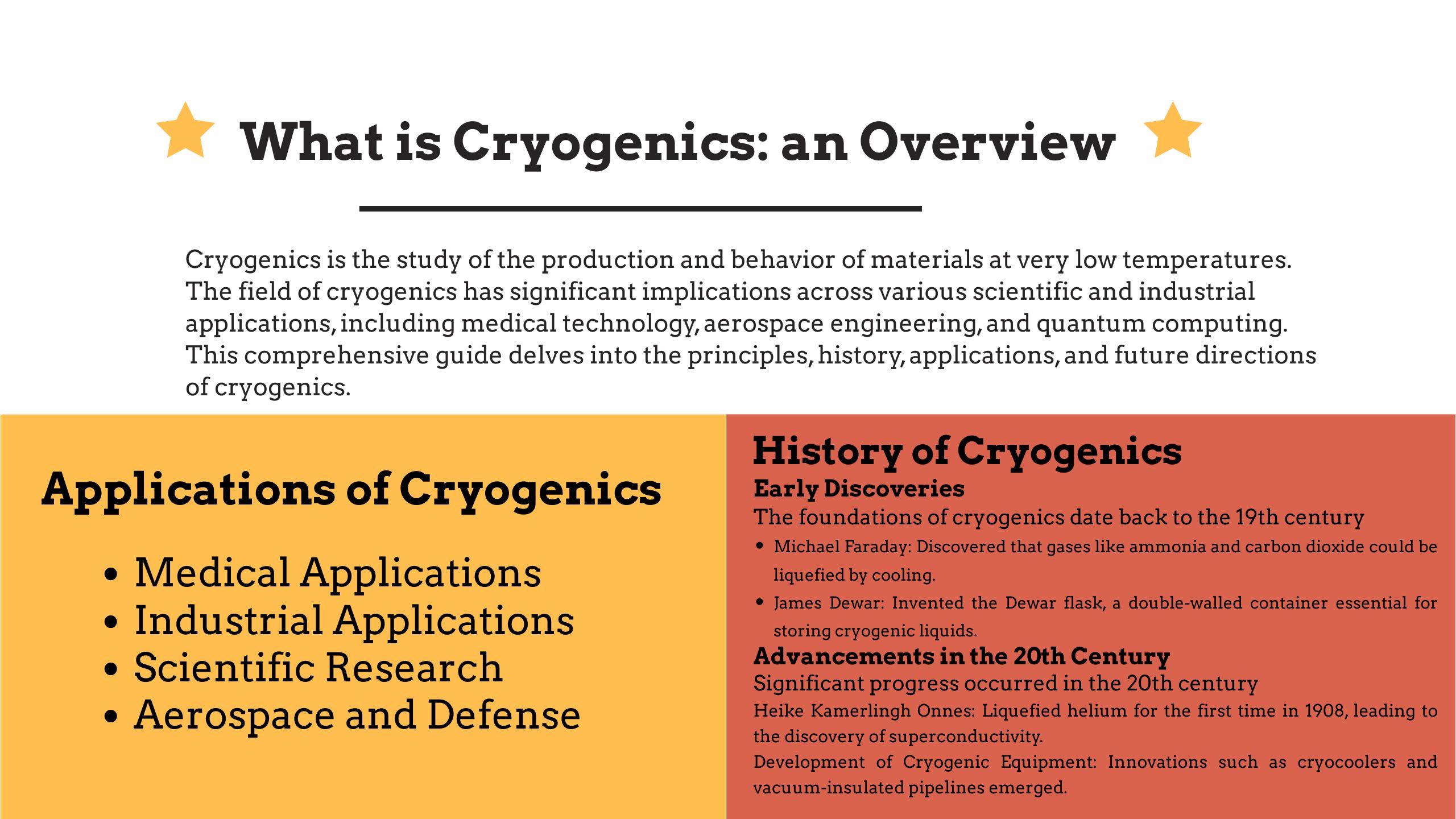
Cryogenics is the study of the production and behavior of materials at very low temperatures. The field of cryogenics has significant implications across various scientific and industrial applications, including medical technology, aerospace engineering, and quantum computing. This comprehensive guide delves into the principles, history, applications, and future directions of cryogenics.
Principles of Cryogenics
Definition of Low Temperatures
Cryogenics involves temperatures below -150°C (-238°F) or 123K. At these low temperatures, the physical properties of materials can change dramatically, leading to phenomena not observed at higher temperatures.
Thermodynamic Principles
The study of cryogenics is rooted in thermodynamics, which examines how energy transfers affect matter. Key concepts include:
- Heat Transfer: The process by which thermal energy moves from a hotter object to a colder one.
- Entropy: A measure of the disorder or randomness in a system.
- Enthalpy: The total heat content of a system.
Cooling Methods
Several methods are used to achieve cryogenic temperatures:
- Adiabatic Demagnetization: Utilizes magnetic fields to cool materials by reducing magnetic disorder.
- Joule-Thomson Effect: Involves expanding a gas to lower its temperature.
- Helium Refrigeration: Uses helium, which remains a liquid at very low temperatures, to achieve cryogenic cooling.
History of Cryogenics
Early Discoveries
The foundations of cryogenics date back to the 19th century:
- Michael Faraday: Discovered that gases like ammonia and carbon dioxide could be liquefied by cooling.
- James Dewar: Invented the Dewar flask, a double-walled container essential for storing cryogenic liquids.
Advancements in the 20th Century
Significant progress occurred in the 20th century:
- Heike Kamerlingh Onnes: Liquefied helium for the first time in 1908, leading to the discovery of superconductivity.
- Development of Cryogenic Equipment: Innovations such as cryocoolers and vacuum-insulated pipelines emerged.
Applications of Cryogenics
Medical Applications
Cryogenics plays a crucial role in modern medicine:
- Cryosurgery: Utilizes extreme cold to destroy abnormal tissues, such as tumors and warts.
- Cryopreservation: Involves freezing biological samples, such as sperm, eggs, and embryos, for future use.
- MRI Technology: Magnetic Resonance Imaging (MRI) machines use superconducting magnets cooled by liquid helium to produce high-resolution images of the body’s interior.
Industrial Applications
Industries benefit from cryogenic technology in various ways:
- Liquefied Natural Gas (LNG): Natural gas is cooled to cryogenic temperatures to facilitate transport and storage.
- Metal Processing: Cryogenic treatment enhances the durability and performance of metals and alloys.
- Food Preservation: Cryogenic freezing helps maintain the quality and freshness of food products over extended periods.
Scientific Research
Cryogenics is essential in scientific exploration:
- Particle Physics: Cryogenic temperatures are used in particle accelerators and detectors, such as the Large Hadron Collider.
- Space Exploration: Cryogenic fuels, like liquid hydrogen and oxygen, power rockets for space missions.
- Quantum Computing: Cryogenic environments are required to maintain the stability of qubits, the fundamental units of quantum computers.
Aerospace and Defense
The aerospace and defense sectors utilize cryogenics in several capacities:
- Satellite Technology: Cryogenic cooling systems ensure the proper functioning of satellite instruments.
- Infrared Sensors: Used in defense applications to detect heat signatures at great distances.
Challenges in Cryogenics
Technical Challenges
Cryogenics presents several technical challenges:
- Material Properties: Materials behave differently at cryogenic temperatures, which can complicate design and engineering.
- Thermal Insulation: Preventing heat transfer is crucial, requiring advanced insulation techniques such as multilayer insulation (MLI).
- Safety Concerns: Handling cryogenic liquids involves risks like frostbite and asphyxiation due to oxygen displacement.
Economic Considerations
The cost of cryogenic systems and maintenance can be substantial:
- High Energy Consumption: Achieving and maintaining cryogenic temperatures requires significant energy input.
- Expensive Equipment: Specialized cryogenic equipment and materials are costly.
Innovations in Cryogenics
Advanced Materials
Research into materials that perform well at cryogenic temperatures is ongoing:
- High-Temperature Superconductors: Materials that exhibit superconductivity at relatively higher temperatures reduce cooling costs.
- Cryogenic Insulation Materials: New materials that provide better thermal insulation help improve efficiency.
Cryocoolers
Developments in cryocooler technology enhance the practicality of cryogenics:
- Pulse-Tube Cryocoolers: Provide reliable and efficient cooling without moving parts, reducing maintenance needs.
- Miniature Cryocoolers: Enable cryogenic applications in portable and small-scale devices.
Quantum Technologies
Cryogenics is integral to the advancement of quantum technologies:
- Quantum Sensors: Require extremely low temperatures to achieve high sensitivity and precision.
- Quantum Communication: Cryogenically cooled systems help maintain the coherence of quantum states over long distances.
Environmental Impact
Efforts are being made to reduce the environmental impact of cryogenic technologies:
- Energy Efficiency: Innovations focus on reducing the energy consumption of cryogenic systems.
- Sustainable Practices: Implementing sustainable practices in the production and disposal of cryogenic materials.
Future Directions in Cryogenics
Space Exploration
Cryogenics will continue to be vital for space exploration:
- Deep Space Missions: Cryogenic propulsion systems and life support technologies will enable long-duration missions.
- Astrobiology: Cryogenic preservation techniques will aid in the study of extraterrestrial life forms.
Biotechnology
Advances in cryogenics will impact biotechnology:
- Regenerative Medicine: Cryopreservation of tissues and organs will support developments in regenerative medicine.
- Cryogenic Biomarkers: Cold storage of biological samples will enhance the accuracy of biomarker research.
Energy Sector
The energy sector will benefit from cryogenic innovations:
- Hydrogen Economy: Cryogenic storage and transport of hydrogen will facilitate its use as a clean energy source.
- Energy Storage: Cryogenic energy storage systems will offer efficient solutions for managing renewable energy.
Conclusion
Cryogenics is a fascinating and essential field that bridges various scientific and industrial domains. From medical applications to space exploration, the ability to achieve and manipulate extremely low temperatures opens up numerous possibilities. Despite the challenges, ongoing innovations promise to make cryogenic technologies more efficient, accessible, and sustainable. As we continue to explore the frontiers of cryogenics, its impact on our world will only grow, driving advancements in science, technology, and industry.