
Fahrenheit to Celsius Conversion: Comprehensive Guide and Tool
Temperature measurement is a vital aspect of daily life, scientific research, and industrial processes. The two most commonly used temperature scales are Fahrenheit (°F) and Celsius (°C). While Celsius is widely used across most countries and scientific applications, Fahrenheit remains the standard in the United States and a few other regions. Understanding how to convert between these scales is essential for seamless communication and accurate data interpretation.
This guide will cover the history of these scales, the conversion formula, examples, practical applications, and a detailed understanding of when and why such conversions are necessary.
The Fahrenheit Scale
The Fahrenheit scale was developed in 1724 by Daniel Gabriel Fahrenheit, a physicist, and engineer. This scale sets the freezing point of water at 32°F and the boiling point at 212°F under standard atmospheric pressure. The Fahrenheit system divides the interval between these points into 180 equal degrees, making it more granular compared to Celsius, which has 100 divisions.
In the Fahrenheit scale:
- Normal body temperature is approximately 98.6°F.
- Room temperature typically ranges from 68°F to 72°F.
The Celsius Scale
The Celsius scale, originally known as the centigrade scale, was introduced in 1742 by Anders Celsius, a Swedish astronomer. It simplifies temperature measurement by setting the freezing point of water at 0°C and the boiling point at 100°C under standard atmospheric conditions. This scale is intuitive and aligns well with the metric system.
In the Celsius scale:
- Normal body temperature is approximately 37°C.
- Room temperature is usually around 20°C to 22°C.
Why Convert Between Fahrenheit and Celsius?
Converting between Fahrenheit and Celsius is necessary in various scenarios:
- Weather Reports: Many international weather forecasts use Celsius, while the U.S. relies on Fahrenheit.
- Cooking and Recipes: Recipes often provide oven temperatures in Celsius, necessitating conversion for American kitchens.
- Scientific Research: Celsius is the standard for scientific experiments and data sharing globally.
- Travel: Travelers moving between countries with different temperature scales need a basic understanding of conversions.
The Fahrenheit to Celsius Conversion Formula
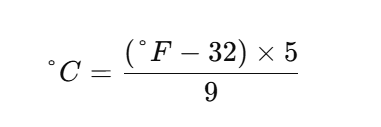
The relationship between Fahrenheit and Celsius is linear. The formula for converting Fahrenheit to Celsius is:
Step-by-Step Breakdown:
- Subtract 32 from the Fahrenheit value.
- Multiply the result by 5.
- Divide the product by 9.
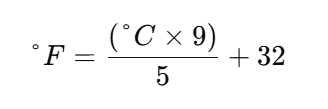
For Celsius to Fahrenheit conversion, the formula is:
Examples of Fahrenheit to Celsius Conversion
Let’s work through a few examples to better understand the process:
Example 1: Convert 68°F to Celsius

Result: 68°F is equivalent to 20°C.
Example 2: Convert 100°F to Celsius
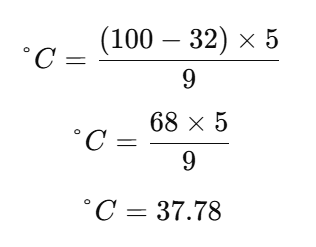
Result: 100°F is approximately 37.78°C.
Example 3: Convert -40°F to Celsius

Result: Interestingly, -40°F equals -40°C.
Fahrenheit to Celsius Conversion Table
To simplify conversions, here’s a quick reference table:
| Fahrenheit (°F) | Celsius (°C) |
|---|---|
| 32°F | 0°C |
| 50°F | 10°C |
| 68°F | 20°C |
| 86°F | 30°C |
| 104°F | 40°C |
| 122°F | 50°C |
Practical Applications of Fahrenheit to Celsius Conversion
- Weather and Climate Analysis
Meteorologists and climate scientists frequently work with data in Celsius, making conversion necessary for U.S.-based researchers or audiences. - Travel and Tourism
A traveler moving between Europe (Celsius) and the U.S. (Fahrenheit) needs conversion knowledge for interpreting weather, health advisories, or even cooking instructions. - Education and Research
Students and researchers often encounter Celsius in textbooks, making Fahrenheit-to-Celsius conversions a common task in academic settings. - Cooking and Baking
Oven temperatures in recipes from international sources often use Celsius. Understanding these conversions ensures consistent cooking results.
Tips for Quick Manual Conversions
For quick approximations:
- Subtract 30 from the Fahrenheit value and divide by 2. This method provides a rough estimate.
Example:
To convert 80°F:
80 – 30 = 50
50÷2=25°C(approx.)
Automated Fahrenheit to Celsius Conversion Tools
While manual calculation is insightful, automated tools make life easier. Many websites and apps provide real-time conversion features. Additionally, smart assistants like Alexa and Google Assistant can perform these conversions on demand.
How to Build a Fahrenheit to Celsius Conversion Tool
If you’re interested in creating your own tool, here’s a simple algorithm to follow:
- Input the Fahrenheit value.
- Apply the formula °C=(°F−32)×5/9
- Output the result in Celsius.
This tool can be implemented in any programming language or even on a WordPress-based website using custom JavaScript.
Conclusion
Understanding Fahrenheit to Celsius conversion is more than just a mathematical exercise—it bridges cultural and scientific communication gaps. Whether you’re a traveler, a student, or someone curious about temperature scales, mastering this conversion enhances your practical knowledge and adaptability.
For easy calculations, bookmark this guide or explore our online conversion tool to save time. Temperature conversions have never been so simple!