
Understanding PPM to mg/m³ Conversion: A Comprehensive Guide
In environmental science, chemistry, and engineering, converting between PPM (parts per million) and mg/m³ (milligrams per cubic meter) is essential for interpreting gas concentration data. This article dives into the definition of these units, their differences, and how to perform accurate conversions with examples. It also highlights the significance of this conversion in practical applications like air quality monitoring and industrial safety.
What is PPM (Parts Per Million)?
PPM stands for parts per million, representing the number of gas molecules per million molecules of air. It is a dimensionless unit commonly used to describe very low concentrations of substances in air, water, or other mediums.
For example:
- 1 PPM of gas means 1 molecule of the gas is present in 1 million molecules of the mixture.
What is mg/m³ (Milligrams Per Cubic Meter)?
mg/m³, or milligrams per cubic meter, is a unit of concentration in mass terms. It measures the mass of a substance (in milligrams) in a given volume of air or liquid (1 cubic meter).
For example:
- 1 mg/m³ means 1 milligram of a substance is present in 1 cubic meter of air.
The Key Difference Between PPM and mg/m³
- PPM expresses concentration as a ratio of molecules, irrespective of molecular mass.
- mg/m³ expresses concentration as mass per unit volume, influenced by the gas’s molecular weight and environmental conditions like temperature and pressure.
The Formula for PPM to mg/m³ Conversion
The conversion between PPM and mg/m³ depends on the gas’s molecular weight and environmental factors. Here’s the general formula:
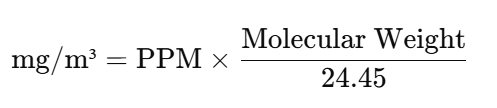
Where:
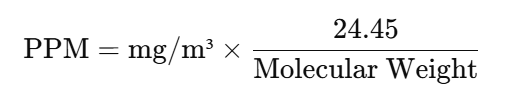
- Molecular Weight is the molar mass of the gas in grams/mole.
- 24.45 is the molar volume of air at standard temperature (25°C) and pressure (1 atm), measured in liters per mole.
How to Convert mg/m³ to PPM
The reverse conversion is given by:
Conversion Examples
Example 1: Convert 10 PPM of CO₂ to mg/m³
The molecular weight of CO₂ is 44.01 g/mol. Using the formula:
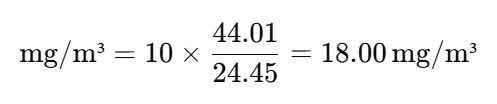
So, 10 PPM of CO₂ equals 18.00 mg/m³.
Example 2: Convert 50 mg/m³ of Ozone (O₃) to PPM
The molecular weight of O₃ is 48 g/mol. Using the formula:
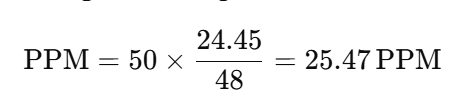
So, 50 mg/m³ of ozone equals 25.47 PPM.
Factors Affecting the Conversion
The standard conversion formula assumes:
- Temperature: 25°C
- Pressure: 1 atmosphere
If conditions differ, adjustments must be made using the Ideal Gas Law.
Practical Applications
- Air Quality Monitoring
Converting PPM to mg/m³ allows air quality professionals to assess compliance with standards like those set by the WHO or EPA, which often specify limits in mg/m³. - Industrial Safety
Workplace safety regulations frequently use mg/m³ to define exposure limits for hazardous substances. - Emission Control
PPM measurements are converted to mg/m³ to calculate pollutant loads in industrial emissions.
Using Online Conversion Tools
Online tools simplify the PPM to mg/m³ conversion process. By entering the gas’s PPM value and molecular weight, users can obtain the corresponding mg/m³ value in seconds. Such calculators are especially useful for environmental engineers and safety managers.
Conclusion
The ability to convert between PPM and mg/m³ is crucial in fields like environmental science, industrial safety, and public health. Understanding the principles behind these units and their conversion formulas ensures accurate data interpretation and compliance with regulatory standards. Whether you’re monitoring air quality, ensuring workplace safety, or studying atmospheric chemistry, this conversion bridges the gap between molecular concentration and mass-based measurements.
By mastering these calculations or using reliable online tools, professionals can make informed decisions that protect both people and the environment.