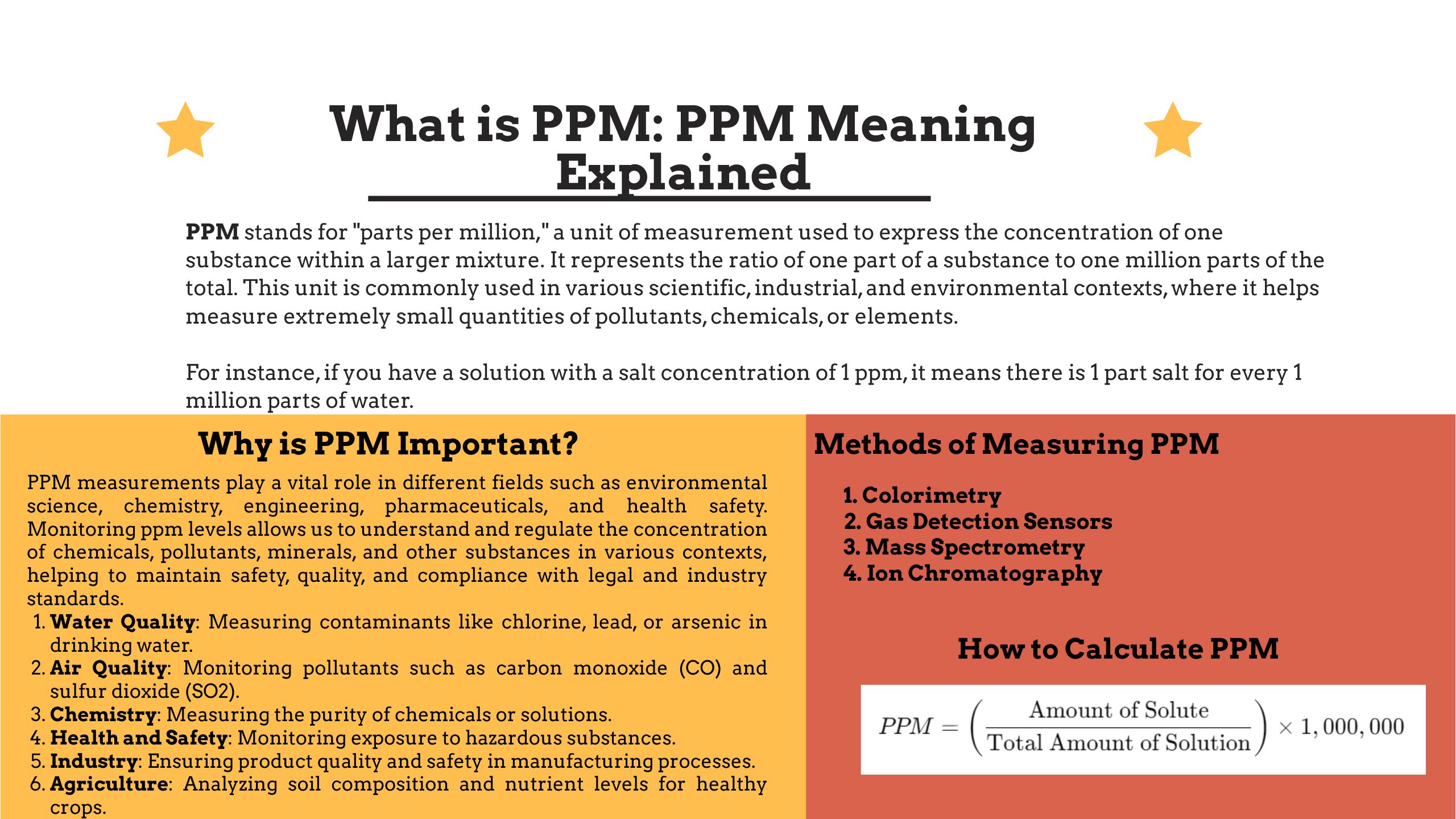
PPM stands for “parts per million,” a unit of measurement used to express the concentration of one substance within a larger mixture. It represents the ratio of one part of a substance to one million parts of the total. This unit is commonly used in various scientific, industrial, and environmental contexts, where it helps measure extremely small quantities of pollutants, chemicals, or elements.
In simple terms, ppm allows us to quantify how much of one particular substance is present within a larger substance, such as a liquid, gas, or solid. For instance, if you have a solution with a salt concentration of 1 ppm, it means there is 1 part salt for every 1 million parts of water.
Examples to Understand PPM
- 1 ppm is like adding one drop of ink into a 50-liter water tank.
- It’s equivalent to finding one second in a period of 11.5 days.
- Imagine one grain of salt in an entire sack of sugar – that’s about 1 ppm.
Why is PPM Important?
PPM measurements play a vital role in different fields such as environmental science, chemistry, engineering, pharmaceuticals, and health safety. Monitoring ppm levels allows us to understand and regulate the concentration of chemicals, pollutants, minerals, and other substances in various contexts, helping to maintain safety, quality, and compliance with legal and industry standards.
- Water Quality: Measuring contaminants like chlorine, lead, or arsenic in drinking water.
- Air Quality: Monitoring pollutants such as carbon monoxide (CO) and sulfur dioxide (SO2).
- Chemistry: Measuring the purity of chemicals or solutions.
- Health and Safety: Monitoring exposure to hazardous substances.
- Industry: Ensuring product quality and safety in manufacturing processes.
- Agriculture: Analyzing soil composition and nutrient levels for healthy crops.
By using ppm, professionals can assess whether certain concentrations are within safe or acceptable limits, ensuring compliance with environmental regulations, safety standards, and quality control guidelines.
Understanding PPM in Different Contexts
PPM is widely used in different fields, and its meaning can vary depending on the context. Let’s take a closer look at how ppm is applied in various industries:
1. PPM in Air Quality
Air quality measurements often use ppm to express the concentration of gases such as carbon dioxide (CO2), carbon monoxide (CO), sulfur dioxide (SO2), and nitrogen dioxide (NO2). For example:
- CO2 Levels: The average outdoor concentration of CO2 is about 400 ppm, but indoor levels can be higher in poorly ventilated spaces. Keeping CO2 levels below 1,000 ppm is recommended for indoor air quality.
- Carbon Monoxide (CO): CO concentrations above 9 ppm can be harmful over extended periods, while levels above 35 ppm are considered dangerous and require immediate attention.
PPM measurements are essential for ensuring that air quality is safe for human health, and regulatory agencies like the Environmental Protection Agency (EPA) use ppm values to establish air quality standards.
Related Read: Understanding Carbon Dioxide Levels: A Comprehensive Guide
2. PPM in Water Quality
Water treatment is one of the most critical applications of ppm measurements. Ensuring safe drinking water involves monitoring and adjusting the concentrations of various substances to keep them within acceptable ppm limits. This process is essential for protecting public health and preventing waterborne diseases.
Common Substances Measured in PPM in Water Treatment:
- Chlorine: Used for disinfecting water to kill bacteria and pathogens. The ideal concentration for drinking water is between 0.2 and 4 ppm. Levels above 4 ppm can lead to health risks, such as eye irritation and gastrointestinal issues.
- Fluoride: Added to water to help prevent tooth decay, with recommended levels typically between 0.7 and 1.2 ppm.
- Lead: The maximum allowable lead concentration in drinking water is 0.015 ppm (15 parts per billion). Even low levels of lead can be toxic, especially for children.
- Hardness (Calcium and Magnesium): Hard water contains high levels of calcium and magnesium, measured in ppm. A concentration above 120 ppm indicates hard water, which can cause scaling and reduce the efficiency of water heaters and plumbing.
The Role of PPM in Wastewater Treatment
PPM measurements are also crucial in wastewater treatment to remove harmful contaminants before releasing treated water back into the environment. Substances like nitrogen, phosphorus, and heavy metals must be monitored and controlled to prevent pollution and protect aquatic life.
Monitoring ppm levels in water helps protect public health by ensuring that drinking water is safe and meets quality standards.
3. PPM in Industrial Applications
PPM is widely used in industrial applications, where precise measurements ensure product quality, safety, and compliance with regulatory standards. Here are some examples:
1. Food and Beverage Industry
- Preservatives and Additives: PPM measurements help regulate the concentration of preservatives, colorants, and flavor enhancers to ensure safety and compliance with food safety regulations.
- Contaminants: Monitoring ppm levels of contaminants like pesticides or heavy metals is essential to ensure food safety.
2. Pharmaceuticals
- Drug Formulations: Accurate ppm measurements ensure the correct dosage and concentration of active ingredients in medications.
- Purity Standards: Ensuring the purity of raw materials and finished products is crucial, as even small impurities can affect drug safety and efficacy.
3. Manufacturing and Electronics
- Semiconductor Production: High-purity chemicals and gases are required in semiconductor manufacturing, and ppm measurements help maintain the necessary purity levels.
- Coatings and Paints: Monitoring ppm levels of solvents and pigments ensures consistency and quality in coatings and paints.
4. Automotive Industry
- Emissions Testing: PPM measurements are used to monitor pollutants such as CO and NOx in vehicle emissions to meet environmental standards.
- Coolants and Lubricants: Ensuring the right concentration of additives in coolants and lubricants extends engine life and improves performance.
Methods of Measuring PPM
PPM can be measured using various analytical methods, each suited for different substances and applications. The accuracy of these methods is crucial for maintaining safety and quality standards. Some common methods include:
1. Colorimetry
Colorimetry involves adding a reagent to a sample, causing a color change that corresponds to the concentration of a substance. The intensity of the color is measured using a colorimeter or spectrophotometer. This method is commonly used for measuring chlorine, fluoride, and nitrate concentrations in water.
2. Gas Detection Sensors
Gas sensors are used to detect gases like CO2, CO, and O2 in the air. These sensors measure gas concentrations in ppm and are widely used in air quality monitoring, industrial safety, and HVAC systems.
3. Mass Spectrometry
Mass spectrometry is a highly accurate technique that measures the mass-to-charge ratio of ions to identify and quantify different substances. It’s commonly used in environmental testing, pharmaceuticals, and forensic analysis.
4. Ion Chromatography
Ion chromatography separates ions and polar molecules based on their charge and size, allowing accurate measurement of various substances in ppm. It’s frequently used in water quality testing and environmental monitoring.
How to Calculate PPM
Calculating ppm is straightforward and follows a simple formula:

For example, if you have 2 grams of salt dissolved in 1,000,000 grams (1,000 liters) of water, the concentration is:

This formula shows how a small amount of a substance can be represented accurately within a larger mixture.
Maintaining Accuracy in PPM Measurements
Accuracy is essential in ppm measurements, especially when dealing with substances that can pose health risks or impact product quality. Here are some best practices for maintaining accuracy:
- Use Proper Equipment: Invest in high-quality, calibrated instruments suitable for the substance being measured.
- Follow Standard Protocols: Adhere to standard operating procedures and guidelines to ensure consistent measurements.
- Regular Calibration: Regularly calibrate measurement instruments to maintain accuracy and reliability.
- Training and Expertise: Ensure that personnel conducting measurements are adequately trained and experienced.
PPM vs. Other Units of Measurement
PPM is one of many units used to express concentrations, but how does it compare to others like percentage, parts per billion (ppb), and parts per trillion (ppt)?
- Percentage (%): Represents parts per 100. For instance, 1% is equal to 10,000 ppm.
- Parts per Billion (ppb): Represents one part per billion (1,000,000,000). There are 1,000 ppb in 1 ppm.
- Parts per Trillion (ppt): Represents one part per trillion (1,000,000,000,000). There are 1,000,000 ppt in 1 ppm.
These units are used when measuring different concentration ranges, with ppm being most appropriate for mid-range concentrations.
Real-World Examples of PPM
PPM measurements are everywhere in our daily lives, from ensuring the safety of our drinking water to monitoring indoor air quality. Here are a few real-world examples:
1. Chlorine in Swimming Pools
Maintaining the proper chlorine concentration in a swimming pool is essential for keeping the water free from harmful bacteria. The ideal chlorine level is typically between 1-3 ppm, which is sufficient to disinfect without causing irritation to the skin or eyes.
2. Air Quality and CO2 Levels
In workplaces, schools, and homes, CO2 levels are monitored to ensure proper ventilation and air quality. CO2 levels should ideally be kept below 1,000 ppm for a healthy environment. Elevated levels above 2,000 ppm can lead to discomfort, fatigue, and impaired concentration.
3. Automotive Emissions
The concentration of pollutants emitted by vehicles, such as carbon monoxide (CO) and nitrogen oxides (NOx), is measured in ppm to assess environmental impact and compliance with emissions standards.
Common Misconceptions About PPM
- PPM is Always Safe: Just because a substance is present in ppm doesn’t mean it’s safe. For example, even a low concentration of toxic gases like carbon monoxide (CO) can be hazardous to health.
- PPM is Only Used for Liquids: PPM can be used to measure concentrations in gases, liquids, and solids, making it a versatile unit of measurement.
- Higher PPM Always Means Greater Danger: The impact of a specific ppm concentration depends on the substance. While 1,000 ppm of CO2 might be harmless, 1,000 ppm of a toxic chemical could be lethal.
How PPM is Used in Environmental Monitoring
PPM is a crucial unit in environmental monitoring, helping track pollution, contamination, and chemical levels in various ecosystems. It plays a role in:
- Air Quality Index (AQI): The AQI uses ppm measurements to indicate air quality, particularly for pollutants like ozone (O3) and particulate matter.
- Water Treatment: PPM measurements are used to ensure that water treatment processes remove harmful contaminants, such as lead or arsenic, to safe levels.
- Soil Testing: Monitoring ppm levels of nutrients, minerals, or contaminants in soil helps maintain healthy agricultural practices and prevents environmental damage.
PPM in Industrial Quality Control
In industrial settings, ppm measurements are essential for maintaining product quality, ensuring safety, and complying with regulations. For example:
- Electronics Manufacturing: Maintaining a low ppm of impurities in semiconductor materials is crucial for producing high-performance microchips.
- Pharmaceutical Production: Accurate ppm measurements ensure the correct concentration of active ingredients, preservatives, and other chemicals in medications.
Why PPM Matters for Health and Safety
PPM measurements are crucial for maintaining safe environments, as they help identify potential health hazards and prevent overexposure to harmful substances. For example:
- Occupational Safety: Workers exposed to chemicals, fumes, or gases must operate within permissible ppm levels to prevent health risks.
- Indoor Air Quality: Monitoring ppm levels of CO2 and other pollutants ensures safe, healthy indoor environments, reducing the risk of respiratory issues or other health problems.
Conclusion
Understanding and measuring PPM (parts per million) is vital across multiple industries, from water treatment and environmental monitoring to industrial manufacturing and pharmaceuticals. It allows us to monitor and regulate substances at extremely low concentrations, ensuring safety, quality, and compliance with regulatory standards. Whether it’s keeping our drinking water free of contaminants, ensuring air quality, or producing high-quality products, ppm measurements play a crucial role in maintaining health, safety, and efficiency.
By accurately measuring and maintaining ppm levels, industries can protect the environment, ensure public health, and deliver products that meet the highest quality standards. Therefore, being well-versed in ppm measurements and their applications is essential for professionals in various fields, enabling them to make informed decisions and safeguard the well-being of communities and ecosystems alike.
Related Read: What is CO2 ppm? CO2 PPM Meaning Explained