
What is vibration?
Vibration is repetitive (oscillating) motion of an object back and forth around an equilibrium position.
- A motor housing shaking slightly
- A fan causing a duct to buzz
- A bridge swaying in wind
- A phone buzzing (intentional vibration)
All of these are vibration: motion that alternates direction and repeats over time.
Why vibration matters (real-world impact)
Vibration can be:
- Harmless/normal (a running motor has some vibration)
- Annoying (noise, discomfort)
- Damaging (loose bolts, cracked welds, bearing failure, fatigue)
In industrial systems, vibration is one of the most useful early indicators of:
- imbalance
- misalignment
- looseness
- bearing/gear issues
- resonance problems
Key vibration terms (the “vibration vocabulary”)
1) Amplitude (how big the vibration is)
Amplitude describes the size of the motion. Depending on what you measure, amplitude can be:
- Displacement (how far it moves) — µm, mm
- Velocity (how fast it moves) — mm/s
- Acceleration (how quickly speed changes) — m/s² or g
2) Frequency (how fast it oscillates)
Frequency is how many cycles per second, measured in Hz.
- 10 Hz = 10 cycles per second
- Higher frequency usually feels “buzzier” and can relate to certain fault types.
3) Phase (timing relationship)
Phase tells you when one vibration signal peaks relative to another.
It’s useful for diagnosing imbalance, misalignment, and multi-sensor directionality.
The 3 main ways to describe vibration (displacement vs velocity vs acceleration)
You can measure vibration as:
A) Displacement
Best for: low-frequency motion and structural movement (slow sway, looseness at low speed)
Units: µm, mm
B) Velocity
Best for: overall vibration severity in many rotating machines
Units: mm/s (often RMS)
Velocity is popular in condition monitoring because it correlates well with many common mechanical issues across a broad band.
Related: Vibration Velocity Sensors
C) Acceleration
Best for: higher-frequency events like bearing defects and impacts
Units: m/s² or g
Acceleration sensors (accelerometers) are extremely common because they’re compact, wide-band, and versatile.
Types of vibration (how engineers classify it)
1) Free vibration vs forced vibration
- Free vibration: a system vibrates after being disturbed (like a spring you pull and release)
- Forced vibration: continuous input causes vibration (motor rotation, gear mesh, airflow turbulence)
2) Damped vs undamped vibration
- Damped: vibration gradually reduces (real-world systems)
- Undamped: vibration continues forever (ideal model)
3) Periodic vs random vibration
- Periodic: repeats predictably (rotating machines)
- Random: unpredictable, broad-spectrum (turbulence, road vibration)
4) Resonance (the “amplifier” effect)
Resonance occurs when forcing frequency matches a system’s natural frequency, causing vibration amplitude to rise dramatically.
This is why a machine can seem “fine” at one speed but vibrate heavily at another.
Common causes of vibration in machines
Rotating equipment (motors, fans, pumps, gearboxes)
- Imbalance (mass not centered)
- Misalignment (shafts not collinear)
- Looseness (mounts, bolts, base, bearings)
- Bearing damage (wear, pitting)
- Gear issues (tooth wear, mesh problems)
- Bent shaft or eccentricity
- Electrical issues (motor electromagnetic forces)
Structures and pipelines
- Flow-induced vibration (air/liquid turbulence)
- Weak supports or poorly braced frames
- Resonance of ducts, pipes, panels
How vibration is measured (practical overview)
1) Sensors (most common)
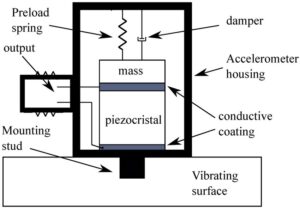
- Accelerometers (measure acceleration)
- Velocity sensors / velocity transducers (measure vibration velocity directly)
- Displacement sensors (eddy current probes, LVDT, laser)
2) What instruments do with the signal
- Show time waveform (how vibration changes over time)
- Compute RMS / peak / peak-to-peak
- Convert to frequency domain using FFT (find dominant frequencies)
- Trend changes over weeks/months for predictive maintenance
Vibration units and common metrics
Common units
- Displacement: µm, mm
- Velocity: mm/s
- Acceleration: m/s² or g (1 g ≈ 9.81 m/s²)
unitsconvert: https://quickconver.com/category/length-converter/
Common metrics
- RMS: stable indicator of overall energy (very common)
- Peak: captures maximum excursion
- Peak-to-peak: often used for displacement-type measurements
Vibration vs noise (they’re related, not identical)
- Vibration is mechanical motion
- Noise is pressure variation in air
Vibration often causes noise (structures radiate sound), and reducing vibration commonly reduces noise.
How to reduce vibration (high-level methods)
- Balance rotating parts
- Align shafts properly
- Tighten mounts / improve base stiffness
- Replace worn bearings/gears
- Add damping material or isolators
- Change operating speed to avoid resonance
- Redesign structure (stiffen, brace, add mass, change natural frequency)
FAQ: What is vibration?
1) Is all vibration a problem?
No. Many machines have normal baseline vibration. The key is trend change, abnormal frequency components, or rising overall severity.
2) What’s the simplest way to monitor vibration in industry?
A common approach is an accelerometer feeding a vibration monitor that calculates RMS and trends it over time (often with alarms).
3) Why do engineers use vibration velocity (mm/s) so often?
Velocity is often a strong general indicator of rotating-machine health and is widely used for overall vibration severity trending.
4) What is resonance in simple terms?
Resonance is when a system is “pushed” at its natural frequency, causing vibration to grow much larger—like pushing a swing at the right timing.
Portable vs Fixed Refrigerant Detection: How Their Jobs Differ
Compare handheld leak locators, fixed-point monitors and aspirating systems by sample location, response chain and commissioning needs.
Read More
Refrigerant Identification vs Concentration Measurement: Which Test Do You Need?
Distinguish a sealed-charge identifier from ambient concentration monitoring, handheld leak location and formal refrigerant purity testing.
Read More
How Humidity Affects Optical PM2.5 Sensor Readings
Learn why humidity, water uptake, fog and condensation can affect optical PM2.5 estimates and how to investigate and validate a humid-air spike.
Read More
How to Interpret CO2 Readings in a Vehicle Cabin
Read vehicle-cabin CO2 trends alongside passengers, HVAC mode and route conditions while separating ventilation clues from particle and exhaust safety questions.
Read More
Gas Heater Monitoring at Home: Which Alarm and Sensor Does What?
Understand the separate roles of a household CO alarm, fuel-gas detector, CO2 monitor and qualified heater service, including what to do after a warning.
Read More
How to Plan IAQ Monitoring in Shared Indoor Spaces
Plan indoor-air-quality monitoring for libraries, waiting areas and shared rooms by matching CO2, particles and other channels to a defined decision.
Read More