
PPB to PPM Conversion: Everything You Need to Know
In various scientific, industrial, and environmental disciplines, accurate concentration measurement plays a critical role. Units such as PPB (Parts Per Billion) and PPM (Parts Per Million) are commonly used to describe the concentration of substances. Converting between these units is often necessary, especially when dealing with varying scales of measurements.
This article provides a detailed guide on PPB to PPM conversion, the significance of these units, real-world applications, and easy-to-follow conversion methods. Whether you’re a scientist, engineer, or enthusiast, this guide will equip you with all the information you need.
What Is PPB (Parts Per Billion)?
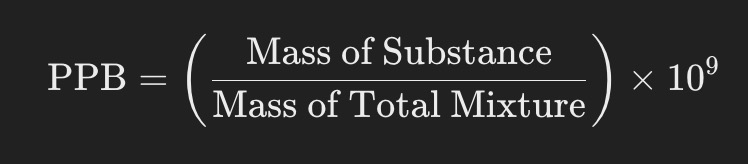
PPB stands for Parts Per Billion, a unit that expresses the concentration of one part of a substance in a billion parts of a mixture. This unit is often used for measuring extremely low concentrations, particularly in environmental studies, medical diagnostics, and chemistry.
Examples of PPB Usage:
- Measuring trace amounts of pollutants in air or water.
- Detecting ultra-low levels of chemicals in food and beverages.
- Monitoring contaminants in pharmaceuticals.
Formula for PPB:
What Is PPM (Parts Per Million)?
PPM stands for Parts Per Million, a unit used to describe the concentration of one part of a substance in a million parts of a mixture. PPM is ideal for slightly higher concentrations compared to PPB but still represents very small quantities.
Examples of PPM Usage:
- Measuring CO2 levels in the atmosphere.
- Determining the concentration of dissolved salts in water.
- Assessing chemical levels in industrial processes.
Formula for PPM:

Key Difference Between PPB and PPM
The fundamental difference between PPB and PPM lies in the scale. PPB is used for ultra-low concentrations, whereas PPM is used for higher concentrations within the same context.
- 1 PPM = 1,000 PPB
- PPB is suitable for detecting minute traces of substances, while PPM is used when the concentrations are relatively higher but still small compared to percentages.
How to Convert PPB to PPM
Converting PPB to PPM is straightforward and involves dividing the PPB value by 1000. This relationship exists because one million parts is 1000 times smaller than one billion parts.
Conversion Formula:
PPM=PPB / 1000
Examples of PPB to PPM Conversion:
- 5000 PPB to PPM:PPM=5000/1000=5PPM
- 200 PPB to PPM:PPM=200/1000=0.2PPM
- 1,000,000 PPB to PPM:PPM=1,000,000/1000=1000PPM
Why Is PPB to PPM Conversion Important?
1. Environmental Monitoring
Accurate reporting of pollutant levels in air, water, and soil is critical for regulatory compliance. While PPB is often used to detect trace pollutants, PPM may be required for certain reports or comparisons.
2. Chemical and Industrial Applications
In chemical manufacturing, understanding the concentration of additives, impurities, or contaminants at different scales is vital. PPB to PPM conversions help ensure precision in processes and quality control.
3. Medical Diagnostics
Medical tests, such as detecting trace gases in breath analysis or chemicals in blood, may report results in PPB. For ease of interpretation or comparison with other measurements, these values are often converted to PPM.
4. Scientific Research
Research involving nanotechnology, biochemistry, or material science often deals with minute concentrations. Converting between PPB and PPM ensures consistency in experimental results and publications.
Tools for PPB to PPM Conversion
1. Online Calculators
Numerous websites offer free PPB to PPM converters. These tools allow users to input a PPB value and instantly get the corresponding PPM value.
2. Mobile Apps
Apps designed for engineers, scientists, and environmentalists often include PPB to PPM conversion functionalities alongside other unit conversions.
3. Excel Formulas
Excel provides a simple platform to perform batch conversions using formulas like =A1/1000, where A1 contains the PPB value.
4. Manual Calculation
For quick conversions, simply divide the PPB value by 1000. This method is useful when calculators or apps aren’t readily available.
Applications of PPB and PPM in Real-World Scenarios
1. Air Quality Monitoring
- PPB: Ozone (O₃) is often measured in PPB due to its low concentration.
- PPM: Carbon dioxide (CO₂) is usually reported in PPM as its concentration is higher.
2. Water Quality Analysis
- PPB: Detecting trace metals like mercury or lead.
- PPM: Measuring dissolved oxygen or chlorine levels in water.
3. Food and Beverage Industry
- PPB: Tracing pesticide residues in fruits or vegetables.
- PPM: Checking the salt content in processed foods.
4. Medical Testing
- PPB: Measuring volatile organic compounds (VOCs) in exhaled breath for disease diagnostics.
- PPM: Monitoring oxygen levels in medical gases.
Common Misconceptions About PPB and PPM
- “PPB is more accurate than PPM.”
- Accuracy depends on the measuring instrument, not the unit. PPB simply represents smaller quantities.
- “PPB and PPM are interchangeable.”
- While they are related, they represent vastly different scales and should not be confused.
- “PPM is sufficient for all measurements.”
- In ultra-low concentration scenarios, PPM may not provide the granularity needed.
PPB to PPM Conversion Chart
For quick reference, here’s a conversion chart:
| PPB Value | PPM Value |
|---|---|
| 1,000 PPB | 1 PPM |
| 5,000 PPB | 5 PPM |
| 10,000 PPB | 10 PPM |
| 100,000 PPB | 100 PPM |
| 1,000,000 PPB | 1,000 PPM |
SEO Tips for PPB to PPM Content
If you’re creating content around PPB to PPM, consider the following:
- Use keywords like “PPB to PPM conversion”, “PPB to PPM formula”, “Parts Per Billion to Parts Per Million”.
- Structure content with headings, bullet points, and tables for readability.
- Include real-life examples and applications for better user engagement.
- Offer downloadable tools or resources for added value.
Conclusion
Understanding and performing PPB to PPM conversions is essential across a wide range of scientific and industrial applications. Whether you’re monitoring environmental pollutants, ensuring quality in manufacturing, or conducting scientific research, the ability to switch between these units is critical for accuracy and compliance.
With straightforward formulas, user-friendly tools, and real-world applications, PPB to PPM conversions are easy to grasp and apply. By mastering these conversions, you can enhance your efficiency, ensure precision, and contribute to better decision-making in your field.