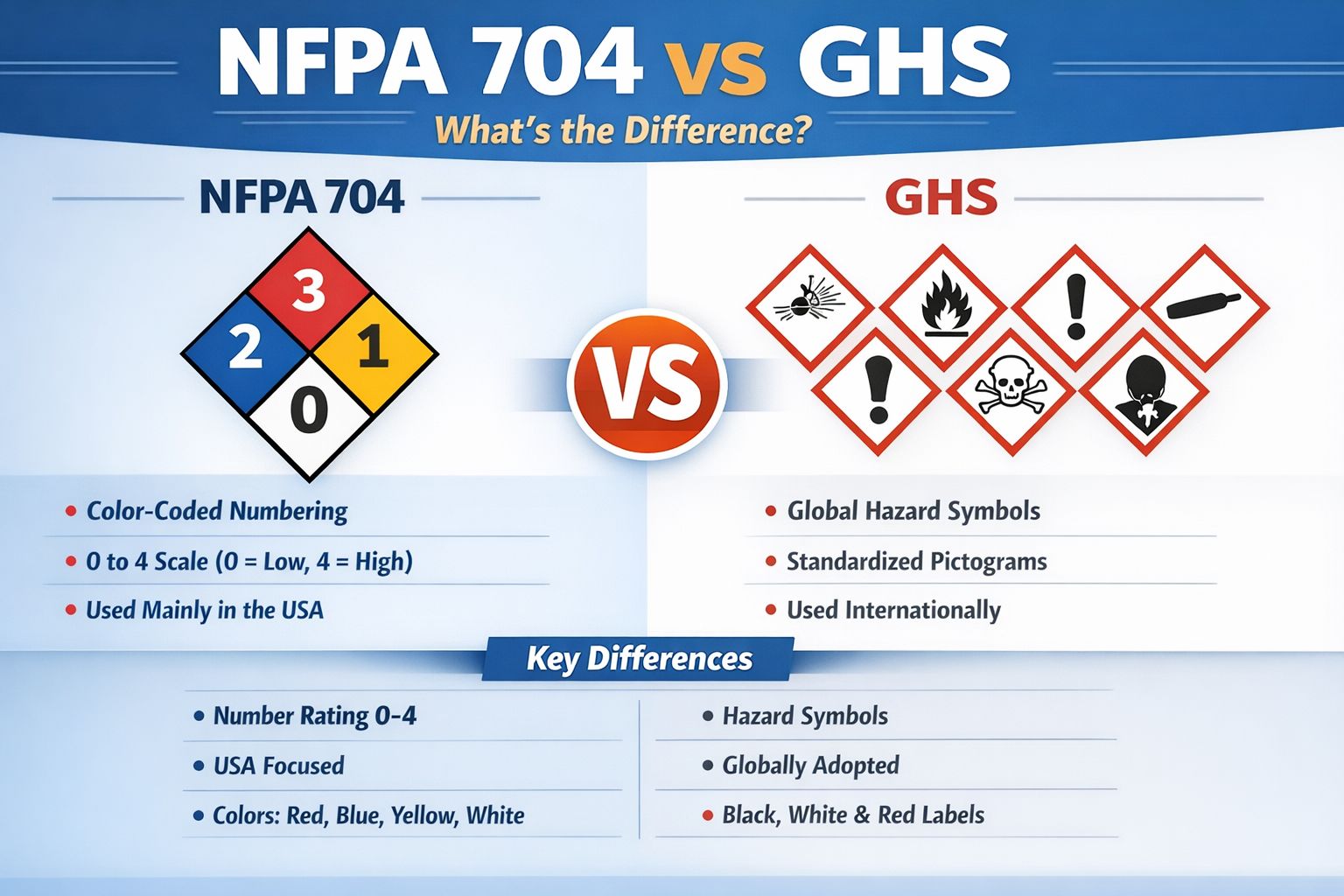
NFPA 704 and GHS are both used to communicate chemical hazards, but they are not the same system and they were not designed for the same purpose. OSHA’s official comparison says NFPA 704 is intended to provide basic information for emergency personnel responding to a fire or spill and for those planning emergency response, while HazCom/GHS is intended to inform workers about chemical hazards under normal conditions of use and foreseeable emergencies.
That distinction is the foundation of the entire topic. If someone asks “NFPA 704 vs GHS,” the most important answer is this: NFPA 704 is an emergency-response hazard rating system, while GHS is a hazard classification and communication system used through OSHA HazCom labels and safety data sheets. OSHA also states that its Hazard Communication Standard is aligned with the Globally Harmonized System of Classification and Labeling of Chemicals.
What Is NFPA 704?
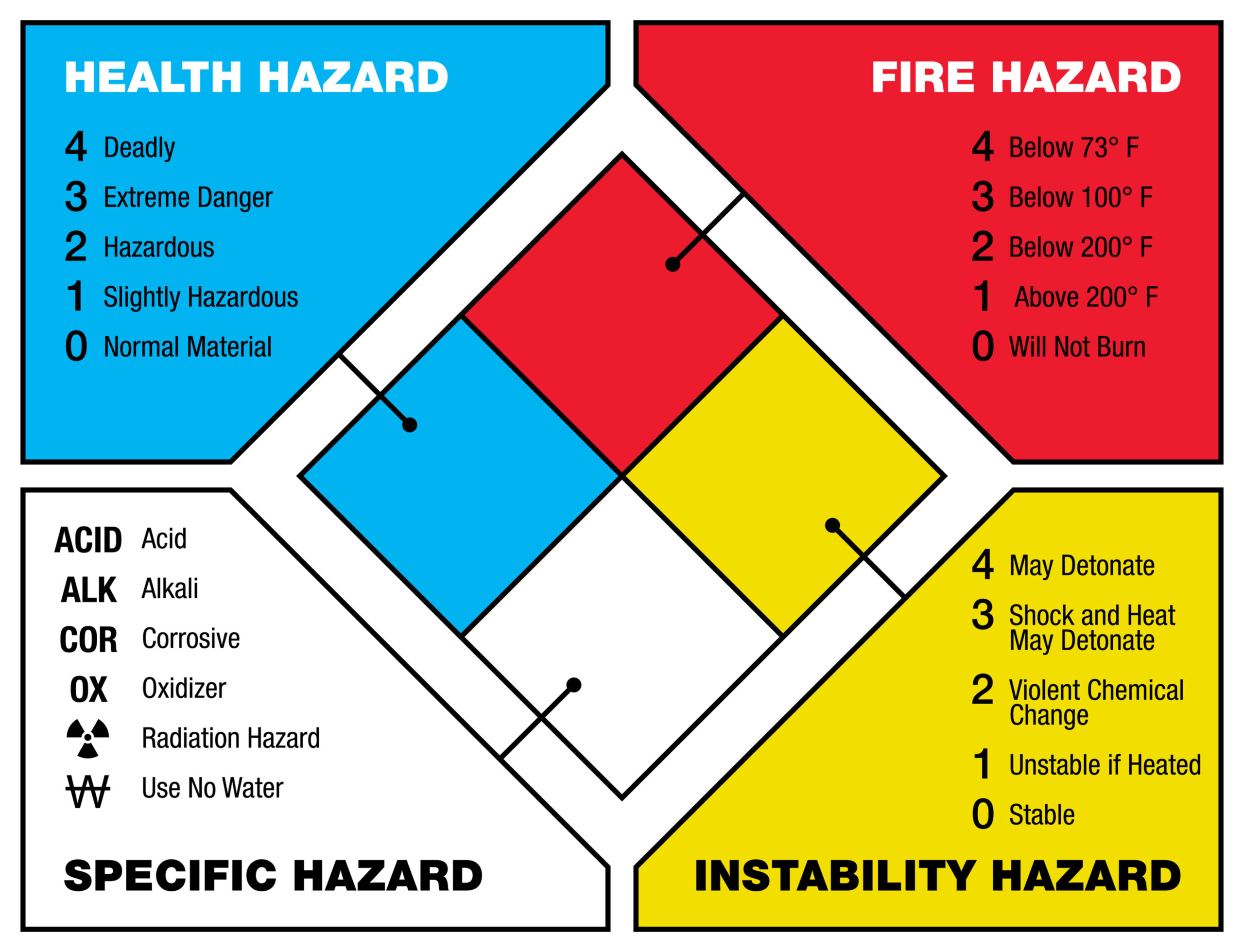
NFPA 704 is the well-known hazard diamond or fire diamond. It uses four color-coded quadrants to communicate hazard severity at a glance: blue for health, red for flammability, yellow for instability, and white for special hazards. OSHA’s comparison card also notes that the white section may include symbols such as OX for oxidizers, W for water reactives, and SA for simple asphyxiants.
NFPA describes the system as a simple and easily understood marking system for identifying the specific hazards of a material and the severity of the hazard. That is why NFPA 704 is commonly posted on tanks, storage areas, doors, and facility placards where emergency responders may need fast hazard recognition.
More About NFPA 704: https://sensor1stop.com/knowledge/nfpa-704/
What Is GHS?
GHS stands for the Globally Harmonized System of Classification and Labeling of Chemicals. In the United States, OSHA’s Hazard Communication Standard is aligned with GHS, and OSHA explains that the purpose of this alignment is to create a common and coherent approach to classifying chemicals and communicating hazard information on labels and safety data sheets.
Under OSHA HazCom, shipped containers of hazardous chemicals must include standardized label elements such as the product identifier, signal word, hazard statements, precautionary statements, pictograms, and supplier identification. OSHA’s label guidance and Appendix C make these required elements explicit.
The Core Difference: Rating vs Classification
One of the most important differences between NFPA 704 and GHS is that they use different systems for different jobs. OSHA’s comparison card explains that NFPA uses a rating system, while HazCom/GHS uses a classification system. The GHS hazard category numbers are used to determine which label elements apply, but those category numbers are not required on labels and are instead required in Section 2 of the SDS.
This leads directly to one of the biggest sources of confusion: the numbers go in opposite directions. OSHA states that in NFPA 704, 0 means least hazardous and 4 means most hazardous, while in the HazCom/GHS classification system, 1 means most severe hazard and 4 means least severe hazard.
Because of that difference, OSHA explicitly warns that the hazard category numbers found in Section 2 of HazCom-compliant SDSs are NOT to be used to fill in the NFPA 704 diamond. This is one of the most important practical points in any NFPA 704 vs GHS article.
NFPA 704 Focuses on Emergency Response
OSHA’s official comparison says NFPA 704 is primarily intended for emergency response applications, especially situations such as fires and spills. The health portion of NFPA 704 focuses on acute, short-term health hazards, and OSHA’s comparison specifically states that chronic health effects are not covered by NFPA 704.
This emergency focus is also why the NFPA diamond is so simple. It is designed to help responders quickly understand the degree of hazard, rather than to provide full worker-facing instructions or a complete legal hazard communication framework. NFPA’s public description of the hazard diamond emphasizes that it is meant to provide a simple, readily recognized, and easily understood system.
GHS Covers Workplace Hazard Communication More Broadly
By contrast, OSHA’s comparison says HazCom/GHS addresses both acute and chronic health hazards, because employees may work with chemicals day after day under normal use conditions as well as foreseeable emergencies. OSHA’s overview also stresses that manufacturers and importers must classify hazards and communicate them through harmonized labels and SDSs.
This is why GHS-style labels contain more detailed communication elements than the NFPA diamond. OSHA requires the label for each classified hazardous chemical to include the signal word, hazard statements, pictograms, and precautionary statements, and shipped-container labels must also include the product identifier and manufacturer/importer/responsible party contact information.
Label Design: Diamond vs Pictograms and Statements
Another major difference is visual format. NFPA 704 uses a single diamond-style placard with numeric ratings and optional special-hazard symbols. GHS/OSHA HazCom labels use pictograms, signal words, hazard statements, and precautionary statements rather than a simple 0–4 hazard diamond.
OSHA Appendix C specifies that GHS pictograms are displayed as a square set at a point with a black symbol on a white background and a red frame, and it also states that the label must carry the required signal word and statements associated with each hazard class and category.
So although both systems may appear diamond-like at a glance, they should not be confused. The NFPA diamond is a hazard rating placard, while the GHS pictogram frame is part of a broader standardized label system.
Shipped Containers vs Workplace Containers
A practical compliance difference is where and how each system is used. OSHA requires shipped containers to carry the OSHA/HazCom label elements described above. That means a shipped hazardous chemical container must be labeled with the required GHS-aligned information.
For workplace containers, OSHA allows more flexibility. In its FAQ, OSHA states that employers may use alternative systems such as NFPA 704 or HMIS for workplace containers, as long as those labels provide at least general hazard information, do not conflict with the HCS-required warnings or pictograms for the chemical, and employees are trained to understand them.
This is an important reason both systems are often seen in the same facility. A chemical may arrive with a GHS/HazCom-compliant shipped-container label, while the facility may also use NFPA 704 placards on storage areas or workplace containers for emergency recognition.
Why the Numbers Cause So Much Confusion
The numbering issue is one of the biggest reasons people search for “NFPA 704 vs GHS.” In many safety topics, people assume higher numbers always mean greater danger. That is true for NFPA 704, where 4 is most hazardous, but not for GHS categories, where Category 1 is generally the most severe and higher category numbers are usually less severe within that hazard class. OSHA’s comparison card spells this out directly.
That is why copying “Flammable Gas Category 1” from SDS Section 2 into the red NFPA quadrant would be a mistake. OSHA’s comparison guide shows that GHS categories are used to determine the required GHS label information, while NFPA 704 ratings must be derived using the NFPA 704 criteria and appropriate SDS sections.
Can NFPA 704 and GHS Be Used Together?
Yes, but they must be used correctly. OSHA says NFPA 704 and HMIS are permitted as alternative workplace labeling systems, and NFPA/HMIS information may also appear on SDSs if it does not contradict or cast doubt on the Hazard Communication classification. OSHA also says that hazard warnings or pictograms that conflict with the required HCS information may not appear on workplace labels.
So the right way to think about the relationship is not “NFPA 704 or GHS.” In many workplaces, it is NFPA 704 for rapid emergency-response awareness and GHS/HazCom for classification, labeling, SDS communication, and worker protection.
Common Mistakes in NFPA 704 vs GHS
A common mistake is assuming the two systems are interchangeable. They are not. OSHA says clearly that they were developed for different purposes.
Another common mistake is using SDS Section 2 hazard category numbers to populate the NFPA 704 diamond. OSHA explicitly says not to do this.
A third mistake is believing NFPA 704 covers the same health-hazard scope as GHS. It does not. OSHA says NFPA 704 addresses acute short-term health hazards only, while HazCom/GHS includes both acute and chronic health effects relevant to employee exposure.
Which One Is More Important?
Neither system replaces the other. For emergency responders arriving at a fire, spill, or release scene, the NFPA 704 diamond can provide extremely fast hazard recognition. For day-to-day chemical management, shipped-container compliance, SDS communication, and employee training, GHS/HazCom provides the broader and more detailed communication framework.
That is why the best safety and SEO explanation is not to frame them as competitors, but as different tools serving different communication needs.
Conclusion
NFPA 704 and GHS both communicate chemical hazards, but they do so in fundamentally different ways. NFPA 704 is a numeric emergency-response hazard rating system, while GHS is a classification-based labeling and SDS communication system used through OSHA HazCom.
The most important practical takeaway is simple: do not treat GHS category numbers as NFPA ratings. NFPA runs from 0 to 4, with 4 most hazardous, while GHS categories generally run from 1 to 4, with 1 most severe. OSHA’s comparison materials make this difference explicit, and that single point prevents many real-world labeling mistakes.
FAQ
Is NFPA 704 the same as GHS?
No. OSHA states that NFPA 704 and HazCom/GHS were developed for different purposes. NFPA 704 is for emergency-response hazard recognition, while GHS/HazCom is for chemical classification and worker-facing hazard communication through labels and SDSs.
What is the main difference between NFPA 704 and GHS?
The main difference is purpose. NFPA 704 provides fast emergency-response information, while GHS provides a broader hazard classification and labeling framework for workplace communication.
Why are NFPA 704 and GHS numbers different?
OSHA explains that NFPA uses a rating system where 0 is least hazardous and 4 is most hazardous, while GHS categories use a classification system where 1 is the most severe hazard and 4 is the least severe within the category structure shown in OSHA’s comparison.
Can I use GHS category numbers in an NFPA diamond?
No. OSHA explicitly says the hazard category numbers in Section 2 of HazCom-compliant SDSs are not to be used to fill in the NFPA 704 diamond.
Does NFPA 704 include chronic health hazards?
OSHA’s comparison says NFPA 704 covers acute short-term health hazards only and does not cover chronic health effects in the same way HazCom/GHS does.
Can NFPA 704 still be used in a GHS workplace?
Yes. OSHA says alternative systems such as NFPA 704 may be used for workplace containers as long as they provide general hazard information, do not conflict with required HCS warnings or pictograms, and employees are trained to understand them.
What must appear on a GHS/OSHA label?
OSHA requires labels for classified hazardous chemicals to include the product identifier, signal word, hazard statements, pictograms, precautionary statements, and supplier identification on shipped containers.
What do NFPA 704 white-section symbols mean?
OSHA’s comparison card lists examples including OX for oxidizers, W for water reactives, and SA for simple asphyxiants.