

Breathing near a CO2 sensor can make its reading rise, but it cannot verify accuracy because the concentration at the sensing cell is unknown. Exhaled gas mixes with room air while temperature, humidity, flow and sometimes pressure change together. A rising number establishes a limited response observation, not agreement with a known reference.
Accuracy needs a defined comparison: a reference value with suitable uncertainty, a representative sample at the sensor and conditions consistent with the instrument's specification. Breath supplies none of those automatically. Even a plausible peak can come from a mixture that changes faster than a room-air monitor can follow.

Conceptual room placement: direct breath is a local disturbance. A room monitor should represent its intended sampling location.
What does a rising CO2 reading actually establish?
A rising reading can show that the displayed measurement responds to a changed local environment. Depending on the instrument, it may also support a limited observation about gas access or the electronic signal chain. It does not identify the true concentration or the size of the measurement error.
Several distinct claims are often compressed into the word works. A device can respond, repeat a similar pattern and agree with a second device while both remain biased. It can also be accurate after stabilization but respond too slowly for a different intended task.
| Claim | 証拠が必要です | What an unknown breath plume cannot supply |
|---|---|---|
| The display changes | An observed change associated with a disturbance | Proof that the change has the right magnitude |
| The sensor responds to CO2 | Appropriate technology and a controlled gas response | Isolation from humidity or other simultaneous effects |
| The instrument is repeatable | Repeated measurements under equivalent known conditions | A reproducible unknown plume |
| Two instruments agree | Common sample, timing and condition comparison | An independent true value |
| The instrument is accurate | Suitable reference, uncertainty and specified conditions | Known cell concentration |
| A calibration adjustment is justified | Documented reference and supported procedure | A defensible calibration target |
This separation prevents a useful observation from becoming an unsupported claim. If the purpose is simply to investigate whether a device is frozen, an observed response may be relevant. If the purpose is to certify concentration accuracy, the evidence must be stronger and differently structured.
For a safety instrument, any required functional check or calibration is defined by its supported procedure and applicable use. An informal breath response should not be relabeled as a compliant bump test, alarm verification or calibration.
Why isn't exhaled CO2 a known reference?
Exhaled gas varies over a breath and between conditions. More importantly, the concentration at a nearby room sensor is not the concentration at the mouth. Mixing begins immediately, and the instrument samples only a portion of the moving plume.
Distance, direction, room currents, enclosure openings and diffusion paths all affect how much exhaled gas reaches the cell. A person cannot infer the local mixing fraction from the visible position of the monitor. A small change in air motion can produce a different peak without any instrument fault.
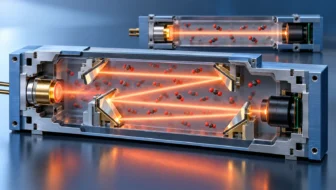
The sensing chamber adds another stage. A room monitor may exchange gas through a protective grille and an internal volume. The gas outside the grille can change before the gas inside the cell follows. The display is therefore not a direct instantaneous measurement of the plume outside the enclosure.
A quoted typical breath concentration cannot solve this problem. Even if the source concentration were known, the dilution fraction at the cell would still be unknown. A reference needs the condition actually presented to the measurement, not merely an estimated source value.
A clinical breath analyzer is a different application. Such instruments use defined sampling methods, measurement dynamics and clinical validation. The fact that specialized equipment can analyze breath does not make breath a calibration material for a room-air monitor.
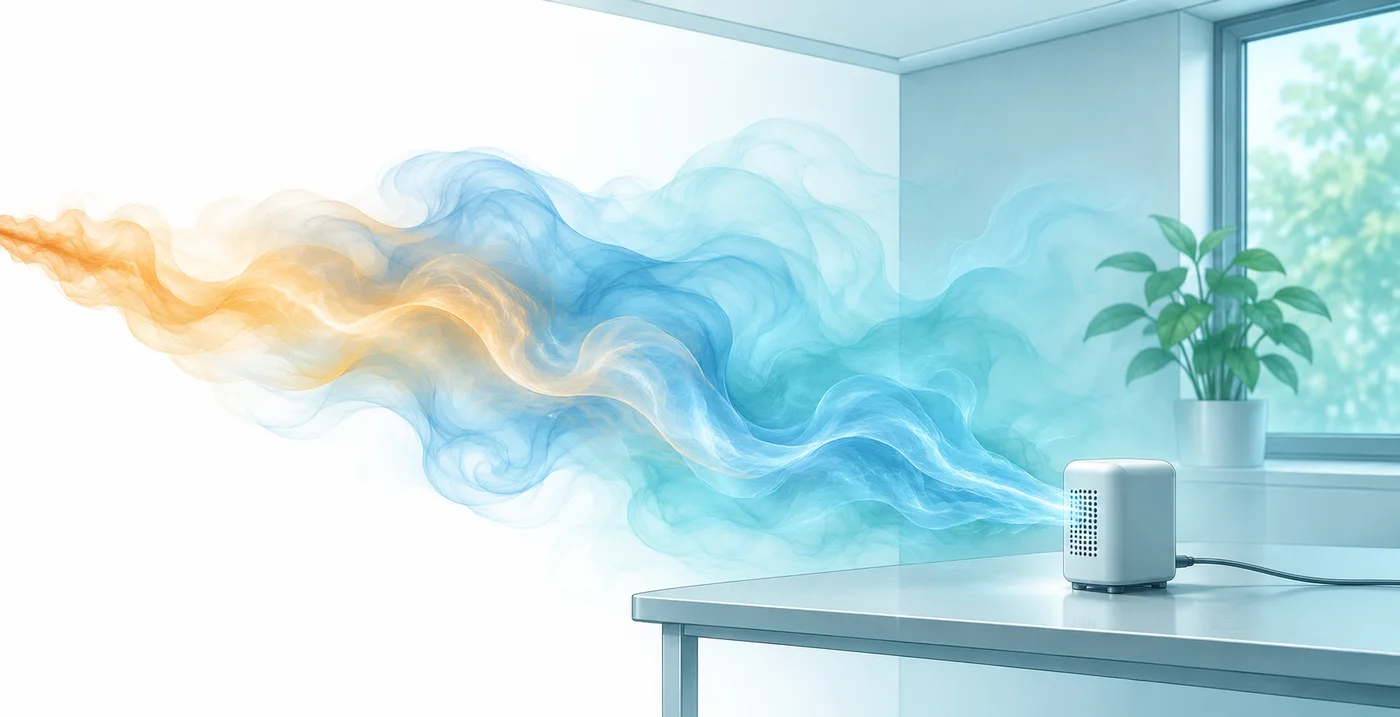
Conceptual mixing: the local sample changes as the plume entrains room air. No concentration is assigned to the illustration.
Humidity changes both the sample and its measurement conditions
Exhaled gas introduces moisture along with CO2. That moisture can matter in several separate ways: it changes mixture composition, alters the humidity seen by the instrument and can condense on cooler surfaces.
Water-vapor dilution is a real composition effect. A wet-basis concentration includes water among the gas molecules; a dry-basis value excludes it. Comparing a wet local sample with a dry reference value without reconciling the basis creates a false accuracy calculation.
Humidity can also affect a device through its specified environmental behavior. The mechanism depends on the sensor technology and compensation system. A measured rise cannot automatically be attributed entirely to CO2 if other conditions changed at the same time.
Condensation adds a physical disturbance. A wet inlet or protective membrane can slow gas exchange or alter the sample path. Droplets need not reach the sensing element to change how quickly a room-air monitor responds.
の Vaisala CO2 measurement application note explains moisture-related composition changes and recommends avoiding placement where people breathe directly onto a transmitter. That placement guidance is consistent with the goal of measuring the intended room environment rather than a local exhaled plume.
The broader article on humidity effects in gas sensors separates dilution, sensor response and condensation. Those mechanisms should remain separate when interpreting an unexpected peak or recovery.
Temperature, flow and pressure change at the same time
A warm plume can create a local thermal transition. The sensing cell, enclosure and compensation thermometer need not warm together. A device designed for stable room conditions can temporarily experience gradients different from those assumed by its characterization.
Flow also matters. Direct movement of gas toward an inlet can change exchange rate and local pressure. A sudden flow disturbance may make a response appear faster than ordinary room sampling, without establishing the steady-state accuracy.
の Sensirion SCD30 デザインイン ガイドライン discuss thermal equilibrium and avoiding external heat sources, as well as pressure disturbances caused by airflow. These are model-specific installation considerations that illustrate why direct breath introduces several confounding variables.
An internal temperature measurement is not proof that the full gas path has equilibrated. It may represent a point on a board or a corrected estimate. Likewise, an external room thermometer cannot establish the temperature of a rapidly changing plume inside a sensor cavity.
The sensible conclusion from a changing number is therefore modest: the measurement chain reacted during a changing local condition. Determining which effects contributed, and whether the final value was correct, requires a controlled comparison.
Why a peak is especially difficult to interpret
A room-air sensor has a response time, an update interval and often filtering. Those quantities are different. A display can refresh frequently while its sensing cell responds slowly. A processor may average several readings before displaying a result.
If the input concentration rises and falls quickly, the measured peak depends on the entire time history. A lower peak can indicate stronger dilution, a shorter disturbance, slower exchange or more filtering. It does not uniquely identify a low-reading calibration error.
Two monitors can therefore show different peaks in the same room while agreeing under a stable common sample. Their inlet locations, housings, sampling dynamics or display processing may differ. Peak comparison is primarily a dynamic-system comparison unless the source is controlled.
Output range is another limitation. A sensor can produce a numeric value beyond the concentration interval over which accuracy is specified. A large number on the display does not extend the manufacturer's stated accuracy range.
の SCD30 interface description distinguishes commands for measurement, calibration and environmental compensation. Reading data successfully is a different operation from establishing a valid calibration reference.
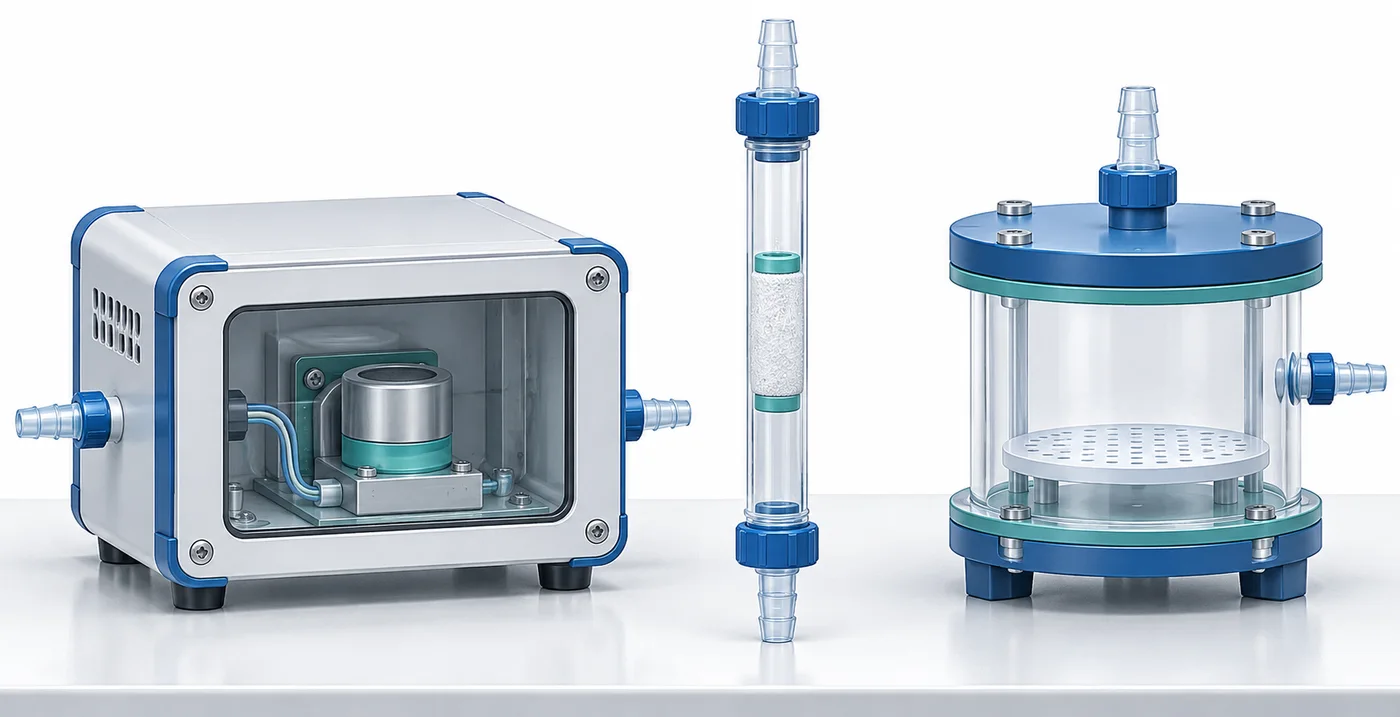
Conceptual sampling components: transport and enclosure exchange can alter the time history before a value reaches the display.
A checked example: unknown dilution dominates the comparison
Assume an entirely hypothetical source gas contains 40,000 ppm CO2 and the room air contains 600 ppm. These numbers are chosen only to illustrate mixing; they are not assigned to a particular person's breath.
If the gas reaching a sensor consists of 5% source gas and 95% room air, the ideal mixture would contain:
0.05 × 40,000 + 0.95 × 600 = 2570 ppm.
If the local source fraction were instead 10%, the mixture would contain:
0.10 × 40,000 + 0.90 × 600 = 4540 ppm.
Changing the unknown mixing fraction by five percentage points changes the local concentration by 1970 ppm. A peak of 3000 ppm could not be judged high or low from the assumed source value alone. The local dilution remains unknown.
Now consider a separate hypothetical accuracy specification of ±(50 ppm + 3% of reading). At 1000 ppm, that expression gives:
50 + 0.03 × 1000 = 80 ppm.
This is a specification arithmetic example, not a named product claim or an acceptance rule. The unknown plume concentration in the mixing example is far too poorly defined to assess an error on that scale.
The first calculation also assumes ideal mixing, no loss, common concentration basis and an instantaneous representative sample. A real breath disturbance adds changing moisture, temperature and instrument dynamics. Those complications strengthen the need for a known reference; they do not provide a way to infer one from a peak.
What makes a reference defensible?
A reference needs an assigned value and a suitable basis for trusting it. For gas measurements, that can involve a certified gas mixture or a reference instrument with an appropriate calibration and uncertainty. The choice depends on concentration, gas matrix and application.
NIST's CO2 measurement and reference-material program describes primary gravimetric standards and gas reference materials supporting concentration measurements. The central point is provenance: a reference value is assigned through a documented measurement chain rather than guessed from a familiar source.
の NOAA Global Monitoring Laboratory Central Calibration Laboratory maintains and distributes gas mole-fraction scales for specified atmospheric gases. Its role illustrates another important distinction: consistency on a documented scale is different from two nearby displays simply showing similar numbers.
A certificate alone is not enough if the delivered sample is wrong. The mixture must reach the instrument without unintended dilution, leaks, contamination, excessive pressure or incompatible moisture conditions. The reference value applies to a defined material, while the measurement occurs at the cell.
A reference instrument also has limitations. It must be suitable for the relevant concentration and conditions, and its response must be considered when comparing dynamic readings. A calibrated instrument sampling another part of a moving plume does not necessarily provide the true value at the test device.
Compare under a common, defined sample
A useful comparison asks whether both instruments receive representative portions of the same gas under compatible conditions. Physical proximity is helpful but not sufficient if the sample has sharp spatial gradients.
For stable room-air comparisons, consider whether nearby people, ventilation outlets, windows and local sources create differences between inlet locations. A short period of agreement in one location supports a narrower claim than a multi-condition comparison against a suitable reference.
For a professional gas-reference comparison, follow the manufacturer's supported sampling arrangement and handling procedure. The relevant record includes the reference concentration, balance gas, uncertainty, moisture basis, pressure, flow where applicable, stabilization criteria and instrument status.
Do not invent a delivery arrangement from the presence of a calibration port. A regulator, chamber or flow adapter must be compatible with the device. An unsupported pressure or flow can change the reading or damage a component.
Choose comparison points that answer the intended question. Agreement at one concentration does not independently establish slope, linearity or performance across the full range. Multiple points also need appropriate references and conditions; more unknown samples do not create a calibration.
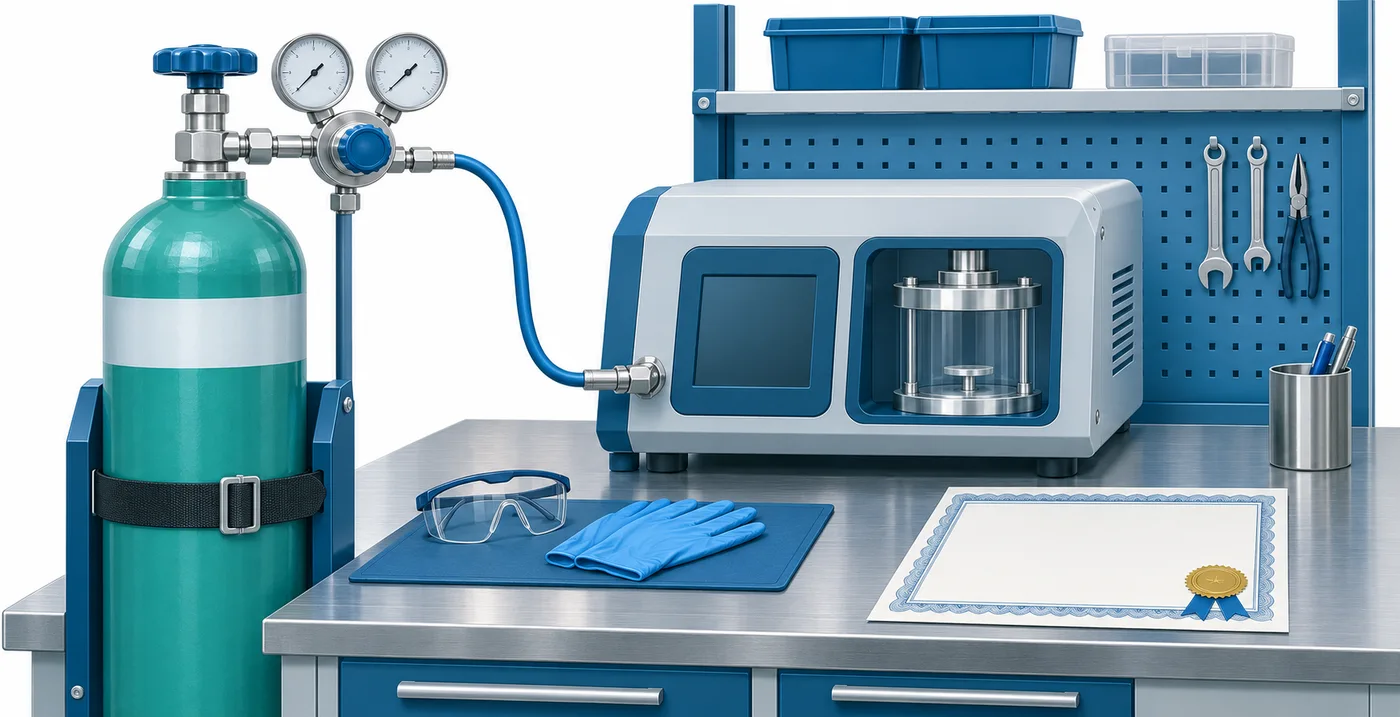
Conceptual professional comparison: the reference material, delivery path and documented conditions all contribute to interpretable evidence.
Calibration, adjustment and automatic background correction differ
Calibration establishes the relationship between an instrument's indication and a reference under stated conditions. Adjustment changes the instrument's response. They are often performed together, but they are different actions.
A comparison can reveal disagreement without yet identifying which device is wrong or whether an adjustment is justified. If the reference, sample delivery or conditions are uncertain, changing the instrument may hide the real cause.
Forced recalibration typically asks the user or host to supply a reference concentration. That value must represent the gas the sensor actually experiences. Entering an assumed breath value tells the device to adopt an unsupported target; it does not turn the source into a known reference.
Automatic background correction is another distinct mechanism. It relies on model-specific assumptions about the history of exposure. An instrument may use a presumed background condition according to its documented algorithm. Those assumptions must fit the installation.
Do not infer a universal background value or exposure schedule from another model's manual. A continuously occupied space, greenhouse or process area may not present the background conditions assumed by a room-air algorithm.
The useful first step before any adjustment is to preserve the original configuration and comparison evidence. Record whether automatic correction was active and whether it could have changed during the observation period. Otherwise a later shift can be difficult to distinguish from environmental variation or a manual change.
Why two monitors can agree and still be wrong
Two instruments may share a similar calibration bias, algorithm assumption or environmental sensitivity. Their agreement reduces uncertainty about their difference under the tested conditions, but it does not independently establish the true concentration.
They may also sample the same room while differing in pressure configuration or moisture basis. Similar displayed numbers can arise from different effects that happen to cancel at one point. A later condition can expose the difference.
An inexpensive reference is not automatically unsuitable, and an expensive analyzer is not automatically correct. What matters is its documented performance, calibration state, uncertainty, suitability and sampling arrangement for the comparison being made.
Time alignment deserves attention. If one monitor reports a moving average and another reports a recent sample, a changing room concentration can create apparent disagreement. Compare stable periods or use a supported method that accounts for the response characteristics.

Side-by-side placement can support comparison, but shared sampling conditions and a qualified reference are needed for an accuracy claim.
What if breathing nearby produces no visible response?
A missing response has several possible explanations. The gas may not have reached the sensing cavity, the disturbance may have been too brief, the display may update slowly, or the sensor may have been outside its valid operating state.
The device may also report an estimated CO2 value derived from another signal rather than directly measuring CO2. Check the stated sensing technology and output definition. Product appearance alone does not establish what is measured.
Some instruments apply smoothing, range limits or status-dependent output behavior. A steady displayed value can therefore reflect processing or an invalid-data hold rather than an unchanged gas concentration. Read status fields and documentation before assuming the sensing element has failed.
Inspect installation and configuration using the supported diagnostic process. Check power, communication, data-ready behavior, update age, inlet obstruction and model-specific readiness. These checks often provide clearer evidence than repeating an uncontrolled disturbance.
If a functional gas-response check is required, use the manufacturer's documented method and an appropriate reference or service arrangement. Repeatedly applying an unknown wet plume does not resolve why the first observation was inconclusive.
Build a comparison record that supports the claim
Start by naming the claim. Is the task to confirm data updates, observe a response, investigate disagreement or verify accuracy? The evidence required grows as the claim becomes stronger.
Record the device identity, firmware, calibration history and active compensation settings. Include any automatic background correction and pressure configuration. A title such as factory calibrated does not describe every later operating condition.
Identify the reference and its uncertainty, concentration range and gas basis. For a reference instrument, record its calibration status and response characteristics. For a gas material, record the assigned value and applicable certificate details without assuming the delivery path preserves them.
Describe the sample arrangement and relevant environmental conditions. Include the inlet locations, common-sample method, temperature, pressure, humidity or dew point, and flow where applicable. These details make a comparison repeatable in meaning.
Preserve the time series and status, not only the most favorable reading. Note when conditions changed and when the agreed comparison interval began. A selected screenshot cannot show whether a device had stabilized or was holding an old value.
State the acceptance criterion before judging the result. The criterion should account for the test device, reference and comparison method. Simply checking whether two numbers differ by less than one manufacturer's headline specification can ignore reference uncertainty and sampling differences.
The article on reading a CO2 monitor accuracy specification explains fixed and reading-dependent error terms. Use that specification literacy to define the comparison; do not replace the actual test conditions with the formula alone.
A practical interpretation ladder
An observed display change supports a response observation. A repeated change under similar but unmeasured disturbances supports only limited qualitative repeatability. Neither identifies the true concentration at the cell.
Agreement between two devices under a stable common sample supports agreement at that condition. If one is a qualified reference and the method controls relevant differences, the comparison can support an accuracy assessment within its scope.
Agreement at multiple documented points can support a broader assessment, provided the references and conditions are suitable. It still does not establish performance during untested humidity, pressure or thermal transitions.
This ladder helps keep reports precise. “The display rose during a local disturbance” is a valid observation. “The instrument met the stated comparison criterion at the documented reference points” is a different, stronger claim requiring different evidence.
Precision in language is useful because it preserves what was learned. It avoids both overclaiming a successful informal observation and dismissing it as meaningless. The observation can guide diagnosis while remaining insufficient for an accuracy decision.
How to report an informal observation without overclaiming
A useful report identifies the stimulus as uncontrolled and records what the device actually did. For example, a note might state that the displayed concentration rose during a nearby local disturbance and later returned toward its previous value. That preserves an observation without assigning an unknown true concentration.
Add the device's update state if available. A recent timestamp, changing raw output or valid data-ready indication can help distinguish a live measurement from a frozen display. These checks remain evidence about data flow, not concentration accuracy.
Avoid calculating an accuracy percentage from the peak. That calculation requires a reference value for the gas actually measured. An estimated source concentration, a value from another breath or a number remembered from a general article cannot supply it.
If a comparison against another monitor was made, describe it as agreement or disagreement under the observed conditions. Record inlet positions and timing. This makes the observation useful for deciding whether a controlled follow-up is warranted while preserving its limited scope.
Such reporting is especially helpful when discussing a suspected fault with a service provider. Model, status, configuration, timing and the exact symptom provide actionable information. A statement that the monitor failed a breath calibration can instead send the investigation toward an adjustment that the evidence does not justify.
よくある質問
Does a high reading after breath prove that the sensor is genuine?
It is limited evidence that the displayed value responds to a disturbance. Confirm the stated sensing technology and use appropriate diagnostics; a response alone does not authenticate the measurement method or establish accuracy.
Can I calibrate using a typical human breath concentration?
No. The concentration at the cell is unknown because source composition, dilution and timing vary. A typical source value is not a delivered reference value.
Why do two monitors show different peaks?
Their local samples, inlet exchange, response times, update timing and filtering may differ. An unknown transient cannot isolate calibration error.
Can outdoor air serve as an exact reference?
Outdoor concentration varies with location and time. Use a manufacturer's supported procedure only within its stated assumptions, and distinguish that procedure from an independently certified reference comparison.
Does the highest displayed value reveal the source concentration?
No. A room monitor may average, lag, limit or dilute the source before reporting. The peak reflects the sample history and instrument dynamics.
What is the appropriate next step after an inconclusive response?
Read the device status and supported diagnostic instructions. If accuracy needs verification, arrange a documented comparison with a suitable reference and compatible sampling method.





返信を残す