
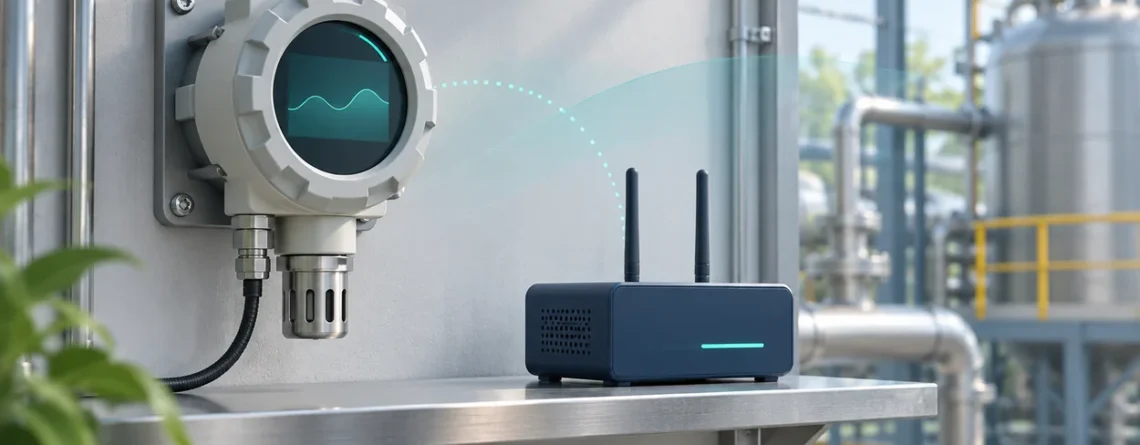
Wireless gas monitoring data is trustworthy when every record preserves which instrument and gas channel produced it, when the instrument sampled, whether the reading was valid, and when the receiver saw it. If a 10:01 reading arrives at 10:09 after buffered transmission, it can complete the historical record without showing what the air is like at 10:09. Evaluate measurement age independently of the latest network transaction.
Think of measurement and delivery as two separate chains. The measurement chain starts with the gas sample and ends with a reading in a known unit and operating state. The delivery chain starts when an instrument makes the measurement available and ends at the database or display. Make both visible so that a quiet dashboard, a flat trend, and a device reporting zero have distinct meanings.
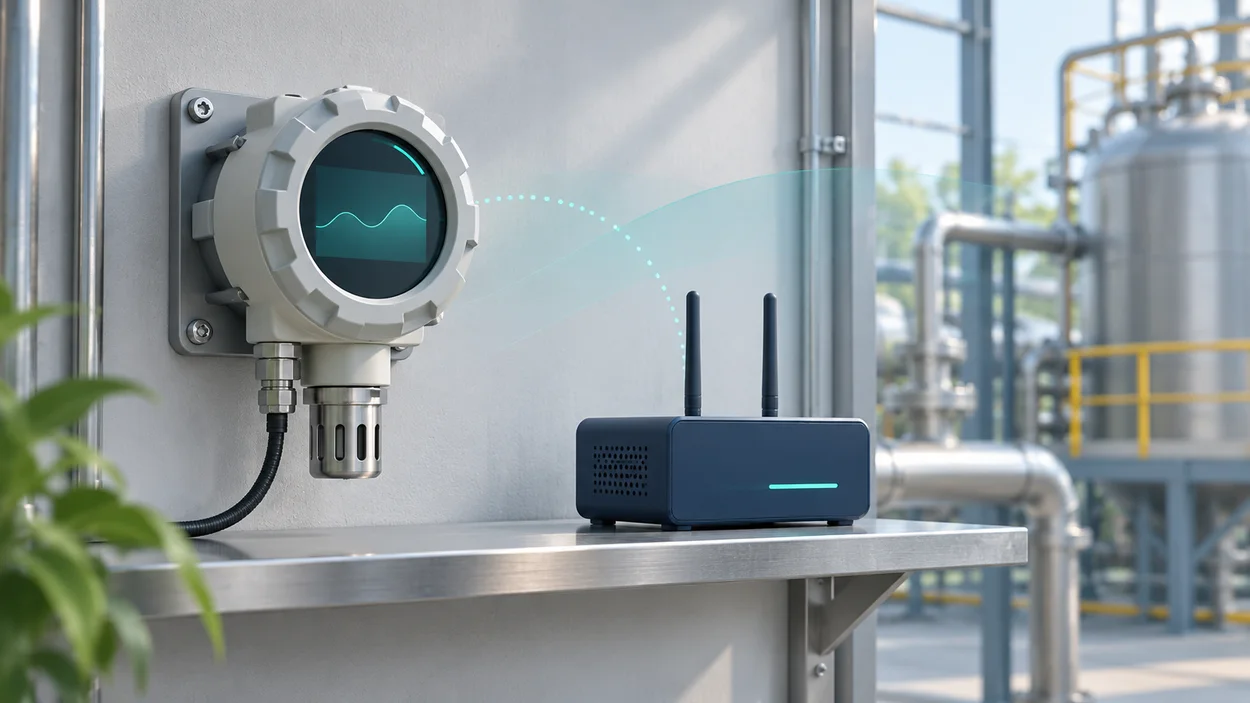
Measurement and wireless delivery have separate equipment and record boundaries.
Define what the system delivers
A gas monitoring system may report instantaneous concentrations, periodic averages, alarm transitions, instrument faults, location, or operational events. Check its message catalog against the local export before treating the transmitted series as a mirror. An instrument that stores a reading every minute might send at another cadence. A receiver may record alarms and communication errors without storing every value. A database may also roll up readings into windows after receiving them.
| Cánh đồng | Hỏi nó trả lời | Risk if it is absent |
|---|---|---|
| Stable device and channel identity | Which instrument produced the record? | Replacements inherit unrelated history |
| Measurement time and clock quality | When was the sample taken? | Buffered records appear current |
| Session identity and sequence | Did a record repeat or go missing? | Delivery duplicates inflate completeness |
| Value, unit and instrument state | Was the observation usable? | Warmup or error codes become concentrations |
| Receive time and persistence status | Where did the delivery slow or fail? | A missing report is difficult to trace |
Keep the facility's human-friendly location tag as a separate field. Location can change without changing the device. Device identity can change without changing location. For example, a portable unit moves between rooms in one shift. Assigning its original site tag as a permanent asset key can make both rooms look as though they experienced the same event. Preserve location at acquisition or maintain time-bounded assignment records that can be joined on the measurement time.
When hardware reports multiple channels together, establish whether it acquired them together, staged them from separate sensor updates, or assembled the last available value for each channel. A timestamp naturally applies to the envelope. It applies to individual readings only if the manufacturer documents that behavior. A battery message can prove that the radio and gateway communicated while giving no evidence that the gas reading updated. Provide a way to say the transmitter is reachable while an individual concentration remains stale.
Separate measurement time from message arrival
Use measurement time for trends, receive time for delivery performance, and recording time for persistence audits when those stages can be separated. If a device reports only uptime, preserve it and attach a UTC estimate with an explicit quality indicator where appropriate. If a receiver assigns time when it polls a device, describe the field as poll time. Accurate receive time cannot repair an unknown measurement time within an old device buffer.
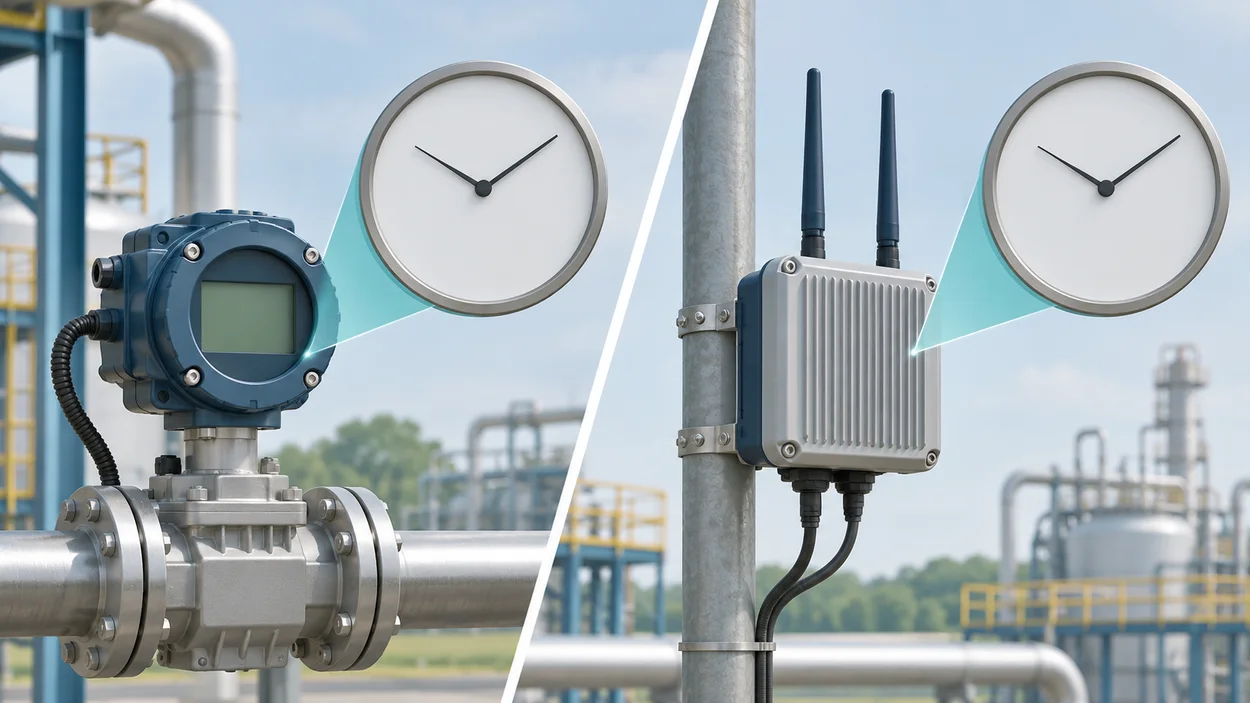
Measurement time originates at the observation or its specified acquisition boundary. Receipt time belongs to a later stage.
Các RFC 3339 timestamp profile provides an interoperable representation. Record a UTC timestamp and format local time at the display layer. Time representation solves parsing and timezone ambiguity. Time quality still depends on the device clock, synchronization policy and ability to attach time when data are acquired. A record with plausible digits can have an invalid clock.
Use a monotonic count for elapsed time in the same boot where available. Wall-clock corrections and battery removal can produce discontinuities. Preserve a boot or session identifier alongside the monotonic counter. An uptime of 20 seconds in one boot cannot be compared directly with 20 seconds in another. If a device starts with unknown wall time and later synchronizes, reconstruct the limited interval only when the needed anchor and uncertainty bound exist. Keep the original time and flag any inferred values.
Time resolution must fit the question. With one-minute records, assigning the same rounded minute to two channels may be acceptable for a daylong ventilation trend. It may be insufficient for reconstructing the order of short events. Ask what clock generated status changes, how the device rounds time, and whether a timestamp refers to the start, end or middle of a collection interval.
Check what a protocol acknowledgement proves
OASIS MQTT 5.0 defines delivery options within a protocol exchange. The QoS 1 exchange supports at-least-once delivery and allows duplicates. Acknowledgement alone does not prove the physical observation was valid, that preceding measurements existed, or that the database committed a row. An application can still receive a delayed record or consume a retained value originating before its display started.
Define a delivery boundary for each stage. The transmitter writes a record locally, a gateway accepts it, a broker passes a message, and the application commits a durable row. Designed receipts and persistence counters can tell whether each stage was reached. Even when middleware suppresses repeated delivery in one exchange, re-export and batch import can introduce copies at a different interface.
A deduplication key can include device identity, stream or channel identity, session identity and sequence. Only use fields actually supported by the device contract. A key derived from timestamp and concentration alone will collapse separate records if their timestamp has coarse resolution and their readings agree. A repeated record with a rounded time can escape such a test. If two records have the same key but different content, preserve the source and route the conflict for review. Silently selecting the most recent arrival removes evidence.
Authenticated transport and protocol integrity checks serve a separate purpose. They can tell you whether data came through a recognized communication peer and whether their representation survived the exchange for which the checks apply. They cannot certify calibration or recover unsampled observations. At ingestion also check data type, unit, asset, and schema revision. An export must remain interpretable after a future firmware change migrates the app to new field names or different units.
Distinguish stale, missing and invalid readings
A display can show 0 ppm when a valid observation reports zero in the applicable scale. During an instrument or communication fault, represent what you know. A hypothetical environmental logger might mark a value stale when its age exceeds an agreed freshness limit. That limit derives from the task and tested system behavior.

Network interruptions can leave the current display stale while measurements continue locally.
Missing means a record expected under the schedule did not reach the table. Stale means the last known reading is too old for the display's purpose. Invalid means a record exists but contains a condition that makes its concentration unusable, such as a warmup flag or incompatible unit. Delayed means an otherwise usable historical measurement arrived later than expected. Unknown time can coexist with a numeric reading, but limits what that record can support.
Distinguish a link loss from a local sampling interruption. A monitor may continue sampling after the link drops. It may also respond to heartbeat queries while a sensing subassembly fails to update. A network chart based on acknowledgements alone cannot reveal either distinction. Make the age and state of a last known value visible and exclude stale observations from calculations requiring freshness.
An analysis can impute values for specific statistical purposes. Preserve any imputed series separately and show observed coverage. A long blank interval does not establish that conditions were uneventful. A moving average drawn over it does not reconstruct high-frequency events. If the radio transmits only summaries, record the source window and minimum source coverage behind each summary.
Completeness depends on the denominator. A one-minute periodic schedule spanning four hours can have 240 slots when the schedule includes the initial boundary and excludes the end. Counting missing minutes on a change-only stream is meaningless without a separate heartbeat or known event-counter behavior. Counter rollovers, changed reporting intervals and restarts need their own interpretation before missing observations can be counted reliably.
Compare archive history with local logging behavior
Find out whether the instrument supports local logging, whether it was enabled, what it stores and how it retains data. Honeywell's AreaRAE Plus/Pro User Manual describes a family that can store measurements with timestamps in nonvolatile memory and whose logging interval is configurable. The Sensidyne SensCast system brochure describes receiver-side event logging and an optional logging interface. These examples illustrate different record locations. A radio alone does not indicate independent transmitter logging.

Check whether the actual monitor retains independent local observations.
Kiểm tra hành vi ghi đè, phương pháp truy xuất và khoảng thời gian ghi nhật ký được giả định bởi các yêu cầu lưu giữ. Dung lượng được biểu thị bằng ngày có thể phụ thuộc vào số lượng kênh và tốc độ ghi định kỳ. Các sự kiện và chẩn đoán làm phức tạp thêm việc ước tính. Với 60 hàng mỗi kênh mỗi giờ trên tám kênh, thời gian gián đoạn kéo dài ba ngày sẽ tạo ra 34.560 bản ghi. Với 160 byte mỗi hàng, tải trọng đơn giản là khoảng 5,5 MB trước các chỉ mục, tiêu đề và lưu lượng sự kiện. Chỉ riêng dung lượng không thể cho biết liệu ứng dụng có thể chèn lấp chính xác sau khi bị gián đoạn hay không.
Try a recovery inspection with approved test data. Identify when outgoing records are removed, whether a partial export resumes logically, and what happens after the buffer fills. Document priority when delayed history and live readings compete during reconnect. Some systems provide separate delivery channels. Their consumers still need clear rules for measurement time and duplicate handling.
Treat a manually retrieved export as a separate source of evidence. Preserve original records and the retrieval date and verify device identity and time basis. Reconcile overlap in a staging process and record how collisions or uncertain times were handled. A data import may restore chronological history without erasing the period when live telemetry was unavailable.
Ví dụ hoạt động: trả lại dữ liệu sau khi ngừng hoạt động
Giả sử một máy ghi CO₂ môi trường thực hiện một lần quan sát cục bộ mỗi phút. Sau khi nhận được bản ghi 420 lúc 10:00, liên kết không dây sẽ dừng. Màn hình giữ lại giá trị 10:00 như được biết lần cuối và hiển thị tuổi ngày càng tăng. Các bản ghi cục bộ từ 421 đến 427 được ghi khi không có đài. Vào lúc 10:08, người nhận nhận được lô còn thiếu và bản ghi hiện tại, sau đó nhận lại 425. Nhà sử học cam kết bảy quan sát đã được khôi phục cộng với bài đọc hiện tại. Nó nhận ra sự lặp lại bằng cách sử dụng thiết bị, phiên và trình tự. Màn hình hiện tại chọn cách đọc hợp lệ mới nhất độc lập với thứ tự gói.
During the interruption the operational display was stale. After recovery the archive is complete for the observed interval. An on-time delivery report still records the outage, while a historical coverage report counts the retrieved records. If records 423 and 424 had been overwritten locally, those two slots would remain missing after backfill.
Add a reboot at 10:04. The counter restarts and the clock has no reliable UTC until 10:07. Associate the records with their separate session. If the complete sequence and a documented time anchor allow reconstruction, mark the new time values as estimates. If no anchor exists, preserve the readings with unknown times and keep them out of time-sensitive analysis. For example, a service investigation cannot confidently align an unknown-time reading to a valve transition simply because it falls close to the event in order of arrival.
Verify that the application preserves the distinction
Exercise representative states in a test environment. Include normal receipt, one dropped measurement, out-of-order backfill, repeated records, a stale channel on a healthy link, a channel invalid flag, a reboot, an unsynchronized clock and an exhausted queue. Specify expected outcomes for the display and the historian separately. Inspect the first values after a gateway or application restart because an old retained value may be the first message displayed.

A useful display presents concentration freshness and communication status separately.
Define the acceptance evidence by stage. For a selected period, count expected observations, distinct committed observations, and observations usable under the defined quality rule. Record first receipt as a stable timestamp so synchronization cannot erase the initial delay. Monitor sequence continuity and clock validity separately by channel. A useful review also checks observability when changes are rolled out. Test that an updated device capable of sending two different reporting cadences keeps the earlier data interpretable under its old schema.
Keep both machine status and human review. One incident report might say the gateway was reachable between 07:00 and 07:30, the instrument rebooted at an estimated time, the channel did not complete warmup for an interval, and local history was received later. Those are testable clues for independent owners. The gas monitor service record gives maintenance a place for instrument identity, service events and approval records that can be correlated with those observations.
If wireless data contribute to a protective function, evaluate the complete approved architecture and its handling of link loss, stale data and device faults under applicable site requirements. Test a research or trending installation independently of protective functions. Field logging and archival decisions cannot establish protective availability.
Choose coverage and freshness metrics for each audience
A pollution study may care chiefly about measured coverage after all recoverable records arrive. An operations desk may care whether an observation was usable upon arrival. Define both metrics before selecting dashboards. Suppose 240 samples were expected in four hours, 200 arrived on time, 30 more arrived later, and among those 230 samples five reported warmup. On-time arrival was 200 divided by 240, or about 83.3 percent. After backfill, 230 were represented in the archive, or 95.8 percent. After excluding the five invalid samples, valid recovered coverage is 225 divided by 240, or 93.75 percent. You still cannot calculate on-time valid coverage without knowing how the five invalid records were distributed. Those separate figures reveal where improvement is possible.
Avoid a single reliability percentage that mixes channels with different meanings. A dashboard with eight stable channels can look healthy if average freshness is high, even if the one channel of interest is stale. For users reviewing a particular area, report channel-level availability and clarify when a number is calculated across an entire fleet. A device whose calibration is overdue according to the managing program can be marked accordingly even while it continues to report. This site-level record is separate from the equipment's own reported measurement status. Consumers should know which one produced the flag.
Mô tả sự tổng hợp một cách rõ ràng. Nếu giá trị trung bình một giờ sử dụng 20 phút được ghi lại, hãy ghi lại phạm vi đó và giải thích liệu giá trị trung bình được tính từ 20 giá trị tức thời, 20 khoảng thời gian quan sát có độ dài bằng nhau hay 20 báo cáo chứa các khoảng thời gian không bằng nhau. Việc xử lý mỗi hàng như nhau có thể tạo ra bản tóm tắt sai về thời gian khi các khoảng thời gian khác nhau. Nếu số đọc được nhập sau khi báo cáo gốc được tạo, hãy lập phiên bản báo cáo và mô tả cửa sổ lịch sử có sẵn ở mỗi phiên bản. Điều này giúp có thể so sánh những gì người vận hành có thể thấy vào thời điểm đó với những gì một nhà phân tích hồi cứu có thể tái tạo lại.
Quyết định hệ thống nhận sẽ làm gì với mỗi tin nhắn
During system design, review the provenance of each transmitted field. An instrument's concentration message might contain a field named status. A gateway might add a second state with the same name. Assign distinct schema meanings, so the destination can distinguish “sensor reports invalid” from “gateway replayed at reconnect.” A user reading a single label without provenance cannot determine whether to investigate the relation between sensor and gas or the relation between transmitter and gateway.
Consider a device that supports two logging modes. In one mode each record stores an instantaneous measurement. In another, the stored record is the maximum over its interval. If the row field is always named value and the configuration changes without a schema or assignment event, post-change readings cannot be compared directly with prior instantaneous data. Store a statistics field or bind each record to a versioned stream definition. The export should carry the new meaning with the data and preserve the old definition for earlier rows.
Review alert messages separately from periodic data. An instrument may produce more than one kind of event: a local alarm, system fault, battery state or a receiver-generated communications loss. A clear event schema identifies who observed it, the state transition, acknowledgement and, if applicable, the time represented. Acknowledge events can be records in their own right. Overwriting an original event when it is acknowledged changes the evidence available for a later investigation. Keep occurrence and acknowledgement as distinguishable fields.
A good ingest review asks how to handle four unusual combinations. A measurement time in the past and a present receive time may be legitimate backfill. A future measurement time after device sync may indicate a clock mismatch. A valid numeric value with an unknown unit requires interpretation before it can be used. A new unit for a known data stream may indicate a documented configuration change or an erroneous decode. Each record can be persisted in raw or staging form while the application declines to use it for current decisions. A permanent drop with no audit record sacrifices the opportunity to reconcile an instrument export later.
Define the reconciliation handoff
Quá trình đánh giá dịch vụ sau khoảng cách đo từ xa sẽ nêu tên khoảng thời gian và các kênh bị ảnh hưởng, chỉ ra cấu hình đang hoạt động và liệt kê những bằng chứng còn lại. Việc xuất thiết bị có thể xác nhận các phép đo bị bỏ lỡ đã được ghi lại cục bộ. Nhật ký cổng có thể hiển thị khi nó dừng chuyển tiếp, biên nhận cơ sở dữ liệu hiển thị khi quá trình lưu trữ được tiếp tục và nhật ký bảng điều khiển cho biết mức độ mới được thể hiện. Giữ nguyên ngày trong biểu diễn thời gian chung và ghi lại mọi độ lệch đồng hồ được quan sát. Định dạng ngày nhất quán giúp bằng chứng dễ so sánh hơn nhưng không nên được trình bày làm bằng chứng cho thấy đồng hồ đã được căn chỉnh.
One useful acceptance scenario is an offline period that overlaps planned maintenance. Begin with a known configuration in a nonproduction setup. Record a service event during an intentional logging suspension, then resume acquisition while the transfer path is still unavailable. The archive should show the suspension state and its data gap, then receive later measurements during backfill. Historical presence of valid observations after maintenance does not mean that the dashboard had current information during the interruption. The review should be able to answer both questions with a reading of existing records.
If only one independent export exists, guard against assumptions about its scope. A USB dump may include readings but omit fault events. A receiver event export can include an alarm time but lack the paired gas value. A screenshot can establish a display seen at a particular time when its origin is preserved, while failing to establish the full stored history. Identify and label the information each source does and does not contain. Then retain the source and explain the reconciliation. This improves the review without artificially creating precision or missing records.
Ask where a clock or index was rewritten
Some gateways add one timestamp to a batch even when the underlying device captured many observations at different times. Others import device time but convert it using a configured timezone. A server can also rewrite display time while leaving stored time intact. To interpret an old export, trace the origin of the field through these stages. Preserve the original record and compare several samples with obvious gaps, as well as records near a reboot or time correction. A plausible event order over a few minutes tells little about daylight saving transitions or an unsynchronized device after extended downtime.
Các trường trình tự có ranh giới riêng. Chuỗi khung mạng có thể đếm tất cả lưu lượng truy cập vô tuyến, bao gồm cả nhịp tim và các báo cáo trùng lặp. Trình tự đo lường ứng dụng có thể tăng lên một lần cho mỗi lần quan sát khí được chấp nhận. Việc nhảy từ chuỗi mạng 230 lên 233 có thể biểu thị hai thông báo không đo lường được cố ý loại trừ khỏi luồng khí. Sử dụng trường được ghi lại cho luồng bạn đang đánh giá. Nếu chỉ có thiết bị nhận dạng vô tuyến tồn tại, hãy dán nhãn bằng chứng vắng mặt ở cấp độ đó và tránh suy ra một số lượng cụ thể các quan sát khí bị mất.
For data exchange between teams, include the current and earliest relevant schema revisions beside the export. A publisher may replace an intermediate field name, such as timestamp, with sample_time and arrive_time and populate both for future data. Earlier records will still need an explicit definition of timestamp. Avoid manufacturing a new sample time merely to fill an older database column. Preserve what is known and record which downstream use tolerates any uncertainty. This can be as simple as carrying a named timing basis and retaining the earlier field definition in an assignment table.
Câu hỏi thường gặp
Does a strong wireless signal guarantee a complete record?
No. It may improve transmission reliability, but measurements can be missing before transmission or after delivery. Compare record sequence or expected schedule against the durable archive and check measurement state independently.
Can cloud ingestion time be used as sample time?
Only as a documented approximation when the delay is bounded and compatible with the analysis. During buffering and backfill, ingestion can be minutes or hours later than acquisition.
What should appear after a communications outage?
A trend can preserve prior observations and display gaps. A current-value tile can present the last value with a timestamp and visible stale indicator. Unavailable values should have a separate representation from a valid numerical zero.
Is a buffered record still valid after it arrives late?
It can remain usable for historical analysis when its instrument state, identity, unit and acquisition time are known. Its age still matters to decisions requiring current information.
What if the wireless system sends only alarms and periodic summaries?
Retain them with their types and relevant time window. Raw concentrations cannot generally be reconstructed from summaries. Check whether a separate local stream is available if the project needs it.








Để lại một câu trả lời