
1. Introduction
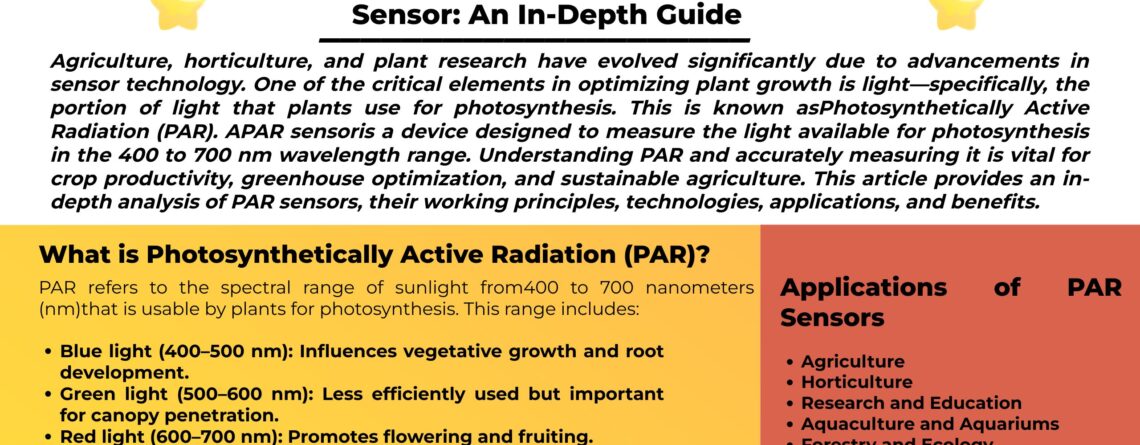
Agriculture, horticulture, and plant research have evolved significantly due to advancements in sensor technology. One of the critical elements in optimizing plant growth is light—specifically, the portion of light that plants use for photosynthesis. This is known as Photosynthetically Active Radiation (PAR). A PAR sensor is a device designed to measure the light available for photosynthesis in the 400 to 700 nm wavelength range.
Understanding PAR and accurately measuring it is vital for crop productivity, greenhouse optimization, and sustainable agriculture. This article provides an in-depth analysis of PAR sensors, their working principles, technologies, applications, and benefits.
2. What is Photosynthetically Active Radiation (PAR)?
PAR refers to the spectral range of sunlight from 400 to 700 nanometers (nm) that is usable by plants for photosynthesis. This range includes:
- Blue light (400–500 nm): Influences vegetative growth and root development.
- Green light (500–600 nm): Less efficiently used but important for canopy penetration.
- Red light (600–700 nm): Promotes flowering and fruiting.
While the sun emits radiation across a wide spectrum, only PAR directly contributes to photosynthetic activity. Measuring PAR is essential for understanding how much light is reaching a plant and how it affects photosynthesis rates.
3. What is a PAR Sensor?
A PAR sensor, also known as a quantum sensor, measures the intensity of PAR in micromoles of photons per square meter per second (µmol/m²/s). It detects the number of photons in the 400–700 nm range hitting a surface each second.
Key Features:
- High accuracy and stability
- Durable for long-term outdoor and indoor use
- Linear response across the PAR spectrum
- Weather-resistant enclosures for harsh environments
4. Working Principle of PAR Sensors
PAR sensors work by using a photodiode or photovoltaic detector paired with an optical filter to isolate the PAR range. The sensor converts the light energy in the PAR spectrum into an electrical signal proportional to the number of photons detected.
Steps:
- Light passes through a cosine-corrected diffuser to ensure uniform response from all angles.
- The optical filter blocks non-PAR wavelengths.
- The detector converts PAR light into a voltage or current signal.
- The signal is processed and output in µmol/m²/s.
5. Types of PAR Sensors
5.1 Quantum Sensors
- Measures: Instantaneous PAR
- Output: µmol/m²/s
- Use: Spot measurements, light profiling
5.2 Line Quantum Sensors
- Measures: PAR across a line (e.g., plant canopy)
- Use: Averaging PAR over large areas
5.3 Integrated PAR Sensors (Dataloggers)
- Measures: Cumulative PAR over time
- Use: Daily Light Integral (DLI) calculations
6. Units and Measurement Concepts
- µmol/m²/s: Instantaneous PAR
- mol/m²/day: Daily Light Integral (DLI), important for plant growth assessment
- PPFD (Photosynthetic Photon Flux Density): Same as PAR in µmol/m²/s
7. Applications of PAR Sensors
7.1 Agriculture
- Ensuring adequate lighting for crops
- Light level optimization in greenhouses
- Seasonal lighting adjustments
7.2 Horticulture
- Monitoring light for ornamental and edible plants
- Adjusting supplemental lighting (e.g., LEDs)
- Timing artificial lighting for flowering and fruiting
7.3 Research and Education
- Plant physiology experiments
- Monitoring photosynthesis rates
- Analyzing light stress and shade effects
7.4 Aquaculture and Aquariums
- Ensuring proper lighting for aquatic plants
- Optimizing light levels for coral growth
7.5 Forestry and Ecology
- Studying light distribution in canopies
- Forest floor PAR mapping for biodiversity assessments
8. Key Considerations When Choosing a PAR Sensor
| Factor | Description |
|---|---|
| Accuracy | Needed for reliable data, especially in scientific research |
| Calibration | Should be traceable to NIST or similar standards |
| Durability | Must withstand environmental stress in outdoor applications |
| Power | Battery-operated vs. wired for continuous monitoring |
| Data Interface | USB, Modbus, SDI-12, analog voltage or current |
| Cosine Correction | Ensures accurate readings from all angles of incident light |
9. PAR Sensor Placement and Installation
Proper placement is crucial for accurate readings:
- Mount horizontally at crop canopy height.
- Ensure no shadows or reflections from nearby structures.
- For greenhouses, place sensors in representative light zones.
- Clean sensor regularly to avoid dust or water droplet interference.
10. Integration with Smart Agriculture Systems
PAR sensors are commonly used in IoT-based precision agriculture platforms. When connected to controllers or cloud-based systems, they can automate lighting, irrigation, and ventilation.
Integration Capabilities:
- Wireless connectivity (LoRa, Zigbee, Wi-Fi)
- Cloud dashboards for remote monitoring
- Automated control of grow lights based on PAR levels
- Alerts when lighting is sub-optimal
11. Benefits of Using PAR Sensors
- Optimized plant growth through light control
- Increased yield in commercial agriculture
- Efficient energy use by avoiding over-lighting
- Data-driven farming decisions
- Research-grade accuracy for academic and commercial studies
12. Challenges and Limitations
- Calibration drift over time requires regular recalibration.
- Cost can be high for advanced models.
- Environmental damage (e.g., from water or dust) can affect accuracy.
- Limited spectral range—does not measure UV or far-red light which may also impact plant growth.
13. Leading PAR Sensor Manufacturers
- Apogee Instruments (USA) – Widely used in agriculture and research.
- LI-COR Biosciences (USA) – Known for high-precision sensors.
- Delta-T Devices (UK) – Integrated PAR and meteorological sensors.
- Skye Instruments (UK) – Specialty sensors for plant science.
- Meter Group (USA) – Offers sensors integrated with environmental monitoring platforms.
14. Future Trends in PAR Sensor Technology
14.1 Hyperspectral PAR Sensors
- Sensors capable of analyzing specific bands for targeted crop studies.
14.2 Machine Learning Integration
- Predictive modeling based on PAR and other environmental data.
14.3 Wireless Mesh Networks
- Sensor nodes that communicate over wide areas for large-scale farms.
14.4 Sustainable Sensors
- Solar-powered, self-calibrating sensors to reduce maintenance.
15. Real-World Use Case
In a modern smart greenhouse:
- PAR sensors track real-time sunlight exposure.
- When natural light drops below a threshold, LED grow lights are activated.
- If cumulative daily PAR is exceeded, lighting is dimmed or shut off to save energy.
- Data logging allows growers to compare PAR levels to plant health and yields, enabling continuous improvement.
16. Conclusion
PAR sensors are essential tools for understanding and managing the light environment of plants. Whether in controlled greenhouses or open-field farming, these sensors empower growers and researchers to optimize light exposure for better growth, higher yields, and improved resource efficiency.
As technology advances and precision agriculture continues to grow, PAR sensors will play an increasingly critical role in sustainable food production and scientific discovery.





Leave a Reply