
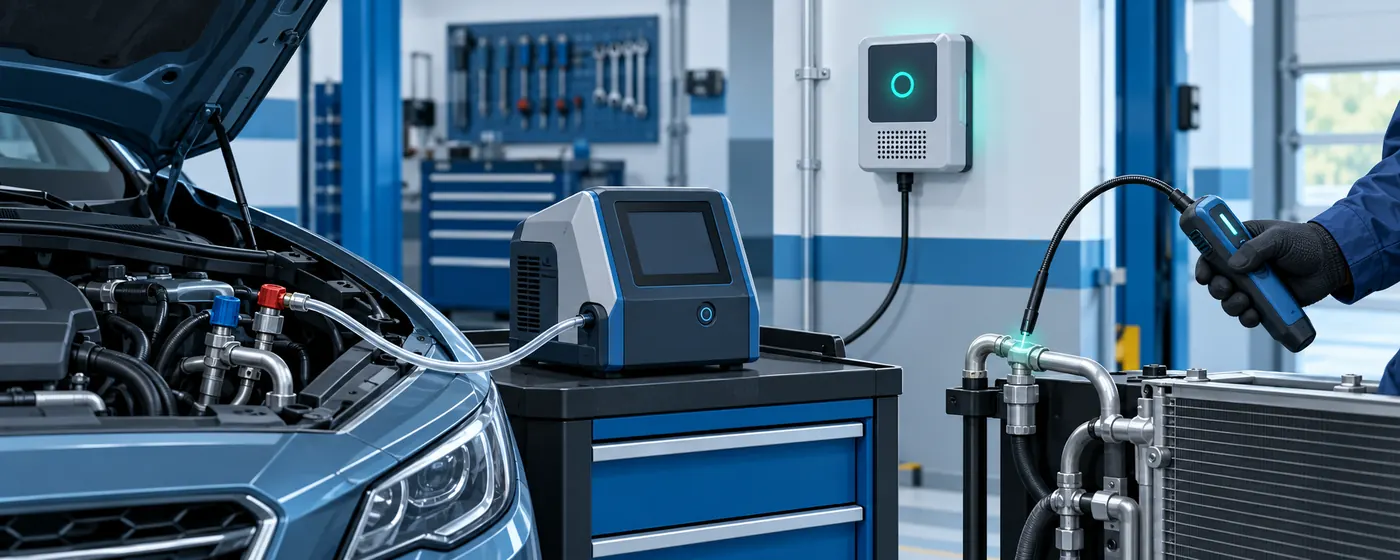
A refrigerant identifier asks what fluid is in a sealed system or cylinder. An ambient refrigerant detector asks how much of a specified target is in the air at its inlet. A handheld leak locator asks where escaping fluid is likely to originate. These measurements use different samples and answer different service or safety decisions. Neither a room-air ppm reading nor an alarm beside a fitting proves that the circuit contains the correct refrigerant.
The distinction becomes critical when equipment has been serviced before, a recovered cylinder's contents are uncertain, or a facility wants a detector for a new refrigerant. Misidentification can contaminate recovery equipment or lead to an inappropriate charge. A concentration monitor configured for the wrong target can give an untrustworthy reading. This guide shows what each test can establish, how its output should be interpreted, and which evidence is still missing after a result.
Identify the sample before choosing an instrument
| Sample | Typical instrument | Useful question | Output | What remains unknown |
|---|---|---|---|---|
| Refrigerant drawn from a service port or cylinder under a defined procedure | Refrigerant identifier or analyzer | Is this the expected fluid or mixture within the instrument's scope? | Identity, pass/fail, composition estimate or contaminant indication | Location of a leak into surrounding air |
| Ambient air at a mounted inlet | Fixed concentration detector | Is the calibrated target present here, and is a configured response required? | Concentration, trend, alarm and fault states | Exact composition of the sealed charge or exact leaking joint |
| Air very near a suspected connection | Portable leak locator | Does response increase at this component? | Relative signal, alarm or model-specific concentration output | Identity or purity of the full charge |
| Equipment operating variables | Indirect leak-detection system | Does the circuit behave as if refrigerant is being lost? | Anomaly, trend or inferred event | Actual ambient concentration without a direct air sample |
| A controlled laboratory sample | Analytical composition/purity method | Does the batch meet an applicable specification? | Detailed composition and impurity results | Real-time room coverage |
The table is a map of decisions, not a claim that all products in each category have identical capability. An identifier may only recognize selected gases. An ambient detector may estimate concentration for one target or a configured family. A leak locator may show a numeric value in a special mode. Read the scope of the exact instrument before interpreting its result.
What a refrigerant identifier really does
An identifier takes a controlled sample from a system or container and compares a measured signature with its supported refrigerants. Depending on the device, it may indicate that the expected refrigerant passes a purity/identity criterion, report likely refrigerant constituents, flag air or another contaminant, or reject an unsupported mixture. The result depends on the instrument's gas library, calibration, sample preparation and decision algorithm. A “pass” means the sample met that instrument's defined test; it does not mean the entire circuit has been independently analyzed by every available method.
The U.S. EPA's guidance on contaminated motor-vehicle refrigerants explains why service labels, port fittings and pressure are not conclusive evidence of contents. Vehicles may have been retrofitted or contaminated. The EPA also distinguishes basic identifiers, which may chiefly confirm the expected refrigerant, from more advanced units that can report composition or flammable substances. It cautions that even sophisticated identifiers cannot correctly resolve every possible combination in refrigerant blends.
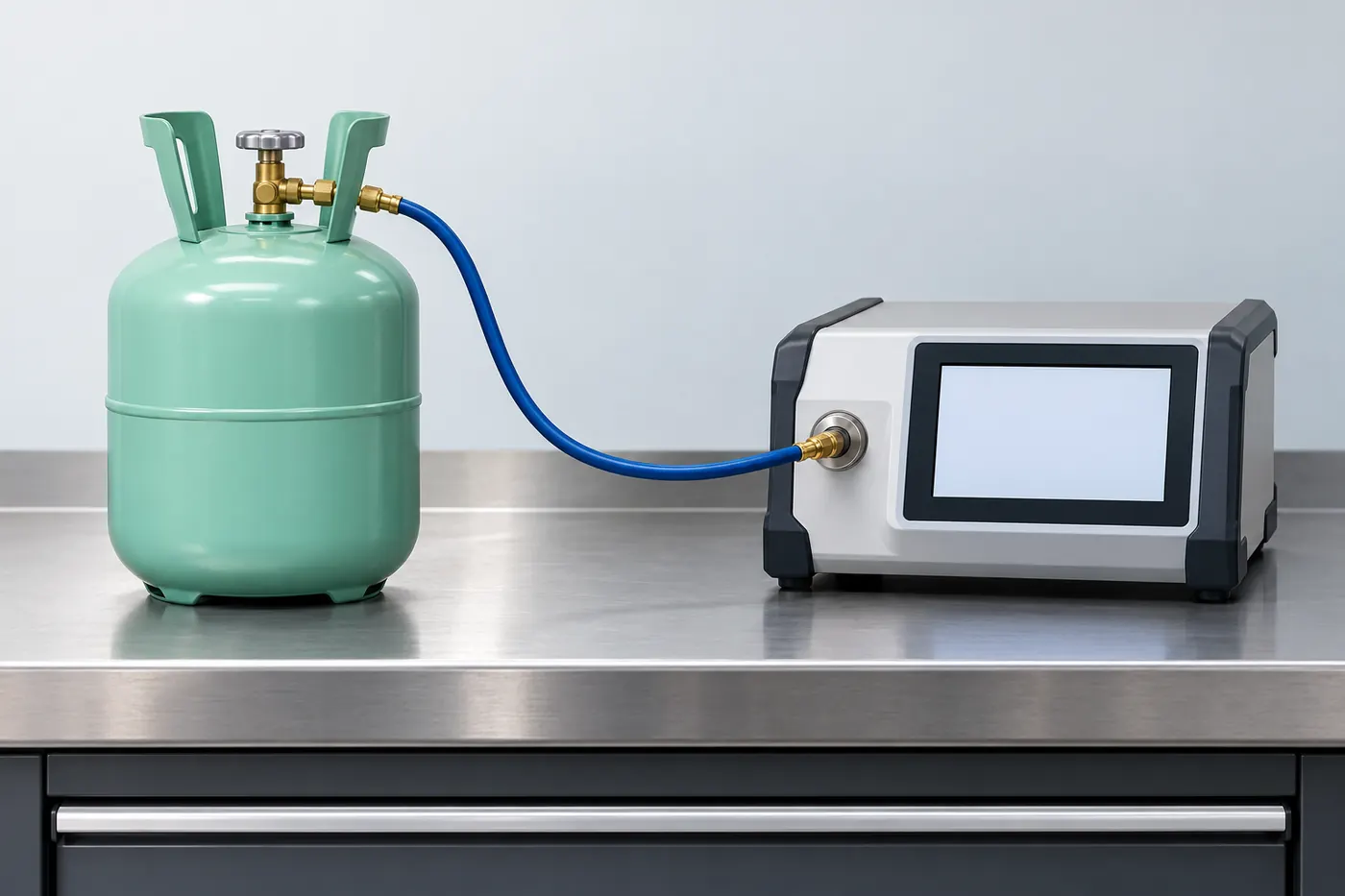
This is why “identifies refrigerants” is too broad as a procurement requirement. A useful request names the refrigerants and blends likely to be encountered, the service environment, sample connection, required decision and acceptable uncertainty. In automotive work, a device intended for a particular pair of refrigerants should be evaluated against the current applicable vehicle-service standards and its manual. Do not infer that it covers supermarket blends, hydrocarbons or every future substitute merely because it can identify two common car A/C fluids.
An identifier is also not a leak locator. It samples from the contained fluid at a controlled connection. A tiny leak at a coil can exist even when the identifier correctly reports the charge. Likewise, a leaking circuit may contain a wrong mixture; the leak probe and identifier would both be needed to answer the two questions.
A representative sample is part of the result
The instrument can only analyze what enters its inlet. A sample contaminated by a dirty hose, residual refrigerant from an earlier job, liquid carryover or an inappropriate connection may misrepresent the system. Follow the identifier's specified sampling and purge procedure and use connections suitable for the refrigerant and service equipment. The reader should not infer from a photograph of a generic cylinder-to-analyzer hose that any hose or fitting is acceptable. The exact instrument and service standards govern the connection.
If different parts of a circuit or recovery container might have different phases or mixture behavior, the sampling method matters even more. A blend is not always represented by a casual sample taken without regard to phase and procedure. Record the sample source, conditions, instrument model and result alongside the identity conclusion. If the instrument returns an unsupported or ambiguous response, preserving that uncertainty is more honest than rounding it to the most familiar refrigerant name.
Identity, blend composition and purity are separate claims
Refrigerants include single substances and designated blends. A blend designation refers to a specified composition; a detector calibrated for one component does not automatically identify the blend. If a service sample gives an unexpected result, consider both other refrigerants and noncondensable contaminants within the instrument's capability. The EPA blend-composition resource illustrates that named blends have defined constituents; it is not a substitute for testing the actual cylinder or system.
“Identity confirmed” can be a relatively narrow pass/fail statement. “Composition reported” gives more detail, but its component list and accuracy are bounded by the device. “Purity certified” is a further claim requiring a specified analytical method and acceptance criteria. In the United States, EPA's discussion of recovering, recycling and reclaiming refrigerants links reclaimed refrigerant to the applicable purity standard. A portable identifier or room detector should not be described as certifying reclaimed product unless its method and the applicable specification actually support that claim.
For refrigerant naming and typical families, consult the refrigerant directory as background; use the actual system documentation and an appropriate test when the physical charge is in doubt. A directory describes products and designations, not the contents of a particular cylinder.
What an ambient concentration detector really does
An ambient detector samples air at a point or through a designed sampling line. A target-gas calibration relates the sensor's response to concentration, usually a volume fraction such as ppmv. The number is meaningful only within the instrument's stated range, calibration, environmental conditions and interference limits. It is a property of the sampled air, not a direct measure of charge purity or inventory.
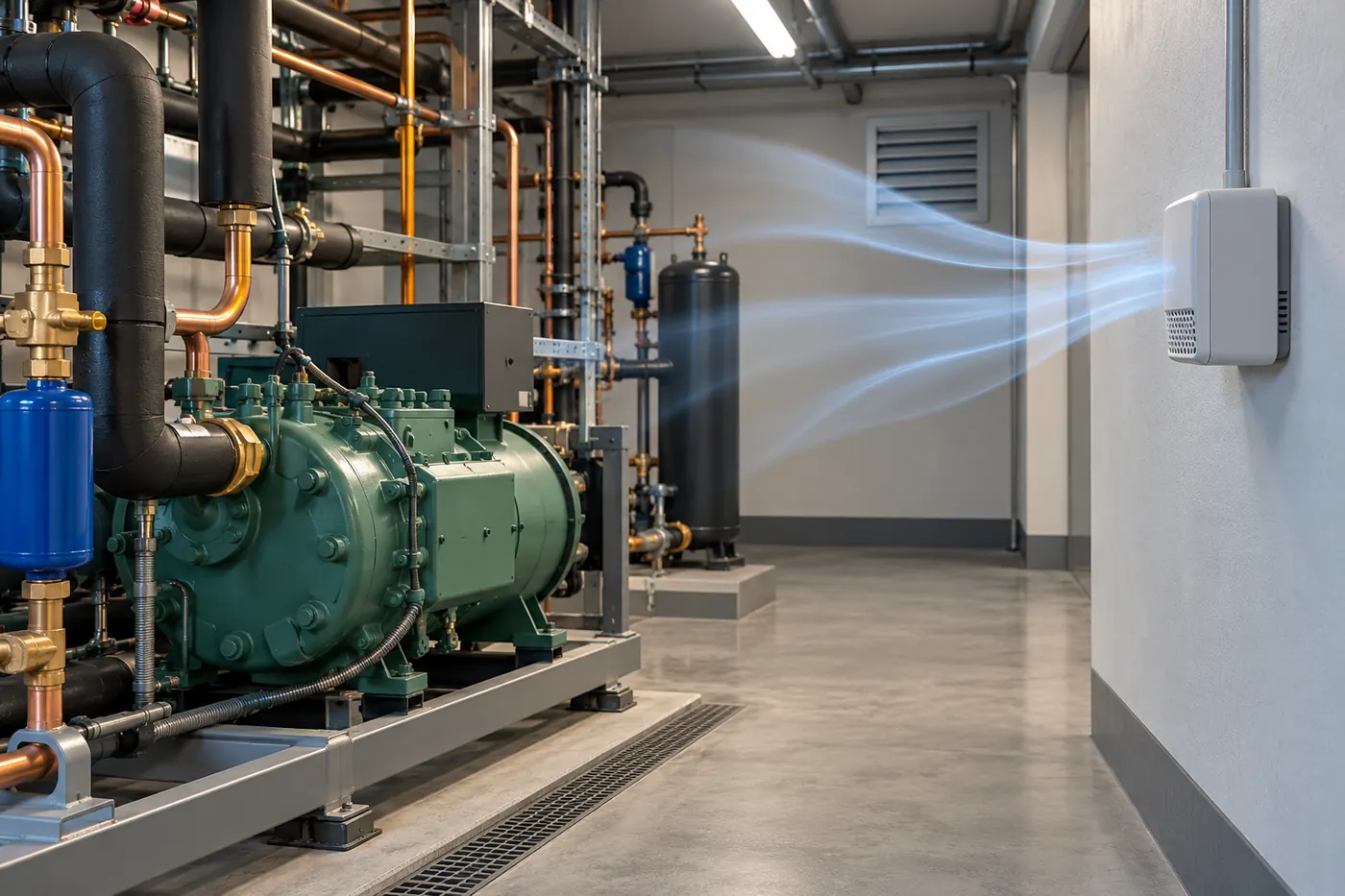
Suppose a wall detector reports an elevated reading. It supports the conclusion that a calibrated response is present at that inlet, subject to cross-sensitivity and fault checks. It does not identify which fitting leaked unless coverage and other evidence narrow the source. It does not prove the circuit contains only the named refrigerant: a detector may respond to a family of gases or to an interferent. If the wall detector reads zero, the result means no reportable response at that inlet under those conditions; it does not certify the entire room or system leak-free.
The EPA's 2026 automatic-leak-detection fact sheet uses direct detection for sensors measuring refrigerant concentration in air and indirect detection for equipment operating parameters. That distinction is useful when assessing a facility proposal. Its legal details apply to the fact sheet's U.S. context; detector design for another market must be checked against its own requirements.
The selected target matters. R-32, R-454B and R-290 are not interchangeable calibrations. A manufacturer may document one module for multiple named gases, but the configuration and tested response need to be explicit. As a model-specific illustration, Winsen describes the ZRT512E as an NDIR module for R-32 and R-454B. That is a useful supported-gas example, not a claim that all NDIR devices identify every refrigerant or measure the actual composition of a blend inside a cylinder.
What a leak-rate claim means—and why ppm is not g/year
A leak locator's published sensitivity may be expressed as a small refrigerant mass release per year under a defined test. A fixed monitor's reading may be ppmv in ambient air. Both can relate to a release, but they are different quantities. Mass flow tells you how fast refrigerant leaves a point; concentration tells you how much target gas is present in a sampled air volume at a particular time and place.
A mathematical conversion would require at least the release dynamics, room volume, mixing, ventilation, temperature, position, probe behavior and time. A real machinery room seldom behaves as a perfectly mixed box during a brief event. Therefore a table that equates “1 g/year” portable sensitivity with “1 ppm” fixed sensitivity without a stated model and conditions is misleading. Choose each instrument by the decision it must make under its own validated test.
The reverse inference is equally unsafe. If a portable instrument detects a small standardized leak in a laboratory, that does not guarantee a fixed inlet across the room will alarm during the same event. Conversely, a high room concentration after a sudden failure tells you that gas reached the inlet, but without a time-resolved ventilation and release model it does not tell you the original hole size. Source location, release-rate estimation and room monitoring can be linked analytically, yet none is a simple unit conversion.
Portable response near a joint can be high while fixed-room concentration remains low. A fixed room alarm can occur after gas accumulates even if a later service search finds no active release. A system can lose charge slowly without a remote detector observing a high concentration. None of these observations is logically inconsistent.
Why refrigerant pressure is a clue, not an identifier
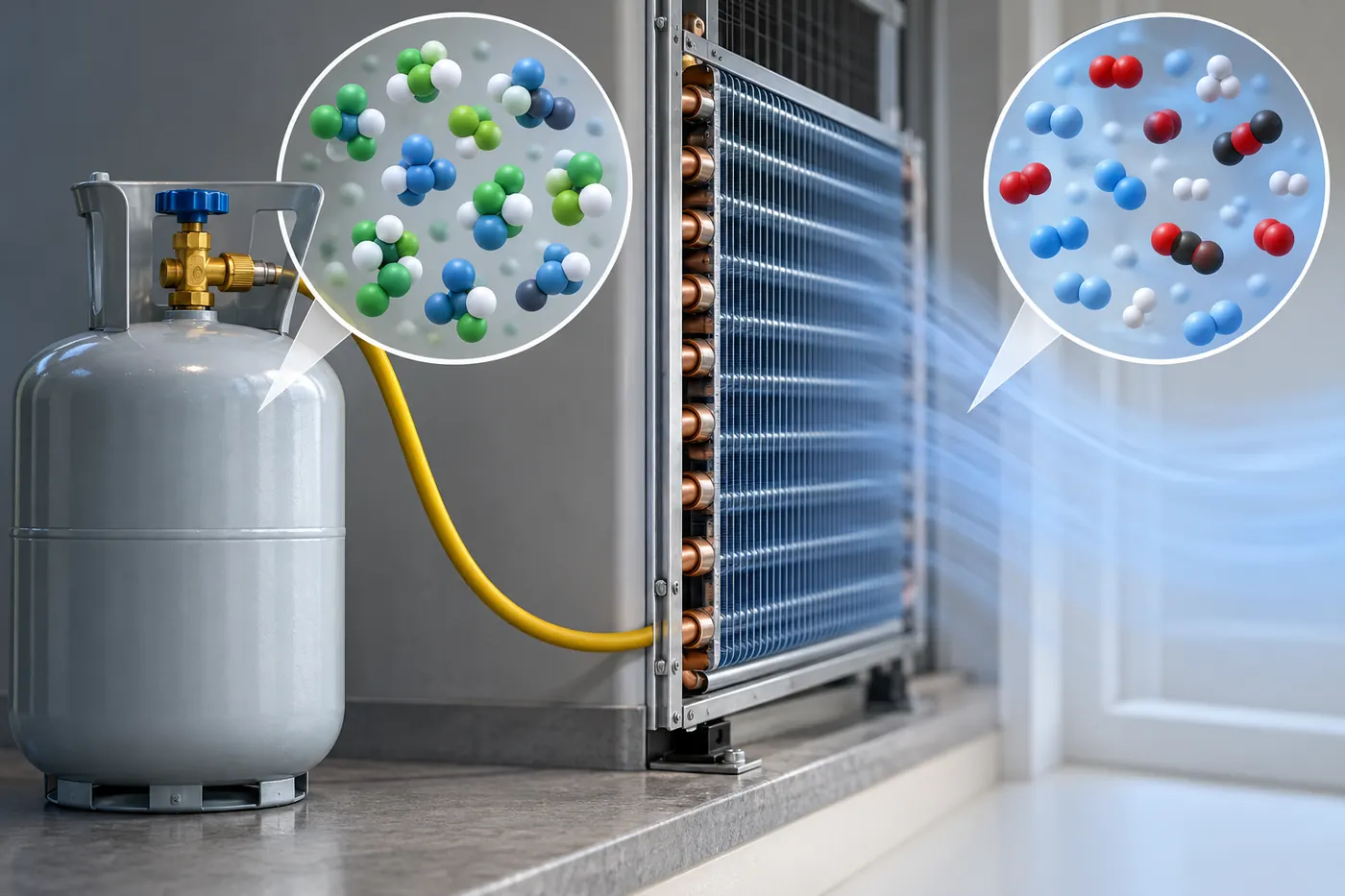
Pressure depends on temperature, operating state, phase and mixture. It can signal a system problem, but one pressure reading cannot uniquely establish which refrigerant is present. Different fluids can produce overlapping pressures under different conditions; a contaminated blend can behave differently from the expected fluid; a running system adds load and control effects. The EPA explicitly notes in its MVAC contamination guidance that pressure may alert a technician to something unusual but does not guarantee recognition of an alternative or contaminated refrigerant.
Similarly, a service-port fitting or color code is a preventive design feature, not an analytical test of present contents. Past service or contamination can defeat the assumption. In a controlled service process, the label and fittings tell you what should be there; the identifier helps test what the sample actually contains within its scope. That distinction protects both diagnostic quality and downstream recovery equipment.
Indirect monitoring can use pressure together with temperature, liquid level, flow and operating context to infer a leak. Such analytics can be valuable, but their output is not an ambient ppm measurement and not a composition report. The inferred event still needs investigation and appropriate confirmation.
Select an instrument by writing the decision first
Use this short decision path before comparing products:
- Is the question about the sealed charge? If you must know whether a cylinder or system contains the expected refrigerant before recovery or charging, choose an identifier with the supported gases and sample procedure needed for that task. If formal purity is required, specify the applicable analytical standard and facility.
- Is the question about air in a space? If you need continuous observation or an alarm at selected air locations, design an ambient fixed or aspirating system for the actual target gas and site. Identify what downstream action follows the alarm.
- Is the question about the exact leak point? Use a portable locator and appropriate search/repair procedure. Check the test basis for its sensitivity and the likely background interferents.
- Is the question about system loss without an air sample? Evaluate equipment operating data and an indirect method, then define how an inferred event is confirmed and located.
- Are two or more questions present? Use complementary tools. One device's marketing claim does not erase the different sample requirements.
For the broader sensor selection, see what a refrigerant sensor should measure.
Build a defensible identifier specification
The following questions make a purchase specification more useful than a broad “refrigerant analyzer” request.
Supported gases and blends. List the actual systems serviced. Ask whether the device is validated for each pure refrigerant and designated blend, and whether it reports an unsupported result rather than forcing a misleading nearest match.
Result granularity. Decide whether a simple pass/fail screen is enough or whether component percentages and contaminant flags are required. A detailed-looking display is only useful if the method and uncertainty support the service decision.
Sampling interface. Confirm the service connection, pressure/temperature limits, sample volume or flow requirements, and what happens if oil, moisture or liquid reaches the instrument. Follow the manufacturer's service instructions and applicable handling rules.
Maintenance and quality control. Identify calibration or self-check requirements, filters, software library updates and records. An old library may not include the refrigerant actually encountered. A successful power-on is not a full performance check.
Scope of an unexpected result. Decide how the shop will isolate, recover and document an unknown or contaminated charge. In the EPA's MVAC context, contaminated-refrigerant guidance discusses recovery and handling; follow the rules that apply to your location and equipment rather than treating a web article as a service procedure.
Build a defensible concentration-monitor specification
For a fixed gas monitor, the purchase specification is different. Name the refrigerant and measurement range. State whether the result is used for early maintenance notice, room warning, equipment mitigation, or another specific purpose. Request model-specific accuracy and response conditions, cross-sensitivity, environmental limits, expected lifetime, diagnostics, and alarm/fault outputs.
Then specify the installation: point location or aspirating inlet, airflow assumptions, cable/tube routing, controller interface and maintenance access. The UK Energy Technology List's permanent detection guidance describes fixed-point and aspirating designs and the importance of refrigerant-specific calibration. Its criteria belong to that program, while the architecture comparison is broadly instructive.
A fixed detector can be technically capable yet poorly deployed. If air from a likely leak cannot reach its inlet under a critical ventilation state, sensitivity on the bench cannot compensate. Conversely, an ideally placed sensor with the wrong gas calibration or no fault supervision is incomplete. Acceptance should test the installed chain from sampled air through indication, alarm, controller action and fault reporting according to the product and applicable rules.
Check the measurement result against its decision threshold
When a concentration number is used to make a decision, ask for uncertainty at the relevant point, not merely full-scale range. A detector intended to raise an early service notice may have a different threshold, filtering and nuisance-alarm tolerance from one integrated into a specific equipment mitigation function. A spec sheet may state accuracy only at reference temperature, while the mounted unit experiences temperature swings, condensation or solvent vapors. Those conditions can affect zero, sensitivity and response; the commissioning record should state which were validated and which remain operational limits.
For blends, configuration deserves particular attention. A device may offer several gas selections and display a number for each, but selection must match the installed refrigerant and manufacturer calibration. A change in refrigerant at a site should trigger a review of sensing, alarm configuration, labels, service tools and response procedures. Merely changing the name in a control dashboard does not update the physical sensor's calibration.
Three examples where the wrong test would mislead
A car A/C system with an uncertain service history
The vehicle label says one refrigerant, but past charging is unknown. A handheld sniffer may find a leaking service connection; it cannot establish what is inside the system. An appropriate MVAC identifier can test the charge before recovery or recharge. If the result is outside the instrument's supported scope, the shop needs a process for unknown or contaminated refrigerant. Checking pressure or relying on the port fitting alone is insufficient, as the EPA explains.
A machinery room alarm after hours
The fixed detector reports refrigerant at its inlet and alerts the responsible person. That is evidence of an ambient event, subject to instrument checks. It does not name the source. A technician later uses a portable tool to inspect the refrigeration circuits. If a recovered cylinder from the repair is to be reused or reclaimed, composition and purity may become separate downstream questions. One alarm cannot answer all of them.
A new appliance designed for a specified A2L refrigerant
The OEM chooses an embedded detection module for a defined equipment mitigation function. The manufacturer supplies gas-specific data and the OEM validates its installed position and control sequence. A refrigerant identifier may be relevant to service and charge verification, but it is not a substitute for the embedded detector. A room monitor may address a different facility risk, but it does not automatically fulfill the appliance's design requirement. The actual refrigerant designation and equipment documentation determine the applicable scope.
Interpret four commonly misunderstood results
“Identifier pass.” The controlled sample met the identifier's defined rule for supported gases. It does not prove a whole system is leak-free, and it may not certify all purity constituents.
“Room concentration zero.” The monitor saw no reportable response at its inlet under current conditions. It does not establish that every point in the room has zero refrigerant or that the sealed system contains the right fluid.
“Portable leak alarm.” The probe responded near a location. The technician should investigate and confirm the source with the appropriate method; the alarm is not a universal quantitative estimate of annual loss.
“Abnormal pressure trend.” Equipment behavior warrants investigation. The trend may reflect leak, load, control state or another fault. It is not a chemical identity measurement and not a room-air reading.
An expert report should state the sample, instrument model/configuration, measured quantity, unit, conditions and decision drawn. Leaving out the sample can make a correct instrument reading misleading to the next person who sees it.
Frequently asked questions
Can a refrigerant gas detector identify an unknown cylinder?
Usually no. An ambient detector is calibrated to respond to target gases in air. A cylinder identifier draws and analyzes a controlled sample of the contained fluid. Use an identifier with a documented supported-gas list and handling procedure for an unknown charge.
If an identifier reports R-134a, is the refrigerant pure?
Not necessarily. The result means what the particular identifier's method and acceptance rule say it means. It may not measure every impurity or resolve every blend. If purity to a formal specification matters, use the required analytical method and acceptance criteria.
Does a ppm alarm tell me how many grams leaked?
No. Ppmv is the concentration of gas in sampled air; grams describe mass. Estimating released mass requires a model or additional measurements of ventilation, volume, mixing and time. A single point reading is not enough.
Can pressure confirm which refrigerant is charged?
No. Pressure depends on temperature, phase and system operation, and different fluids or mixtures can overlap. It can raise suspicion, but an appropriate identification test is needed when identity affects service.
Is a blend one target or several targets for a sensor?
That depends on the sensing method and calibration. A blend has specified constituents, while an ambient detector may respond differently to those constituents. Ask the manufacturer for validation on the exact designated blend and intended measurement range rather than assuming a single-component response applies.
What should I do if the identifier says “unknown”?
Treat it as an unresolved identity question. Follow the instrument and equipment instructions and the applicable refrigerant-handling rules. Do not relabel it as the expected fluid merely because a pressure reading seems plausible. A qualified facility may need a more capable analytical method.
Sources and related reading
- U.S. EPA: Handling contaminated automotive refrigerants — identity, label/pressure limitations and identifier scope in MVAC service.
- U.S. EPA: Compositions of refrigerant blends — designated blends have component compositions.
- U.S. EPA: Recovering, recycling and reclaiming refrigerants — distinguishes service handling from reclamation/purity requirements in the U.S. context.
- U.S. EPA: Automatic Leak Detection Requirements fact sheet — direct ambient detection and indirect equipment monitoring.
- UK Energy Technology List: Automated permanent refrigerant leak detection systems — fixed-point and aspirating designs.
For specific gas-sensor families, GasNose's refrigerant sensor overview is a relevant extension. For product and fluid names, the refrigerant directory can orient the first check; neither replaces an identifier result or the exact instrument datasheet.
Portable vs Fixed Refrigerant Detection: How Their Jobs Differ
Compare handheld leak locators, fixed-point monitors and aspirating systems by sample location, response chain and commissioning needs.
Read More
How Humidity Affects Optical PM2.5 Sensor Readings
Learn why humidity, water uptake, fog and condensation can affect optical PM2.5 estimates and how to investigate and validate a humid-air spike.
Read More
How to Interpret CO2 Readings in a Vehicle Cabin
Read vehicle-cabin CO2 trends alongside passengers, HVAC mode and route conditions while separating ventilation clues from particle and exhaust safety questions.
Read More
Gas Heater Monitoring at Home: Which Alarm and Sensor Does What?
Understand the separate roles of a household CO alarm, fuel-gas detector, CO2 monitor and qualified heater service, including what to do after a warning.
Read More
How to Plan IAQ Monitoring in Shared Indoor Spaces
Plan indoor-air-quality monitoring for libraries, waiting areas and shared rooms by matching CO2, particles and other channels to a defined decision.
Read More
How to Build a School IAQ Monitoring Record That Leads to Action
Use linked room, occupied-event and issue logs to turn school CO2 observations into reliable ventilation follow-up.
Read More
Comments (2)
[…] 2. Confirm the actual refrigerant. Use the equipment documentation and service records. If the charge is uncertain, an appropriate identifier may be needed; a leak detector is not a composition analyzer. See refrigerant identification versus concentration measurement. […]
[…] The last row is deliberately included because an identifier is often called a refrigerant detector in casual conversation. Its sample is the contained refrigerant, not the air around equipment. We examine it in detail in refrigerant identification versus concentration measurement. […]