
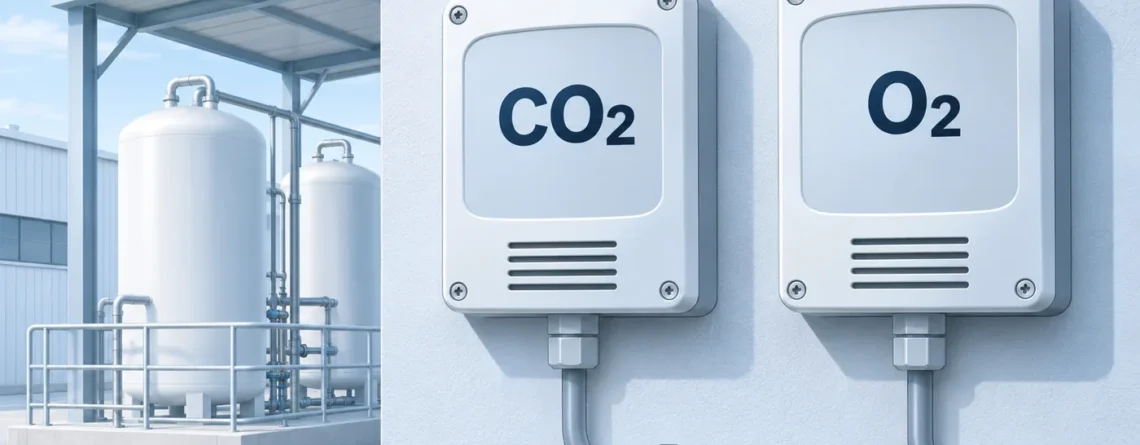
二酸化炭素モニターは CO2 を測定します。酸素モニターは O2 を測定します。どちらの測定値も、実際の職場における他のガス濃度を確立するものではありません。酸素が酸素欠乏警報閾値を超えたままである間、CO2 の放出は有害な暴露を引き起こす可能性があります。窒素またはアルゴンは、対応する CO2 の増加を引き起こすことなく酸素を置き換えることができます。両方の放出メカニズムが信頼できる場合、モニタリング評価では両方の測定値とその個別の制限に対処する必要があります。
この区別は、仕様書に「窒息監視」のみが記載されている場合に重要です。このフレーズは危険な結果を説明するものであり、完全な測定要件を説明するものではありません。設計には、特定されたガスの在庫、定義されたシナリオ、適切な機器、および測定値と保護措置の間の文書化された関係が必要です。馴染みのあるデバイス名や通常のディスプレイでは、これらのギャップを埋めることはできません。
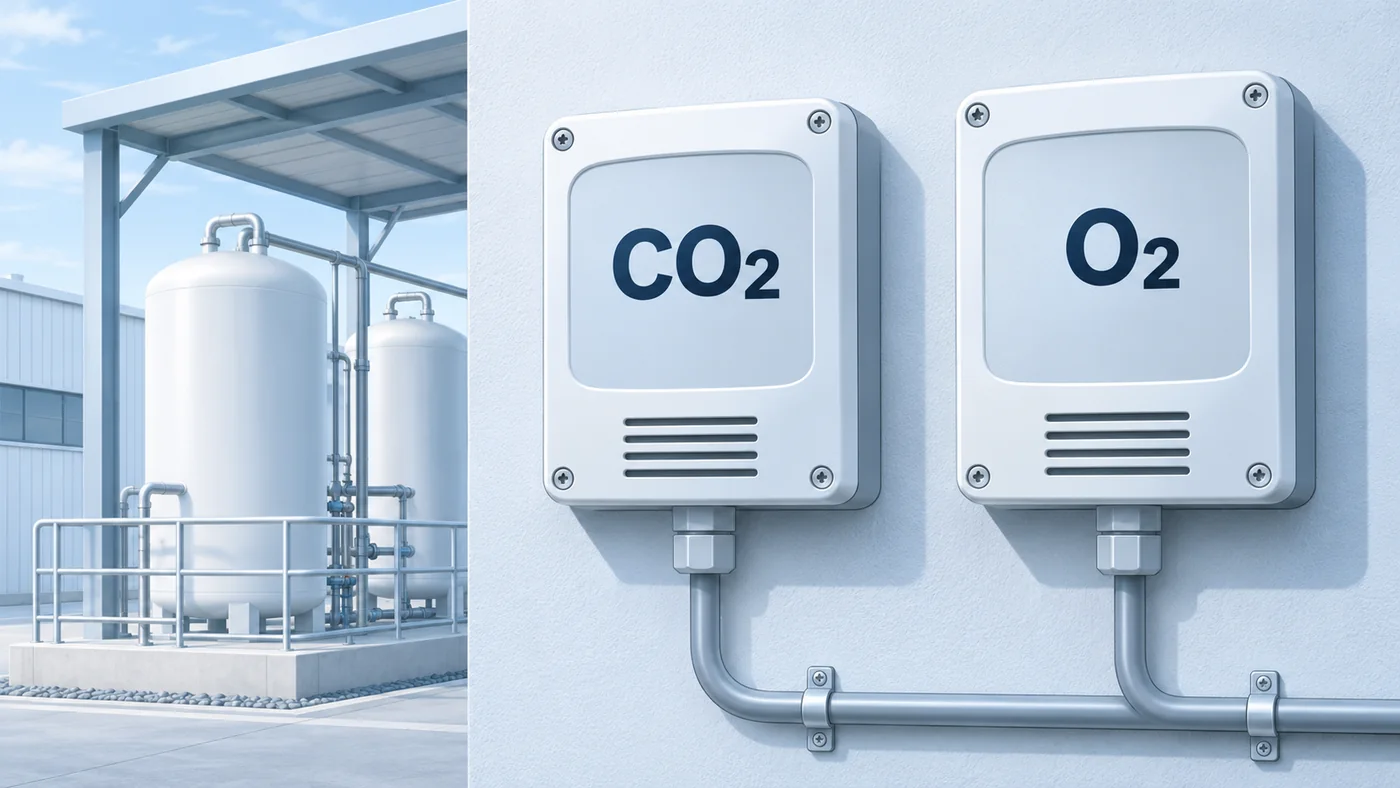
窒息という言葉の背後にある 2 つの異なる疑問
最初の問題は、大気中に意図した活動に十分な酸素が含まれているかどうかです。 2 つ目は、特定の物質が許容できない暴露を引き起こすかどうかです。これらの質問は、互換性を持たずに重複する可能性があります。 CO2 にはそれ自体の生理学的効果があります。その重要性は、それが置き換える酸素の量に還元することはできません。の NIOSH 二酸化炭素エントリー 呼吸器および心血管への影響、および窒息を特定します。したがって、その暴露基準は CO2 濃度に直接関係します。
たとえば、近くに CO2 源がない場合でも、窒素供給障害が発生すると空気の組成が変化します。酸素チャネルは指定された能力内で酸素欠乏を検出できますが、CO2 チャネルは以前の測定値に近い状態を維持する可能性があります。逆に、CO2 を追加しても、CO2 への直接曝露が重要になる前に酸素の大部分を除去する必要はありません。デバイスを選択する前に、監視の目的を別のステートメントとして記述する必要があります。
An engineer might write “detect a credible CO2 accumulation in the cylinder room” and “detect oxygen depletion associated with the separate nitrogen installation.” Each statement needs a location basis and a response definition. Combining them into “install an air-quality monitor” removes essential information about what must be measured and why.
A dilution calculation explains the mismatch
部屋のモデルやアラームの推奨事項ではなく、意図的に単純化した計算を検討してください。 20.9% の酸素を含む均一な雰囲気から始めます。燃焼、生物学的酸素消費、圧力変化、選択的除去を行わずに、その大気の 1% を純粋な CO2 に置き換えます。残りの酸素割合は、約 20.9% に 0.99 を乗算した値、つまり 20.691% です。追加される CO2 は、元のバックグラウンド寄与とは別に、体積で約 1%、10,000 ppm に相当します。
この計算は、重要な数学的点を示しています。つまり、CO2 の大幅な変化は、酸素パーセントの絶対変化のはるかに小さな変化を伴う可能性があるということです。許容可能な暴露量を確立するものではありません。誰もこの計算を使用して、占有を許可したり、アラーム時刻を予測したり、センサーの場所を選択したりしないでください。実際の放出には、流量、温度、混合、換気、および局所的な濃度勾配の変化が含まれます。
次に、同じ部分を窒素に置き換えます。計算された酸素削減量は同様ですが、対応する CO2 増加は必要ありません。したがって、逆計算は不十分です。酸素の測定値だけでは、どのガスが空気を置換したかは特定できません。 CO2 の測定値だけでは、腐食、燃焼、またはその他のプロセスによって消費される酸素は考慮されません。表示される濃度は、実際の測定とシナリオに関連付けられて初めて意味を持ちます。
警報の決定から暴露基準を分離する
Exposure references have jurisdiction, averaging period, and purpose. An occupational time-weighted average is not automatically an instantaneous alarm setpoint. A short-term limit is not a universal evacuation threshold. A definition of an oxygen-deficient atmosphere is not a complete specification for a fixed detector system.
For United States general-industry permit spaces, OSHA 1910.146 defines oxygen deficiency below 19.5% oxygen by volume and includes other hazardous-atmosphere criteria. Its scope excludes construction, agriculture, and shipyard employment. The definition is relevant within that framework; it does not mean that every atmosphere above the number is safe or that every application must adopt the same alarm arrangement.
の HSE CO2 hazard guidance 英国に言及し、COSHHに基づく職場での暴露制限を指摘している。その短期基準は NIOSH 勧告とは異なります。この違いは、検索結果から値をコピーするのではなく、管理管轄区域と参照を識別するのに役立つ注意事項です。承認されたシステム設計では、遅延、ラッチ、確認応答、およびリセット動作を含む、すべてのしきい値のソースと目的を文書化する必要があります。
リリースインベントリから始める
飲料の CO2 供給を、窒素発生装置、ドライアイスの取り扱い、溶接シールドガス、発酵、冷凍回路から区別できるように、在庫を具体的に作成します。シリンダー数だけでは、部屋の外に接続されているソースを見逃す可能性があります。通常のプロセス記述では、メンテナンス状態や回線の切断が見逃される可能性があります。責任ある評価では、初期設置時だけでなく使用時における信頼できる変化も考慮する必要があります。
Useful fields include gas identity, supply form, connected equipment, normal operating area, possible release locations, adjacent occupied spaces, and the person responsible for confirming changes. Quantity and pressure may influence the assessment, but this article does not turn them into a simplified detector-count formula. The purpose of the inventory is to make hidden assumptions visible for the designer.
Where the material is a mixture, obtain its actual identity and relevant safety documentation. “Inert gas” is not a channel specification. A shielding-gas mixture containing CO2 can raise both direct exposure and oxygen-displacement questions. A mixed installation may require separate instruments or a suitable combined system; the answer depends on the hazards and the capabilities of the exact equipment, not the label on the enclosure.
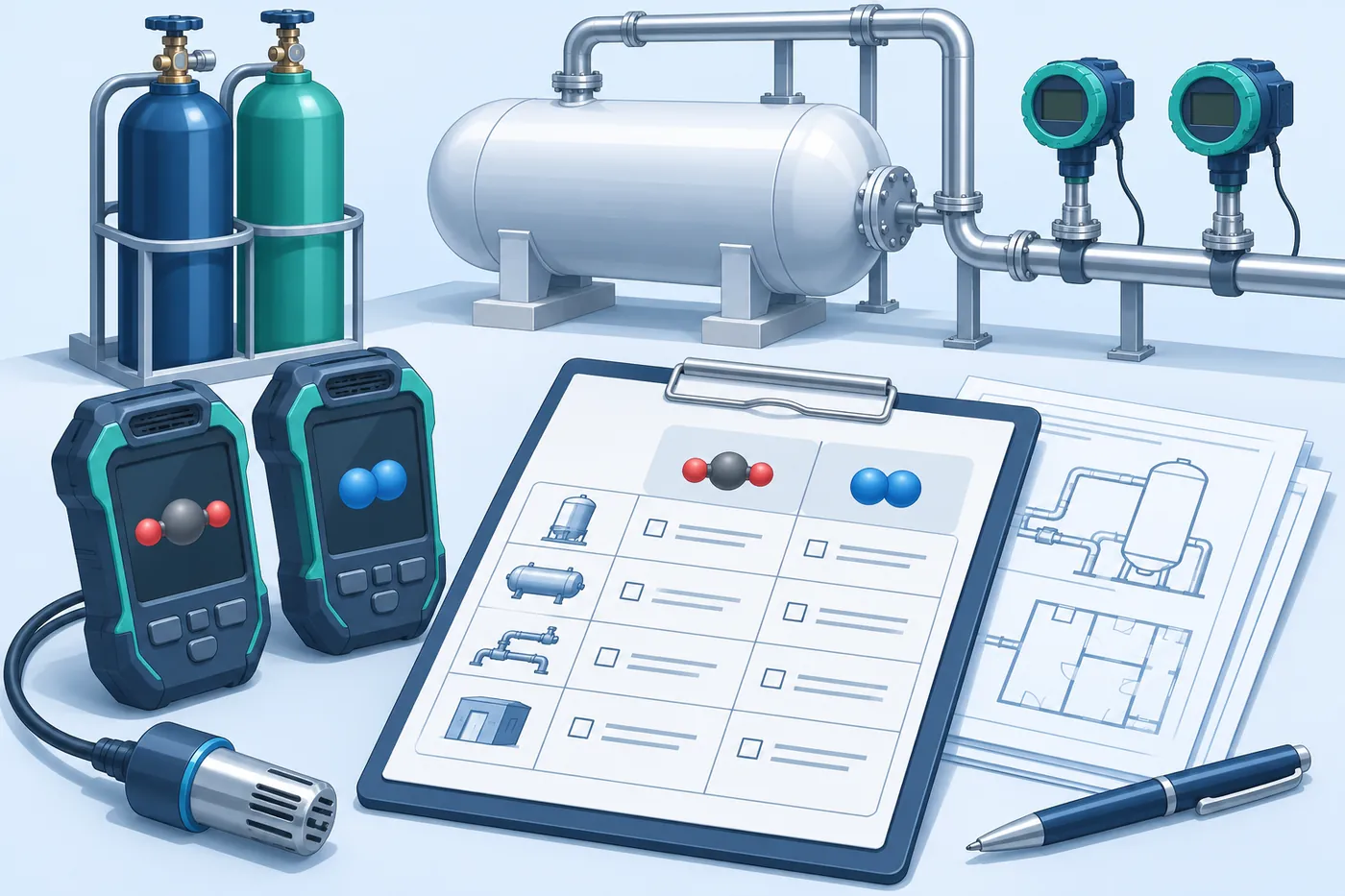
Compare objectives before comparing products
| Assessment question | 要求する証拠 | What cannot be inferred |
|---|---|---|
| Is CO2 accumulation credible? | Gas inventory, process description, release assessment | A normal O2 reading does not exclude direct CO2 exposure |
| Is oxygen depletion credible? | Inert-gas sources and oxygen-consuming processes | A normal CO2 reading does not establish adequate oxygen |
| Is the space represented by the sensor? | Location rationale, air movement and obstructions | One point does not characterize every connected space |
| Will people receive the warning? | Notification layout and defined response | A detector LED does not prove an alarm is understood |
| Is the system available? | Fault behavior, power provisions and maintenance evidence | A blank or stale display is not a healthy measurement |
| Is the design applicable locally? | Adopted requirements and project approvals | A manufacturer application guide is not local adoption |
Use the table to establish the questions that a supplier must answer. It is not an equipment qualification checklist by itself. A proposal may be technically capable of measuring both gases and still leave the location basis or warning interface unresolved. Those omissions affect the usefulness of the installed system even when each sensor performs correctly on a bench.
An indoor-air-quality monitor has a different job
An occupied-room CO2 trend can help assess ventilation when people are the relevant source and the space is suitable for that interpretation. That does not make the same instrument a safety detector for a gas-release scenario. The HSE ventilation guidance explicitly separates ventilation assessment from CO2 as a hazardous substance and identifies limitations where processes produce CO2.
For procurement, identify the actual intended use of the instrument. Review its range, output behavior, power dependence, environmental limits, maintenance instructions, and available alarm functions. A display intended to prompt occupants to open a window may have a very different role from a continuously supervised detection system connected to notification or other protective equipment.
Avoid translating a ventilation traffic-light color into a safety conclusion. The color may reflect a manufacturer-selected ventilation category, a user configuration, or a cloud service rule. It does not establish that the instrument has the required concentration range, fault response, or suitability for the assessed gas hazards. Read the exact manual and the project requirements together.
Location depends on the release and the room
Gas density matters, but it does not produce a universal mounting height. Cold releases, jets, obstructions, ventilation patterns, equipment enclosures, doors, and openings can change how gas reaches a sensing point. A drawing should explain why a location represents the scenario that the instrument is intended to detect.
の HSE welding guidance explains that turbulence and gas movement can disrupt simple assumptions about gases rising or sinking. This is particularly relevant when a design relies only on “CO2 is heavier than air.” The statement is a physical property, not evidence that a single low-mounted detector will cover every release or breathing location.
Review adjacent spaces as interfaces. Gas can migrate through openings while people enter from a different direction. The place where a warning must be received can therefore differ from the place where concentration is measured. The location review should address both. It should also consider whether planned storage, cleaning, or new equipment could block the sensor or obscure notification after handover.
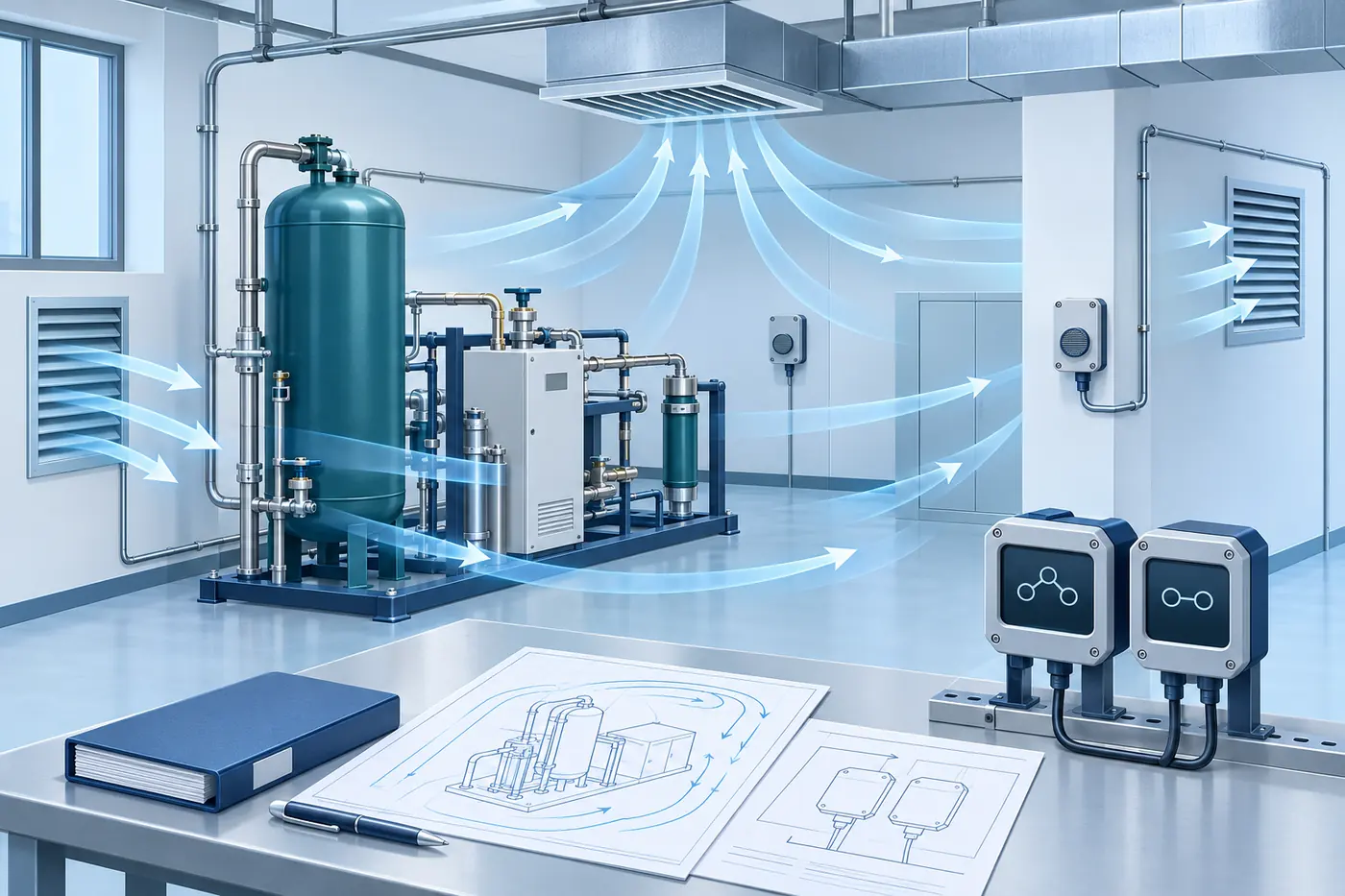
組み合わせた機器を 2 つの測定チェーンとして扱う
CO2/O2 機器を組み合わせると設置が簡素化されますが、エンクロージャを共有しても各チャネルを確認する必要がなくなるわけではありません。実際に設置されているセンサー、サポートされる範囲と単位、各仕様が適用される条件を確認してください。表示されているチャンネルがアクティブであること、および出力がそれを明確に識別していることを確認してください。
The two measurements may have different sensing principles, service requirements, interference limits, and failure indications. A common power supply or controller also creates shared dependencies. The technical review should identify which faults remove one measurement and which remove both. A single green status light is insufficient evidence unless its meaning is documented for that precise configuration.
サンプリングされたシステムの場合は、サンプリング入口から各感知要素までの完全なルートを含めます。チューブ、フィルター、ポンプ、付属品はサンプルの配送に影響を与える可能性があります。該当する製造元の指示は、ガス、材料、長さ、配置をサポートしている必要があります。ポンプを備えたマルチガス検出器が、その入口に物理的に適合するチューブを介してすべてのガスを正確に測定するとは考えないでください。
集中単位を見えるようにする
CO2 は通常、ppm または体積パーセントで表示されます。酸素は通常、体積パーセントで表示されます。 1 体積パーセントは、同じガスおよび濃度ベースでは 10,000 ppm に相当します。この変換は、CO2 濃度を酸素濃度に変換するものではありません。単一の量の表現方法が変わるだけです。
文書には、各チャネルのガスのアイデンティティと単位がまとめて示されている必要があります。建物管理インターフェイスでは、一般的な「ガスレベル」ラベルが混乱を招きます。統合レビューでは、スケーリング、有効範囲、障害の表示、および表示された値が現在の値であるかどうかも確認する必要があります。正しい数値と間違った工学単位を組み合わせると、重大な誤った解釈が生じる可能性があります。
Check the same details in exported trends and alarm messages. A controller may retain a meaningful local display while a downstream system applies the wrong range. A record that says “1.2 gas” without channel, unit, timestamp, and quality information cannot support a reliable review. Better documentation makes the reading interpretable without requiring someone to reconstruct the original configuration from memory.
Measurement is only one part of the warning function
A detector can respond correctly while an occupant receives no useful warning. Notification may be outside the relevant area, inaudible in the work environment, visually obscured, or presented with ambiguous wording. A remote signal may reach an unattended workstation. These are system questions, not corrections to the sensor accuracy specification.
The design should connect the identified condition to the required notification and the approved response. It should state who receives the warning, what area it concerns, and how loss of measurement is distinguished from a gas alarm. Any interface to ventilation, isolation, or another system needs its own documented responsibility and acceptance basis.
This article does not prescribe actions for entering, investigating, or rescuing in a suspect atmosphere. Those actions belong to the employer's applicable procedures and competent response arrangements. The documentation review should confirm that the installed warning vocabulary and equipment behavior agree with those arrangements. An alarm that requires interpretation of undocumented codes adds uncertainty precisely when time and attention may be limited.
Availability needs explicit evidence
Ask how the system indicates power loss, sensor fault, blocked sampling, communications loss, maintenance inhibition, and an overdue required check. Not every product detects every failure, so request the documented limitations as well as the advertised diagnostics. A healthy controller does not prove that every connected sensing point is delivering a valid measurement.
メンテナンス記録では、デバイスとチャネル、実行された作業、適用される指示、結果、および未解決の制限を特定する必要があります。 「チェック済み」という言葉が目視検査、ガス反応検証、校正、またはエンドツーエンドのシステムチェックを意味する場合、広義すぎます。これらのアクティビティはさまざまな質問に答えます。校正記録は、外部アラームまたはリンクされた出力が正しく動作したことを自動的に実証するものではありません。
Define ownership of a bypass or disabled channel. The important record is not simply that someone knew about it; the responsible organization needs to know which monitoring objective was unavailable, what authorized arrangements applied, and how restoration was confirmed. Do not invent a universal maintenance interval. The applicable requirements, manufacturer's instructions, service conditions, and assessment determine the schedule.
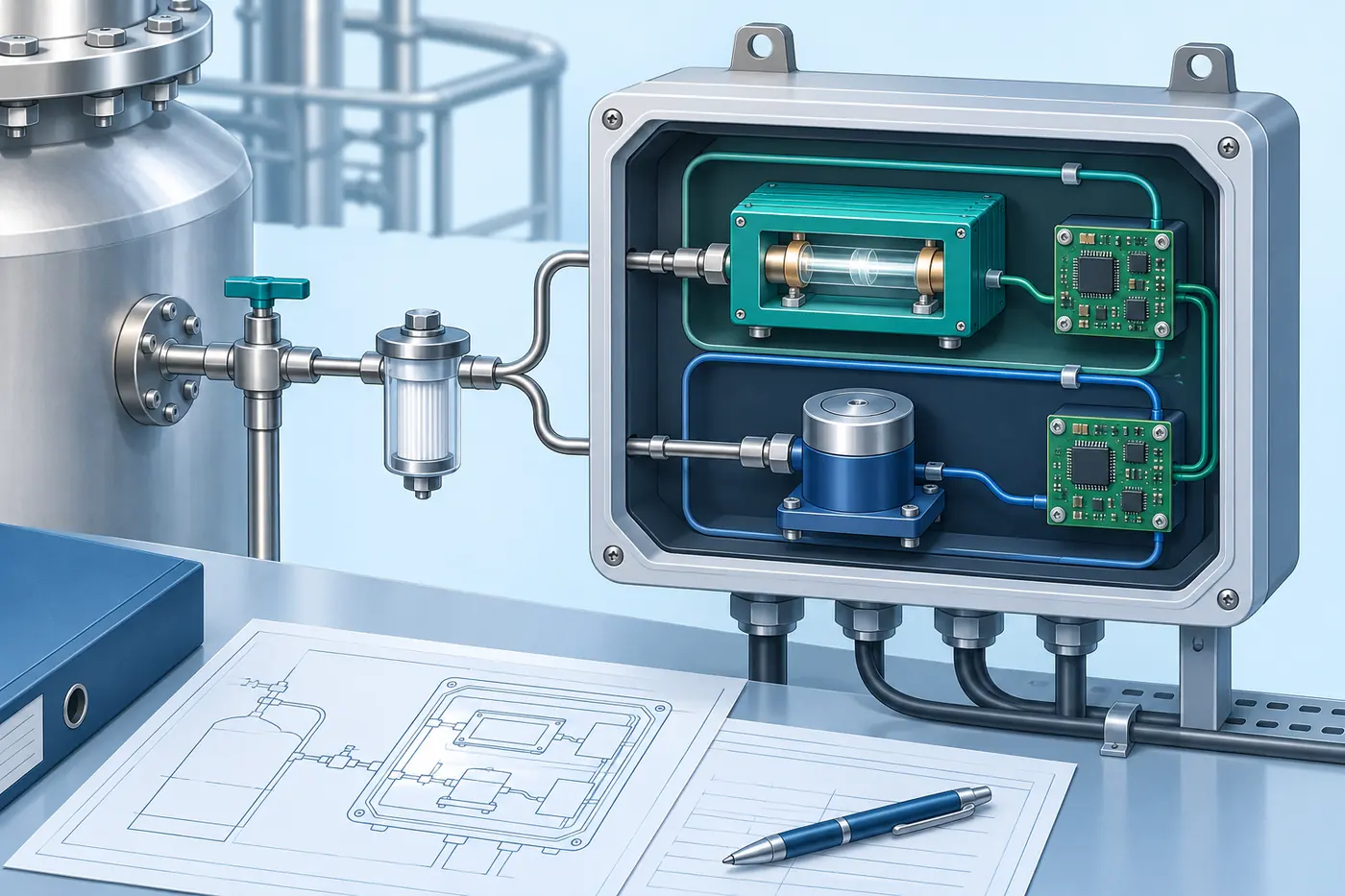
仮説上の混合ガス実験室レビュー
Imagine a laboratory with a nitrogen supply and a separate CO2 incubator supply. The initial request says “one asphyxiation alarm.” The design reviewer first separates the nitrogen release objective from the CO2 release objective. The question becomes whether the proposed equipment and locations can address both, with suitable evidence.
The supplier offers an oxygen detector and a room ventilation display. That proposal does not yet demonstrate a CO2 safety detection function. The reviewer requests the exact intended-use documentation for the CO2 device, the applicable concentration range and alarm behavior, and the rationale for its location relative to the supply equipment and room arrangement. The oxygen detector is reviewed against its own objective and operating conditions.
Suppose the room layout later changes and the cylinders move behind a partition. The original sensor location remains on the drawing, but its reasoning may no longer apply. The change review therefore considers both sensing coverage and notification visibility. This is a hypothetical documentation example, not a claim that the proposed installation is acceptable or that any particular detector count is sufficient.
The practical lesson is to resolve a disagreement at the level of requirements. Asking whether a product is “good” will not reveal that two people mean different hazards by the same word. Asking which scenario each channel covers makes the missing evidence identifiable and allows the responsible designer to address it.
Questions to settle before accepting a proposal
- Which gas release or oxygen-consuming process creates each monitoring objective?
- Which exact channel measures the relevant quantity, and in what units?
- What installed range and performance evidence support the application?
- What conditions, gases, accessories, or environments limit that evidence?
- Why are the proposed sensing locations representative of the assessed scenarios?
- Where must warnings be received, and how are gas alarms distinguished from faults?
- Which local requirements, adopted editions, and manufacturer instructions govern the design?
- What evidence will confirm the installed channel mapping and linked responses?
- Who owns maintenance, configuration changes, and restoration after an impairment?
Record answers as references to drawings, manuals, configuration records, and acceptance evidence rather than as unsupported yes/no statements. A statement such as “complies with standards” does not reveal which gas, edition, clause, or part of the system was assessed. A useful answer can be checked by someone who was absent from the original discussion.
Resolve apparently contradictory readings without inventing a relationship
2 つの測定値は、異なるガス、場所、時間枠、またはデータ状態を表すため、矛盾しているように見えることがあります。数値的な調整を試みる前に、チャネルの ID と各レコードの状況を確立します。ある発生源の近くにある CO2 機器と別の開口部の近くにある酸素機器は、同じ部屋にあるというだけの理由で同じ大気をサンプリングしているわけではありません。リモート トレンドでは、ローカル表示とは異なる更新間隔が使用される場合もあります。
The first useful comparison is documentary. Match the gas, unit, timestamp, location and configuration. Identify whether each value was valid, stale, inhibited, over range, or associated with a fault. A communications system that retains the previous value during an outage can create an apparently steady reading after the underlying measurement is unavailable. That is a data-quality issue rather than evidence that the atmosphere remained unchanged.
Next, review whether the proposed relationship is physically justified. The simple dilution example earlier assumes a particular replacement gas and uniform mixing. A real workplace may contain multiple gas sources, oxygen-consuming processes and changing ventilation. No unique CO2 concentration can be calculated from a single oxygen measurement without those assumptions and sufficient supporting information. Similarly, an increase in CO2 does not quantify every other atmospheric hazard.
Where an instrument's fitness is uncertain, use the organization's arrangements for that condition and the applicable manufacturer instructions. Do not adjust a channel or invent an offset simply to make two readings agree. A good investigation produces an explanation linked to the actual measurement chain, or explicitly identifies the evidence that remains missing. Numerical agreement obtained by unsupported configuration changes is not a reliable resolution.
Define coverage claims at handover
A handover statement should describe the monitoring function with its boundaries. For instance, it can identify the accepted CO2 sensing points, the separate oxygen sensing points, their associated alarm zones, the accepted configuration revision, and the records that demonstrate the required interfaces. It should also identify limitations that affect interpretation, such as areas outside the assessed coverage or functions outside the supplier's scope.
The wording matters. Saying that a building is “protected against asphyxiation” is broader than most equipment evidence can support. It can conceal missing channels, unassessed rooms, or scenarios outside the original design. Saying which measurement functions were accepted under a defined assessment lets the owner understand what a later process change might affect. This is a practical description of evidence, not a new performance certification.
測定場所と作業パターンの関係を見直します。通常占有されている部屋用に設計された警告配置は、同じ部屋が断続的に占有されている保管庫になった場合には、異なって解釈される可能性があります。新しいドア、機器の筐体、または換気の変更は、ガスの移動や人々が警告を受け取る経路に影響を与える可能性があります。引き継ぎにより、責任ある変更レビューがそれらを調査できるように、元の仮定にアクセスできるようにする必要があります。
Ownership should cover the continuing function rather than only the equipment. Someone must own the inventory changes, another person or team may maintain the instruments, and an integrator may control remote display mapping. The organization needs a way for changes in one area to reach the others. Without that connection, each team can maintain its own component correctly while the original monitoring objective becomes less well supported.
Finally, make the accepted records usable during a future review. A device tag should connect to the channel list, location drawing, manual revision, configuration and relevant service history. The alarm zone name should agree with signs and response information. These links reduce the chance that a normal-looking display or familiar room name will be interpreted as stronger evidence than it is. They also help the owner distinguish an equipment fault, an integration issue and a genuine change in atmospheric conditions.

What should a dual-objective review record contain?
A useful record preserves the distinction between the two objectives all the way through acceptance. Give each objective its own identifier, gas or process basis, affected area, intended instrument channel, relevant limitations, and evidence references. If the same enclosure serves both, identify the shared dependencies as well as the separate measurements. This prevents a combined product description from hiding the loss of one channel or a common power dependency.
Keep assumptions explicit. If the location assessment relies on a particular ventilation arrangement or gas-use pattern, identify that condition and the drawing or assessment that supports it. A later reviewer can then recognize that a partition, fan change or new source may affect coverage. An unexplained assertion that the position is correct gives the owner little help when the installation changes.
記録では、測定された状態と解釈を区別する必要もあります。 CO2 の測定値、酸素の測定値、アラーム状態、およびシステムの健全性の表示は別のフィールドです。リモート インターフェイスがこれらを 1 つのサマリーに結合する場合は、基礎となる意味へのアクセスを保持し、障害がサマリーにどのような影響を与えるかを特定します。文書化された定義のない緑色のアイコンでは、どの目標が引き続き利用可能であるかを確認できません。
Finally, connect review outcomes to actual responsibilities. If additional evidence is required, state what is missing and who will resolve it. A reviewer should be able to tell whether the issue concerns equipment capability, location, integration, jurisdiction or operating arrangements. That makes the next decision concrete and avoids repeatedly asking whether the room has an adequate monitor without identifying what adequacy means for either hazard.
よくある質問
Can a normal oxygen reading prove that CO2 is acceptable?
No. Oxygen concentration and CO2 concentration are different quantities. Direct CO2 exposure may matter before the reduction in oxygen reaches an oxygen-deficiency criterion. The relevant CO2 measurement and assessment remain necessary where a credible CO2 hazard exists. A stable oxygen display also says nothing about unmeasured toxic gases or local conditions away from its sampling point.
Can a CO2 monitor detect nitrogen leakage?
It does not measure nitrogen simply because nitrogen can displace air. Some release scenarios may change several gas fractions, but that correlation is not a dependable substitute for the required oxygen measurement. Identify the monitored hazard directly and confirm the chosen instrument's intended use.
Is a dual-gas device always the best option?
No. It may be appropriate if both channels, the common dependencies, installation conditions, and notification functions satisfy the design. Separate equipment may fit another application better. The comparison should address the complete installed function and lifecycle support, rather than the number of gas names printed on a product page.
Does the oxygen-deficiency definition establish that entry is safe above it?
No. Other atmospheric and non-atmospheric hazards may remain, and the applicable entry framework has additional requirements. A monitoring device does not issue a permit or replace the employer's assessment. Scope and jurisdiction must be identified before using any regulatory definition in a project specification.
Where can I read the broader background?
既存のガイドは、 酸素欠乏雰囲気 そして レストランや会場における CO2 の安全性 それらの幅広いトピックを紹介します。ハザードの説明を、証拠に裏付けられた個別のモニタリング目標に変換する場合は、ここでの区別を使用してください。



返信を残す