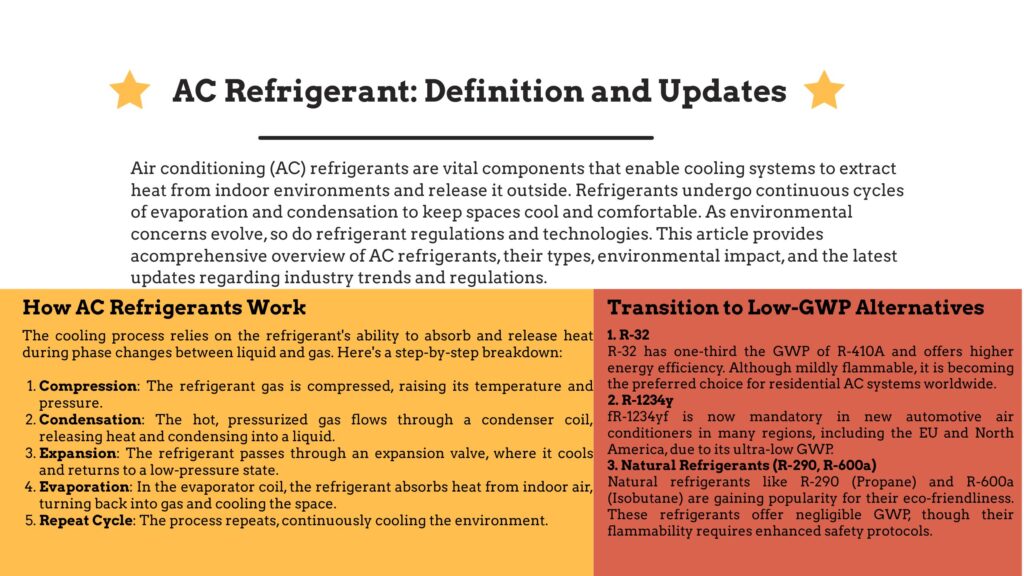
Air conditioning (AC) refrigerants are vital components that enable cooling systems to extract heat from indoor environments and release it outside. Refrigerants undergo continuous cycles of evaporation and condensation to keep spaces cool and comfortable. As environmental concerns evolve, so do refrigerant regulations and technologies. This article provides a comprehensive overview of AC refrigerants, their types, environmental impact, and the latest updates regarding industry trends and regulations.
What is an AC Refrigerant?
An AC refrigerant is a chemical compound used in air conditioning and refrigeration systems to transfer heat. Through a cycle of compression, condensation, and evaporation, refrigerants absorb heat from one area and release it in another, making indoor spaces cooler.
The efficiency of AC units depends heavily on the type of refrigerant used, with factors such as thermal capacity, flammability, and environmental impact influencing refrigerant selection.
Types of AC Refrigerants
AC refrigerants have evolved over time to meet both technological demands and environmental regulations. Below are the major refrigerants used in air conditioning systems.
1. R-12 (CFC-12)
- One of the earliest refrigerants, R-12 was widely used in automotive AC systems and refrigerators.
- Banned globally due to its ozone-depleting potential (ODP) under the Montreal Protocol.
2. R-22 (HCFC-22)
- Used in many residential and commercial air conditioners throughout the 20th century.
- Phased out in many countries due to its high ODP and global warming potential (GWP).
3. R-134a (HFC-134a)
- Introduced as a replacement for R-12, it became the standard in automotive air conditioning.
- While it has zero ODP, its high GWP has led to restrictions in many regions.
4. R-410A
- A common refrigerant in residential and commercial air conditioners, offering higher efficiency than R-22.
- Phased down due to its high GWP, though still used in many parts of the world.
5. R-32 (HFC-32)
- A modern refrigerant with lower GWP and better efficiency than R-410A.
- Gaining popularity as the preferred option for residential air conditioners.
6. R-1234yf (HFO-1234yf)
- Now widely used in automotive AC systems, replacing R-134a due to its ultra-low GWP.
- Classified as mildly flammable, requiring new safety protocols.
7. R-290 (Propane)
- A natural refrigerant with very low GWP, used in both air conditioners and refrigeration systems.
- Highly flammable but gaining acceptance due to its eco-friendly properties.
AC Refrigerant Comparisons: R-410A vs. R-32
| Feature | R-410A | R-32 |
|---|---|---|
| GWP | 2088 | 675 |
| Efficiency | Moderate | High |
| Flammability | Non-flammable | Mildly flammable |
| Environmental Impact | High | Low |
| Adoption | Phasing out | Increasing |
More Refrigerant:
R-1234ze Refrigerant: The Future of Sustainable Cooling Solutions
R-744 Refrigerant: The Natural Cooling Solution
R-717 Refrigerant: Ammonia’s Role in Sustainable Cooling
R-454B Refrigerant: Properties, Benefits, and Future Adoption
How AC Refrigerants Work
The cooling process relies on the refrigerant’s ability to absorb and release heat during phase changes between liquid and gas. Here’s a step-by-step breakdown:
- Compression: The refrigerant gas is compressed, raising its temperature and pressure.
- Condensation: The hot, pressurized gas flows through a condenser coil, releasing heat and condensing into a liquid.
- Expansion: The refrigerant passes through an expansion valve, where it cools and returns to a low-pressure state.
- Evaporation: In the evaporator coil, the refrigerant absorbs heat from indoor air, turning back into gas and cooling the space.
- Repeat Cycle: The process repeats, continuously cooling the environment.
The Role of Refrigerants in Air Conditioning Systems
Refrigerants circulate inside the AC’s compressor, condenser, evaporator, and expansion valve, enabling the system to cool or heat air. As it evaporates inside the evaporator coils, the refrigerant absorbs indoor heat and expels it outdoors through the condenser, making the indoor environment cooler. Without refrigerants, air conditioners wouldn’t be able to perform this essential heat exchange.
Environmental Concerns and Regulations
Global Warming Potential (GWP)
GWP measures the impact of refrigerants on global warming. High-GWP refrigerants like R-134a and R-410A trap heat more effectively than CO₂, making them unsustainable in the long term.
Ozone Depletion Potential (ODP)
Refrigerants like R-12 and R-22 contain chlorine, which destroys the stratospheric ozone layer. Their use has been heavily restricted under the Montreal Protocol to protect the ozone layer.
Regulatory Updates: Montreal and Kigali Protocols
- Montreal Protocol: Focused on eliminating CFCs and HCFCs, including R-12 and R-22, due to their ODP.
- Kigali Amendment: Aimed at phasing down HFCs such as R-134a and R-410A, focusing on reducing their climate impact.
Many countries are now shifting toward low-GWP refrigerants like R-32, R-290, and R-1234yf to meet international climate targets.
Transition to Low-GWP Alternatives
1. R-32
R-32 has one-third the GWP of R-410A and offers higher energy efficiency. Although mildly flammable, it is becoming the preferred choice for residential AC systems worldwide.
2. R-1234yf
R-1234yf is now mandatory in new automotive air conditioners in many regions, including the EU and North America, due to its ultra-low GWP.
3. Natural Refrigerants (R-290, R-600a)
Natural refrigerants like R-290 (Propane) and R-600a (Isobutane) are gaining popularity for their eco-friendliness. These refrigerants offer negligible GWP, though their flammability requires enhanced safety protocols.
Key Industry Trends
- Shift to Green Refrigerants:
The trend is moving toward low-GWP refrigerants to align with environmental regulations and climate targets. - Retrofitting Systems:
As old refrigerants are phased out, many businesses are retrofitting AC systems to work with new refrigerants. - Energy-Efficient Air Conditioners:
Modern refrigerants like R-32 not only reduce environmental impact but also offer better cooling performance, encouraging consumers to switch to energy-efficient models. - Smart HVAC Systems:
The adoption of smart technologies in AC units is making systems more adaptive and sustainable, with refrigerants playing a central role in optimizing cooling efficiency.
Best Practices for Handling AC Refrigerants
1. Leak Detection
Regular inspections ensure that refrigerant leaks are identified and repaired quickly, preventing environmental harm.
2. Refrigerant Recovery and Recycling
Proper recovery equipment ensures refrigerants are not released into the atmosphere during maintenance or disposal.
3. Training and Certification
Technicians handling refrigerants must have certified training to comply with safety and environmental regulations.
-

 Read moreQuick View
FAQ
The Evolution of AC Refrigerants
Early refrigerants like R-12 and R-22 were widely used until it was discovered that they had a severe impact on the ozone layer. The Montreal Protocol led to the gradual phaseout of these refrigerants, prompting a shift to more environmentally friendly alternatives, such as R-410A and R-32.
Why the Shift Towards Low-GWP Refrigerants?
Global warming and ozone depletion concerns have driven the shift towards refrigerants with low global warming potential (GWP). As regulations tighten, manufacturers are adopting natural refrigerants and low-GWP synthetic options like R-32 and R-1234yf to meet environmental goals.
Is R-32 better than R-410A?
Yes, R-32 is more energy-efficient, has a lower GWP, and is becoming the standard refrigerant in many markets.
Can I replace R-410A with R-32?
No, the systems are not directly interchangeable. However, newer air conditioners come equipped with R-32.
Are natural refrigerants safe to use?
Yes, with proper handling, natural refrigerants like R-290 are safe and highly efficient.
When will R-410A be phased out?
Many regions plan to phase out R-410A by 2025 due to environmental regulations.
Conclusion
AC refrigerants play a critical role in providing efficient and effective cooling solutions for homes, vehicles, and industries. However, the impact of high-GWP refrigerants on climate change has prompted global efforts to phase them out. Moving forward, the industry is adopting low-GWP and natural alternatives like R-32, R-1234yf, and R-290, ensuring a more sustainable future for air conditioning systems.
As regulatory frameworks evolve, businesses and consumers need to stay informed about refrigerant updates and make environmentally responsible choices. The transition to green refrigerants not only helps the environment but also drives innovation and energy efficiency in the HVAC industry.
Looking for reliable refrigerant suppliers from China ?
We offer end-to-end procurement solutions, handling everything from sourcing to shipping, ensuring you get the best products at competitive prices.
- sales@sensor1stop.com
- +86 18037022596
- 18037022596