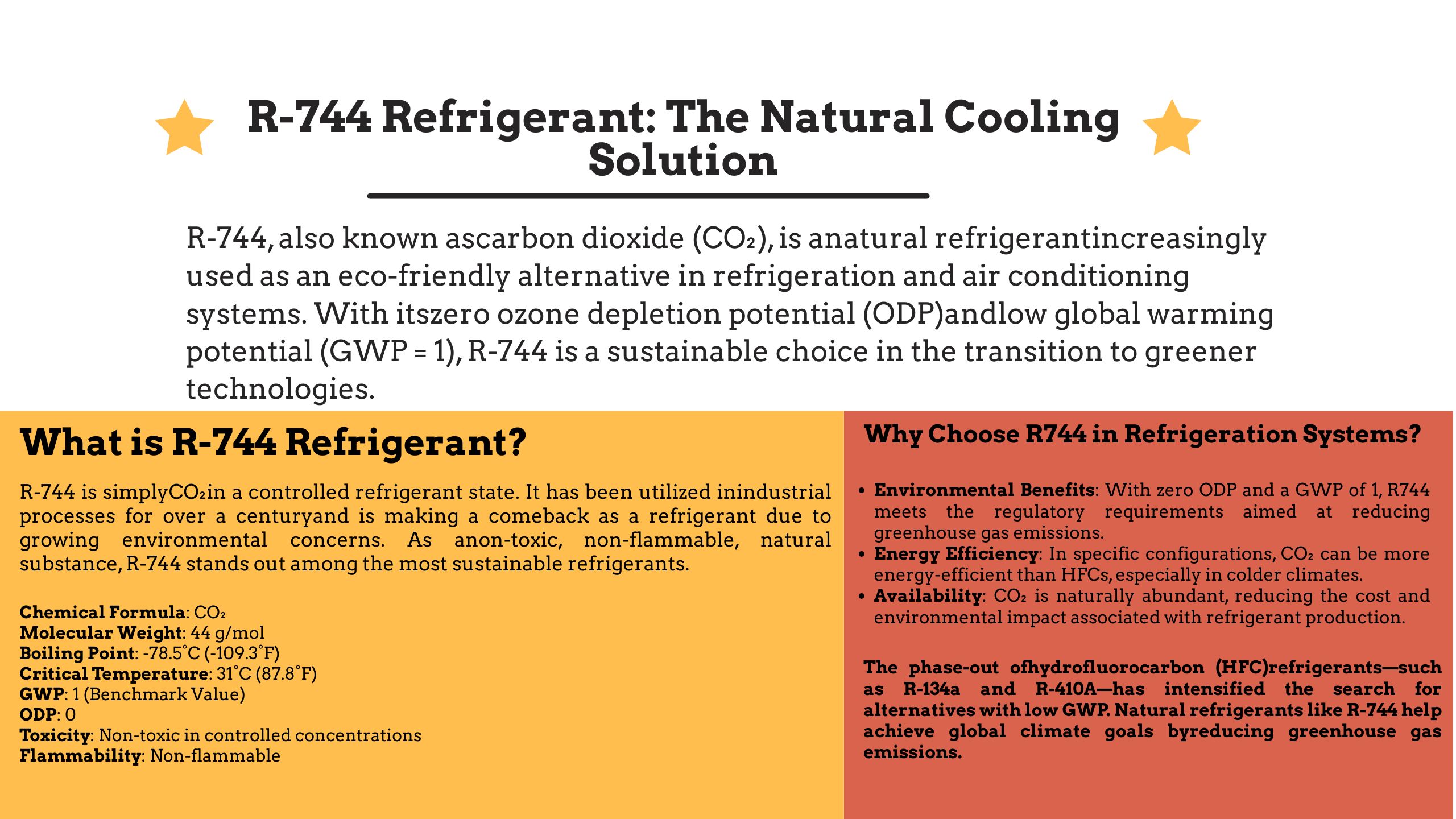


R-744, also known as carbon dioxide (CO₂), is a natural refrigerant increasingly used as an eco-friendly alternative in refrigeration and air conditioning systems. With its zero ozone depletion potential (ODP) and low global warming potential (GWP = 1), R-744 is a sustainable choice in the transition to greener technologies.
What is R-744 Refrigerant?
R-744 is simply CO₂ in a controlled refrigerant state. It has been utilized in industrial processes for over a century and is making a comeback as a refrigerant due to growing environmental concerns. As a non-toxic, non-flammable, natural substance, R-744 stands out among the most sustainable refrigerants.
Key Properties and Characteristics of R-744
- Chemical Formula: CO₂
- Molecular Weight: 44 g/mol
- Boiling Point: -78.5°C (-109.3°F)
- Critical Temperature: 31°C (87.8°F)
- GWP: 1 (Benchmark Value)
- ODP: 0
- Toxicity: Non-toxic in controlled concentrations
- Flammability: Non-flammable
The unique properties of R744 give it a distinct advantage in specific cooling applications, although it also poses operational challenges, particularly due to its high-pressure requirements.
History of R744 as a Refrigerant
The use of CO₂ in refrigeration dates back to the 19th century. CO₂ refrigeration was popular in marine and commercial applications until the 1930s, when synthetic refrigerants, such as chlorofluorocarbons (CFCs), entered the market. These synthetic refrigerants offered lower pressures and were more convenient to use. However, as environmental concerns emerged regarding CFCs and HCFCs due to their ozone-depleting characteristics, CO₂ regained attention as a natural refrigerant alternative.
The re-emergence of R744 began in the 1990s, driven by environmental regulations such as the Montreal Protocol and subsequent F-gas regulations, which aimed to phase out harmful refrigerants. CO₂ is now widely considered for various applications in the food and beverage industry, retail, and industrial cooling.
More About Refrigerant: Understanding Refrigerants: Types, Uses, and Environmental Impact
Why Choose R744 in Refrigeration Systems?
R744, or CO₂, has several characteristics that make it appealing in refrigeration systems:
- Environmental Benefits: With zero ODP and a GWP of 1, R744 meets the regulatory requirements aimed at reducing greenhouse gas emissions.
- Energy Efficiency: In specific configurations, CO₂ can be more energy-efficient than HFCs, especially in colder climates.
- Availability: CO₂ is naturally abundant, reducing the cost and environmental impact associated with refrigerant production.
Because of these factors, R744 is commonly used in industries seeking sustainable, long-term refrigerant solutions that align with environmental regulations.
Related Read: What Makes a Good Refrigerant?
The Need for Natural Refrigerants
The phase-out of hydrofluorocarbon (HFC) refrigerants—such as R-134a and R-410A—has intensified the search for alternatives with low GWP. Natural refrigerants like R-744 help achieve global climate goals by reducing greenhouse gas emissions.
Applications of R744
R744 is utilized across a variety of sectors, especially where stringent environmental standards are prioritized. Here are some of the most common applications:
- Supermarket Refrigeration: R744 is commonly used in transcritical and subcritical systems in supermarket chains worldwide.
- Industrial Refrigeration: CO₂ is used in low-temperature environments for food processing, storage, and distribution.
- Heat Pumps: High-pressure CO₂ heat pumps are gaining popularity for their ability to provide efficient water heating.
- Automotive Air Conditioning: CO₂ systems are increasingly considered for car air conditioning due to the environmental regulations on HFCs.
More Refrigerants Aplication: Applications of Refrigerants: An In-Depth Analysis
Advantages of R744 Refrigerant
1. Low Environmental Impact
CO₂ is a natural refrigerant with a GWP of 1 and no ozone depletion potential, making it an ideal choice for companies committed to sustainability.
2. High Efficiency in Specific Conditions
R744 can achieve high efficiency, especially in cooler ambient conditions, which is beneficial in commercial and industrial applications.
3. Cost-Effective and Readily Available
CO₂ is readily available and does not rely on complex manufacturing processes, making it more affordable and sustainable.
4. High Heat Transfer Coefficient
R744 offers excellent heat transfer properties, enhancing system performance and potentially reducing the size of equipment.
Disadvantages of R744 Refrigerant
Despite the advantages, R744 also presents some challenges:
1. High Operating Pressures
One of the primary drawbacks is its high operating pressure, which requires specialized, robust equipment and increases safety concerns.
2. Efficiency Loss in Warm Climates
In warmer climates, R744 systems can experience efficiency losses, requiring additional design considerations, such as cascade or booster systems.
3. Complexity and Initial Costs
Systems using R744 can be more complex to install and maintain, which translates into higher initial costs for equipment and training.
4. Safety Risks
Due to its high pressure and potential hazards (as discussed below), R744 requires strict safety protocols, limiting its application in some sectors.
Related Read: Comparative Analysis of Refrigerants, Properties, Advantages, and Disadvantages
Potential Hazards of R744 (CO₂) Refrigerant
R744 can pose certain risks that must be managed effectively to ensure safety in its use. Here are five key hazards associated with CO₂ as a refrigerant:
1. Asphyxiation
CO₂ is an asphyxiant, meaning it can displace oxygen in confined spaces. In poorly ventilated areas, a CO₂ leak could lead to oxygen deprivation.
2. High System Operating Pressures
The high-pressure requirements of R744 systems increase the risk of leaks or ruptures. Pressure safety valves and pressure-resistant materials are essential.
3. Trapped Liquid
Liquid CO₂ can become trapped in system components due to its unique properties, leading to pressure build-up and potential system damage if not properly managed.
4. Dry Ice Formation
If CO₂ pressure falls below 5.18 bar at low temperatures, it can solidify into dry ice, blocking valves and pipes, which disrupts system operation.
5. Freeze Burns
Due to its low temperature, contact with CO₂ or CO₂ gas during leaks can cause freeze burns, necessitating the use of protective equipment for operators.
More Dangers CO2: Dangers of CO2: Everything You Need to Know
R-744 (CO₂) vs. Other Refrigerants: Pros and Cons
When compared to synthetic refrigerants like HFCs and HFOs, R744 presents both clear benefits and limitations. Here’s a quick comparison:
| Criteria | R744 (CO₂) | HFCs & HFOs |
|---|---|---|
| Environmental Impact | Low (GWP of 1) | Moderate to high GWP |
| Pressure Requirements | High (specialized equipment) | Low to moderate |
| Availability | Widely available | Manufactured |
| Cost | Generally lower | Higher production costs |
| Efficiency | High in cool climates | High across all climates |
Challenges of Using R-744
1. High Operating Pressure
R-744 operates at extremely high pressures compared to other refrigerants, requiring specialized equipment designed for strength and durability.
2. Performance at High Temperatures
The critical temperature of R-744 is only 31°C, limiting its performance in hotter climates. Transcritical systems are required to manage this limitation, but they are more complex.
3. Cost of System Installation
The need for high-pressure equipment increases the initial installation cost of R-744-based systems. However, these costs can be offset by energy savings over time.
R744 Cylinder Storage and Handling
R744 cylinders must be handled with care to manage its high-pressure characteristics:
- Storage: Cylinders should be stored upright in a cool, dry place, away from direct sunlight or extreme heat.
- Transportation: Due to CO₂’s high pressures, cylinders are generally equipped with safety relief valves and must be transported securely to prevent damage.
Proper labeling and training are essential to ensure safe handling and compliance with transportation regulations.
Quality and Safety in CO₂ (R744) Refrigeration Systems
Quality Requirements for R744
For effective operation in refrigeration systems, R744 must meet high purity standards. Contaminants like water or hydrocarbons can cause operational issues such as acid formation, which could damage the system. High-quality, refrigeration-grade R744 is recommended, with strict monitoring of contaminant levels.
Safe Handling Practices for R744
Handling R744 requires specialized training to address its high-pressure nature and potential hazards. Safety protocols include:
- Ventilation: Ensuring adequate ventilation in case of leaks
- Protective Gear: Using gloves and protective clothing to prevent freeze burns
- Pressure Management: Installing pressure relief devices and regular pressure checks to prevent over-pressurization
Global Regulations on R-744 Adoption
Governments and organizations worldwide are promoting the use of natural refrigerants, including R-744.
- European Union: Supports R-744 adoption under the F-Gas Regulation to phase out high-GWP refrigerants.
- US Environmental Protection Agency (EPA): Lists R-744 under the Significant New Alternatives Policy (SNAP) program.
- Montreal Protocol and Kigali Amendment: Encourages countries to transition to low-GWP refrigerants, favoring natural refrigerants like CO₂.
FAQs about R-744
Is R-744 refrigerant safe to use?
Yes, R-744 is non-toxic and non-flammable, but high concentrations can displace oxygen, creating a suffocation hazard in confined spaces.
Can R-744 replace R-134a directly?
No, systems using R-744 require specialized high-pressure equipment, and retrofitting existing R-134a systems is not feasible without significant modifications.
What industries benefit most from R-744?
Industries that rely on industrial refrigeration, transport cooling, and supermarket refrigeration benefit significantly from adopting R-744 refrigerant.
Future Trends in R-744 Technology
The adoption of R-744 is expected to increase as industries move towards sustainable cooling solutions. Ongoing research focuses on improving transcritical CO₂ systems to overcome performance limitations in hot climates. Additionally, hybrid systems combining R-744 with other refrigerants are being developed to enhance energy efficiency and reduce environmental impact further.
Conclusion
R-744 (CO₂) is a natural, sustainable refrigerant with exceptional environmental benefits, including a GWP of 1 and ODP of 0. It is widely used in various industrial and commercial applications, including supermarkets, transport refrigeration, and heat pumps. While high operating pressures and performance limitations in hot climates present challenges, the long-term environmental and economic advantages of R-744 make it an essential part of the future of refrigeration and cooling technologies.
As industries transition to low-GWP refrigerants, R-744 is poised to become a key player in meeting global environmental targets and advancing sustainable cooling solutions.
Looking for reliable refrigerant suppliers from China ?
We offer end-to-end procurement solutions, handling everything from sourcing to shipping, ensuring you get the best products at competitive prices.
- [email protected]
- +86 18037022596
- 18037022596