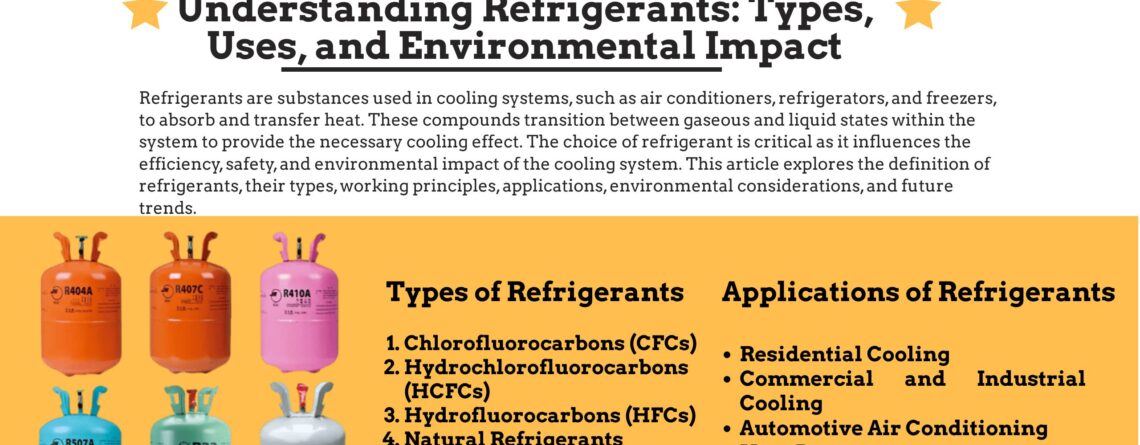
Refrigerants are substances used in cooling systems, such as air conditioners, refrigerators, and freezers, to absorb and transfer heat. These compounds transition between gaseous and liquid states within the system to provide the necessary cooling effect. The choice of refrigerant is critical as it influences the efficiency, safety, and environmental impact of the cooling system. This article explores the definition of refrigerants, their types, working principles, applications, environmental considerations, and future trends.
Definition and Role of Refrigerants
A refrigerant is a chemical compound that undergoes phase changes from liquid to gas and vice versa within a refrigeration cycle, thereby facilitating the heat transfer necessary for cooling. The process involves the refrigerant absorbing heat from the environment or space being cooled and releasing it elsewhere, usually to the atmosphere.
How Refrigerants Work
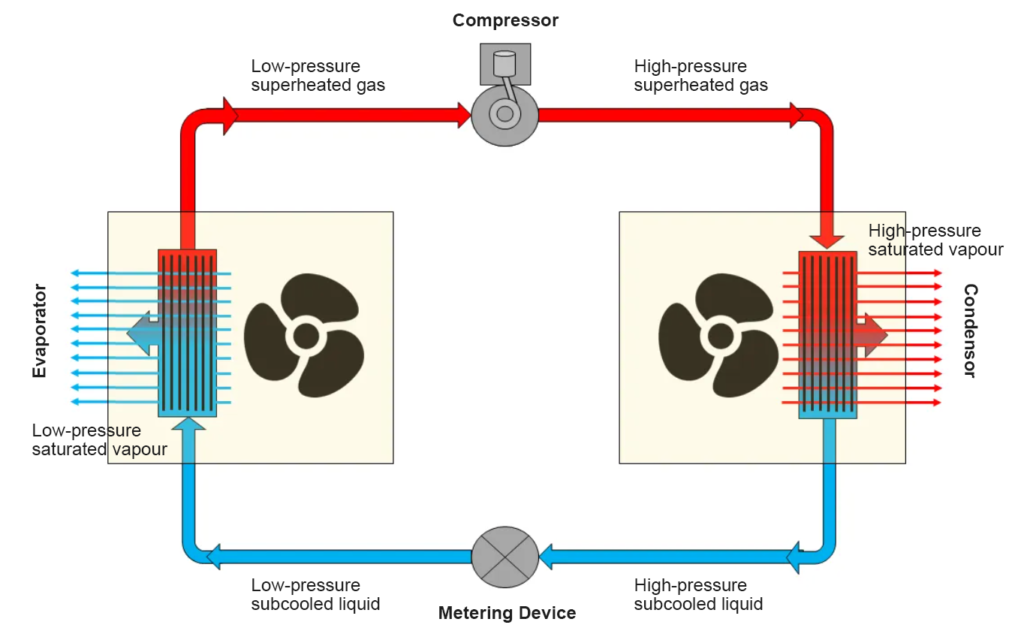
Refrigerants operate within a closed-loop system, typically consisting of the following key components:
- Compressor: The compressor increases the pressure and temperature of the refrigerant vapor, preparing it for condensation.
- Condenser: In the condenser, the high-pressure refrigerant gas releases its heat to the surroundings and condenses into a liquid.
- Expansion Valve: The high-pressure liquid refrigerant passes through the expansion valve, where it undergoes a significant pressure drop, causing it to cool and partially vaporize.
- Evaporator: In the evaporator, the low-pressure refrigerant absorbs heat from the space to be cooled, causing it to evaporate into a gas. This gas then returns to the compressor to continue the cycle.

Types of Refrigerants
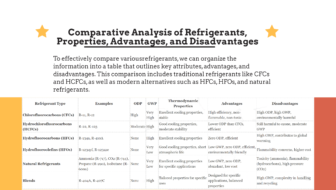
Refrigerants are classified based on their chemical composition, thermodynamic properties, and environmental impact. The main categories include:
Chlorofluorocarbons (CFCs)
CFCs were among the first widely used refrigerants due to their stability and non-flammability. However, they were found to have a high ozone depletion potential (ODP) and were phased out under the Montreal Protocol. Examples include R-11 and R-12.
Hydrochlorofluorocarbons (HCFCs)
HCFCs were developed as interim replacements for CFCs. They have lower ODP but still pose environmental concerns. They are also being phased out under international agreements. Examples include R-22 and R-123.
Hydrofluorocarbons (HFCs)
HFCs do not contain chlorine and therefore have zero ODP. However, they have high global warming potential (GWP). They are commonly used in modern systems but are also facing regulatory scrutiny. Examples include R-134a and R-410A.
Natural Refrigerants
Natural refrigerants include substances like ammonia (R-717), carbon dioxide (R-744), and hydrocarbons (e.g., propane R-290, isobutane R-600a). These refrigerants are favored for their low environmental impact, though they may pose other challenges such as flammability or toxicity.
Hydrofluoroolefins (HFOs)
HFOs are a newer class of refrigerants designed to have low GWP and zero ODP. They are considered a promising solution for future refrigeration needs. Examples include R-1234yf and R-1234ze.
What is a good refrigerant: What Makes a Good Refrigerant
Environmental Considerations
The environmental impact of refrigerants is a major factor in their selection and regulation. The two primary environmental concerns are ozone depletion and global warming.
Ozone Depletion Potential (ODP)
ODP measures the potential of a substance to deplete the stratospheric ozone layer. CFCs and HCFCs have high ODP values, leading to their phase-out under the Montreal Protocol. Modern refrigerants like HFCs and HFOs have zero ODP.
Global Warming Potential (GWP)
GWP indicates the potential of a substance to contribute to global warming over a 100-year period compared to carbon dioxide (CO2). HFCs, while having zero ODP, often have high GWP, prompting the development of low-GWP alternatives like HFOs and natural refrigerants.
Applications of Refrigerants
Refrigerants are used across a wide range of applications, including:
Residential Cooling
Refrigerants in residential cooling systems, such as air conditioners and refrigerators, provide comfort and food preservation. Common refrigerants in this sector include R-134a, R-410A, and increasingly, R-32 and natural refrigerants.
Commercial and Industrial Cooling
In commercial and industrial settings, refrigerants are used in large-scale refrigeration systems, such as those in supermarkets, cold storage facilities, and industrial processes. Ammonia (R-717) and carbon dioxide (R-744) are popular choices due to their efficiency and low environmental impact.
Automotive Air Conditioning
Automotive air conditioning systems primarily use HFCs like R-134a, although there is a growing shift towards HFOs like R-1234yf to reduce GWP.
Heat Pumps
Heat pumps use refrigerants to transfer heat from one place to another, often for heating and cooling buildings. The choice of refrigerant impacts the efficiency and environmental footprint of these systems.
More About Application: Applications of Refrigerants, An In-Depth Analysis
Future Trends in Refrigerants
The refrigeration industry is moving towards more environmentally friendly options, driven by regulatory changes and technological advancements. Key trends include:
Transition to Low-GWP Refrigerants
There is a global push to adopt low-GWP refrigerants to mitigate climate change. This includes the phase-down of HFCs under the Kigali Amendment to the Montreal Protocol and the adoption of HFOs and natural refrigerants.
Improved System Efficiency
Advances in refrigeration technology aim to improve the efficiency of systems, reducing energy consumption and the overall environmental impact. This includes optimizing system designs and using advanced refrigerants.
Development of Alternative Technologies
Research is ongoing into alternative cooling technologies that do not rely on traditional refrigerants. These include magnetic refrigeration, thermoelectric cooling, and solid-state cooling methods.
Conclusion
Refrigerants play a crucial role in modern life by enabling cooling in various applications, from residential air conditioning to industrial processes. However, their environmental impact necessitates careful consideration and management. The shift towards low-GWP refrigerants and the development of alternative cooling technologies represent significant steps towards sustainable refrigeration. Understanding the different types of refrigerants, their environmental impact, and future trends is essential for making informed decisions in the design, operation, and regulation of cooling systems.
Realted Read:
Refrigerant Sensors: Ensuring Safety and Efficiency in Cooling Systems
Looking for reliable refrigerant suppliers from China ?
We offer end-to-end procurement solutions, handling everything from sourcing to shipping, ensuring you get the best products at competitive prices.
- [email protected]
- +86 18037022596
- 18037022596