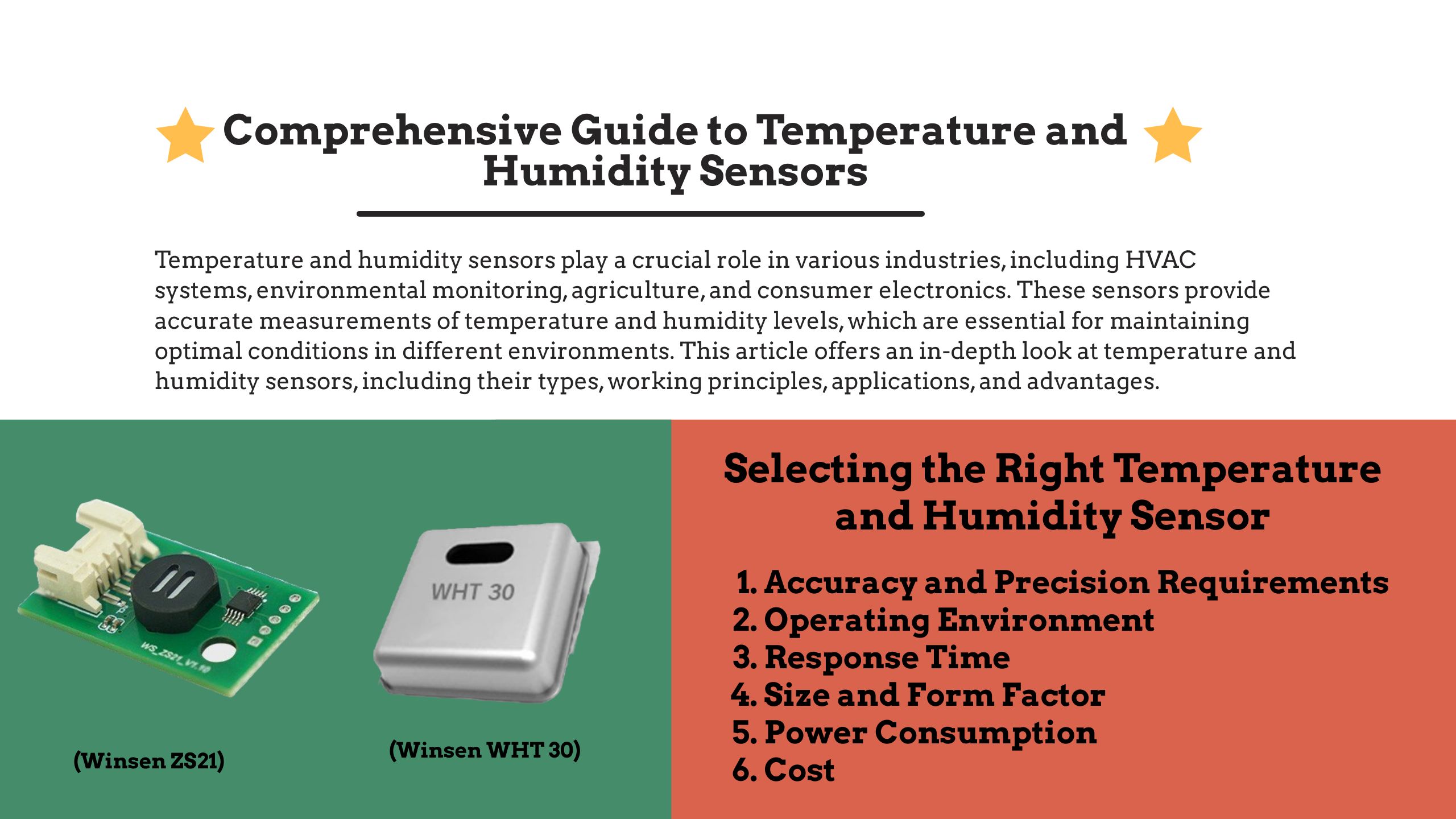
Temperature and humidity sensors play a crucial role in various industries, including HVAC systems, environmental monitoring, agriculture, and consumer electronics. These sensors provide accurate measurements of temperature and humidity levels, which are essential for maintaining optimal conditions in different environments. This article offers an in-depth look at temperature and humidity sensors, including their types, working principles, applications, and advantages.
Understanding Temperature and Humidity Sensors
Temperature Sensors
Temperature sensors measure the degree of hotness or coldness in an environment. They come in various forms, including thermocouples, resistive temperature devices (RTDs), thermistors, and semiconductor-based sensors. Each type has its unique properties and applications.
Thermocouples
- Principle: Thermocouples generate a voltage proportional to the temperature difference between two dissimilar metals.
- Advantages: Wide temperature range, fast response time, and robustness.
- Applications: Industrial processes, automotive, and HVAC systems.
Resistive Temperature Devices (RTDs)
- Principle: RTDs measure temperature based on the change in electrical resistance of a material (typically platinum) with temperature.
- Advantages: High accuracy, stability, and repeatability.
- Applications: Industrial automation, laboratory measurements, and process control.
Thermistors
- Principle: Thermistors are temperature-sensitive resistors whose resistance decreases (NTC) or increases (PTC) with temperature.
- Advantages: High sensitivity and low cost.
- Applications: Consumer electronics, automotive sensors, and home appliances.
Semiconductor Temperature Sensors
- Principle: These sensors use the temperature-dependent properties of semiconductor materials to measure temperature.
- Advantages: Compact size, linear response, and integration with digital systems.
- Applications: Mobile devices, wearables, and environmental monitoring.
Humidity Sensors
Humidity sensors measure the amount of water vapor in the air. The two main types of humidity sensors are capacitive and resistive sensors.
Capacitive Humidity Sensors
- Principle: These sensors measure humidity by detecting changes in the capacitance of a hygroscopic dielectric material as it absorbs moisture.
- Advantages: High accuracy, stability, and wide operating range.
- Applications: HVAC systems, meteorological stations, and industrial control.
Resistive Humidity Sensors
- Principle: These sensors measure humidity based on the change in electrical resistance of a hygroscopic material as it absorbs moisture.
- Advantages: Low cost and simple construction.
- Applications: Consumer electronics, automotive climate control, and household appliances.
Combined Temperature and Humidity Sensors
Combined temperature and humidity sensors integrate both sensing elements into a single package, providing simultaneous measurements of temperature and humidity. These sensors are widely used in applications where both parameters need to be monitored and controlled.
Working Principles of Temperature and Humidity Sensors
Temperature Sensors
Thermocouples
Thermocouples consist of two different metals joined at one end, forming a junction. When there is a temperature difference between the junction and the other ends, a voltage is generated, known as the Seebeck effect. This voltage is proportional to the temperature difference and can be measured to determine the temperature.
RTDs
RTDs operate based on the principle that the electrical resistance of a metal increases with temperature. Platinum is commonly used due to its stable and predictable resistance-temperature relationship. RTDs are typically constructed with a thin film or wire wound element, and their resistance is measured using a Wheatstone bridge circuit.
Thermistors
Thermistors are made from semiconductor materials that exhibit significant changes in resistance with temperature. NTC thermistors decrease in resistance as temperature increases, while PTC thermistors increase in resistance. These changes in resistance can be measured and converted to temperature readings.
Semiconductor Temperature Sensors
Semiconductor temperature sensors use the temperature-dependent properties of semiconductor materials, such as the base-emitter voltage of a bipolar junction transistor (BJT). The voltage changes linearly with temperature, and this relationship is used to determine the temperature.
Humidity Sensors
Capacitive Humidity Sensors
Capacitive humidity sensors consist of a hygroscopic dielectric material placed between two conductive plates, forming a capacitor. As the dielectric material absorbs water vapor from the air, its capacitance changes. This change is proportional to the relative humidity and can be measured to determine the humidity level.
Resistive Humidity Sensors
Resistive humidity sensors use a hygroscopic material whose electrical resistance changes with moisture absorption. The material’s resistance decreases as it absorbs moisture, and this change can be measured to determine the humidity level.
Applications of Temperature and Humidity Sensors
HVAC Systems
Temperature and humidity sensors are critical components in heating, ventilation, and air conditioning (HVAC) systems. They provide real-time data for controlling indoor climate, ensuring comfort, and improving energy efficiency.
Environmental Monitoring
These sensors are used in meteorological stations, greenhouses, and environmental monitoring systems to track temperature and humidity levels. Accurate data helps in weather forecasting, agricultural management, and studying climate change.
Industrial Processes
In industrial processes, maintaining precise temperature and humidity levels is essential for product quality and process efficiency. Sensors are used in manufacturing, food processing, and pharmaceuticals to monitor and control these parameters.
Consumer Electronics
Temperature and humidity sensors are integrated into consumer electronics such as smartphones, tablets, and smart home devices. They help maintain optimal operating conditions, improve user comfort, and enhance device performance.
Automotive Industry
In the automotive industry, these sensors are used in climate control systems to regulate the cabin environment. They also play a role in engine management and battery monitoring systems.
Healthcare and Pharmaceuticals
Temperature and humidity sensors are used in healthcare and pharmaceutical applications to ensure proper storage conditions for medications and biological samples. They are also used in medical devices to monitor patient conditions.
Advantages of Temperature and Humidity Sensors
Accuracy and Precision
Modern temperature and humidity sensors offer high accuracy and precision, providing reliable data for critical applications. This is particularly important in industries such as healthcare, pharmaceuticals, and environmental monitoring.
Wide Operating Range
These sensors can operate across a wide range of temperatures and humidity levels, making them suitable for diverse applications. For example, RTDs can measure temperatures from -200°C to +600°C, while capacitive humidity sensors can operate from 0% to 100% relative humidity.
Real-time Monitoring
Temperature and humidity sensors provide real-time data, allowing for immediate adjustments and control. This is crucial in applications where environmental conditions need to be maintained within specific limits.
Integration with Digital Systems
Many temperature and humidity sensors come with digital interfaces, enabling easy integration with microcontrollers, data loggers, and IoT platforms. This facilitates remote monitoring and data analysis.
Low Power Consumption
Modern sensors are designed to be energy-efficient, making them ideal for battery-powered devices and remote monitoring systems. Low power consumption extends the operational life of these devices.
Selecting the Right Temperature and Humidity Sensor
Choosing the appropriate sensor for a specific application requires consideration of several factors, including:
Accuracy and Precision Requirements
Different applications have varying requirements for accuracy and precision. For example, laboratory measurements may require high-precision sensors, while consumer electronics may tolerate lower accuracy.
Operating Environment
The operating environment, including temperature range, humidity levels, and potential exposure to contaminants, influences the choice of sensor. Industrial environments may require robust sensors with high durability.
Response Time
The response time of a sensor is critical in applications where rapid changes in temperature or humidity need to be detected. Fast-response sensors are essential in dynamic environments such as HVAC systems and automotive climate control.
Size and Form Factor
The size and form factor of the sensor may be important in space-constrained applications such as wearable devices and smartphones. Miniature sensors can be integrated into compact designs without compromising performance.
Power Consumption
For battery-powered applications, low power consumption is a key consideration. Sensors with low power requirements extend the battery life of portable and remote monitoring devices.
Cost
The cost of the sensor is an important factor, especially for large-scale deployments. Balancing performance and cost is essential for selecting the most suitable sensor for the application.
Realted Read: The Importance of Temperature and Humidity Sensors
Future Trends and Developments
Advanced Materials
Research and development in advanced materials are leading to the creation of more sensitive and durable sensors. New materials with enhanced hygroscopic properties and improved thermal stability are being developed to increase sensor performance.
IoT Integration
The integration of temperature and humidity sensors with IoT platforms is expanding their capabilities. IoT-enabled sensors provide remote monitoring, real-time data analysis, and predictive maintenance, enhancing the efficiency of various applications.
Miniaturization
Ongoing advancements in microfabrication techniques are leading to the development of smaller, more compact sensors. Miniaturized sensors can be integrated into a wider range of devices, including wearables and portable electronics.
AI and Machine Learning
Artificial intelligence (AI) and machine learning algorithms are being used to analyze sensor data and predict environmental changes. These technologies enable more sophisticated control systems and enhance the accuracy of environmental monitoring.
Wireless Technology
Wireless temperature and humidity sensors are becoming more prevalent, offering greater flexibility and ease of installation. These sensors can be deployed in remote or hard-to-reach locations without the need for extensive wiring.
Conclusion
Temperature and humidity sensors are essential tools in a wide range of applications, from industrial processes and environmental monitoring to consumer electronics and healthcare. Understanding the different types of sensors, their working principles, and their applications is crucial for selecting the right sensor for specific needs. Advances in sensor technology, including IoT integration, miniaturization, and AI, are driving the development of more sophisticated and versatile sensors. As these technologies continue to evolve, temperature and humidity sensors will play an increasingly important role in maintaining optimal conditions and improving efficiency across various industries.