
Introduction
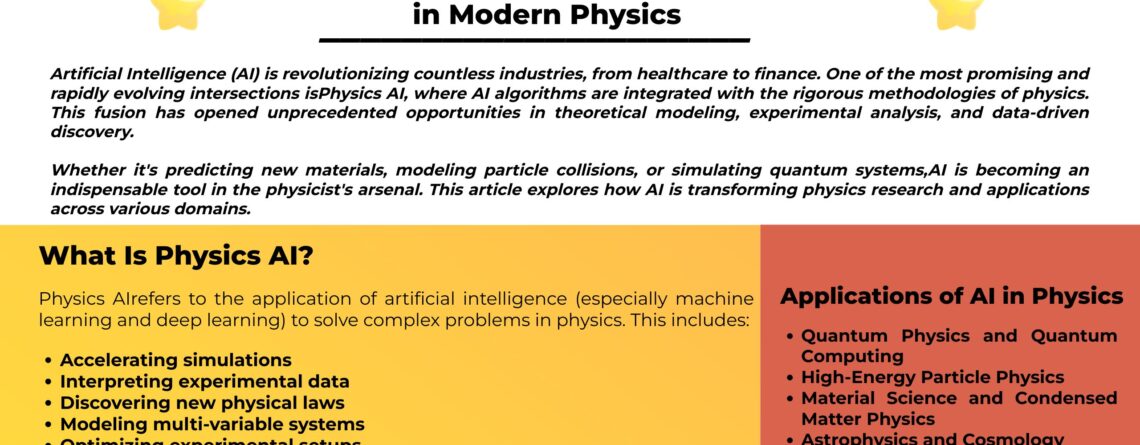
Artificial Intelligence (AI) is revolutionizing countless industries, from healthcare to finance. One of the most promising and rapidly evolving intersections is Physics AI, where AI algorithms are integrated with the rigorous methodologies of physics. This fusion has opened unprecedented opportunities in theoretical modeling, experimental analysis, and data-driven discovery.
Whether it’s predicting new materials, modeling particle collisions, or simulating quantum systems, AI is becoming an indispensable tool in the physicist’s arsenal. This article explores how AI is transforming physics research and applications across various domains.
1. What Is Physics AI?
Physics AI refers to the application of artificial intelligence (especially machine learning and deep learning) to solve complex problems in physics. This includes:
- Accelerating simulations
- Interpreting experimental data
- Discovering new physical laws
- Modeling multi-variable systems
- Optimizing experimental setups
It merges data-driven algorithms with physics-based principles, often producing results that neither could achieve independently.
2. Why Combine AI and Physics?
Physics problems are often:
- High-dimensional
- Nonlinear
- Data-intensive
- Computationally expensive
AI, particularly machine learning (ML) and deep neural networks, can handle these complexities efficiently. Here’s why AI and physics are such a powerful match:
| Aspect | Traditional Physics | With AI |
|---|---|---|
| Computation Speed | High for complex simulations | Greatly reduced using ML surrogates |
| Pattern Recognition | Manual and model-based | Automatic and data-driven |
| Experimental Design | Time-consuming, iterative | Optimized using reinforcement learning |
| Predictive Modeling | Relies on known equations | Can extrapolate from data patterns |
| Interpretation of Data | Rule-based analysis | Statistical and probabilistic |
3. Applications of AI in Physics
3.1 Quantum Physics and Quantum Computing
Quantum mechanics is inherently probabilistic and mathematically complex. AI is applied to:
- Solve the Schrödinger equation in multi-particle systems.
- Design quantum circuits using reinforcement learning.
- Develop quantum machine learning algorithms that run on quantum computers.
- Model quantum entanglement and decoherence.
Example: Google’s AI algorithm was used to control qubits in the Sycamore quantum processor, optimizing operations with fewer errors.
3.2 High-Energy Particle Physics
In particle accelerators like the Large Hadron Collider (LHC):
- Massive amounts of data are generated (petabytes per year).
- AI helps filter, classify, and analyze events in real time.
- Deep learning is used to classify particles and identify rare phenomena like the Higgs boson.
Jet tagging, used to classify particle jets, has improved significantly with CNNs (convolutional neural networks).
3.3 Material Science and Condensed Matter Physics
AI accelerates the discovery of new materials by:
- Predicting material properties (e.g., conductivity, thermal resistance).
- Learning structure-property relationships from databases.
- Using generative models to design molecules or crystal structures.
Example: Projects like the Materials Genome Initiative use ML to explore new superconductors and alloys.
3.4 Astrophysics and Cosmology
Astrophysics deals with vast datasets from telescopes and simulations.
AI applications include:
- Classifying galaxies, stars, and exoplanets from telescope images.
- Identifying gravitational waves from LIGO data.
- Simulating cosmic structures like dark matter halos.
- Enhancing resolution of astronomical imagery using super-resolution techniques.
3.5 Climate and Atmospheric Physics
Understanding Earth’s climate system is a grand challenge.
AI is used for:
- Forecasting weather patterns with neural weather models.
- Modeling ocean currents, CO₂ distribution, and aerosol interactions.
- Downscaling climate models to local regions.
- Real-time disaster prediction (e.g., hurricanes, droughts).
3.6 Plasma and Fusion Research
AI supports nuclear fusion by:
- Controlling plasma confinement in devices like tokamaks.
- Predicting instabilities using real-time monitoring.
- Automating experiments for optimal energy output.
- Simulating magnetic confinement and plasma behavior.
Example: DeepMind worked with ITER and other fusion projects to optimize plasma control algorithms.
4. Machine Learning Techniques Used in Physics
Physics AI often involves:
| ML Technique | Physics Application Example |
|---|---|
| Supervised Learning | Particle classification, phase recognition |
| Unsupervised Learning | Pattern discovery in cosmic microwave data |
| Reinforcement Learning | Quantum control, experiment automation |
| Generative Models | New molecule or material generation |
| Neural ODEs | Modeling time evolution of physical systems |
| Bayesian Inference | Parameter estimation in complex models |
| Graph Neural Networks | Molecule and crystal structure learning |
5. AI-Assisted Experimental Design
AI can automate and optimize experimental processes:
- Suggest best parameters for measurements
- Reduce number of iterations
- Control instruments in real time
- Handle noisy data
Active learning techniques are increasingly used where AI queries the most informative data points to update its model with the least effort.
6. Theoretical Physics and Symbolic AI
Beyond data-driven approaches, symbolic AI (using logic and symbolic reasoning) is entering theoretical physics:
- Deriving physical laws from experimental data
- Discovering conservation laws
- Interpreting black box models with physics constraints
Example: AI rediscovered Kepler’s Laws from planetary data using symbolic regression techniques.
7. Data Analysis and Pattern Recognition
AI excels at finding structure in large datasets, such as:
- Recognizing anomalies in collider experiments
- Detecting gravitational waves
- Classifying astrophysical spectra
- Filtering background noise in detectors
In modern science, AI is often the first layer of interpretation before a human researcher even sees the data.
8. Challenges and Limitations
Despite its promise, Physics AI faces several challenges:
- Interpretability: AI models are often black boxes.
- Data Scarcity: Some domains have limited labeled data.
- Physical Constraints: Many AI models do not naturally enforce conservation laws.
- Bias and Overfitting: AI models can be misled by noise or biased training data.
- Integration with Theory: Bridging AI with first-principles physics is still an open area of research.
9. Future Outlook
Physics AI is poised for exponential growth. Some of the future directions include:
- Physics-informed neural networks (PINNs) that obey physical laws.
- Autonomous labs that conduct and analyze experiments with minimal human input.
- AI-accelerated quantum computing that integrates machine learning with quantum hardware.
- Interdisciplinary collaborations between physicists, data scientists, and AI engineers.
- Explainable AI (XAI) to ensure scientific rigor and trustworthiness.
10. Conclusion
Artificial Intelligence is fundamentally reshaping the landscape of physics. By augmenting human intuition with computational power, Physics AI is solving previously intractable problems and opening doors to discoveries yet unimagined.
From quantum mechanics to climate science, AI empowers physicists to push the boundaries of knowledge, uncover new physical laws, and design the next generation of experiments and technologies.
As AI continues to evolve, its synergy with physics will undoubtedly lead to breakthroughs that define the scientific frontier of the 21st century.






Leave a Reply