
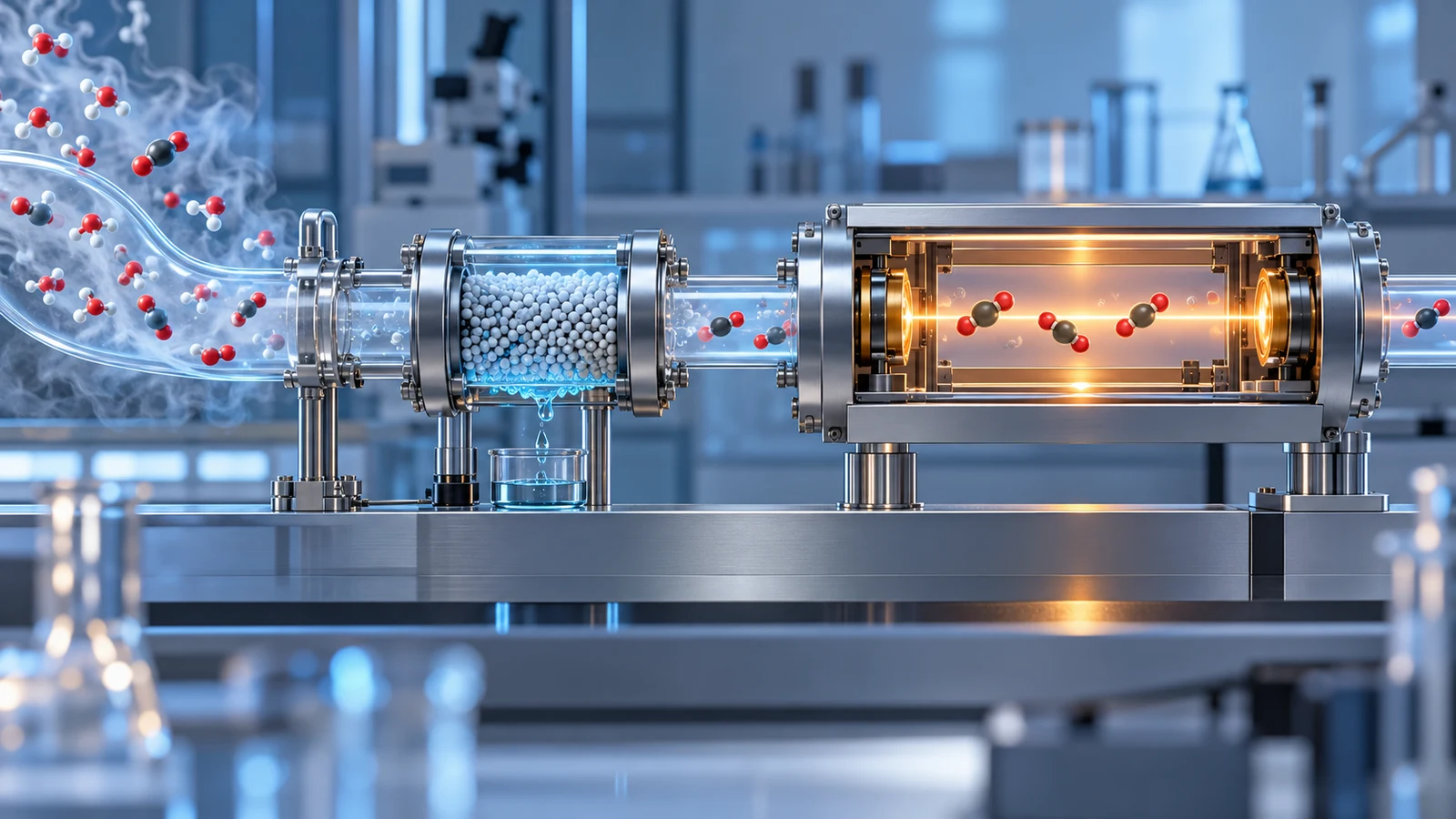
Two CO₂ instruments can measure the same underlying gas mixture and report different ppm values if one result is on a wet-gas basis and the other is on a dry-gas basis. Water vapor occupies part of the molecule count in humid gas. A wet mole fraction includes water molecules in its denominator; a dry mole fraction excludes them. If CO₂ is conserved while water is removed, the dry-basis CO₂ fraction is higher.
This is not automatically sensor drift, and it does not mean that drying improves every measurement. The important questions are what gas reached each measurement cell, whether water was removed or modeled, and which basis the instrument reports. Those questions matter most when comparing a room monitor with a sampled-gas analyzer, a field record with an atmospheric reference, or two process instruments with different conditioning paths.
What Is the Difference Between Wet and Dry CO2 Fraction?
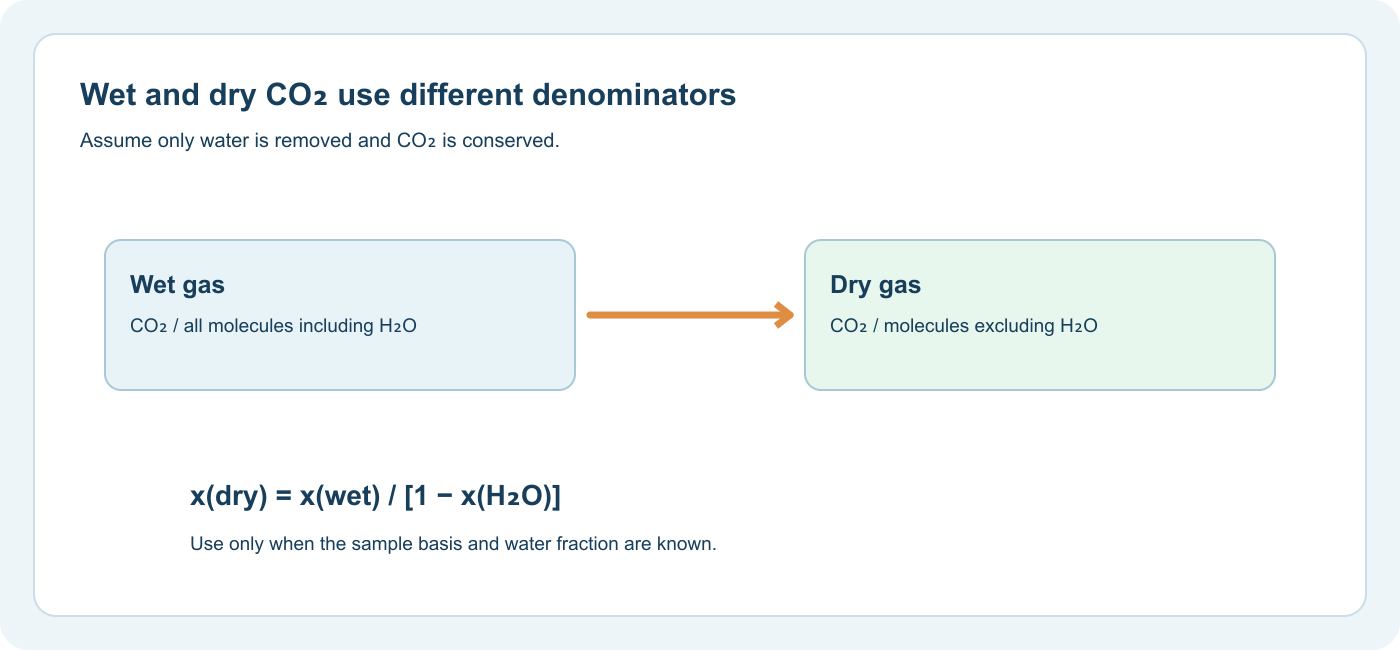
A gas fraction divides the number of CO₂ molecules by a defined total number of molecules. On a wet basis, the denominator includes water vapor. On a dry basis, water vapor is excluded. In atmospheric measurements, NOAA explains its CO₂ quantity as a mole fraction in dry air and shows how adding water lowers the wet-air CO₂ fraction without adding or removing CO₂ molecules.
Let xw be CO₂ mole fraction in wet gas, xd its fraction in the otherwise identical dry gas, and h water-vapor mole fraction in the wet gas. If the only change is water removal and CO₂ is neither lost nor added:
xw = xd × (1 − h)
Equivalently, xd = xw / (1 − h).
The condition is essential. A real sample line may leak, condense or exchange gases; a dryer may alter the sample in ways beyond removing water. The formula is a mass-balance relation for a defined mixture, not a universal correction to apply to any instrument display.
NOAA's published example makes the direction intuitive: a dry-air CO₂ fraction becomes a smaller wet-air fraction when water vapor is added to the same air. The example describes a change in mixture composition, not a day-to-day change in atmospheric CO₂. Keep that distinction in mind when comparing an ambient reference series with a local instrument that may report humid-air values.
A Worked Numerical Example
Suppose an idealized wet gas sample contains 1,000 ppm CO₂ and 2% water vapor by mole fraction. If the water is removed completely while all CO₂ remains in the sample, the corresponding dry-gas CO₂ fraction is 1,000 / (1 − 0.02) ≈ 1,020.4 ppm. The roughly 20 ppm difference reflects the changed denominator, not production of extra CO₂.
Reverse the question and the same relation applies: a dry reading of 1,000 ppm corresponds to 980 ppm on a wet basis at 2% water-vapor fraction, provided the stated assumptions hold. Neither number is intrinsically “the real CO₂ concentration” without the reporting basis. Both describe a specific ratio.
At other water fractions, the correction changes. Do not use the 2% example as a fixed field adjustment. Measure or otherwise establish the water-vapor mole fraction and follow the instrument's own reporting definition. For a wider unit explanation, see CO₂ ppm and percent conversion.
The size of the basis difference must also be judged beside instrument uncertainty. A hypothetical 20 ppm basis shift is not proof that two ordinary room monitors should agree within 20 ppm: their accuracy, calibration, placement and averaging may contribute larger differences. Conversely, a small basis shift can matter in a carefully controlled comparison. Calculate the expected effect, then compare it with the uncertainty and purpose of the measurement; do not use the arithmetic alone to accept or reject a device.
Relative Humidity Is Not the Same as Water-Vapor Mole Fraction
A display showing 50% relative humidity does not mean 50% of the gas molecules are water. Relative humidity is a relationship to saturation at the gas temperature. The water-vapor mole fraction depends on the actual water partial pressure and total pressure. Temperature matters because the saturation vapor pressure changes strongly with temperature.
Therefore, a wet-to-dry CO₂ conversion cannot generally be calculated from a lone RH percentage without temperature and pressure context. Even when an instrument measures RH and temperature, confirm whether its firmware already applies a dry-basis correction. Applying another manual correction to a value already reported dry would double-count the effect.
Vaisala's CO₂ measurement application note discusses the dilution effect of water and how drying a sample changes a reported CO₂ value. Its examples reinforce the need to define both the wet and conditioned sample states.
The Optical Measurement Has More Than a Denominator Effect
Water vapor can influence an infrared analyzer in ways beyond diluting the gas fraction. Spectral overlap or band broadening, pressure changes, condensation on optics and calibration behavior may matter in a particular design. Those effects must not all be folded into the simple 1 − h calculation.
LI-COR's LI-830/LI-850 equation summary is a useful instrument-specific example: its CO₂ computation includes pressure and water-vapor-related terms, and the LI-850 measures an H₂O channel. The details are part of that analyzer's calibration model. A different NDIR room monitor may estimate or compensate environmental effects in another way, or may report a value without a separately exposed H₂O measurement.
Optical response, gas-fraction reporting and sample conditioning are therefore three different layers. A product may manage all three, but its documentation must say how. Our NDIR measurement-chain explanation traces the optical part of the chain.
What Happens When a Wet Sample Is Drawn Through Tubing?
The gas at a process tap is not necessarily the gas that reaches an analyzer cell unchanged. A hot, humid sample can cool in tubing. Water may condense on the line wall or in a trap, changing the gas fraction. Condensation can also produce droplets that obstruct a filter or contaminate an optical chamber. A dryer may remove water in a controlled way, but the final value then needs a clear basis and an understanding of any unintended CO₂ loss.
Vaisala's sampling guidance notes that as a gas sample dries during sampling, its CO₂ concentration on the dry sample basis becomes higher than the wet sample's fraction in the measured environment. That is the denominator effect described above. It does not prove that every line preserves all CO₂ or that every process gas can be handled with the same hardware.
Before choosing a drying method, ask which output the application actually requires. If a controller needs the concentration in the wet process environment, a dry-cell reading may require a documented transformation back to that basis. If an atmospheric comparison requires dry-air mole fraction, controlled drying or a validated water-vapor correction may be appropriate. In both cases, the conditioning equipment has to keep the CO₂ sample representative and within the analyzer's operating limits. The word “dry” by itself does not specify how much water remains after conditioning or whether the reported value has already been corrected.
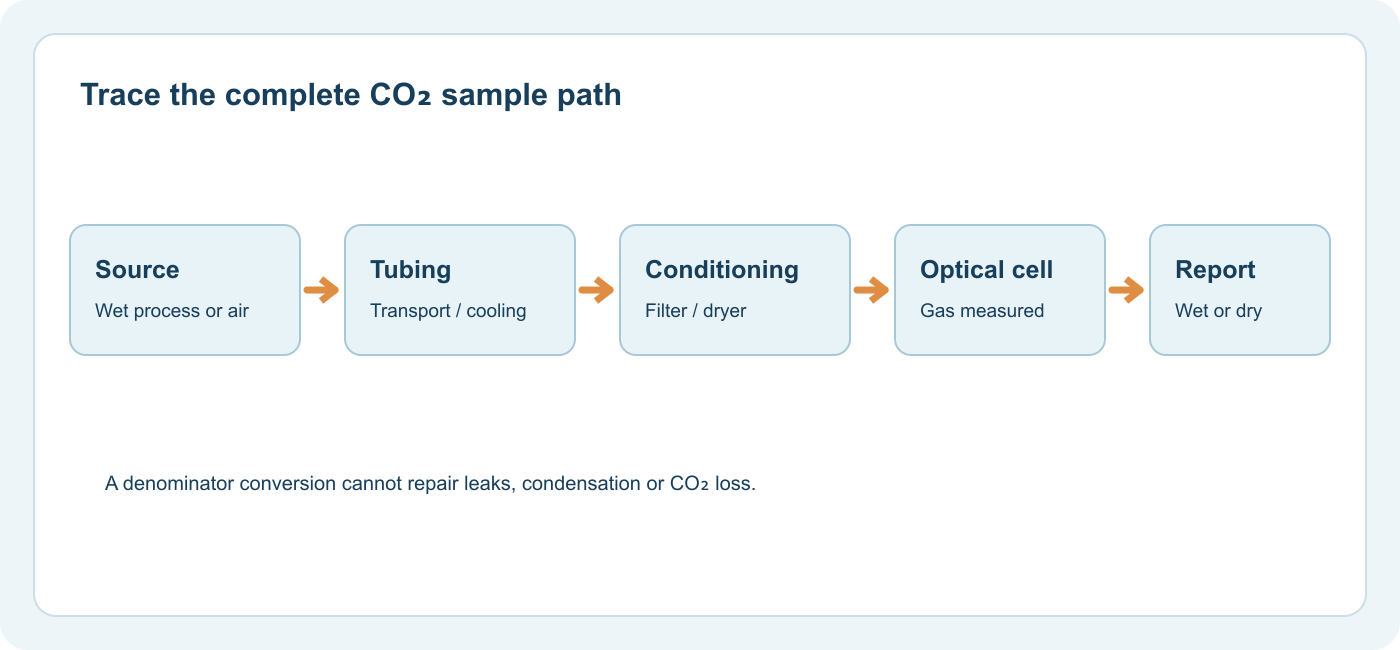
Trace the actual path: source → inlet → tubing → filter or dryer → optical cell → software output. Record temperature and pressure where they are relevant. Ask whether condensation can occur before a measurement and whether the instrument is designed for the resulting water load. A hydrophobic filter, condensate trap and dryer perform different jobs; their selection follows the sample and instrument manual.
When Do Wet and Dry Basis Differences Matter Most?
| Measurement situation | The basis question to resolve |
|---|---|
| Ordinary room monitor | What does the firmware report, and is its humidity correction already built in? |
| Atmospheric reference comparison | Is the reference a dry-air mole fraction while the field device reports humid room air? |
| Greenhouse or grow room | Is the gas enriched and humid, and do two devices sample at the same point? |
| Fermentation or other wet process | Is the sample dried, cooled or filtered before the cell, and can CO₂ be lost? |
| Tube-fed analyzer | What are the inlet and cell conditions, and is the reported value wet, dry or instrument-corrected? |
For low-humidity room air, the difference may be smaller than the uncertainty or spatial variation of a particular monitor. In a wet process or careful reference comparison, ignoring the basis may be material. Neither statement supplies a universal threshold; the instrument's accuracy, the water fraction and the decision being made set the context.
The monitor-versus-analyzer guide helps identify which sample each device measures. The CO₂ range-selection guide explains why a correct basis does not make an out-of-range instrument accurate.
A Record That Makes Two Readings Comparable
If two CO₂ results appear to disagree, preserve more than the two numbers. A useful comparison record includes:
- The sample point and time for each instrument.
- Whether the result is a wet, dry or otherwise corrected gas fraction.
- Temperature, pressure and humidity conditions at the relevant sample points.
- Tubing, filter, dryer or condensate management between source and cell.
- The instrument model, firmware, calibration state and averaging interval.
- The specified accuracy interval and any validity or fault flags.
Only after those items are aligned does it make sense to investigate calibration drift. For example, a dry-air atmospheric value and a humid indoor monitor value should not be declared inconsistent solely because their ppm figures differ. They may describe different gas samples and different denominators.
Likewise, do not convert a monitor value to dry basis and then treat it as a process-gas result. The location and gas path remain different. The denominator correction solves only one clearly defined problem.
Common Errors in Wet/Dry Comparisons
“Removing water adds CO₂.” It does not have to add CO₂ molecules. The fraction rises because the denominator shrinks if CO₂ is conserved.
“Relative humidity can go straight into the equation.” RH is not water-vapor mole fraction. Convert using an appropriate temperature and pressure model or use an instrument's documented H₂O output.
“Every analyzer output is dry basis.” Some instruments physically dry a sample, some model the effect, and others report a wet-gas fraction or configurable output. Check the exact product manual.
“The wet/dry formula corrects condensation problems.” It does not repair a line that loses CO₂, leaks, carries droplets or changes the sample in an unknown way.
“The larger dry value is automatically more accurate.” Accuracy depends on the instrument, calibration and sample handling. The larger number simply reflects a defined reporting basis under the stated assumptions.
For the broader NDIR implications of humidity and condensation, Gasnose's NDIR sensor guide provides a useful technical extension.
A Practical Interpretation
When comparing CO₂ readings, put sample location and gas basis beside each value. If water has been removed or corrected, document how. Use the wet-to-dry relation only when its conservation assumptions are justified and the water-vapor fraction is known. That makes a comparison explainable without mistaking a denominator change for a sensor fault.
Frequently Asked Questions
Why can a dry-air CO₂ reading be higher than a wet-air reading? Excluding water molecules makes CO₂ a larger fraction of the remaining gas, if the CO₂ amount is unchanged.
Does 2% relative humidity mean 2% water vapor by mole? No. Relative humidity is not a direct gas fraction; temperature and pressure information is needed.
Can I convert any room monitor reading to dry basis? Only if you know what the monitor already reports and have the needed water-vapor information. Avoid applying a second correction to a value already corrected by the instrument.
Does a dryer always preserve CO₂? No universal guarantee follows from drying alone. The sample system must be suitable for the gas and documented conditions.
Which value should a report use? Use the basis required by the measurement purpose or reference method, and label it explicitly so others can compare like with like.
CO2 Sensor Range: Choosing ppm or Percent Measurement
Choose a CO2 measurement range around the concentrations and decisions that matter. Compare ppm and percent units, accuracy intervals, overrange behavior and sampling conditions.
Read More
CO2 Monitor vs Gas Analyzer: Sampling, Data and Instrument Choice
Compare CO2 monitors and gas analyzers by sample point, gas path, measurement range, time resolution, calibration evidence and the decision the data supports.
Read More
CO2 Sensor Module vs Complete Monitor: What Each Specification Proves
A CO2 sensor module and a complete monitor solve different engineering tasks. Compare enclosure, sampling, power, data, calibration, alarms and finished-device evidence.
Read More
NDIR CO2 Sensors: How the Measurement Chain Works
Follow the NDIR CO2 measurement chain from infrared source and gas cell to filter, detector, reference signal, compensation and calibrated output.
Read More
Optical Path Length in CO2 Sensors: Range, Sensitivity and Size
Learn how NDIR optical path length affects low-CO2 signal, high-concentration range, cell geometry and module size, and which specifications to compare.
Read More
NDIR Reference Channels: What They Correct and What They Cannot
Understand the optical reference in NDIR CO2 sensors: common-mode drift, shared-path contamination, temperature and pressure limits, and calibration implications.
Read More