

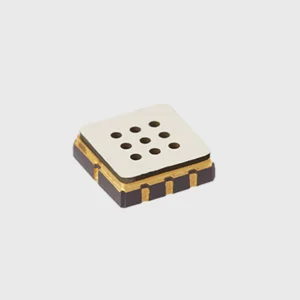
Murata SCH1633 6DoF IMU Sensor
Murata SCH1633 is a high-performance combined gyroscope + accelerometer sensor built on proven 3D capacitive MEMS technology. It sets a strong benchmark for performance, system integration, and total cost optimization in automotive and advanced motion applications.
Phone/wechat:+8618410865002 email: [email protected]
- Description
- Reviews (0)
Description
Murata SCH1633 6DoF IMU Sensor — High-Performance Gyro + Accelerometer for ADAS/Autonomous Driving
Murata SCH1633 is a high-performance combined gyroscope + accelerometer sensor built on proven 3D capacitive MEMS technology. It sets a strong benchmark for performance, system integration, and total cost optimization in automotive and advanced motion applications.
Designed as an ideal single-package 6DoF IMU, SCH1633 supports data fusion with GNSS and other perception sensors (e.g., cameras, radar, LiDAR) for ADAS (Advanced Driver Assistance Systems) and AD (Autonomous Driving).
Why SCH1633
1) High-quality inertial signal even over short integration time
With market-leading angle random walk and bias stability, SCH1633 can produce a clean, reliable gyro signal even when the accumulation time is only a few seconds—critical for vehicle control loops and sensor fusion.
2) Built for system-wide sharing & synchronization
Fast data rate, time synchronization features, and strong performance allow multiple vehicle subsystems—HUD control, camera systems, headlamp leveling, and more—to share a consistent IMU signal.
3) Strong functional safety & built-in monitoring
SCH1633 includes 200+ internal monitoring signals, enabling a robust self-diagnostic capability and higher functional-safety readiness compared to typical market solutions.
4) Easier integration: calibrated orthogonality
Measurement-axis orthogonality is factory calibrated by Murata, allowing system integrators to skip a costly and performance-critical calibration step.
Key Features
-
Gyro range: ±300 °/s
-
Accelerometer range: ±8 g
-
Redundant digital accelerometer channel, dynamic range up to ±26 g
-
Gyro bias instability: as low as 0.5 °/h
-
Angle Random Walk (ARW): down to 0.03 °/√Hz
-
Output interpolation & decimation options
-
Time sync capabilities: Data Ready output, timestamp index, and SYNC input
-
Operating temperature: −40 to 110 °C
-
Supply voltage: 3.0 to 3.6 V; I/O supply: 1.7 to 3.6 V
-
SafeSPI v2.0 interface
-
Selectable 20-bit or 16-bit output via SPI frame option
-
Broad self-test & diagnostics with 200+ monitoring signals
-
Package: SOIC-24 inverted, 11.8 × 13.4 × 2.9 mm (L×W×H)
-
AEC-Q100 Grade 1, RoHS compliant, suitable for lead-free soldering and SMD assembly
Specifications
Measurement Characteristics
| Parameter | XYZ Gyroscope | XYZ Accelerometer |
|---|---|---|
| Range | ±300 °/s | ±8 g |
| User-selectable LPF | 13 / 30 / 68 / 235 / 280 / 370 Hz | 13 / 30 / 68 / 235 / 280 / 370 Hz |
| Default sensitivity | 1600 LSB/(°/s) (2.25 °/h) | 3200 LSB/(m/s²) |
| Offset temp dependency (−40…+110 °C, typ.) | XY: ±0.15 °/s; Z: ±0.05 °/s | ±2 mg |
| ARW / VRW (−40…+110 °C, typ.) | 0.03 °/√Hz | 32 mm/s/√Hz |
| Bias instability (min Allan deviation ÷ 0.664) | 0.4 °/h | 2.2 µg |
| Bias stability (Allan deviation at τ=10 s) | 0.5 °/h | 25 µg |
Typical Applications
-
ADAS (Advanced Driver Assistance Systems)
-
Autonomous Driving (AD)
-
Inertial navigation
-
Advanced vehicle stability control
-
Dynamic leveling & headlamp leveling
FAQ
-
Is SCH1633 suitable for ADAS sensor fusion with GNSS?
Yes. It is positioned as an ideal 6DoF IMU to fuse with GNSS and sensors like camera/radar/LiDAR for ADAS/AD use cases. -
What makes SCH1633 easier to integrate than many IMUs?
Murata calibrates measurement-axis orthogonality, reducing integration effort and avoiding a costly calibration step. -
How does SCH1633 support time synchronization?
It provides Data Ready output, timestamp index, and a SYNC input for clock-domain synchronization. -
What interface does SCH1633 use?
It supports SafeSPI v2.0, with selectable 20-bit or 16-bit output via SPI frame choice. -
What is the operating temperature range?
−40 to 110 °C, suitable for automotive environments. -
What functional-safety related diagnostics are available?
A wide self-diagnostic range using 200+ internal monitoring signals.


Reviews
There are no reviews yet.