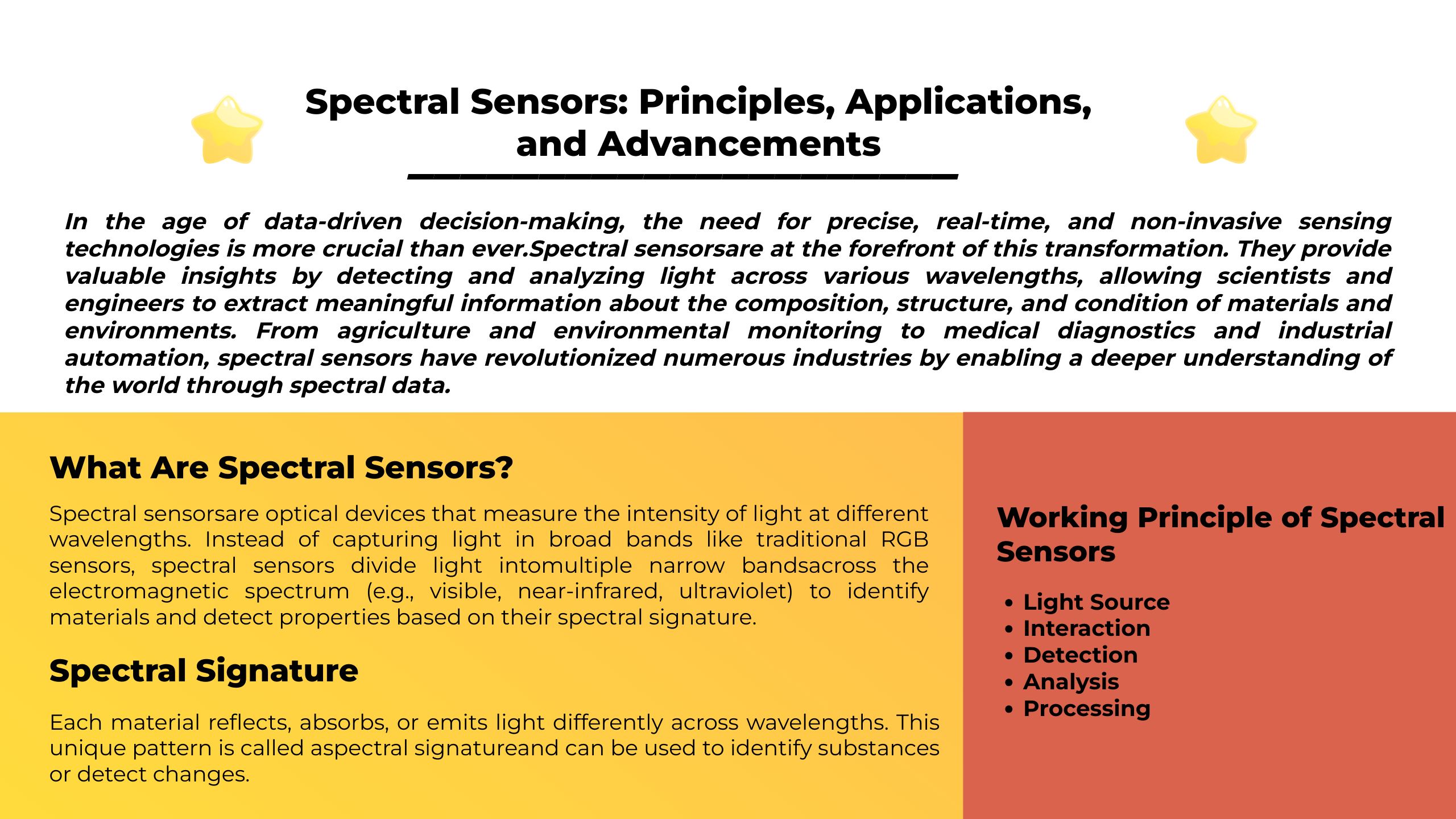
In the age of data-driven decision-making, the need for precise, real-time, and non-invasive sensing technologies is more crucial than ever. Spectral sensors are at the forefront of this transformation. They provide valuable insights by detecting and analyzing light across various wavelengths, allowing scientists and engineers to extract meaningful information about the composition, structure, and condition of materials and environments.
From agriculture and environmental monitoring to medical diagnostics and industrial automation, spectral sensors have revolutionized numerous industries by enabling a deeper understanding of the world through spectral data.
This article explores the fundamentals of spectral sensors, how they work, the technologies behind them, their applications, key design considerations, and future trends.
1. What Are Spectral Sensors?
Spectral sensors are optical devices that measure the intensity of light at different wavelengths. Instead of capturing light in broad bands like traditional RGB sensors, spectral sensors divide light into multiple narrow bands across the electromagnetic spectrum (e.g., visible, near-infrared, ultraviolet) to identify materials and detect properties based on their spectral signature.
1.1 Spectral Signature
Each material reflects, absorbs, or emits light differently across wavelengths. This unique pattern is called a spectral signature and can be used to identify substances or detect changes.
2. Working Principle of Spectral Sensors
Spectral sensors operate based on the interaction of electromagnetic radiation with matter. The fundamental process involves:
- Light Source: Illumination of the target (sunlight, LED, laser, etc.).
- Interaction: Light reflects, transmits, or is absorbed by the material.
- Detection: A spectrometer or filter array splits the incoming light into components.
- Analysis: The sensor measures intensity at specific wavelengths, creating a spectrum.
- Processing: Algorithms analyze the spectral data for classification, detection, or quantification.
3. Types of Spectral Sensors
3.1 Based on Spectral Range
- UV Sensors (100–400 nm)
- Visible Spectrum Sensors (400–700 nm)
- Near-Infrared (NIR) (700–2500 nm)
- Short-Wave Infrared (SWIR) (1000–2500 nm)
- Mid-Wave and Long-Wave Infrared (MWIR/LWIR) (3–14 µm)
3.2 Based on Architecture
- Multispectral Sensors: Measure light in a few discrete bands (e.g., red, green, NIR).
- Hyperspectral Sensors: Capture hundreds of contiguous narrow bands for detailed analysis.
- Snapshot Spectral Sensors: Capture the full spectrum in one shot (used in mobile/compact devices).
- Scanning Spectrometers: Use diffraction gratings or filters to scan across wavelengths.
4. Technologies Behind Spectral Sensors
4.1 Diffraction Gratings
Use prisms or gratings to split light into its spectral components before detection.
4.2 Fabry-Pérot Interferometers
Microelectromechanical systems (MEMS)-based components that tune to select wavelengths.
4.3 Filter Arrays
Stacked or patterned interference filters on sensor arrays for simultaneous wavelength detection.
4.4 Tunable Lasers
Allow scanning through wavelengths by changing laser emission properties (used in gas analysis).
5. Applications of Spectral Sensors
5.1 Agriculture
- Crop Health Monitoring: Detect nutrient deficiencies, stress, or disease using NDVI and other indices.
- Precision Agriculture: Optimize fertilization and irrigation through plant reflectance data.
- Fruit Ripeness Detection: Determine sugar content and ripeness using NIR analysis.
5.2 Environmental Monitoring
- Water Quality: Detect pollutants and algae based on spectral absorption.
- Air Quality: Monitor gases like NO₂, SO₂, and ozone.
- Climate Research: Measure solar radiation and atmospheric composition.
5.3 Industrial Automation
- Material Sorting: Identify plastics, paper, or metals for recycling.
- Food Inspection: Detect bruises, contamination, and freshness in produce.
- Process Control: Monitor chemical reactions and moisture content.
5.4 Medical and Biomedical
- Tissue Diagnostics: Differentiate healthy vs. diseased tissue.
- Non-Invasive Glucose Monitoring: Using NIR spectral response from skin.
- Blood Oxygenation: Pulse oximeters use spectral methods.
5.5 Remote Sensing and Drones
- Hyperspectral imaging on UAVs for land surveying, vegetation analysis, and mineral exploration.
5.6 Consumer Electronics
- Smartphones and wearables with embedded spectral sensors for skincare, food scanning, and environmental sensing.
6. Key Parameters in Spectral Sensors
| Parameter | Description |
|---|---|
| Spectral Range | Defines the portion of the spectrum covered (e.g., 400–1000 nm). |
| Spectral Resolution | The smallest wavelength difference the sensor can distinguish (e.g., 5 nm). |
| Number of Bands | Determines data richness (e.g., 5 for multispectral, 200+ for hyperspectral). |
| Sensitivity | Minimum detectable light level or signal-to-noise ratio. |
| Field of View (FOV) | Angular coverage of the sensor (especially in imaging sensors). |
| Response Time | Time taken to produce a usable spectrum. |
7. Advantages of Spectral Sensors
- Non-destructive testing
- Real-time analysis
- Compact and increasingly low-cost
- No need for physical contact
- Versatile across industries
8. Challenges and Limitations
- Data Volume: Hyperspectral sensors generate large datasets requiring high bandwidth and storage.
- Cost: High-resolution and high-band sensors remain expensive.
- Environmental Influences: Lighting and weather can affect reflectance data.
- Calibration: Requires consistent and accurate reference calibration for trustworthy results.
- Complex Algorithms: Requires machine learning and spectral libraries for classification.
9. Trends and Innovations
9.1 Miniaturization
Advancements in MEMS and nanophotonics are shrinking spectral sensors for integration into mobile phones and IoT devices.
9.2 AI and Machine Learning
Used to process and interpret high-dimensional spectral data quickly and accurately.
9.3 Real-Time Edge Processing
Embedded processors enable in-sensor spectral analysis, reducing latency and power consumption.
9.4 Affordable Consumer Products
Startups are launching handheld or smartphone-attachable spectral devices for everyday use in food quality, skincare, and textiles.
9.5 Integrated Systems
Combining spectral sensors with GPS, environmental, and imaging sensors for holistic data acquisition.
10. Selecting the Right Spectral Sensor
Consider the following when choosing a spectral sensor for an application:
- Target Material: What needs to be identified or measured?
- Spectral Range: Choose based on material properties (e.g., NIR for organics).
- Resolution and Bands: Higher resolution provides more detail but increases complexity.
- Environment: Indoor, outdoor, rugged, or lab use?
- Form Factor: Handheld, UAV-mounted, industrial-grade?
- Budget: Trade-off between performance and cost.
11. Future Outlook
The market for spectral sensors is rapidly expanding due to their integration into:
- Smart farming
- Space-based Earth observation
- Portable medical diagnostics
- Smart cities
- Next-generation industrial automation
With continuing advancements in photonics, AI, and microfabrication, spectral sensors are expected to become ubiquitous in both specialized and consumer domains. The convergence of hyperspectral sensing with 5G, cloud computing, and AI will make real-time, spectral-based decisions commonplace in everything from shopping to clinical medicine.
Conclusion
Spectral sensors represent a transformative class of devices that provide a unique and detailed window into the composition and condition of the physical world. Their ability to extract spectral fingerprints non-invasively has unlocked new possibilities in science, engineering, and daily life. As the technology becomes more accessible and integrated, it holds immense promise for smarter, faster, and more sustainable decisions across the globe.