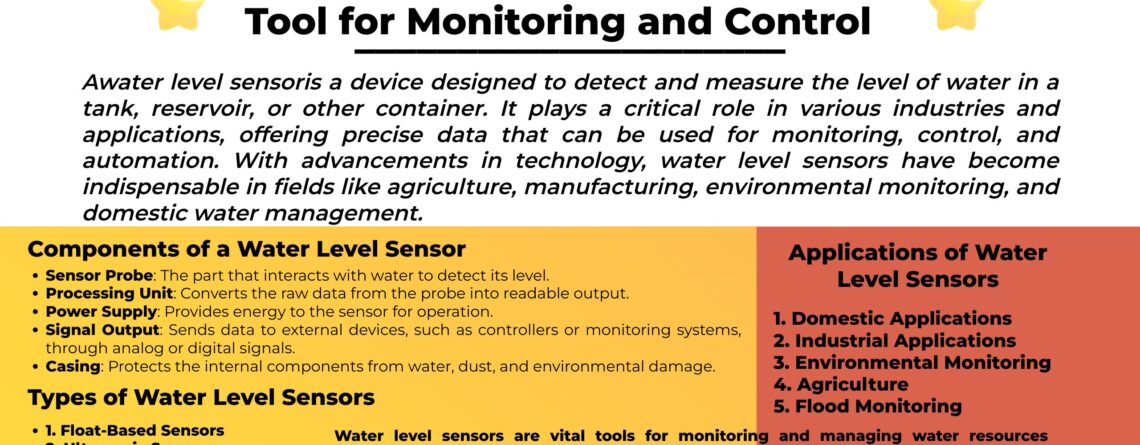

A water level sensor is a device designed to detect and measure the level of water in a tank, reservoir, or other container. It plays a critical role in various industries and applications, offering precise data that can be used for monitoring, control, and automation. With advancements in technology, water level sensors have become indispensable in fields like agriculture, manufacturing, environmental monitoring, and domestic water management.
Types of Water Level Sensors
Water level sensors are available in different types based on their working principles and use cases. How Does the Water Level Sensor Work, here are the most common types:
1. Float-Based Sensors
- Working Principle: These sensors use a float attached to a lever or rod that moves as the water level changes.
- Applications: Commonly used in domestic water tanks and industrial reservoirs.
- Advantages: Simple design, cost-effective, and reliable for basic applications.
2. Ultrasonic Sensors
- Working Principle: Emit ultrasonic sound waves and measure the time it takes for the echo to return after hitting the water surface.
- Applications: Widely used in environmental monitoring and industrial automation.
- Advantages: Non-contact, high precision, and suitable for harsh environments.
3. Capacitive Sensors
- Working Principle: Measure changes in capacitance caused by the presence or absence of water around a sensing probe.
- Applications: Ideal for detecting water levels in closed or pressurized systems.
- Advantages: High sensitivity and no moving parts.
4. Pressure Sensors
- Working Principle: Measure the hydrostatic pressure exerted by the water column to determine the level.
- Applications: Frequently used in deep wells and underwater tanks.
- Advantages: Suitable for large-scale and deep-water measurements.
5. Radar Sensors
- Working Principle: Use microwave radar waves to determine water levels by measuring the time delay of reflected signals.
- Applications: Used in industrial and hazardous environments.
- Advantages: High accuracy, long range, and works in extreme conditions.
6. Conductive Sensors
- Working Principle: Detect water levels by measuring the conductivity between electrodes.
- Applications: Suitable for applications requiring a quick response, like sump pump systems.
- Advantages: Simple and effective for specific use cases.
Components of a Water Level Sensor
A water level sensor typically consists of the following components:
- Sensor Probe: The part that interacts with water to detect its level.
- Processing Unit: Converts the raw data from the probe into readable output.
- Power Supply: Provides energy to the sensor for operation.
- Signal Output: Sends data to external devices, such as controllers or monitoring systems, through analog or digital signals.
- Casing: Protects the internal components from water, dust, and environmental damage.
Applications of Water Level Sensors
Water level sensors are versatile and find applications in numerous industries and environments:
1. Domestic Applications:
- Water Tanks: To monitor the water level in tanks, ensuring a constant supply without overfilling.
- Sump Pumps: To control the water level in basements or other areas prone to flooding, triggering the pump to remove excess water.
- Swimming Pools: To maintain a consistent water level in pools, ensuring proper filtration and water quality.
2. Industrial Applications:
- Boilers: To maintain water levels for safe operation of boilers and ensure the system does not run dry, which could cause damage.
- Chemical Processing: To monitor water or liquid levels in tanks for safe and controlled chemical processes.
- Cooling Systems: To maintain proper levels of coolant in cooling towers or heat exchangers.
3. Environmental Monitoring:
- Rivers and Lakes: To measure water levels in rivers, lakes, and reservoirs, helping monitor water resources and predict floods.
- Rainwater Harvesting: To track the amount of collected rainwater for reuse in agricultural or domestic applications.
4. Agriculture:
- Irrigation Systems: To ensure that water levels in irrigation ponds or reservoirs are sufficient for crop watering, optimizing water use.
- Fish Tanks: To maintain stable water levels in aquaculture tanks, supporting fish health and system stability.
5. Flood Monitoring:
- Flood-Prone Areas: Used in flood-prone regions to provide early warnings and activate drainage systems or flood control measures.
Advantages of Water Level Sensors
Water level sensors offer numerous advantages that make them valuable tools for a variety of industries and applications:
1. Automation:
- Water level sensors allow for automation of water management systems, reducing the need for manual intervention. For example, they can automatically activate or deactivate pumps, valves, and alarms.
2. Prevention of Overflows:
- Sensors help prevent overflows by triggering actions (like turning off pumps) when the water level reaches a predetermined point. This reduces the risk of water wastage and property damage.
3. Optimized Water Usage:
- In agricultural applications, these sensors optimize water usage by providing accurate data on irrigation needs, leading to more efficient farming practices.
4. Enhanced Safety:
- In industrial applications, water level sensors can protect against dangerous conditions such as boiler dry-out, which could result in system damage or even explosions.
5. Cost-Efficiency:
- By reducing water wastage, preventing overflows, and automating processes, water level sensors help save costs in both domestic and industrial settings.
6. Real-Time Monitoring:
- With modern technology, many water level sensors offer real-time data, allowing operators to monitor conditions continuously and respond immediately to any issues.
7. Environmental Protection:
- In environmental monitoring, these sensors help track water levels in bodies of water, providing valuable data for flood prediction and sustainable water resource management.
Challenges in Using Water Level Sensors
Despite their advantages, water level sensors face certain challenges:
- Maintenance: Regular cleaning and calibration may be required, especially for sensors exposed to sediments or algae.
- Environmental Factors: Extreme weather, such as freezing temperatures, can impact sensor performance.
- Cost of Advanced Sensors: High-precision sensors like radar and ultrasonic systems can be expensive.
- Interference: Electrical or magnetic interference may affect the accuracy of certain sensor types.
How to Choose the Right Water Level Sensor
Selecting the appropriate water level sensor depends on several factors:
- Application Needs: Identify whether you need a sensor for domestic, industrial, or environmental use.
- Measurement Range: Choose a sensor capable of measuring the required depth or height.
- Environmental Conditions: Consider factors like temperature, pressure, and potential exposure to corrosive substances.
- Output Type: Decide between analog or digital output based on your system requirements.
- Budget: Balance the features and precision with your budget constraints.
Future Trends in Water Level Sensing Technology
- IoT Integration: Sensors are increasingly being integrated with IoT platforms for real-time monitoring and data analysis.
- Smart Systems: AI and machine learning are being used to predict water usage and optimize resource management.
- Energy Efficiency: Development of low-power sensors for sustainable operation.
- Miniaturization: Compact sensors are being designed for deployment in smaller systems and complex environments.
Conclusion
Water level sensors are vital tools for monitoring and managing water resources efficiently. With a wide variety of sensor types and applications, they cater to industries ranging from agriculture to industrial automation and environmental monitoring. As technology continues to advance, water level sensors will become even more accurate, reliable, and integrated into smart systems, ensuring sustainable and effective water management in the years to come.


Leave a Reply