Particulate Matter (PM) sensors are critical tools in monitoring air quality by measuring the concentration of airborne particles. Among the various types of PM sensors, infrared (IR) and laser-based sensors are prominent due to their effectiveness and widespread use. This analysis aims to compare these two types of sensors, examining their working principles, performance metrics, applications, advantages, disadvantages, cost considerations, and future developments.
Infrared PM Sensors

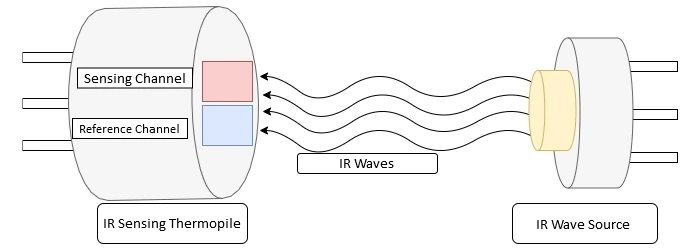
Infrared PM sensors detect particles by utilizing the scattering of infrared light. The primary components of an infrared PM sensor include:
- Infrared Light Source: An infrared LED emits light into the air sample.
- Detection Chamber: The air containing particulate matter passes through this chamber.
- Photodetector: Positioned to detect scattered light from the particles.
- Processing Unit: Converts the detected signal into particle concentration data.
When infrared light encounters particles in the air, it scatters. The amount and angle of scattering depend on the particle size and concentration. The photodetector captures this scattered light, and the sensor’s electronics process this information to estimate the particle concentration.
Advantages
- Cost-Effective: Infrared PM sensors are generally cheaper than other types, making them accessible for widespread use.
- Low Power Consumption: They typically consume less power, which is beneficial for battery-operated devices.
- Simplicity and Durability: The technology is relatively simple and durable, ensuring long-term operation with minimal maintenance.
Disadvantages
- Lower Accuracy and Sensitivity: Compared to laser PM sensors, infrared sensors have lower accuracy and sensitivity, especially for smaller particles.
- Limited Particle Size Detection: Less effective at detecting very fine particles below 0.3 micrometers.
- Potential Interference: Other particles and environmental factors (like humidity) can affect the accuracy of readings.
Laser PM Sensors
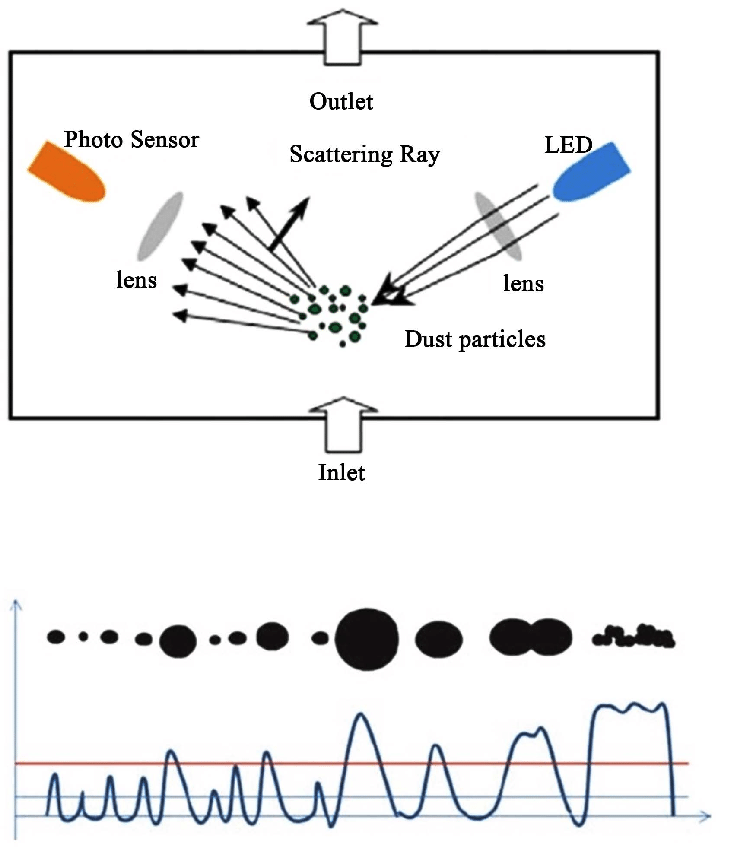
(Source: researchgate.net)
Laser PM sensors operate by using a laser light source to detect particles in the air. The primary components of a laser PM sensor include:
- Laser Light Source: A laser diode emits a focused beam of light.
- Detection Chamber: Air containing particulate matter flows through this chamber.
- Photodetector: Captures the light scattered by particles in the air.
- Processing Unit: Analyzes the scattered light to determine particle concentration and size distribution.
When the laser light encounters particles, it scatters in various directions. The photodetector measures the intensity and pattern of the scattered light. The sensor’s electronics then process this information to accurately determine the number and size of particles present in the air sample.
Advantages
- High Accuracy: Provides precise measurements of particle concentration and size.
- High Sensitivity: Capable of detecting very small particles, essential for detailed air quality analysis.
- Wide Detection Range: Effective for a broad range of particle sizes, from fine to coarse particles.
Disadvantages
- Higher Cost: More expensive than other types of PM sensors due to the advanced technology used.
- Greater Power Consumption: Typically consumes more power, which can be a limitation for battery-operated devices.
- Complexity: More complex design, which can lead to higher maintenance needs and potential fragility.
Performance Metrics
Infrared PM Sensors
Accuracy
The accuracy of infrared PM sensors is influenced by several factors, including particle size, shape, and the sensor’s calibration. Generally, these sensors provide moderate accuracy suitable for many air quality monitoring applications but may struggle with very fine particles.
Sensitivity
Infrared PM sensors are sensitive to a range of particle sizes, typically from 0.3 to 10 micrometers. However, they are less effective at detecting particles smaller than 0.3 micrometers, which limits their sensitivity compared to other technologies like laser PM sensors.
Laser PM Sensors
Accuracy
Laser PM sensors are highly accurate due to their precise measurement capabilities. The narrow wavelength of the laser light allows for accurate detection and sizing of particles, providing reliable data for air quality monitoring.
Sensitivity
Laser PM sensors are extremely sensitive and can detect particles as small as 0.1 micrometers. This high sensitivity makes them suitable for applications that require detailed monitoring of fine particulate matter, which can be critical for health and safety.
Comparison of Infrared and Laser PM Sensors: Advantages and Disadvantages
| Feature | Infrared PM Sensors | Laser PM Sensors |
|---|---|---|
| Accuracy | Moderate accuracy; less precise due to broader light spectrum. | High accuracy; precise due to narrow laser wavelength. |
| Sensitivity | Adequate for general monitoring; less sensitive to smaller particles (<0.3 micrometers). | High sensitivity; capable of detecting very fine particles (down to 0.1 micrometers). |
| Cost | Cost-effective; suitable for budget-sensitive applications. | Higher cost; suitable for applications requiring detailed and precise measurements. |
| Power Consumption | Low power consumption; ideal for battery-operated devices. | Greater power consumption; may not be ideal for battery-operated devices. |
| Complexity | Simpler design; easier to maintain and less prone to damage. | More complex design; potentially higher maintenance needs and fragility. |
| Application Range | Suitable for general indoor air quality monitoring, HVAC systems, and consumer electronics. | Suitable for detailed environmental monitoring, industrial emission monitoring, and research. |
| Durability | Generally durable and reliable for long-term operation. | Can be more fragile due to the precision components used. |
| Interference | Potentially more affected by environmental factors like humidity and other particles. | Less affected by environmental interference, providing more reliable readings. |
| Detection Range | Effective for particle sizes typically ranging from 0.3 to 10 micrometers. | Effective for a broader range of particle sizes, from 0.1 to 10 micrometers. |
| Technological Advancements | Advancements focus on improving calibration, signal processing, and miniaturization. | Advancements focus on integrating AI, reducing costs, miniaturization, and enhancing durability. |
How to Choose Between Infrared and Laser PM Sensors
1. Accuracy Requirements
- Infrared PM Sensors: Suitable for applications where moderate accuracy is acceptable. If your primary goal is to get a general sense of air quality without needing highly precise measurements, infrared sensors are a good choice.
- Laser PM Sensors: Ideal for applications requiring high accuracy and detailed data. If you need precise measurements of particle concentration and size, such as in research or industrial applications, laser sensors are preferable.
2. Sensitivity Needs
- Infrared PM Sensors: Adequate for detecting larger particles (typically >0.3 micrometers). If your application involves monitoring dust, pollen, or other larger particles, infrared sensors can be sufficient.
- Laser PM Sensors: Highly sensitive to very fine particles (down to 0.1 micrometers). For applications needing detection of fine particulate matter, such as in health studies or high-precision environments, laser sensors are the better option.
3. Budget Constraints
- Infrared PM Sensors: More cost-effective and suitable for budget-sensitive projects. If cost is a significant concern and high precision is not critical, infrared sensors are a more economical choice.
- Laser PM Sensors: Higher cost but justifiable for applications where performance and precision are critical. If budget allows, investing in laser sensors can provide better data quality.
4. Power Consumption
- Infrared PM Sensors: Lower power consumption, making them ideal for battery-operated devices and applications where power efficiency is important.
- Laser PM Sensors: Typically consume more power. Consider laser sensors if your application has adequate power supply and demands high precision.
5. Application Specificity
- Infrared PM Sensors: Best for general indoor air quality monitoring, HVAC systems, and basic environmental monitoring. Suitable for consumer electronics where moderate accuracy suffices.
- Laser PM Sensors: Suited for detailed environmental monitoring, industrial emission control, medical and research applications, and high-end consumer products requiring precise air quality data.
6. Environmental Conditions
- Infrared PM Sensors: May be more affected by environmental factors like humidity and other particles. If the application environment is stable and controlled, infrared sensors can perform adequately.
- Laser PM Sensors: Less affected by environmental interference, making them more reliable in varied conditions. If the application environment is harsh or variable, laser sensors are more robust.
7. Durability and Maintenance
- Infrared PM Sensors: Generally simpler and more durable, requiring less maintenance. Ideal for long-term, low-maintenance applications.
- Laser PM Sensors: More complex and potentially more fragile, requiring regular maintenance. Suitable for applications where frequent calibration and maintenance are feasible.
8. Technological Advancements and Future Proofing
- Infrared PM Sensors: Advancements focus on improving calibration, signal processing, and miniaturization. If ongoing improvements and long-term usability are important, consider the latest infrared sensor models.
- Laser PM Sensors: Continual advancements in integrating AI, reducing costs, and enhancing durability. If staying at the forefront of technology is crucial, laser sensors offer more cutting-edge features.
Conclusion
Infrared and laser PM sensors each have their unique strengths and weaknesses. Infrared sensors are cost-effective and suitable for general applications, while laser sensors offer superior accuracy and sensitivity for detailed monitoring. The choice between them depends on the specific requirements of the application, including accuracy, sensitivity, and budget considerations. As technology advances, both types of sensors will continue to evolve, providing better tools for maintaining air quality and protecting public health.