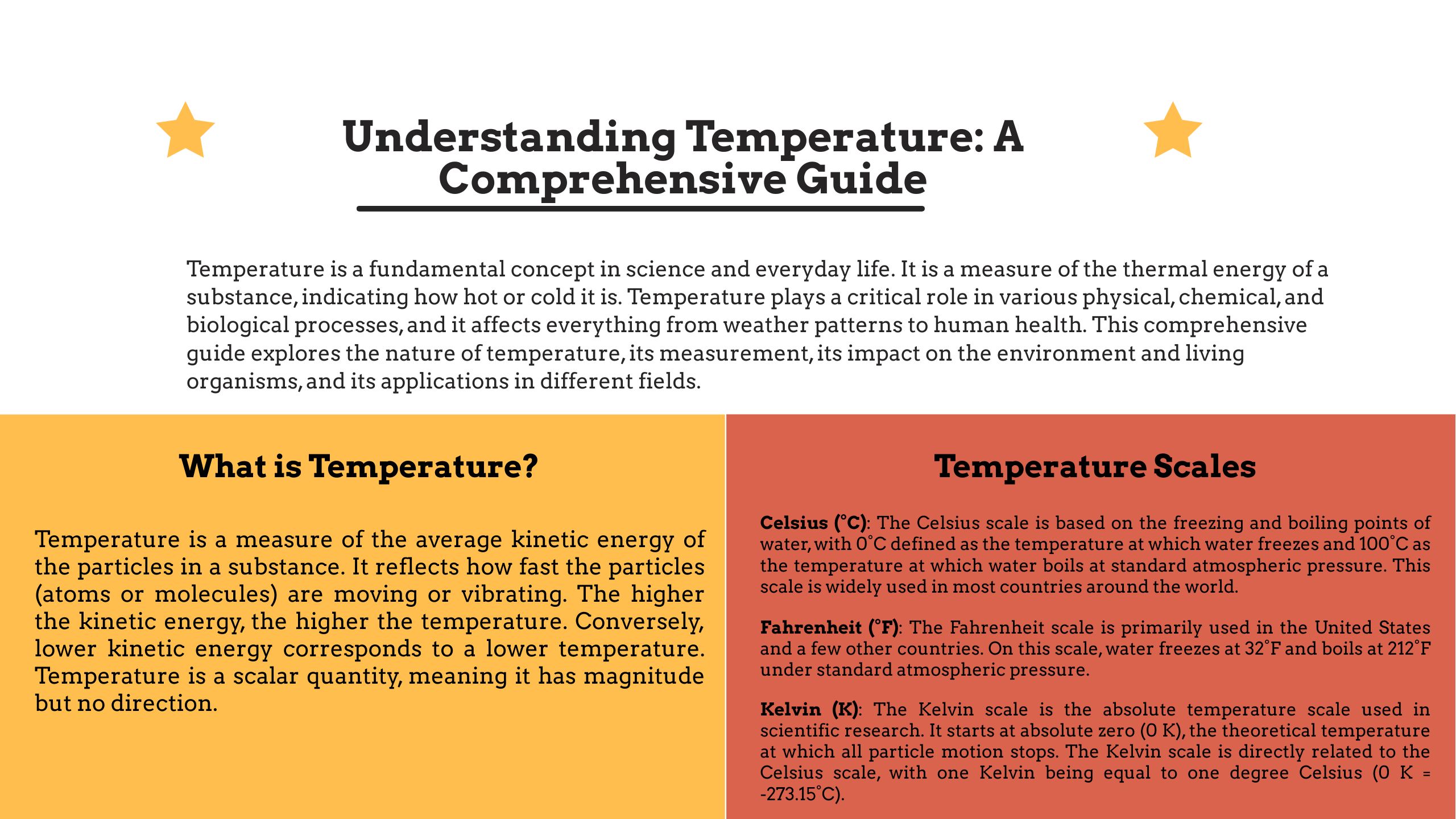
Temperature is a fundamental concept in science and everyday life. It is a measure of the thermal energy of a substance, indicating how hot or cold it is. Temperature plays a critical role in various physical, chemical, and biological processes, and it affects everything from weather patterns to human health. This comprehensive guide explores the nature of temperature, its measurement, its impact on the environment and living organisms, and its applications in different fields.
What is Temperature?
Temperature is a measure of the average kinetic energy of the particles in a substance. It reflects how fast the particles (atoms or molecules) are moving or vibrating. The higher the kinetic energy, the higher the temperature. Conversely, lower kinetic energy corresponds to a lower temperature. Temperature is a scalar quantity, meaning it has magnitude but no direction.
Temperature Scales
There are several temperature scales used to measure temperature, the most common of which are Celsius (°C), Fahrenheit (°F), and Kelvin (K).
- Celsius (°C): The Celsius scale is based on the freezing and boiling points of water, with 0°C defined as the temperature at which water freezes and 100°C as the temperature at which water boils at standard atmospheric pressure. This scale is widely used in most countries around the world.
- Fahrenheit (°F): The Fahrenheit scale is primarily used in the United States and a few other countries. On this scale, water freezes at 32°F and boils at 212°F under standard atmospheric pressure.
- Kelvin (K): The Kelvin scale is the absolute temperature scale used in scientific research. It starts at absolute zero (0 K), the theoretical temperature at which all particle motion stops. The Kelvin scale is directly related to the Celsius scale, with one Kelvin being equal to one degree Celsius (0 K = -273.15°C).
Converting Between Temperature Scales
Temperature conversions are essential for comparing measurements from different systems. The following formulas are used for conversion:
- Celsius to Fahrenheit: T(°F)=T(°C)×5/9+32
- Fahrenheit to Celsius: T(°C)=(T(°F)−32)×9/5
- Celsius to Kelvin: T(K)=T(°C)+273.15
- Kelvin to Celsius: T(°C)=T(K)−273.15
Measurement of Temperature
Accurate temperature measurement is crucial in various scientific, industrial, and everyday applications. Several instruments and techniques are used to measure temperature, each with its own advantages and limitations.
Thermometers
Thermometers are the most common instruments for measuring temperature. They come in various types, including:
- Liquid-in-Glass Thermometers: These thermometers use a liquid (usually mercury or alcohol) that expands or contracts with temperature changes. The liquid level rises or falls in a calibrated glass tube to indicate temperature.
- Digital Thermometers: These thermometers use electronic sensors to measure temperature and display the reading on a digital screen. They are widely used for medical, industrial, and environmental monitoring.
- Infrared Thermometers: These devices measure temperature from a distance by detecting the infrared radiation emitted by an object. They are useful for measuring the temperature of surfaces that are hard to reach or hazardous to touch.
- Bimetallic Strip Thermometers: These thermometers use a strip made of two different metals bonded together. The metals expand at different rates when heated, causing the strip to bend. The amount of bending indicates the temperature.
Thermocouples
Thermocouples are widely used in industrial applications for temperature measurement. They consist of two different metals joined at one end. When the junction is heated or cooled, it produces a voltage that can be measured and converted into a temperature reading. Thermocouples are known for their wide temperature range and fast response time.
Resistance Temperature Detectors (RTDs)
RTDs measure temperature by correlating the resistance of a metal (usually platinum) with temperature. As the temperature changes, the resistance of the metal changes in a predictable way. RTDs are highly accurate and stable, making them suitable for precision temperature measurements.
Thermistors
Thermistors are temperature-sensitive resistors made from ceramic materials. Their resistance changes significantly with temperature, allowing for precise temperature measurements. Thermistors are commonly used in electronic devices and HVAC systems.
Pyrometers
Pyrometers are non-contact temperature measuring devices used to measure high temperatures, typically in industrial settings. They detect the thermal radiation emitted by an object and convert it into a temperature reading. Pyrometers are essential for monitoring furnaces, kilns, and other high-temperature environments.
More About Temperature Sensor: Temperature Sensors: Essential Tools for Precision and Control
The Science of Temperature
Temperature is a key parameter in the study of thermodynamics, which is the branch of physics that deals with heat, work, and energy. Understanding temperature and its effects is fundamental to understanding the laws of thermodynamics and various physical phenomena.
Kinetic Theory of Gases
The kinetic theory of gases explains the behavior of gases in terms of the motion of their particles. According to this theory, the temperature of a gas is directly proportional to the average kinetic energy of its molecules. As the temperature increases, the molecules move faster, increasing the pressure and volume of the gas (if the gas is not confined).
Heat Transfer
Heat transfer is the process by which thermal energy moves from a region of higher temperature to a region of lower temperature. There are three modes of heat transfer:
- Conduction: The transfer of heat through direct contact between molecules. It occurs in solids, liquids, and gases but is most effective in solids.
- Convection: The transfer of heat through the movement of fluids (liquids or gases). Convection currents can form when a fluid is heated, causing it to expand and become less dense, which results in the fluid rising and being replaced by cooler fluid.
- Radiation: The transfer of heat through electromagnetic waves, such as infrared radiation. Unlike conduction and convection, radiation does not require a medium and can occur in a vacuum.
Thermal Expansion
Thermal expansion is the increase in the size of a substance due to an increase in temperature. Most materials expand when heated and contract when cooled. This property is important in various applications, such as designing bridges and buildings to accommodate temperature changes and preventing thermal stress in materials.
Phase Changes
Temperature plays a crucial role in phase changes, which are the transitions between different states of matter (solid, liquid, gas). The key phase changes include:
- Melting: The transition from a solid to a liquid.
- Freezing: The transition from a liquid to a solid.
- Vaporization: The transition from a liquid to a gas (includes boiling and evaporation).
- Condensation: The transition from a gas to a liquid.
- Sublimation: The transition from a solid directly to a gas.
- Deposition: The transition from a gas directly to a solid.
These phase changes occur at specific temperatures, known as melting points, freezing points, and boiling points, which are characteristic of each substance.
Applications of Temperature
Temperature measurement and control are essential in a wide range of applications, from everyday activities to advanced scientific research.
Weather and Climate
Temperature is a fundamental parameter in meteorology and climate science. It influences weather patterns, atmospheric pressure, and the behavior of the Earth’s climate system. Accurate temperature measurements are crucial for weather forecasting, climate modeling, and understanding global warming.
Healthcare
Body temperature is an important vital sign in medical diagnostics. Fever, hypothermia, and hyperthermia are conditions related to abnormal body temperature. Medical thermometers, including oral, ear, and forehead thermometers, are used to monitor body temperature and detect illnesses.
Industrial Processes
Temperature control is vital in various industrial processes, such as chemical reactions, metalworking, food processing, and semiconductor manufacturing. Precise temperature regulation ensures product quality, safety, and energy efficiency.
HVAC Systems
Heating, ventilation, and air conditioning (HVAC) systems rely on temperature sensors to maintain comfortable indoor environments. These systems regulate temperature and humidity to provide optimal conditions for human comfort and health.
Electronics
Temperature management is crucial in electronic devices to prevent overheating and ensure reliable operation. Cooling systems, such as fans and heat sinks, are used to dissipate heat generated by electronic components.
Food and Beverage
Temperature control is essential in the food and beverage industry to ensure food safety and quality. Proper refrigeration, cooking, and storage temperatures are necessary to prevent spoilage and contamination.
Scientific Research
Temperature measurement and control are fundamental in scientific research, particularly in physics, chemistry, and biology. Experiments often require precise temperature conditions to study reactions, behaviors, and properties of materials.
Automotive
In the automotive industry, temperature sensors are used to monitor engine temperature, coolant temperature, and exhaust gas temperature. Proper temperature management is essential for engine performance, fuel efficiency, and emissions control.
Aerospace
Temperature regulation is critical in aerospace applications, where extreme temperatures can affect the performance and safety of aircraft and spacecraft. Thermal control systems are used to manage temperatures in these environments.
Conclusion
Temperature is a fundamental physical quantity that affects every aspect of our lives. From the weather we experience to the industrial processes that produce the goods we use, temperature plays a crucial role. Understanding the science behind temperature, how it is measured, and its applications can help us better manage and control it in various contexts. Advances in temperature measurement technology continue to enhance our ability to monitor and regulate temperature with greater accuracy and precision, leading to improved outcomes in numerous fields.
Realted Read: The Interplay Between Temperature and Humidity: A Comprehensive Analysis