Temperature and humidity are two fundamental atmospheric variables that significantly influence each other and have profound impacts on various environmental, industrial, and human activities. Understanding the intricate relationship between these two factors is crucial for weather forecasting, HVAC (Heating, Ventilation, and Air Conditioning) systems, agricultural practices, and numerous other applications. This article delves into the dynamics of temperature and humidity, exploring their interdependence, the science behind their interaction, and the practical implications of this relationship.
Understanding Temperature and Humidity
What is Temperature?
Temperature is a measure of the thermal energy of a substance. It indicates how hot or cold an environment or object is and is measured in degrees Celsius (°C), Fahrenheit (°F), or Kelvin (K). Temperature affects the kinetic energy of particles in a substance, influencing physical states, chemical reactions, and biological processes.
What is Humidity?
Humidity refers to the concentration of water vapor present in the air. It can be expressed in several ways, including absolute humidity, relative humidity, and specific humidity:
- Absolute Humidity: The mass of water vapor per unit volume of air, usually expressed in grams per cubic meter (g/m³).
- Relative Humidity (RH): The ratio of the current amount of water vapor in the air to the maximum amount the air can hold at a given temperature, expressed as a percentage. RH indicates how close the air is to being saturated with moisture.
- Specific Humidity: The mass of water vapor per unit mass of air, usually expressed in grams of water vapor per kilogram of air (g/kg).
The Relationship Between Temperature and Humidity
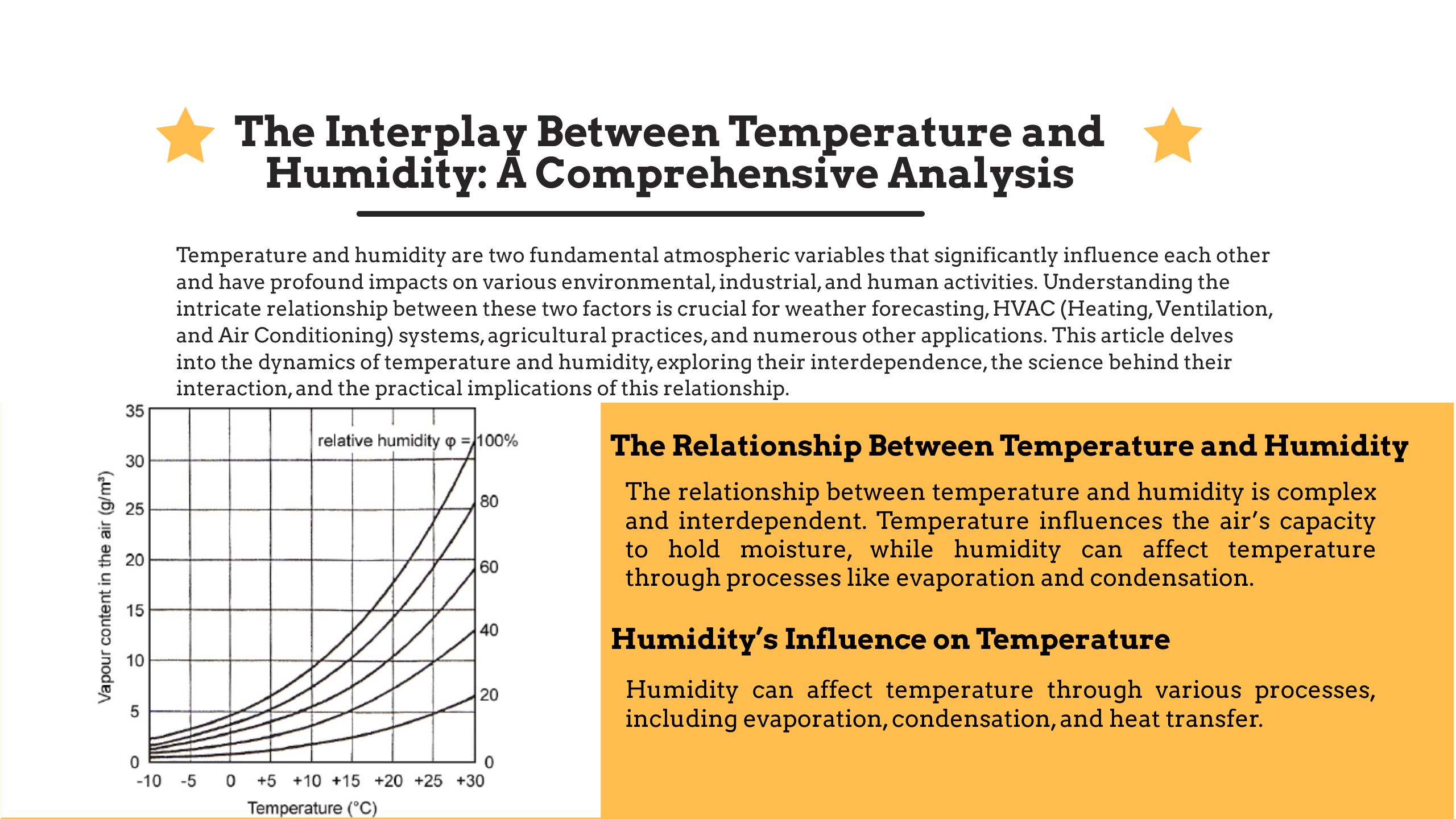
The relationship between temperature and humidity is complex and interdependent. Temperature influences the air’s capacity to hold moisture, while humidity can affect temperature through processes like evaporation and condensation.
Temperature’s Influence on Humidity
The air’s ability to hold water vapor increases with temperature. Warm air can contain more moisture than cold air because higher temperatures increase the kinetic energy of water molecules, preventing them from condensing into liquid form.
Saturation Vapor Pressure
Saturation vapor pressure is the maximum pressure that water vapor exerts at a given temperature. It represents the point at which air is fully saturated with moisture and can hold no more water vapor. This pressure increases exponentially with temperature, meaning that a slight increase in temperature significantly raises the air’s capacity to hold water vapor.
Dew Point
The dew point is the temperature at which air becomes saturated with moisture and water vapor begins to condense into liquid. It is a direct measure of the air’s moisture content. When the temperature drops to the dew point, relative humidity reaches 100%, and condensation occurs, forming dew, fog, or clouds.
Humidity’s Influence on Temperature
Humidity can affect temperature through various processes, including evaporation, condensation, and heat transfer.
Evaporation
Evaporation is the process by which water changes from a liquid to a gas. This process requires heat, which is absorbed from the surrounding environment, causing a cooling effect. High humidity levels slow down evaporation because the air is already saturated with moisture, reducing the cooling effect.
Condensation
Condensation is the process by which water vapor changes from a gas to a liquid. This process releases heat into the surrounding environment, causing a warming effect. When humid air rises and cools to its dew point, condensation occurs, releasing latent heat and warming the air.
Heat Transfer
Humidity affects heat transfer in the atmosphere. Water vapor is a greenhouse gas, trapping heat and affecting temperature regulation. High humidity levels can enhance the greenhouse effect, leading to warmer temperatures.
Practical Implications of Temperature and Humidity
The interplay between temperature and humidity has significant implications for various fields, including meteorology, agriculture, HVAC systems, human health, and industrial processes.
Meteorology
Accurate weather forecasting relies on understanding the relationship between temperature and humidity. These variables influence weather patterns, cloud formation, precipitation, and storm development.
Cloud Formation and Precipitation
Clouds form when moist air rises and cools to its dew point, causing water vapor to condense into tiny droplets. If the droplets combine and grow large enough, they fall as precipitation. The amount and intensity of precipitation depend on the moisture content of the air and the temperature.
Heat Index
The heat index, also known as the apparent temperature, combines air temperature and relative humidity to estimate the perceived temperature. High humidity levels reduce the body’s ability to cool through sweating, making it feel hotter than the actual air temperature. The heat index is crucial for assessing heat stress and preventing heat-related illnesses.
Agriculture
Temperature and humidity are critical factors in agricultural practices. They influence crop growth, soil moisture levels, pest and disease prevalence, and irrigation requirements.
Crop Growth
Different crops have specific temperature and humidity requirements for optimal growth. Understanding these needs helps farmers manage planting schedules, greenhouse conditions, and climate control systems to maximize yields.
Soil Moisture
Soil moisture levels are affected by temperature and humidity. High temperatures increase evaporation rates, reducing soil moisture. Monitoring these variables helps in efficient irrigation management, ensuring crops receive adequate water.
HVAC Systems
HVAC systems are designed to maintain comfortable indoor environments by controlling temperature and humidity levels. Understanding the relationship between these variables is essential for efficient system design and operation.
Comfort and Health
Maintaining optimal temperature and humidity levels is crucial for indoor comfort and health. High humidity levels can lead to mold growth and respiratory problems, while low humidity levels can cause dryness and irritation. HVAC systems regulate these variables to create a healthy indoor environment.
Energy Efficiency
Efficient HVAC systems use sensors to monitor temperature and humidity, adjusting settings to minimize energy consumption. For example, in humid climates, dehumidifiers are used to remove excess moisture, reducing the cooling load and saving energy.
Human Health
Temperature and humidity significantly affect human health and comfort. Extreme conditions can lead to heat stress, dehydration, respiratory problems, and other health issues.
Heat-Related Illnesses
High temperatures combined with high humidity levels can lead to heat-related illnesses such as heat exhaustion and heat stroke. The body’s ability to cool itself through sweating is compromised in humid conditions, increasing the risk of overheating.
Respiratory Health
Humidity levels impact respiratory health. High humidity can exacerbate conditions like asthma and allergies by promoting mold and dust mite growth. Low humidity levels can dry out mucous membranes, leading to respiratory irritation.
Industrial Processes
Temperature and humidity control are essential in various industrial processes, including manufacturing, storage, and quality control.
Manufacturing
Many manufacturing processes require precise temperature and humidity control to ensure product quality and consistency. For example, in the electronics industry, humidity control is crucial to prevent static electricity buildup and damage to sensitive components.
Storage
Proper temperature and humidity control are essential for the storage of perishable goods, pharmaceuticals, and sensitive materials. Maintaining optimal conditions prevents spoilage, degradation, and loss of product quality.
Tables and Figures
To enhance understanding, the following tables and figures summarize key points and data related to temperature and humidity.Table 1: Common Units and Conversion Factors for Temperature
| Unit | Symbol | Conversion to Celsius |
|---|---|---|
| Celsius | °C | – |
| Fahrenheit | °F | (°F – 32) × 5/9 |
| Kelvin | K | K – 273.15 |
Table 2: Common Units and Conversion Factors for Humidity
| Humidity Measure | Unit | Description |
|---|---|---|
| Absolute Humidity | g/m³ | Mass of water vapor per unit volume of air |
| Relative Humidity | % | Ratio of current to maximum water vapor at a given temperature |
| Specific Humidity | g/kg | Mass of water vapor per unit mass of air |
Conclusion
The relationship between temperature and humidity is a complex and dynamic interplay that significantly impacts the environment, industries, and human activities. Understanding this relationship is crucial for accurate weather forecasting, efficient HVAC system design, optimal agricultural practices, and numerous other applications. By comprehensively analyzing the science behind temperature and humidity interaction, we can better manage and control these variables to improve comfort, health, and productivity in various fields.
References
- American Meteorological Society
- World Meteorological Organization
- ASHRAE – American Society of Heating, Refrigerating and Air-Conditioning Engineers
- Agricultural Research Service – USDA
- National Institute for Occupational Safety and Health (NIOSH)
By exploring the interplay between temperature and humidity, we can enhance our understanding and management of these critical environmental variables, leading to improved outcomes in various applications.