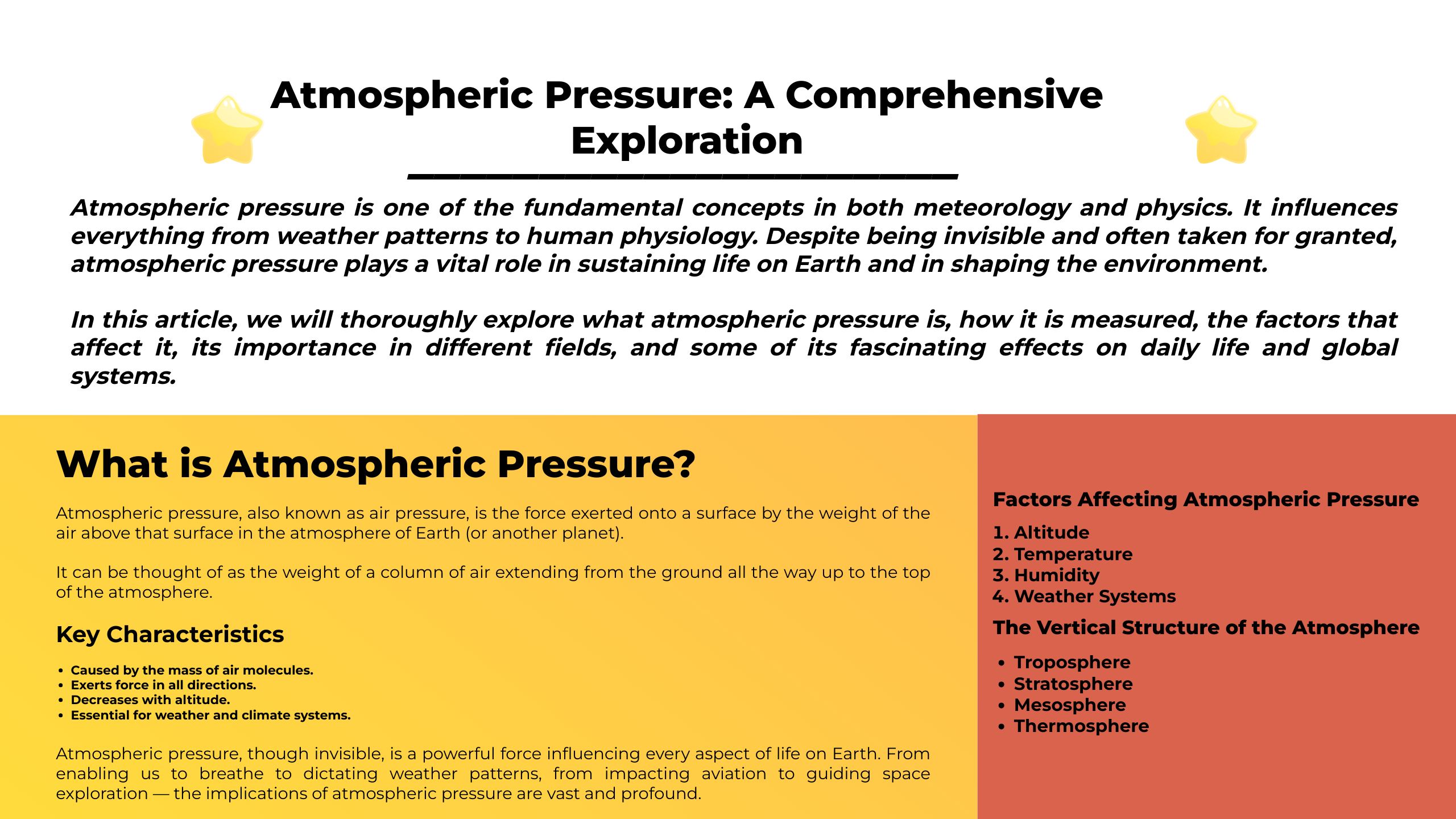
Atmospheric pressure is one of the fundamental concepts in both meteorology and physics. It influences everything from weather patterns to human physiology. Despite being invisible and often taken for granted, atmospheric pressure plays a vital role in sustaining life on Earth and in shaping the environment.
In this article, we will thoroughly explore what atmospheric pressure is, how it is measured, the factors that affect it, its importance in different fields, and some of its fascinating effects on daily life and global systems.
What is Atmospheric Pressure?
Atmospheric pressure, also known as air pressure, is the force exerted onto a surface by the weight of the air above that surface in the atmosphere of Earth (or another planet).
It can be thought of as the weight of a column of air extending from the ground all the way up to the top of the atmosphere.
Key Characteristics
- Caused by the mass of air molecules.
- Exerts force in all directions.
- Decreases with altitude.
- Essential for weather and climate systems.
Scientific Explanation
Molecular Motion
Air consists of countless molecules in constant motion. Each collision of air molecules with a surface contributes to the total force exerted over that surface. Summing up these countless impacts gives rise to what we perceive as atmospheric pressure.
Gravity’s Role
Gravity pulls air molecules toward Earth, creating a dense atmosphere. Without gravity, the gases would disperse into space, and there would be no measurable atmospheric pressure.
How is Atmospheric Pressure Measured?
Atmospheric pressure can be measured in several ways, using different units and instruments:
Units of Measurement
- Pascal (Pa): SI unit (1 Pa = 1 N/m²).
- Hectopascal (hPa): Common in meteorology (1 hPa = 100 Pa).
- Millibar (mb): 1 mb = 1 hPa.
- Atmosphere (atm): 1 atm = 101,325 Pa.
- Torr: 1 atm = 760 Torr.
Measuring Instruments
- Mercury Barometer: Measures atmospheric pressure based on the height of a mercury column.
- Aneroid Barometer: Uses a sealed, flexible metal box to detect pressure changes.
- Digital Sensors: Modern weather stations often use electronic sensors to measure pressure.
Standard Atmospheric Pressure
At sea level, under standard conditions (0°C temperature), atmospheric pressure is defined as:
1 atm=101,325 Pa=760 mmHg=29.92 inHg
This standard is critical for calibrating instruments and defining conditions for scientific experiments.
Factors Affecting Atmospheric Pressure
Several factors can influence atmospheric pressure:
Altitude
- Pressure decreases with altitude.
- At higher elevations, there is less air above a given surface.
Temperature
- Warm air is less dense and leads to lower pressure.
- Cold air is denser and results in higher pressure.
Humidity
- Moist air is less dense than dry air because water vapor is lighter than oxygen or nitrogen.
- Thus, increased humidity can lower atmospheric pressure.
Weather Systems
- High-pressure systems are associated with fair weather.
- Low-pressure systems often bring clouds, rain, or storms.
The Vertical Structure of the Atmosphere
The atmosphere is divided into several layers, each with different pressure characteristics:
Troposphere
- Lowest layer, where weather occurs.
- Pressure decreases rapidly with altitude.
Stratosphere
- Contains the ozone layer.
- Pressure continues to drop but more slowly.
Mesosphere
- Meteors burn up here.
- Very low pressure.
Thermosphere
- Extremely low pressure despite high temperatures.
In general, about 50% of Earth’s atmospheric mass is found below 5.6 km (18,000 ft) altitude.
Atmospheric Pressure and Weather
Atmospheric pressure is a key player in weather systems:
High-Pressure Systems (Anticyclones)
- Air descends.
- Results in clear skies and calm weather.
Low-Pressure Systems (Cyclones)
- Air rises.
- Leads to cloud formation and precipitation.
Pressure Gradients
- Differences in pressure drive winds.
- The greater the gradient, the stronger the wind.
Effects of Atmospheric Pressure on Humans
Breathing
- Atmospheric pressure helps push oxygen into our lungs.
- At high altitudes, reduced pressure can cause difficulty breathing.
High-Altitude Sickness
- Symptoms include headaches, nausea, and dizziness.
- Caused by low oxygen availability at reduced pressures.
Decompression Sickness
- Divers ascending too quickly experience nitrogen bubble formation in the blood due to pressure changes.
Atmospheric Pressure in Technology
Aviation
- Pilots rely on pressure-based altimeters to determine altitude.
- Cabin pressurization ensures passenger comfort and safety.
Weather Forecasting
- Barometric pressure readings predict weather changes.
- Rapid pressure drops often indicate incoming storms.
Industrial Applications
- Vacuum systems.
- Pressure-sensitive equipment in scientific research and manufacturing.
Historical Perspective
Evangelista Torricelli
- Invented the mercury barometer in 1643.
- Proved that air has weight and exerts pressure.
Blaise Pascal
- Demonstrated that atmospheric pressure decreases with altitude.
- His experiments paved the way for understanding fluid dynamics and meteorology.
Atmospheric Pressure on Other Planets
Other celestial bodies have different atmospheric pressures:
| Planet | Surface Pressure |
|---|---|
| Mercury | Near zero |
| Venus | 92 atm (very high) |
| Earth | 1 atm |
| Mars | 0.006 atm (very low) |
| Jupiter | Extremely high (estimates vary) |
These differences significantly impact potential habitability and exploration strategies.
Interesting Phenomena Related to Atmospheric Pressure
Boiling Point Changes
- Water boils at lower temperatures at high altitudes due to reduced pressure.
Weather Glass
- Simple devices use water or mercury to show pressure changes visually.
Barometric Pressure and Health
- Some people experience joint pain or migraines with pressure fluctuations.
Modern Measurement and Data Use
Today, atmospheric pressure data is gathered through:
- Weather balloons.
- Satellites.
- Remote sensing technologies.
These measurements are crucial for:
- Predicting natural disasters like hurricanes.
- Studying climate change.
- Supporting aviation and space missions.
The Future of Atmospheric Pressure Research
Climate Change Impacts
- Shifting pressure patterns influence storm paths and rainfall distribution.
Advanced Modeling
- Supercomputers use atmospheric pressure data in complex climate models.
New Technologies
- Improvements in sensor miniaturization are making atmospheric pressure readings more accessible in mobile devices.
Conclusion
Atmospheric pressure, though invisible, is a powerful force influencing every aspect of life on Earth. From enabling us to breathe to dictating weather patterns, from impacting aviation to guiding space exploration — the implications of atmospheric pressure are vast and profound.
Understanding this crucial concept helps us appreciate the delicate balance of Earth’s environment and prepares us for innovations in science, technology, and environmental management. Whether studying the atmosphere for weather prediction, health research, or space travel, atmospheric pressure remains a central focus in unraveling the complexities of our universe.