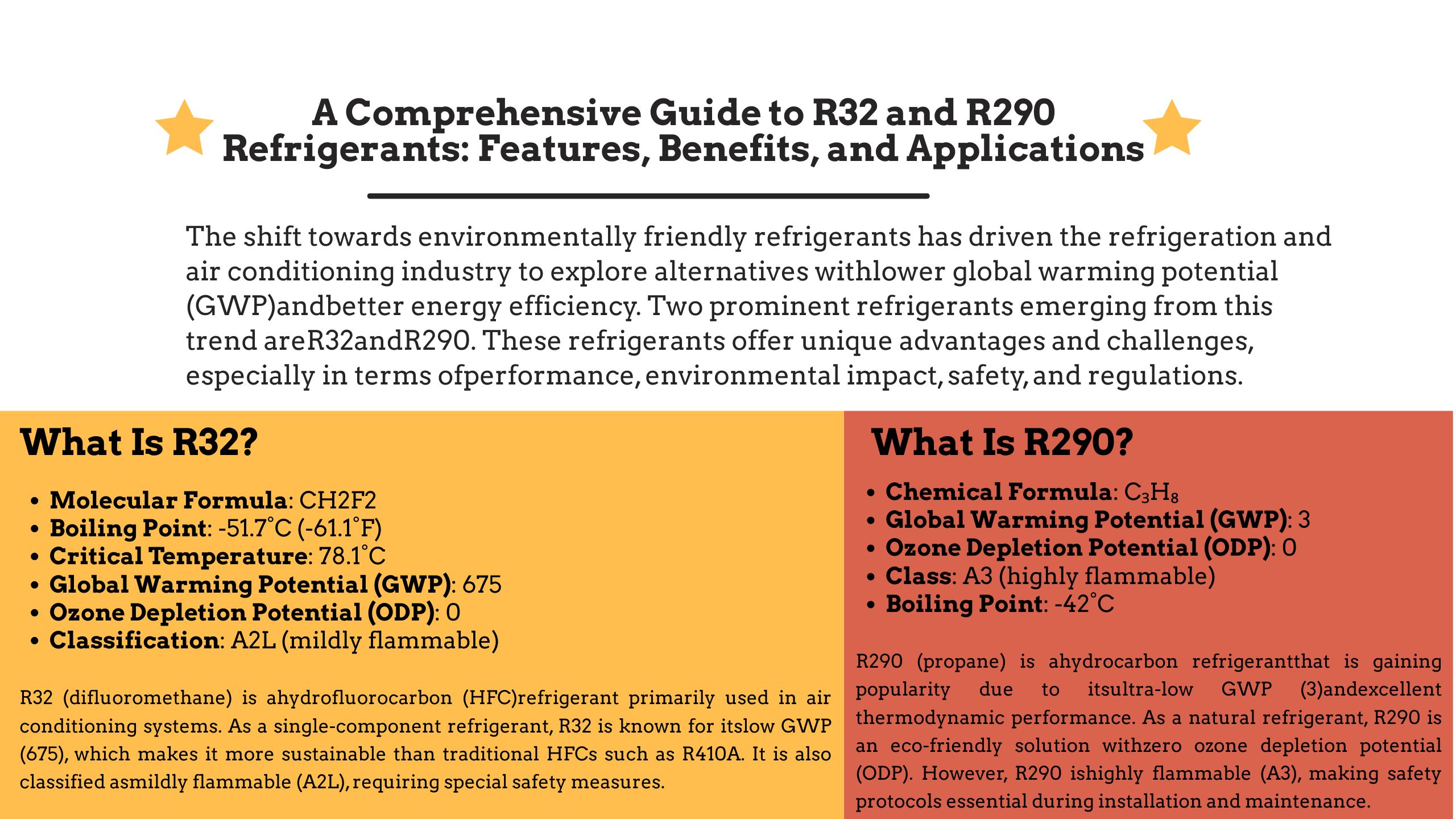
The shift towards environmentally friendly refrigerants has driven the refrigeration and air conditioning industry to explore alternatives with lower global warming potential (GWP) and better energy efficiency. Two prominent refrigerants emerging from this trend are R32 and R290. These refrigerants offer unique advantages and challenges, especially in terms of performance, environmental impact, safety, and regulations.
In this article, we will explore the features, applications, pros, and cons of both R32 and R290, comparing their suitability for residential, commercial, and industrial applications.
What Is R32?
Overview
R32 (difluoromethane) is a hydrofluorocarbon (HFC) refrigerant primarily used in air conditioning systems. As a single-component refrigerant, R32 is known for its low GWP (675), which makes it more sustainable than traditional HFCs such as R410A. It is also classified as mildly flammable (A2L), requiring special safety measures.
Key Properties of R32
Chemical Formula: CH₂F₂
Global Warming Potential (GWP): 675
Ozone Depletion Potential (ODP): 0
Class: A2L (mildly flammable)
Boiling Point: -51.7°C
Applications of R32
R32 is commonly used in:
Residential air conditioners
Split systems and heat pumps
Commercial HVAC systems
Portable air conditioning units
R32 is increasingly replacing R410A in new air conditioning units due to its higher energy efficiency and lower environmental impact.
R290 (propane) is a hydrocarbon refrigerant that is gaining popularity due to its ultra-low GWP (3) and excellent thermodynamic performance. As a natural refrigerant, R290 is an eco-friendly solution with zero ozone depletion potential (ODP). However, R290 is highly flammable (A3), making safety protocols essential during installation and maintenance.
Key Properties of R290
Chemical Formula: C₃H₈
Global Warming Potential (GWP): 3
Ozone Depletion Potential (ODP): 0
Class: A3 (highly flammable)
Boiling Point: -42°C
Applications of R290
R290 is widely used in:
Refrigerators and freezers
Display cabinets and cold storage
Heat pumps
Industrial cooling systems
Many manufacturers in Europe and Asia have switched to R290 for refrigerators and commercial refrigeration units to meet environmental regulations.
Both R32 and R290 offer significant environmental advantages over older refrigerants such as R410A and R134a.
R32:
GWP: 675 (much lower than R410A’s 2,088)
ODP: 0
Energy Efficiency: Higher energy efficiency than R410A, reducing power consumption.
R290:
GWP: 3 (extremely low, almost negligible)
ODP: 0
Energy Efficiency: Superior thermodynamic properties result in excellent energy performance.
While both refrigerants are eco-friendly, R290 is a more sustainable option due to its near-zero GWP. However, its flammability restricts its usage in certain applications.
Many countries encourage the adoption of R32-based air conditioning systems due to its low GWP. It complies with the Kigali Amendment for phasing down high-GWP refrigerants.
R290 Regulations
R290 is compliant with European F-Gas regulations and other international environmental frameworks. However, due to its flammability, some regions impose restrictions on the quantity of R290 allowed in specific systems.
Pros and Cons of R32
Pros
Lower GWP than R410A
High energy efficiency for air conditioning systems
Widespread availability and easy adoption in existing HVAC systems
Cons
Mild flammability requires some additional safety measures
High pressure requires robust system components
Pros and Cons of R290
Pros
Extremely low GWP of 3, making it highly sustainable
Excellent thermodynamic performance for refrigeration systems
Both R32 and R290 offer significant environmental benefits compared to older refrigerants, aligning with global efforts to reduce greenhouse gas emissions. R32 is becoming the go-to refrigerant for air conditioning systems due to its high energy efficiency and manageable flammability. On the other hand, R290 is favored for refrigeration systems because of its outstanding sustainability and performance.
However, safety is a critical factor when choosing between the two. While R32 is mildly flammable, R290’s high flammability limits its use to controlled environments.
Choosing the right refrigerant involves evaluating factors such as performance, environmental impact, safety, and regulatory compliance. As the industry shifts towards sustainable solutions, both R32 and R290 will play crucial roles in creating energy-efficient and eco-friendly cooling systems.