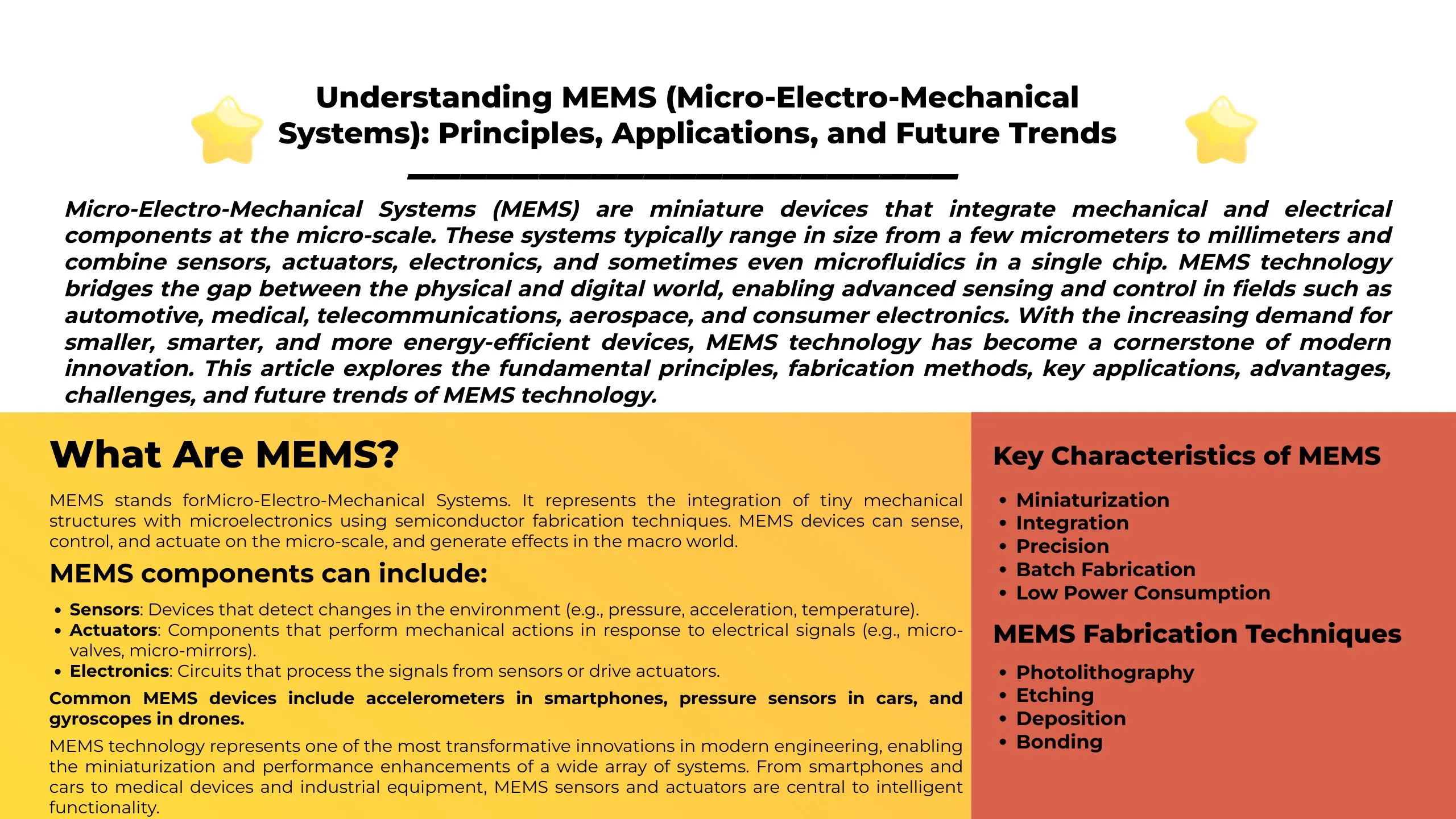
Micro-Electro-Mechanical Systems (MEMS) are miniature devices that integrate mechanical and electrical components at the micro-scale. These systems typically range in size from a few micrometers to millimeters and combine sensors, actuators, electronics, and sometimes even microfluidics in a single chip. MEMS technology bridges the gap between the physical and digital world, enabling advanced sensing and control in fields such as automotive, medical, telecommunications, aerospace, and consumer electronics.
With the increasing demand for smaller, smarter, and more energy-efficient devices, MEMS technology has become a cornerstone of modern innovation. This article explores the fundamental principles, fabrication methods, key applications, advantages, challenges, and future trends of MEMS technology.
1. What Are MEMS?
MEMS stands for Micro-Electro-Mechanical Systems. It represents the integration of tiny mechanical structures with microelectronics using semiconductor fabrication techniques. MEMS devices can sense, control, and actuate on the micro-scale, and generate effects in the macro world.
MEMS components can include:
- Sensors: Devices that detect changes in the environment (e.g., pressure, acceleration, temperature).
- Actuators: Components that perform mechanical actions in response to electrical signals (e.g., micro-valves, micro-mirrors).
- Electronics: Circuits that process the signals from sensors or drive actuators.
Common MEMS devices include accelerometers in smartphones, pressure sensors in cars, and gyroscopes in drones.
2. Key Characteristics of MEMS
MEMS devices possess several distinct characteristics:
- Miniaturization: MEMS devices are fabricated using lithographic processes, enabling sizes in the micrometer range.
- Integration: Mechanical and electrical elements are integrated on a single chip.
- Precision: MEMS devices offer high sensitivity and precision in measurement and control.
- Batch Fabrication: Like semiconductor ICs, MEMS devices can be mass-produced, reducing costs.
- Low Power Consumption: Their size and efficiency make them suitable for battery-operated devices.
3. MEMS Fabrication Techniques
MEMS fabrication is heavily based on semiconductor manufacturing methods, especially those used in silicon-based electronics. Key techniques include:
3.1. Photolithography
Photolithography uses light to transfer geometric patterns onto a silicon wafer coated with a light-sensitive material (photoresist). This process is crucial for defining the shapes and structures in MEMS.
3.2. Etching
Etching removes material to create patterns or cavities. It can be:
- Wet Etching: Uses liquid chemicals.
- Dry Etching: Uses plasma or reactive gases.
Deep Reactive Ion Etching (DRIE) is widely used for creating deep, narrow features.
3.3. Deposition
Thin layers of materials are deposited on the wafer to build structures:
- Chemical Vapor Deposition (CVD)
- Physical Vapor Deposition (PVD)
- Electroplating
3.4. Bonding
Wafer bonding techniques, such as anodic bonding or fusion bonding, are used to join multiple layers of materials or encapsulate MEMS structures.
4. Common MEMS Components
4.1. MEMS Accelerometers
Measure linear acceleration by detecting the displacement of a proof mass. Used in smartphones, automotive airbags, and gaming controllers.
4.2. MEMS Gyroscopes
Detect angular velocity and orientation using vibrating structures. Common in drones, navigation systems, and wearable devices.
4.3. MEMS Pressure Sensors
Measure gas or liquid pressure by detecting the deflection of a diaphragm. Used in medical devices, HVAC systems, and automotive applications.
4.4. MEMS Microphones
Convert sound into electrical signals using a vibrating diaphragm. Found in smartphones, hearing aids, and smart speakers.
4.5. MEMS Optical Switches and Mirrors
Used in optical communication and projection systems. Tiny mirrors can tilt or rotate to control light paths.
5. Applications of MEMS Technology
5.1. Automotive Industry
- Airbag deployment systems
- Tire pressure monitoring
- Engine control
- Vehicle stability and rollover detection
5.2. Consumer Electronics
- Smartphone motion sensors (gyroscopes, accelerometers)
- Screen rotation and gesture recognition
- Microphones and environmental sensors
5.3. Healthcare and Medical Devices
- Pressure sensors for blood monitoring
- MEMS-based drug delivery systems
- Inhalers and infusion pumps
- Diagnostic lab-on-chip systems
5.4. Aerospace and Defense
- Inertial navigation systems
- Altimeters and barometers
- Micro-thrusters
- Vibration and structural health monitoring
5.5. Industrial and Robotics
- Vibration and tilt sensors in machines
- Micro-valves and actuators in automation
- Environmental monitoring (temperature, humidity, gas)
5.6. Telecommunications
- RF MEMS switches for signal routing
- Optical MEMS for fiber optics
- Tunable capacitors and filters
6. Advantages of MEMS Technology
- Compact Size: Enables miniaturization of devices and systems.
- Cost-Effective Production: Batch fabrication allows for mass production.
- Integration with Electronics: Easier integration with CMOS circuits.
- Low Power Consumption: Suitable for battery-powered or energy-harvesting devices.
- Fast Response Time: Micro-scale structures respond quickly to environmental changes.
- High Sensitivity and Precision: Accurate detection and actuation.
7. Challenges in MEMS Development
Despite their advantages, MEMS devices also face challenges:
- Packaging: Protecting delicate microstructures from the environment while maintaining performance.
- Reliability: MEMS devices must withstand mechanical fatigue, shock, and temperature variations.
- Manufacturing Yield: Microscopic defects during fabrication can lead to failure.
- Standardization: Lack of universal standards in MEMS design and packaging.
- Integration Complexity: Difficulties in combining MEMS with digital electronics on the same chip.
8. MEMS vs. NEMS (Nano-Electro-Mechanical Systems)
NEMS are the next evolution of MEMS, with components on the nanometer scale. While MEMS operates in the micrometer range, NEMS offers even smaller and faster devices, often with enhanced sensitivity.
- MEMS: 1–1000 microns
- NEMS: 1–100 nanometers
NEMS are still in the research and early commercialization phase, while MEMS is widely adopted in industry.
9. Future Trends in MEMS
9.1. Integration with IoT
MEMS sensors are integral to the Internet of Things (IoT). They gather data from the physical world for smart cities, homes, and industrial IoT applications.
9.2. Wearable and Implantable Devices
Smaller, biocompatible MEMS devices are being developed for continuous health monitoring and drug delivery.
9.3. 5G and RF MEMS
The rollout of 5G networks drives demand for RF MEMS components like switches, filters, and tunable antennas.
9.4. Artificial Intelligence and Edge Computing
MEMS sensors combined with AI enable real-time decision-making in edge devices, improving speed and reducing cloud dependency.
9.5. Microfluidics and Lab-on-a-Chip
Integration of MEMS with microfluidics is advancing point-of-care diagnostics, enabling lab-quality testing on small, portable platforms.
10. Leading Companies in MEMS Development
Several global companies are at the forefront of MEMS research and manufacturing:
- STMicroelectronics
- Bosch Sensortec
- Analog Devices
- Texas Instruments
- TDK InvenSense
- ROHM Semiconductor
- Murata Manufacturing
These companies supply MEMS components to industries including automotive, healthcare, industrial automation, and consumer electronics.
Conclusion
MEMS technology represents one of the most transformative innovations in modern engineering, enabling the miniaturization and performance enhancements of a wide array of systems. From smartphones and cars to medical devices and industrial equipment, MEMS sensors and actuators are central to intelligent functionality.
As technology continues to evolve, MEMS will play an even greater role in enabling smart, connected devices that interact with the world in real time. Whether you’re a design engineer, researcher, or tech enthusiast, understanding MEMS is key to participating in the future of innovation.