
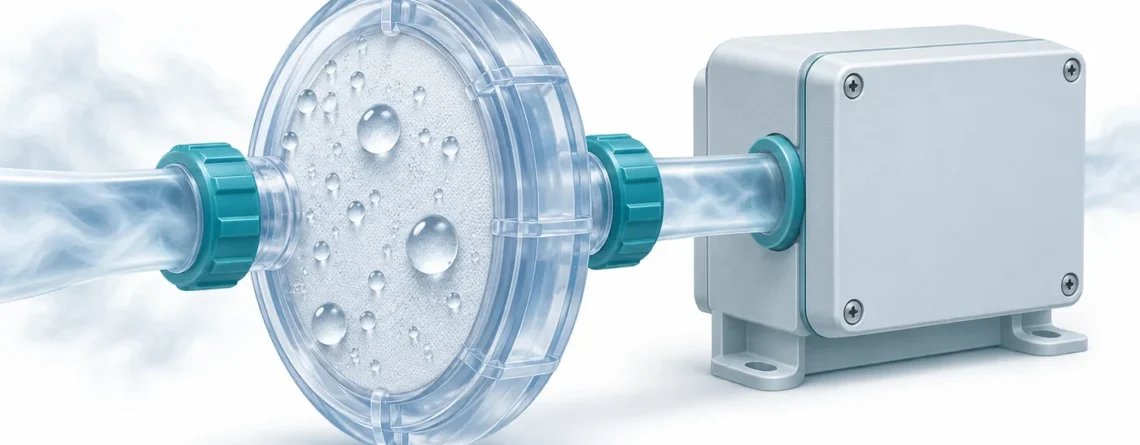
A suitable hydrophobic filter can resist liquid water entering a gas sensor while allowing gas to pass. It does not normally remove water vapor from a humid sample, and it cannot guarantee that condensation will not form farther downstream. Protection depends on the membrane, liquid chemistry, pressure difference, installation and filter condition.
The practical question is therefore broader than whether a filter is waterproof. A gas measurement needs both a protected sensing element and a representative sample. A filter may protect the element while delaying gas arrival, increasing pressure drop, or becoming covered by liquid. A dryer may solve a moisture problem while changing the concentration basis. Those effects must be considered separately.
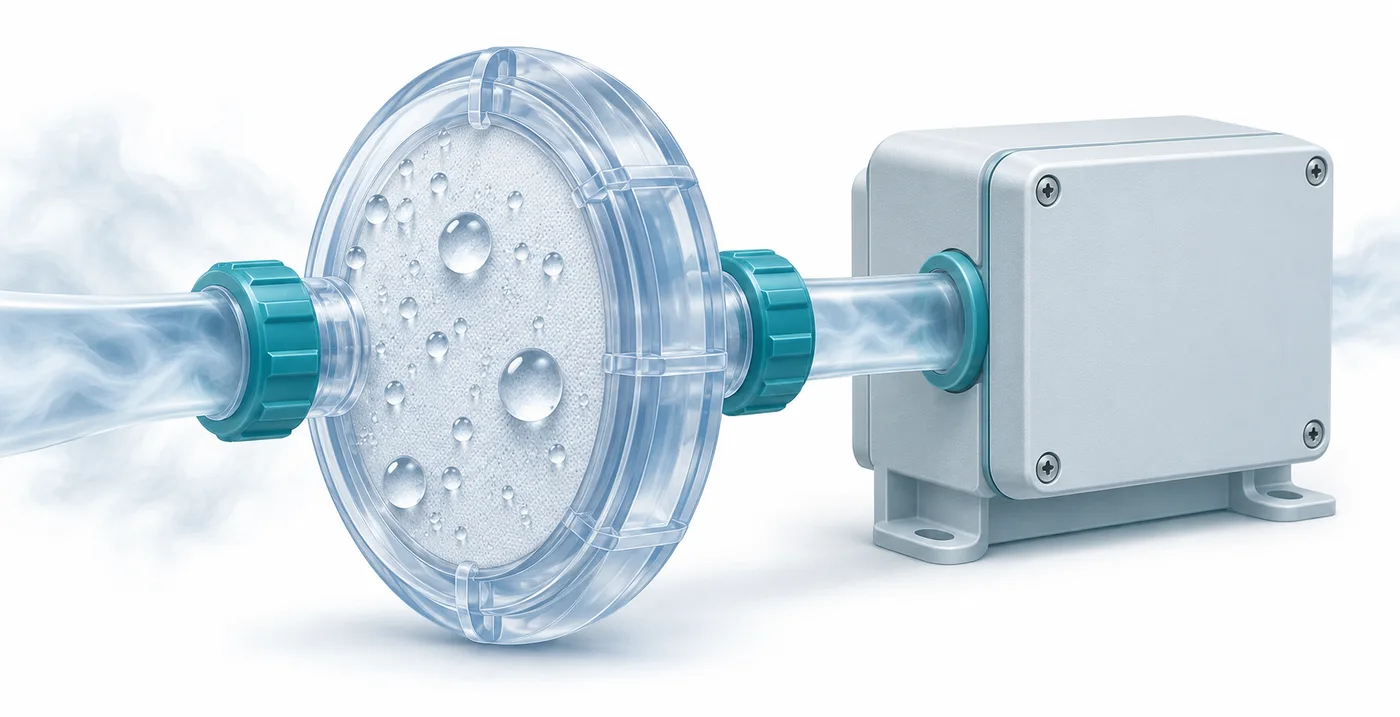
Conceptual barrier: droplets can be resisted at a membrane while humid gas remains on both sides. A liquid barrier is not automatically a vapor dryer.
Water vapor and liquid water require different controls
Water vapor consists of water molecules in the gas phase. Humid gas can look completely clear. Liquid water appears as droplets, films, mist or collected condensate. A sample can contain either phase or both.
A hydrophobic membrane's liquid resistance arises from its material and pore behavior under specified conditions. Water vapor can still accompany the gas through the available gas pathways. Calling the incoming sample high humidity does not reveal whether the main threat is vapor exposure, entrained liquid or condensation after cooling.
Relative humidity describes proximity to saturation at the local temperature. It is not the same as water mole fraction. When a humid gas warms without gaining or losing water, its relative humidity can fall even though its water content has not been reduced.
Dew point is useful because it relates water content to the temperature at which condensation begins at the relevant pressure. If part of the sampling path falls below that dew point, liquid can form there. A membrane upstream cannot stop water that was still vapor while it crossed the membrane.
Pressure changes also belong in the assessment. Dew point and water-vapor conditions depend on pressure. A sample extracted from a pressurized process may not have the same condensation behavior after pressure reduction. Use the conditions at each stage rather than a single humidity number copied from the source.
Before choosing hardware, describe the water problem in physical terms: droplets at the inlet, humid vapor throughout the line, a cold fitting that condenses water, or a sensor that cannot tolerate the water content. Different descriptions lead to different remedies.
What can a hydrophobic membrane actually do?
A suitable membrane can provide a barrier to liquid intrusion while permitting gas exchange. The useful performance depends on the pressure difference and the liquid's interaction with the membrane. It is not an unlimited barrier under every flow, pressure and chemical condition.
Gore's packaging-vent FAQ distinguishes hydrophobic behavior for aqueous liquids from oleophobic behavior relevant to lower-surface-tension fluids such as oils or detergents. It also explains that covering a vent membrane with liquid can prevent gas exchange. These are useful membrane principles, but a packaging example does not certify a gas-analyzer installation.
A contaminated sample may therefore challenge a membrane differently from clean water. Oils, cleaning residues and surfactants can affect wetting. Specify the actual liquid and contaminants when asking for filter compatibility; a clean-water claim alone may not establish suitability.
The complete filter includes more than the membrane material. Housing seals, support structure, connections, assembly and orientation can create additional limitations. A liquid-resistant membrane in a poorly sealed holder does not create a liquid-resistant sample path.
Gore's performance-membrane information also distinguishes membrane applications and airflow characteristics. The integration lesson is to use the relevant product's data and test conditions. Material names such as PTFE do not identify a universal pressure drop, gas response or water-entry rating.
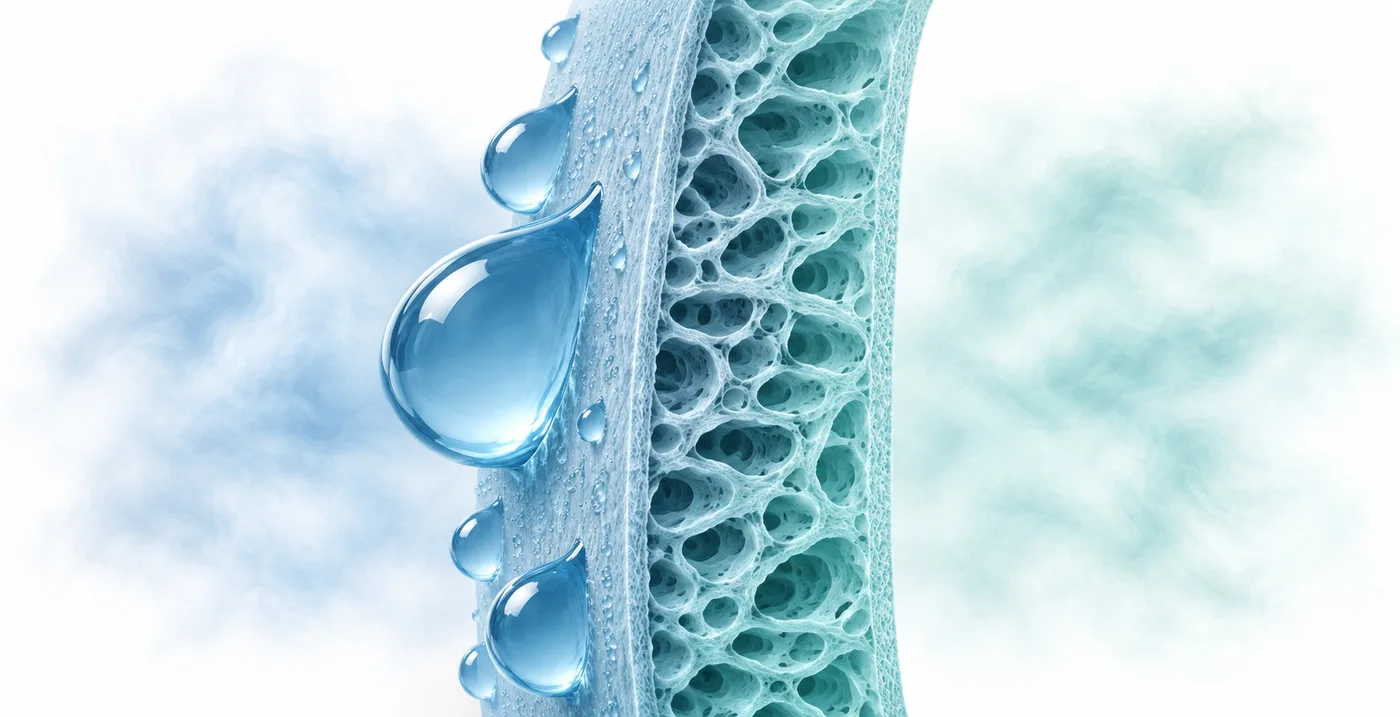
Conceptual membrane behavior, not a microscopic product model. Liquid resistance and water-vapor removal are different functions.
Why can condensation appear after a successful filter?
Consider a warm humid sample that passes through an inlet membrane without any droplets crossing it. The sample then enters a cooler fitting. If that fitting is below the sample's dew point, some of the vapor condenses there.
In that sequence, the inlet barrier can have performed its intended task. The downstream water formed locally from vapor. Replacing the filter with another liquid barrier in the same thermal arrangement may leave the underlying problem unchanged.
The coldest surface matters more than the average cabinet temperature. A metal bulkhead, an exposed connector or a tube touching a cold wall can create a local condensation site. A sample line that is mostly warm can still contain one problematic cold section.
Vaisala's high-humidity application note illustrates the importance of conduction and installation cold spots. Its example concerns humidity probes, but the reasoning applies to locating where condensation can occur in a gas path: the temperature of the actual surface, not merely the surrounding process, determines whether water forms there.
Inspect the full path from source to exhaust. A filter may be at room temperature while a nearby inlet is warmed, or the sensor chamber may cool during an overnight shutdown. Startup can therefore present a different water condition from steady operation.
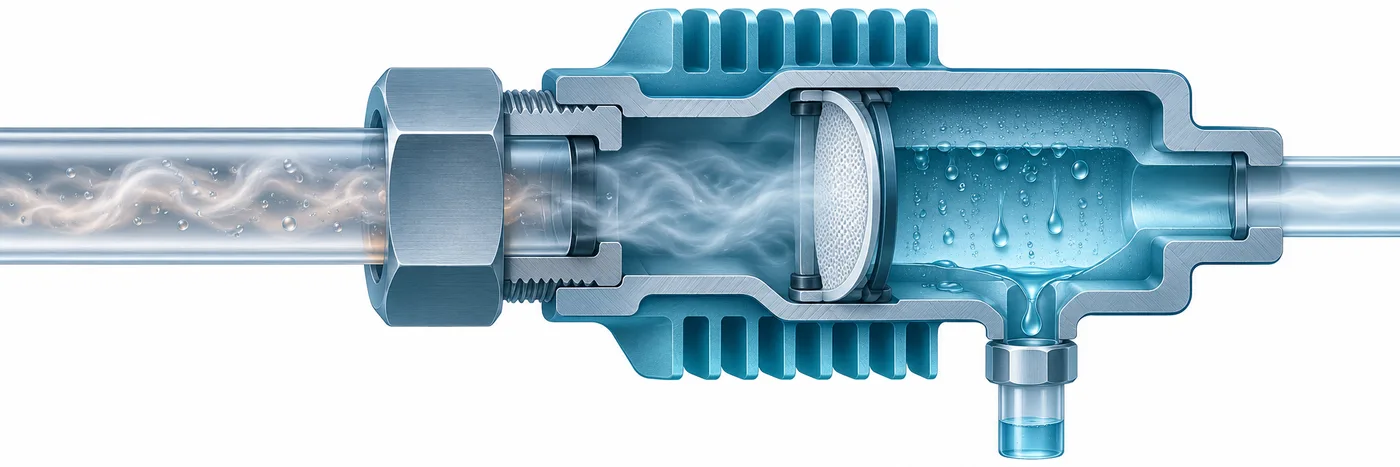
Conceptual downstream condensation: vapor passes the membrane and later forms droplets at a colder section. No liquid breakthrough is required.
Compare a barrier, trap, dryer and heated path
These components solve different problems and should not be treated as interchangeable accessories.
A liquid barrier resists intrusion at a boundary. A trap collects or separates liquid that already exists. A dryer removes water vapor using a specified process. A heated path aims to keep surfaces above the relevant condensation condition while preserving vapor in the sample.
| Component or strategy | Primary task | What it does not establish |
|---|---|---|
| Hydrophobic membrane | Resist liquid entry while allowing suitable gas exchange | Dry sample gas or unrestricted response when wet |
| Liquid trap or separator | Remove or collect liquid droplets and condensate | Complete water-vapor removal |
| Vapor dryer | Reduce water content | Unchanged target-gas recovery or unchanged concentration basis |
| Heated sample path | Reduce condensation risk by thermal control | Removal of water vapor |
| Particulate filter | Control specified particles | Liquid resistance unless separately rated |
| Sensor approved for humid gas | Operate within documented moisture conditions | Unlimited tolerance of liquid, contamination or condensation |
A dryer requires a target-gas compatibility assessment. Some gases can be lost, delayed or altered by contact with a drying medium or condensate. A low moisture reading downstream does not prove that the target gas arrived unchanged.
A trap requires a capacity and maintenance assessment. Liquid accumulation can alter available volume, flow and pressure, and a trap cannot collect water indefinitely without attention. Its presence should be recorded as part of the sampling configuration.
A heated path requires complete thermal coverage and an appropriate temperature measurement strategy. Heating one sensor element does not prove that every fitting remains above dew point. Temperature control also has to remain compatible with the sampled gas and instrument materials.
The HMM170 condensation-prevention documentation provides a useful model-specific warning about parameter meaning: heating changes how temperature-dependent humidity outputs can be used, and an external process-temperature input may be required. Heating is a measurement-design choice, not simply a way to make a wet probe read normally.
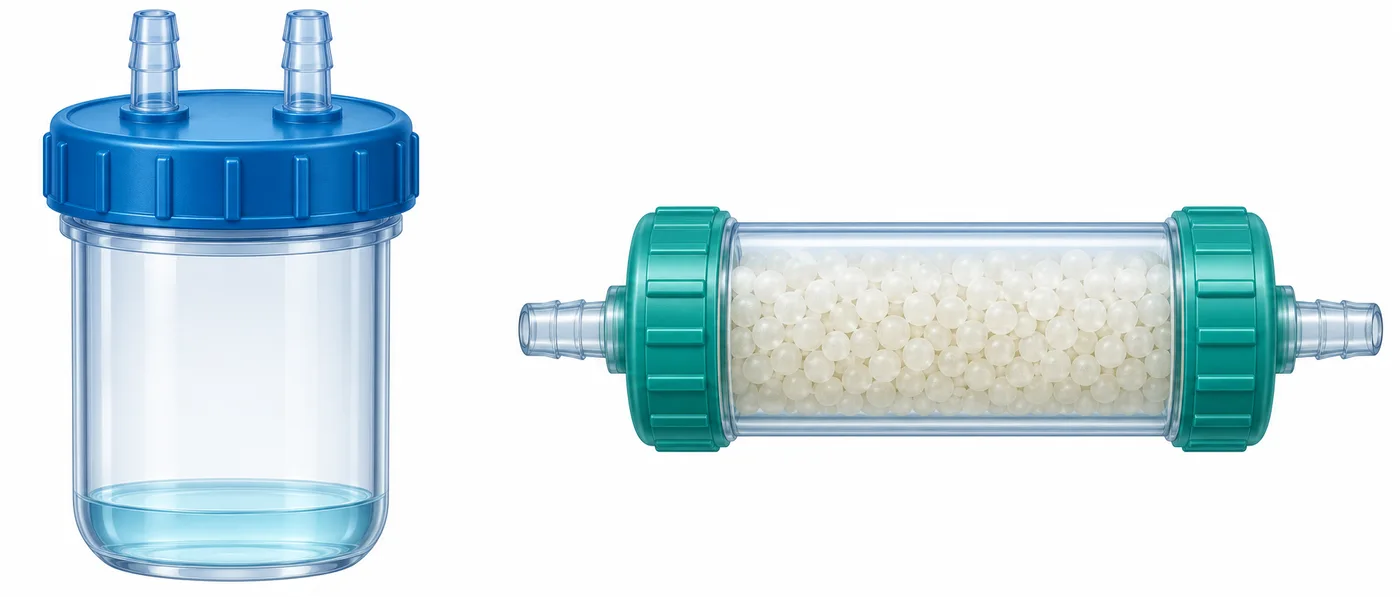
Conceptual components: a trap handles collected liquid; a dryer changes water-vapor content. Selection must also preserve the target measurement.
Does a hydrophobic filter make the result dry-basis?
No. If water vapor passes through with the sample, it remains part of the gas mixture at the cell. A liquid-resistant membrane does not by itself convert a wet-basis concentration into a dry-basis concentration.
A wet-basis fraction includes water vapor in the total gas amount. A dry-basis fraction excludes it. The distinction applies even when the target gas does not react with water and the sensor is otherwise unaffected by humidity.
Vaisala's CO2 measurement application note explains that adding or removing water changes the gas composition and consequently the reported concentration basis. That is a real mixture change, distinct from optical or electronic humidity interference.
A reading can therefore change after moisture removal without indicating a sensor error. Before comparing two analyzers, determine whether both report the same basis and whether their sample conditioning differs.
The converse also matters. If a filter has become wetted and the reading changes, do not immediately label the result a wet/dry conversion. The path may also have developed a pressure drop, a delayed response, a leak or target-gas loss. A valid basis conversion assumes more than the presence of water.
A checked wet/dry example
Assume a hypothetical sample contains 1000 ppm CO2 on a dry basis. Water vapor accounts for 3.0% of the total wet mixture. Assume that adding water does not add or remove CO2 and that the comparison uses consistent mole-fraction units.
The dry gases occupy 97.0% of the wet mixture. The wet-basis concentration is therefore:
Wet CO2 = 1000 × (1 − 0.030) = 970 ppm.
Reversing the calculation:
Dry CO2 = 970 / (1 − 0.030) = 1000 ppm.
The difference is 30 ppm. A membrane that passes the water vapor leaves this basis difference present. A correctly specified dryer that removes water without changing CO2 could change the result toward the dry-basis value even when the sensor's calibration remains unchanged.
The 3.0% figure in this example is water mole fraction, not 3% relative humidity. Substituting an RH value directly into the equation would be incorrect. Converting RH to water fraction requires the relevant temperature and pressure information.
The same arithmetic can be applied to another nonreacting gas fraction under the same assumptions. It does not establish that a real dryer preserves that gas. For gases that dissolve in condensate, adsorb on surfaces or react in the sampling system, investigate recovery separately.
A partially dried sample also needs its remaining water content. Calling the outlet dry because a trap is installed is inadequate. A trap removes collected liquid; gas leaving it can still contain substantial vapor at its local conditions.
How can filters change response time?
Gas takes time to reach the sensing element. Tubing volume, filter housing volume, flow and diffusion all contribute. A membrane adds a transport boundary whose effect depends on its area, thickness, support and condition.
For a flowing system, a simple volume divided by actual volumetric flow provides a rough transport-time scale. It is not a complete response-time specification because mixing, adsorption and sensor dynamics can broaden the response. A housing can hold old sample even after a new sample reaches its inlet.
For a diffusion instrument, there may be no pump to overcome a restrictive path. A membrane or protective cover can slow exchange with the environment. The bare sensor's response time should therefore not be assumed to describe the installed instrument.
Liquid coverage can reduce the membrane area available for gas exchange. A sensor may then continue reporting a stable value from slowly changing gas inside its chamber. The stability can look reassuring while the measurement becomes stale.
This creates an important diagnostic distinction: a noisy reading is not the only sign of a wet sampling problem. An unusually unresponsive or delayed signal can be equally informative. Compare response behavior, flow status and moisture evidence rather than relying on the apparent smoothness of a trend.
Pressure drop can connect moisture to gas error
A restrictive filter can change the pressure at the cell in a pumped system. If the analyzer has pressure sensitivity or uses a pressure input, that pressure change can affect the reading. A symptom that appears humidity-related may therefore include a pneumatic contribution.
The relevant pressure is the condition at the measurement cell. A pressure sensor upstream of the filter may not see the drop downstream. Increasing the flow demand can enlarge the difference while the upstream pressure remains ordinary.
A flow indication also needs location and units. A flowmeter upstream of a leak or restriction may not describe what reaches the cell. Standard and actual volumetric flow are different quantities, so record the meter's basis when evaluating transport.
Do not use a pressure-compensation setting to compensate for an unqualified sampling path. Pressure correction cannot recover gas lost to a leak or water contact, and it cannot make a delayed sample represent the present process.
The Alphasense technical FAQ includes gas-train design guidance addressing flow direction, pressure effects, filtering and condensation. Apply the instructions for the chosen sensor and analyzer; a layout appropriate to one family should not become a universal pump-placement rule.
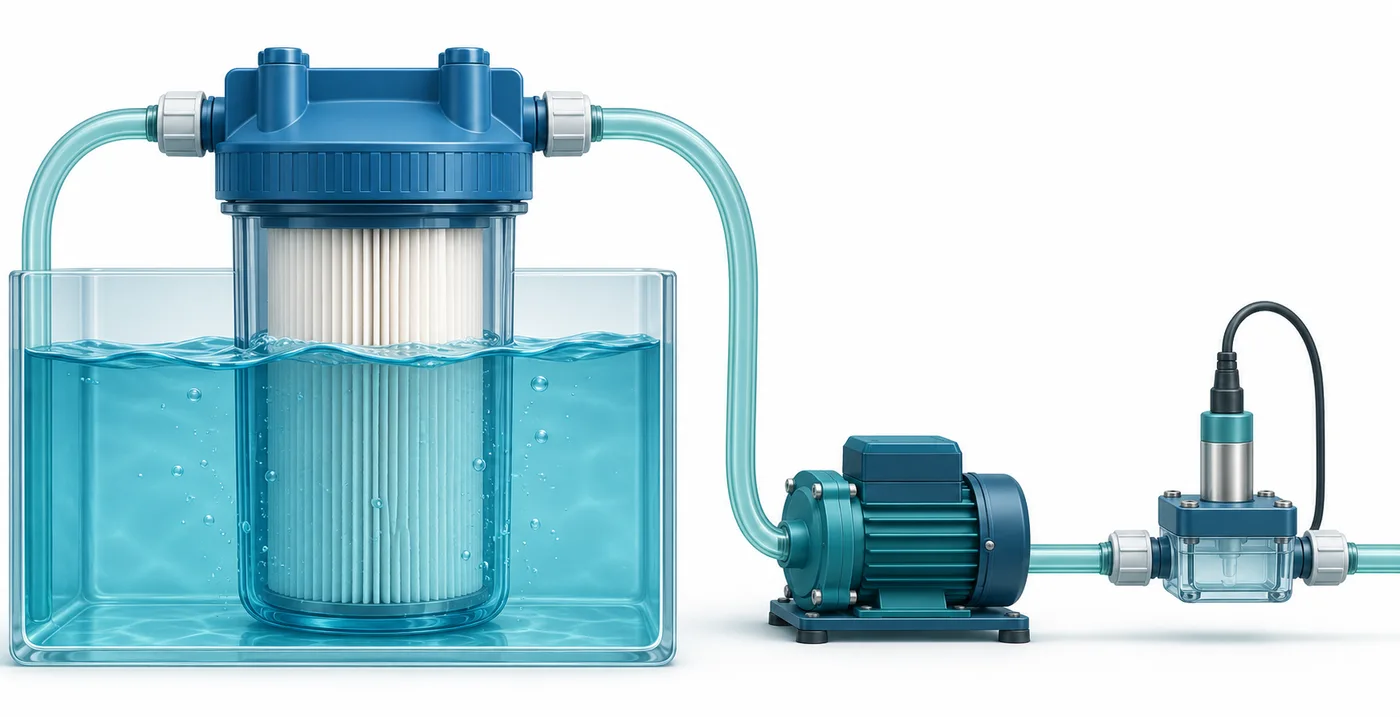
Conceptual liquid coverage: a protected sensor can still receive a restricted or delayed sample. Protection and representativeness need separate checks.
Select the filter using more than pore size
Pore size is only one selection parameter. The complete decision should include liquid-entry behavior, airflow or pressure-drop data, membrane area, housing volume, temperature and chemical compatibility.
Ask which test fluid and pressure conditions support the liquid-resistance claim. Clean water does not represent every condensate. A process containing oils, surfactants or solvents may require different materials or additional separation.
Check the target gas as well as the water. A filter acceptable for CO2 or oxygen may not preserve a reactive trace gas adequately. The relevant question is recovery and response at the required concentration, not merely whether gas can pass through the membrane.
Inspect the housing materials and seals. A membrane may be chemically suitable while an adhesive or elastomer is not. Low concentrations can make otherwise small surface interactions significant.
Review permitted orientation and maintenance. A filter that can shed droplets in one position may remain flooded in another. Installation space should permit inspection and replacement without damaging tubing or confusing the flow direction.
Finally assess the installed response. A component's airflow curve under a specified pressure difference does not establish the complete analyzer's response to a concentration step. The sensor, enclosure, tubing and processing remain part of the result.
Diagnose the symptom by following the water
If liquid is visible before the filter but not after it, the barrier may be containing droplets. Still check whether liquid coverage has reduced gas exchange. Successful containment does not establish unchanged flow.
If droplets appear after the filter, consider both breakthrough and local condensation. Compare surface temperatures and dew point, inspect seals and assess membrane compatibility. The position of the first visible droplet can help form a hypothesis, but visual inspection alone may miss thin films.
If the reading becomes slow during humid operation, compare flow and cell pressure with the clean, dry configuration. Check for collected liquid, saturated protective material and changes in available membrane area. Preserve the original trend before replacing parts.
If the reading changes after drying, first reconcile sample basis. Then assess whether the dryer or condensate could remove target gas. A concentration increase consistent with water removal and a decrease caused by target-gas loss can even partially cancel.
If the problem appears during temperature cycling, inspect cold points and shutdown conditions. A system can operate acceptably after warming but collect water while idle. Restart then introduces a different sample-path state.
The article on humidity effects in gas sensors provides broader context for distinguishing moisture dilution, sensor response and physical condensation. Those mechanisms should remain separate in the fault record.
A useful acceptance record for a humid sample path
Begin with the measurement definition: target gas, concentration range, source location, required response and wet or dry basis. Without that definition, it is difficult to decide whether a change introduced by conditioning is acceptable.
Record the sample path in sequence. Include source pressure and temperature, tube materials and dimensions, filter type, trap or dryer, pump, cell and exhaust arrangement. Add the locations of pressure, temperature and humidity measurements.
Describe expected water states. Is the inlet expected to contain droplets? Can any section cool below dew point? Does the system intentionally remove vapor? State which component handles each condition rather than writing a broad moisture protection label.
Keep clean and challenged conditions distinct. A dry commissioning comparison may establish basic gas response while leaving humid-service behavior unresolved. Any humidity challenge should follow an appropriate manufacturer-supported method and preserve target-gas reference conditions.
Record pressure drop and response behavior along with concentration agreement. A sample path that gives the right settled value but arrives too late may fail the application's need. A path that responds quickly but changes the gas basis may require a documented conversion or a different design.
Specify maintenance evidence. Useful indicators can include filter condition, flow status, collected-liquid level or a manufacturer-defined diagnostic. A fixed replacement interval alone may not reveal an unexpectedly severe moisture event.
After changing a filter type, tubing route or dryer, reassess the affected evidence. Nominally interchangeable parts can differ in internal volume, membrane area and surface chemistry. A stable gas-sensor calibration does not make all sample-path changes neutral.
How to compare two proposed solutions fairly
Compare solutions against the same required output. If one keeps the sample humid and another dries it, first decide how both results will be expressed on the chosen basis. Otherwise an expected composition difference can be mistaken for superior accuracy.
Include time behavior. A small diffusion barrier and a large conditioning assembly can reach the same final value at very different times. Define whether the application needs a settled laboratory result, a process trend or a prompt indication.
Include failure visibility. A solution that loses flow silently when wet presents a different integration problem from one with a clear low-flow status. The diagnostic does not prevent every failure, but it can keep a stale reading from being treated as current.
Include the real maintenance environment. A trap that is easy to inspect on a bench may be inaccessible in a cabinet. A membrane that works with clean condensate may see detergent during routine cleaning. Those conditions belong in selection, not only in later troubleshooting.
Avoid declaring one component universally best. The correct combination is the one that controls the relevant water phase, preserves the target-gas measurement, meets the response requirement and provides interpretable failure behavior within the documented conditions.
A transport example: protection succeeds while the sample changes
Consider a hypothetical warm process sample containing humid gas and occasional entrained droplets. An inlet membrane resists those droplets. The gas then travels through a cooler cabinet fitting before reaching an analyzer. The sensor remains protected from the original droplets, but new liquid forms at the fitting.
Three observations would answer different questions. A dry sensor face supports the limited conclusion that visible liquid did not reach that face. Collected water at the fitting indicates a local phase change. A concentration difference from the source raises a separate question about moisture basis, target-gas recovery and leakage.
Adding another membrane near the sensor could provide another liquid boundary, but it would not explain the sample change upstream. Moving the first membrane would likewise leave the water vapor present unless another process removes it. The design decision should follow the required sample basis and the permitted source-to-cell conditions.
An interpretable comparison would document both source and cell conditions and the intended conditioning method. It would also preserve response-time evidence, because a liquid film can restrict exchange even when a final concentration eventually appears reasonable. This example shows why the most useful question is not whether the sensor stayed dry, but whether the entire measurement remained representative.
Frequently asked questions
Does hydrophobic mean that water vapor cannot pass?
No. A hydrophobic membrane can resist liquid water while permitting humid gas exchange. Check the exact product specification.
Can a filter prevent every condensation problem?
No. Vapor can cross a membrane and condense on a colder surface downstream. Temperature and dew point through the whole path matter.
Is a water trap the same as a dryer?
No. A trap handles collected liquid; a dryer reduces water vapor. Gas leaving a trap can still be humid.
Does drying always improve gas accuracy?
No. Drying can make the sample compatible with an analyzer, but it changes concentration basis and may affect target-gas recovery. Those effects need qualification.
Why did the reading become stable when the filter got wet?
One possibility is restricted exchange, leaving slowly changing gas at the sensor. Confirm with flow, pressure and response evidence; stability alone does not establish accuracy.
What should be checked after replacing the filter?
Confirm the correct part, seals, orientation, flow or pressure behavior and installed gas response. A changed housing volume or membrane can alter performance even when the sensor itself is unchanged.
Sources
- Gore packaging-vent FAQ: membrane wetting and gas exchange principles.
- Gore performance membranes: application-specific membrane characteristics.
- Vaisala high-humidity instrument selection: cold spots, conduction and condensation.
- Vaisala HMM170 condensation prevention: model-specific heating and output conditions.
- Vaisala CO2 measurement application note: water-vapor dilution and concentration basis.
- Alphasense technical FAQ: sampling-system considerations.




Leave a Reply