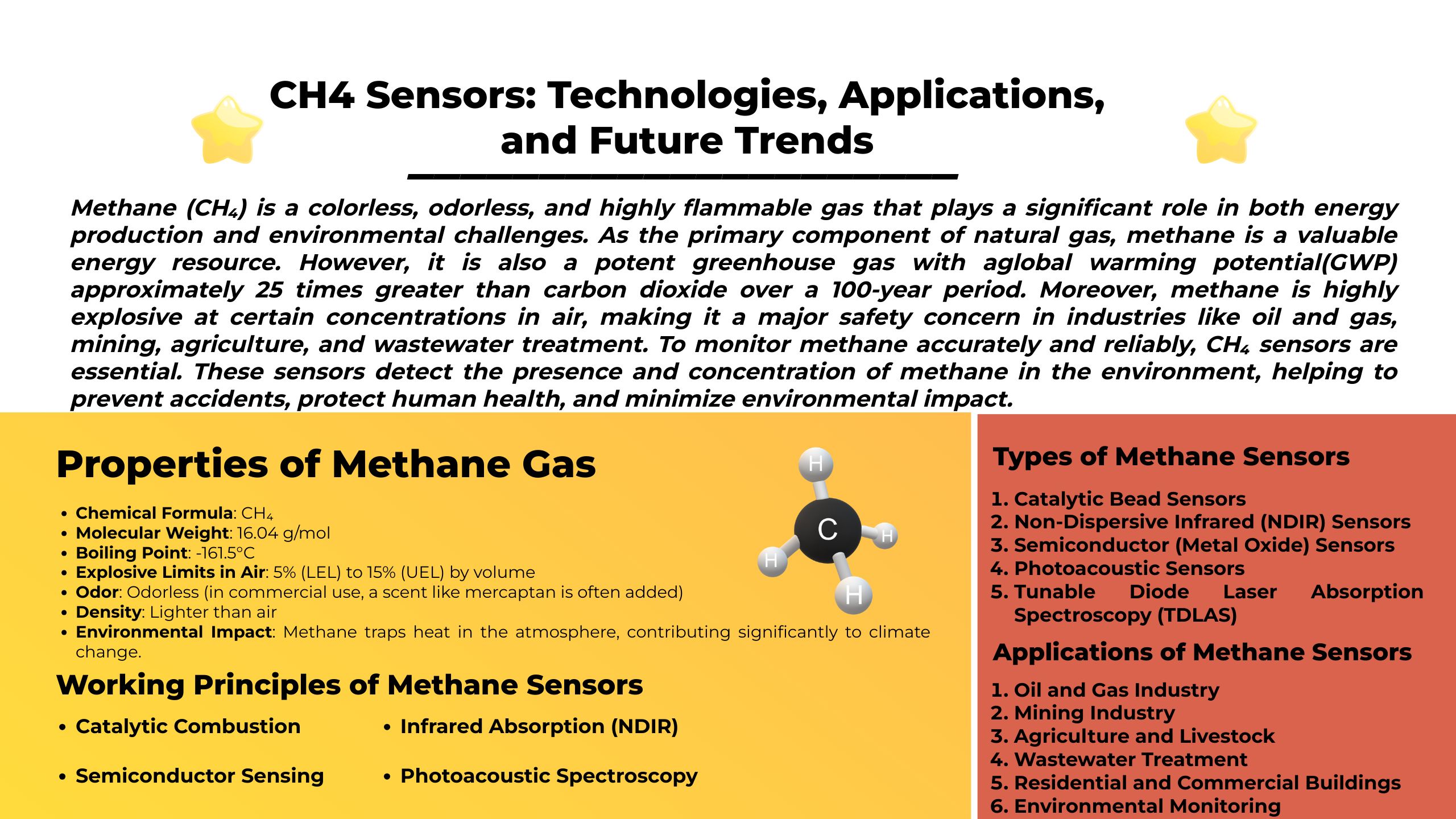
Methane (CH₄) is a colorless, odorless, and highly flammable gas that plays a significant role in both energy production and environmental challenges. As the primary component of natural gas, methane is a valuable energy resource. However, it is also a potent greenhouse gas with a global warming potential (GWP) approximately 25 times greater than carbon dioxide over a 100-year period. Moreover, methane is highly explosive at certain concentrations in air, making it a major safety concern in industries like oil and gas, mining, agriculture, and wastewater treatment.
To monitor methane accurately and reliably, CH₄ sensors are essential. These sensors detect the presence and concentration of methane in the environment, helping to prevent accidents, protect human health, and minimize environmental impact.
This article explores the working principles, types, benefits, challenges, and future trends of methane gas sensors.
Properties of Methane Gas
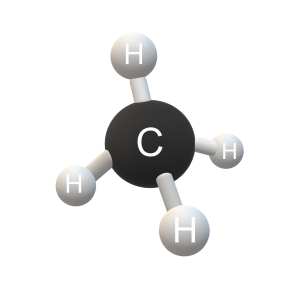
Understanding the properties of methane is crucial for designing and deploying effective sensors:
- Chemical Formula: CH₄
- Molecular Weight: 16.04 g/mol
- Boiling Point: -161.5°C
- Explosive Limits in Air: 5% (LEL) to 15% (UEL) by volume
- Odor: Odorless (in commercial use, a scent like mercaptan is often added)
- Density: Lighter than air
- Environmental Impact: Methane traps heat in the atmosphere, contributing significantly to climate change.
Due to its explosive and environmental risks, continuous and accurate monitoring of methane is critical in various settings.

Working Principles of Methane Sensors
CH₄ sensors operate based on different physical and chemical principles, depending on their design and application. The major detection methods include:
- Catalytic Combustion: Oxidizing methane over a heated catalyst, producing a measurable change in resistance.
- Infrared Absorption (NDIR): Detecting specific infrared light absorption wavelengths characteristic of methane.
- Semiconductor Sensing: Sensing resistance changes in a metal oxide material upon exposure to methane.
- Photoacoustic Spectroscopy: Using sound waves generated by absorbed light to detect gas concentration.
Each method has its advantages and is suited to specific applications and operating environments.
Comparing Methane Sensors: Catalytic Bead, Infrared, Semiconductor, and Laser-based Sensors
Types of Methane Sensors
1. Catalytic Bead Sensors
Also known as Pellistor sensors, catalytic bead sensors consist of two beads: an active bead coated with a catalyst and a reference bead without catalyst. When methane comes into contact with the heated catalyst, it oxidizes, releasing heat and changing the electrical resistance of the active bead.
Advantages:
- Robust and durable
- Capable of detecting methane concentrations from LEL to 100%
Disadvantages:
- Requires oxygen for operation
- Susceptible to poisoning by certain compounds (e.g., silicones, sulfur compounds)
- High power consumption
Applications: Oil and gas facilities, mining, chemical plants.
2. Non-Dispersive Infrared (NDIR) Sensors
NDIR methane sensors use an infrared light source and detectors to measure the absorption of light by methane molecules at specific wavelengths (typically around 3.3 micrometers).
Advantages:
- High accuracy and selectivity
- Long lifespan
- No oxygen requirement
Disadvantages:
- Higher initial cost
- Sensitive to environmental factors like dust and humidity
Applications: Environmental monitoring, industrial safety, leak detection, smart cities.
3. Semiconductor (Metal Oxide) Sensors
Semiconductor sensors use materials like tin dioxide (SnO₂) whose electrical resistance changes in the presence of methane gas.
Advantages:
- Low cost
- Simple design
- Fast response time
Disadvantages:
- Cross-sensitivity to other gases
- High operating temperature (typically 200–400°C)
- Drift over time
Applications: Consumer-grade detectors, indoor air quality monitoring.
4. Photoacoustic Sensors
These sensors use laser beams tuned to the absorption wavelength of methane. When methane absorbs light energy, it generates sound waves that are detected by a microphone.
Advantages:
- Ultra-sensitive (detect ppb levels)
- Compact and reliable
Disadvantages:
- Complex and expensive
- Susceptible to noise interference
Applications: Research, high-precision industrial monitoring.
5. Tunable Diode Laser Absorption Spectroscopy (TDLAS)
TDLAS sensors offer precise methane detection using laser light tuned to the specific absorption line of CH₄.
Advantages:
- Very high specificity and sensitivity
- Fast response
- Suitable for harsh environments
Disadvantages:
- High cost
- Complex setup
Applications: Pipeline monitoring, emissions detection, scientific research.
Applications of Methane Sensors
1. Oil and Gas Industry
Methane is prevalent in natural gas production and transportation. CH₄ sensors monitor:
- Wellheads and pipelines
- Storage tanks
- Gas processing plants
- Compressor stations
They help prevent leaks, explosions, and environmental contamination.
2. Mining Industry
Methane buildup in coal mines can cause devastating explosions. Methane sensors:
- Detect rising gas levels early
- Enable automated ventilation systems
- Protect miners’ lives
3. Agriculture and Livestock
Methane is emitted by livestock and from the decomposition of organic matter. Sensors are used to:
- Monitor emissions from barns and waste management systems
- Study agricultural greenhouse gas contributions
- Improve environmental sustainability
4. Wastewater Treatment
Decomposition of organic materials in wastewater generates methane. Sensors:
- Monitor biogas production
- Ensure safe working conditions
- Optimize energy recovery processes
5. Residential and Commercial Buildings
Methane leak detectors are installed to prevent gas explosions in:
- Homes with natural gas heating
- Commercial kitchens
- Apartments with gas stoves
6. Environmental Monitoring
Methane monitoring stations and mobile sensors track emissions from:
- Landfills
- Wetlands
- Urban environments
These measurements contribute to climate change studies and inform mitigation strategies.
Performance Metrics of Methane Sensors
When choosing a methane sensor, key parameters to consider include:
- Sensitivity: Ability to detect low concentrations (ppm to ppb levels)
- Selectivity: Resistance to interference from other gases
- Response Time: Speed of detection (typically seconds to minutes)
- Stability: Minimal drift over time
- Durability: Ability to withstand harsh environments
- Calibration Requirements: Frequency and ease of recalibration
- Power Consumption: Especially important for battery-powered or remote systems
- Cost: Initial purchase and maintenance costs
Integration with IoT and Smart Systems
Modern methane sensors increasingly integrate with IoT ecosystems, offering:
- Wireless Communication (Wi-Fi, LoRaWAN, Zigbee)
- Cloud Data Storage
- Real-Time Alerts and Notifications
- Remote Monitoring and Control
- Predictive Maintenance Algorithms
Such systems allow operators to monitor multiple locations simultaneously, improving safety, compliance, and operational efficiency.
Challenges in Methane Detection
Despite advancements, several challenges persist:
- Cross-Sensitivity: Semiconductor and catalytic sensors may react to gases other than methane, such as hydrogen or ethanol.
- Sensor Drift: Over time, environmental exposure can degrade sensor performance.
- Power Requirements: Some sensor types, especially catalytic and MOS, require substantial energy.
- Environmental Conditions: Factors like humidity, temperature, and dust can affect sensor accuracy.
- Cost-Performance Balance: Achieving both high performance and low cost remains a challenge, especially for NDIR and laser-based systems.
Future Trends in Methane Sensing Technology
The future of CH₄ sensors is promising, with several emerging trends:
1. Nanomaterials
Nanostructured materials like graphene, carbon nanotubes, and metal-organic frameworks (MOFs) offer improved sensitivity, faster response times, and enhanced selectivity.
2. Wearable Gas Sensors
Development of compact, wearable methane detectors integrated into personal protective equipment (PPE) will enhance worker safety in hazardous industries.
3. Drone-Based Gas Detection
Unmanned aerial vehicles (UAVs) equipped with lightweight methane sensors are being deployed to detect leaks in pipelines and remote areas.
4. Machine Learning and AI Integration
Machine learning algorithms can analyze complex sensor data patterns to:
- Improve gas detection accuracy
- Predict sensor failures
- Reduce false alarms
5. Energy-Efficient Sensors
Low-power methane sensors will enable longer battery life for wireless, remote, or portable detection systems.
Conclusion
Methane gas sensors are critical tools in industrial safety, environmental monitoring, and greenhouse gas management. With a range of available technologies—catalytic, infrared, semiconductor, photoacoustic, and laser-based—there is a sensor suitable for every application, from residential safety to industrial emission tracking.
Advances in nanotechnology, AI, IoT integration, and energy-efficient design are rapidly improving the capabilities and accessibility of methane detection systems. As industries increasingly prioritize sustainability and safety, methane sensing technology will continue to play a vital role in building a safer, cleaner, and more efficient future.
Related Reading: